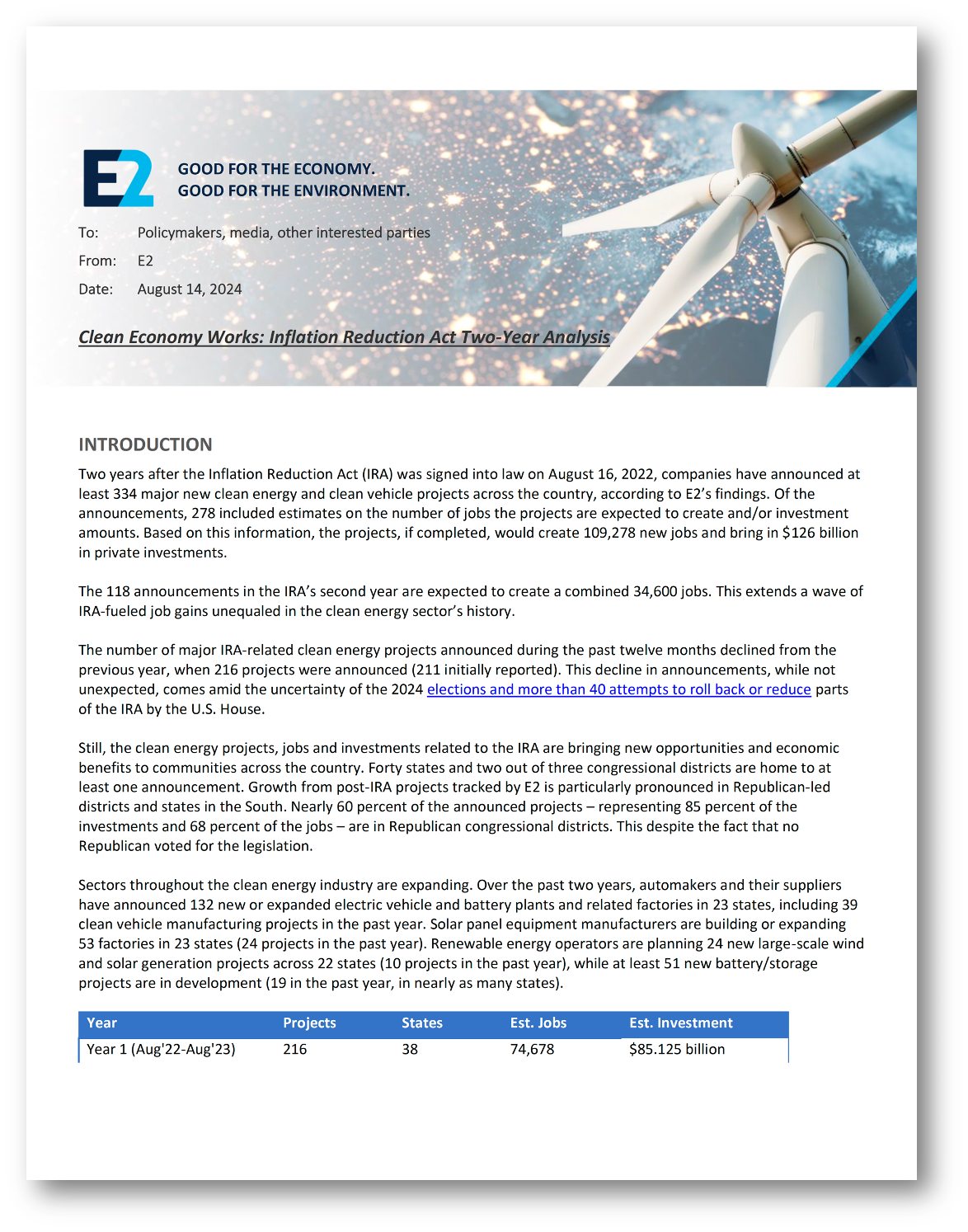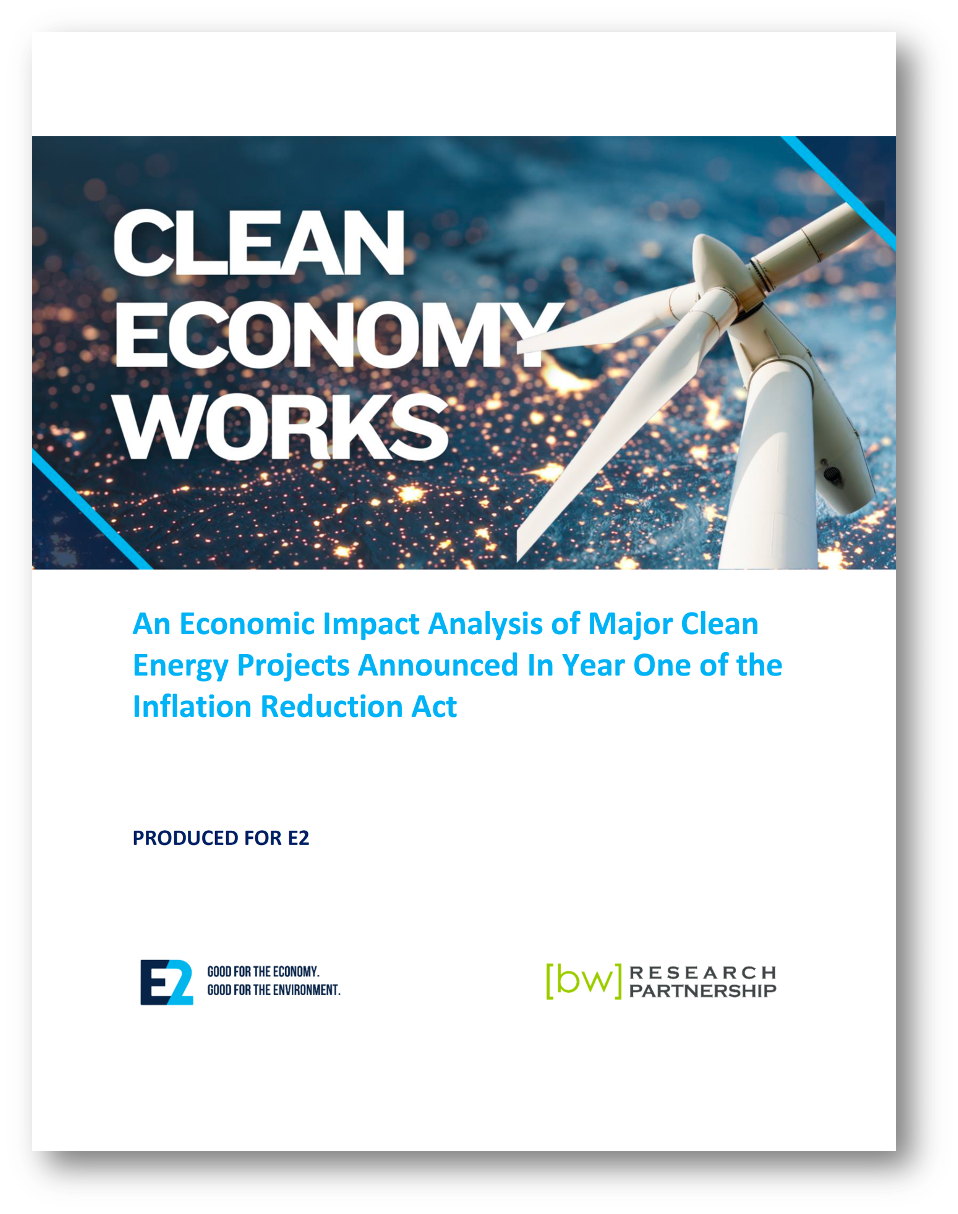
Arizona Clean Economy Works: 8 New Clean Energy, Vehicle Projects to Create 18K Jobs, Add $7B to GDP, Generate $5B in Wages for Arizona Workers

Date: July 3, 2024

Summary:

This analysis uses the original $86 billion in estimated capital expenditures that companies announced in investments nationwide for new developments and extrapolates another $20 billion in additional capital expenditures for project announcements that did not include a dollar amount or required an updated estimate based on available information. In addition to the direct benefits of these expenditures, new modeling from BW Research measures the broader economic benefits and the multiplier effect of the investments and jobs expected if the 210 announced projects were completed over the next five years.

When these broader economic benefits are factored in, BW’s modeling expects the 8 large-scale project announced in Arizona tracked by E2 between August 2022 and August 2023 to create or support more than 18,700 jobs and generate billions of dollars in new wages, tax revenue, and economic growth.

These secondary economic benefits are far-reaching. When new clean energy projects and clean vehicle factories and thousands of new jobs come to a community, local restaurants sell more meals. Schools, police departments and local public works projects benefit from increases in local tax revenues. Local manufacturers and wholesalers sell more goods to feed the growing local supply chain. And small businesses such as accounting firms, construction contractors, landscaping companies and caterers see new revenue streams.

Together, these direct and indirect jobs and investments tell a statewide story of opportunity for domestic manufacturing, clean energy production, transportation and infrastructure modernization and American ingenuity, thanks to the clean energy incentives and investments made possible by the IRA.

They are also just the beginning as E2 continues to track new projects being announced every month.

This field is for validation purposes and should be left unchanged.

Key Findings

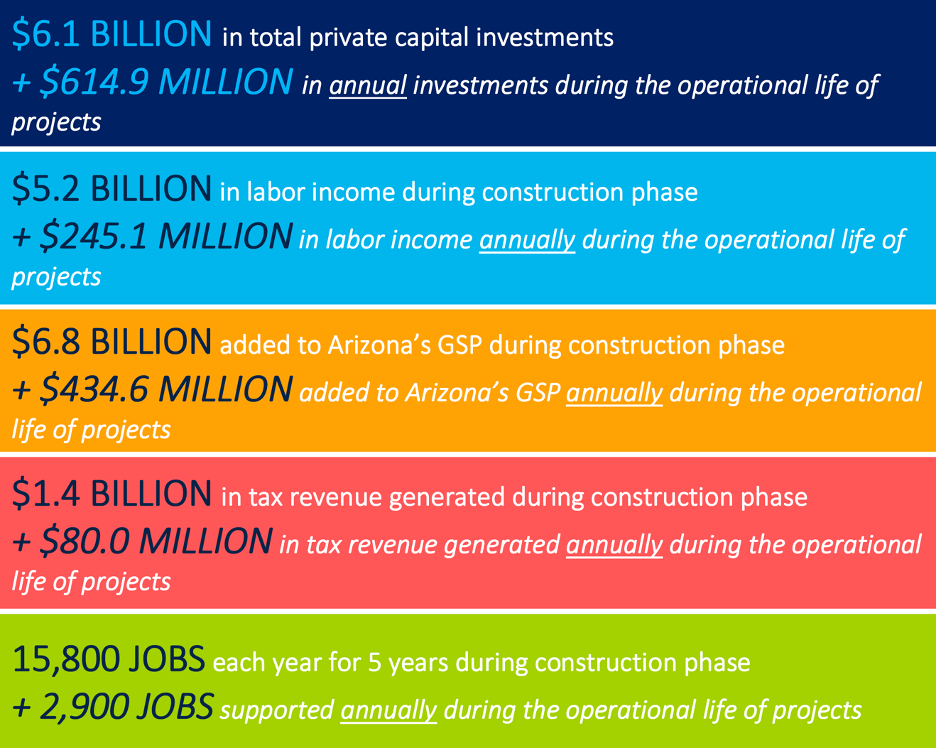
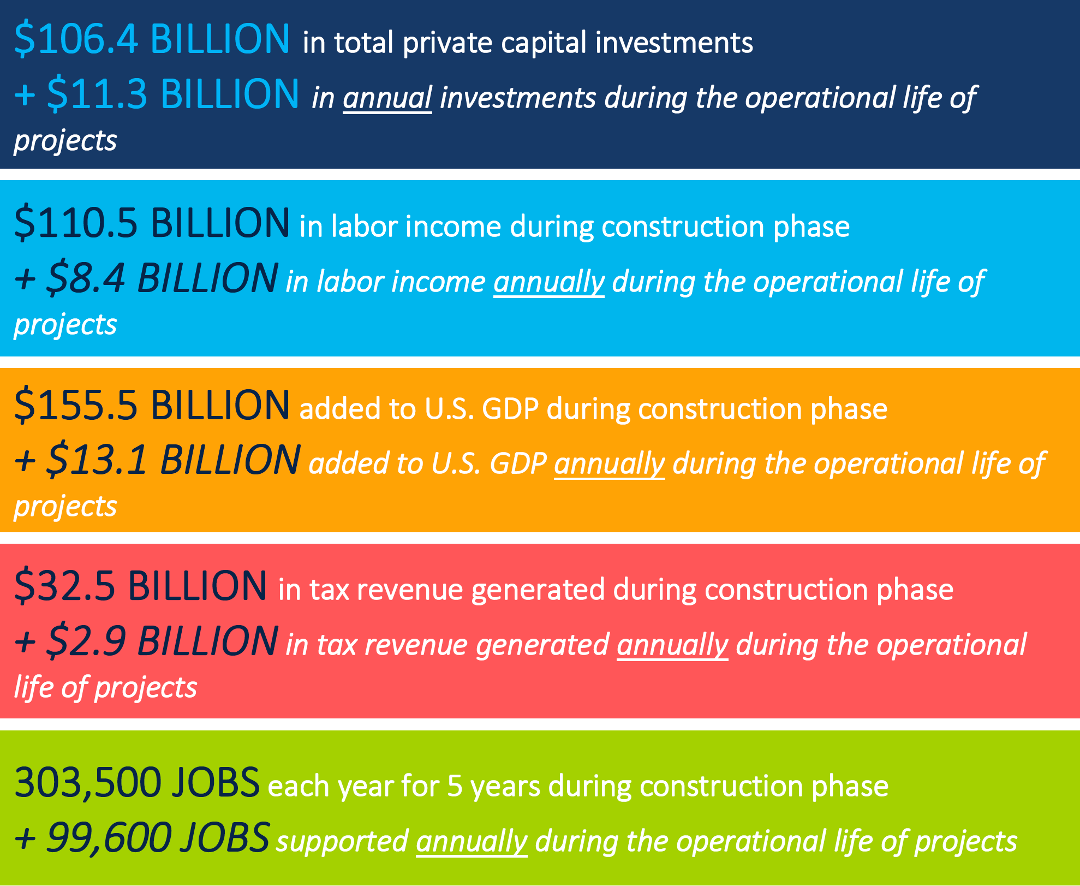
This report details the economic impacts resulting from the clean energy investments in Arizona that were announced after the passing of the IRA, allowing for a more detailed examination of the economic benefits that the clean energy investments bring to the state. The 8 major Arizona projects tracked by E2 between August 2022-August 2023 will create or support more than 18,700 jobs, including 15,800 jobs each year during construction and another 2,900 jobs each year after.

These private-sector investments and jobs will add $6.8 billion to Arizona’s Gross State Product (GSP) while the projects are under construction, and another $434.6 million annually once they are up and running.

Additionally, these projects will result in $1.4 billion in new tax revenues for federal, state, and local governments while under construction, and an additional $80.0 million annually after.

COMBINED JOBS, WAGE, TAX AND GSP IMPACTS OF MAJOR CLEAN ENERGY PROJECTS ANNOUNCED IN FIRST YEAR OF THE IRA

TOTAL INVESTMENTS INTO AND ANNUAL JOBS SUPPORTED BY CLEAN ENERGY PROJECTS, DETAILED BY ENERGY SECTOR

Sector Total Construction Phase Jobs (Annual jobs for 5 years) Annual Operations Phase Jobs (Annual jobs for lifetime of projects)
Battery / Storage 9,445 1,847
Solar 154 30
EV 6,173 1,052
Total 15,771 2,929


Sector Total Capital Investment ($millions) Extrapolated Capital Investment ($millions) Total Capital Investment ($millions) Annual Operational Investment ($millions)
EV $56 $- $56 $5.60
Battery / Storage $3,500.00 $182.36 $3,682.36 $368.24
Solar $60.00 $- $60.00 $5.94
Total Capital Investment $5,901.00 $248.07 $6,149.07 $614.85

Methodology

This analysis provides a thorough economic prediction of the impacts of the 8 announcements by filling in the gaps of publicly announced information. Modeled impacts differ from initial estimates offered by companies announcing new projects, tracked by E2. One of the eight announcements provided no capital investment estimate and two provided no job creation estimate. Additionally, those estimates were inconsistently defined, lacking clarity on if they are direct jobs only or direct, indirect, and induced jobs, and if they were for construction or permanent positions.

To analyze these economic impacts from the clean energy programs and policies in the IRA, BW Research used IMPLAN economic modeling software to estimate the overall economic benefits from publicly sourced clean energy project announcements. BW Research developed a dozen economic impact models in total to represent six tracked sectors: Solar, Wind, Electric Vehicle (EV), Electricity Transmission & Distribution (Electric T&D), Battery Storage, and Clean Fuels. Based on this common methodology and assumptions, BW generated outputs at the national level, including earnings, tax revenue, employment and overall GSP value add.

For more information on methodology, see Appendix B in the report. For the list of all 10 projects tracked by E2 in the first year of the IRA, see Appendix C.

For the latest full list of clean energy job announcements tracked by E2, visit https://e2.org/announcements.

About E2

E2 is a national, nonpartisan group of business leaders, investors, and professionals from every sector of the economy who advocate for smart policies that are good for the economy and good for the environment. E2 members have founded or funded more than 2,500 companies, created more than 600,000 jobs, and manage more than $100 billion in venture and private equity capital.

For additional insight into E2’s other reports, visit e2.org/reports.

View Report »

New York Clean Economy Works | An Economic Impact Analysis of Major Clean Energy, Vehicle Projects

Date: April 18, 2024

Summary:

This analysis uses the original $86 billion in estimated capital expenditures that companies announced in investments nationwide for new developments and extrapolates another $20 billion in additional capital expenditures for project announcements that did not include a dollar amount or required an updated estimate based on available information. In addition to the direct benefits of these expenditures, new modeling from BW Research measures the broader economic benefits and the multiplier effect of the investments and jobs expected if the 210 announced projects were completed over the next five years.

When these broader economic benefits are factored in, BW’s modeling expects the 10 large-scale project announced in New York tracked by E2 between August 2022 and August 2023 to create or support more than 7,000 jobs and generate tens of billions of dollars in new wages, tax revenue, and economic growth.

These secondary economic benefits are far-reaching. When new clean energy projects and clean vehicle factories and thousands of new jobs come to a community, local restaurants sell more meals. Schools, police departments and local public works projects benefit from increases in local tax revenues. Local manufacturers and wholesalers sell more goods to feed the growing local supply chain. And small businesses such as accounting firms, construction contractors, landscaping companies and caterers see new revenue streams.

Together, these direct and indirect jobs and investments tell a statewide story of opportunity for domestic manufacturing, clean energy production, transportation and infrastructure modernization and American ingenuity, thanks to the clean energy incentives and investments made possible by the IRA.

They are also just the beginning as E2 continues to track new projects being announced every month

This field is for validation purposes and should be left unchanged.

Key Findings

This report details the economic impacts resulting from the clean energy investments in New York that were announced after the passing of the IRA, allowing for a more detailed examination of the economic benefits that the clean energy investments bring to the state. The 10 major New York projects tracked by E2 between August 2022-August 2023 will create or support more than 8,000 jobs, including 6,000 jobs each year during construction and another 1,400 jobs each year after.

These private-sector investments and jobs will add $3.2 billion to New York’s Gross State Product (GSP) while the projects are under construction, and another $224.5 million annually once they are up and running.

Additionally, these projects will result in $736.0 million in new tax revenues for federal, state, and local governments while under construction, and an additional $55.7 million annually after.

COMBINED JOBS, WAGE, TAX AND GSP IMPACTS OF MAJOR CLEAN ENERGY PROJECTS ANNOUNCED IN FIRST YEAR OF THE IRA

TOTAL INVESTMENTS INTO AND ANNUAL JOBS SUPPORTED BY CLEAN ENERGY PROJECTS, DETAILED BY ENERGY SECTOR

Sector Total Construction Phase Jobs (Annual jobs for 5 years) Annual Operations Phase Jobs (Annual jobs for lifetime of projects)
EV 115 25
Electrification, Grid, and Transmission 575 60
Wind 86 90
Solar 8 10
Battery / Storage 4,479 1,037
Clean Fuels 795 165
Total 6,058 1,388


Sector Total Capital Investment ($millions) Extrapolated Capital Investment ($millions) Total Capital Investment ($millions) Annual Operational Investment ($millions)
EV $56 $- $56 $5.60
Electrification, Grid, and Transmission $215 $146.40 $361.40 $33.13
Battery / Storage $75 $2,105.43 $2,180.43 $218.04
Wind $50 $- $50 $17.77
Solar $- $7.52 $7.52 $1.54
Clean Fuels $387 $- $387 $32.01
Total Capital Investment $783 $2,259.35 $3,042.35 $308.09

Methodology

This analysis provides a thorough economic prediction of the impacts of the 10 announcements by filling in the gaps of publicly announced information. Modeled impacts differ from initial estimates offered by companies announcing new projects, tracked by E2. Five of the 10 announcements provided no capital investment estimate and four provided no job creation estimate. Additionally, those estimates were inconsistently defined, lacking clarity on if they are direct jobs only or direct, indirect, and induced jobs, and if they were for construction or permanent positions.

To analyze these economic impacts from the clean energy programs and policies in the IRA, BW Research used IMPLAN economic modeling software to estimate the overall economic benefits from publicly sourced clean energy project announcements. BW Research developed a dozen economic impact models in total to represent six tracked sectors: Solar, Wind, Electric Vehicle (EV), Electricity Transmission & Distribution (Electric T&D), Battery Storage, and Clean Fuels. Based on this common methodology and assumptions, BW generated outputs at the national level, including earnings, tax revenue, employment and overall GSP value add.

For more information on methodology, see Appendix B in the report. For the list of all 18 projects tracked by E2 in the first year of the IRA, see Appendix C.

For the latest full list of clean energy job announcements tracked by E2, visit https://e2.org/announcements.

About E2

E2 is a national, nonpartisan group of business leaders, investors, and professionals from every sector of the economy who advocate for smart policies that are good for the economy and good for the environment. E2 members have founded or funded more than 2,500 companies, created more than 600,000 jobs, and manage more than $100 billion in venture and private equity capital.

For additional insight into E2’s other reports, visit e2.org/reports.

View Report »

Michigan Clean Economy Works | An Economic Impact Analysis of Major Clean Energy, Vehicle Projects

Date: April 17, 2024

Summary:

This analysis uses the original $86 billion in estimated capital expenditures that companies announced in investments nationwide for new developments and extrapolates another $20 billion in additional capital expenditures for project announcements that did not include a dollar amount or required an updated estimate based on available information. In addition to the direct benefits of these expenditures, new modeling from BW Research measures the broader economic benefits and the multiplier effect of the investments and jobs expected if the 210 announced projects were completed over the next five years.

When these broader economic benefits are factored in, BW’s modeling expects the 18 large-scale Michigan project announcements tracked by E2 between August 2022 and August 2023 to create or support nearly 28,000 jobs and generate tens of billions of dollars in new wages, tax revenue, and economic growth.

These secondary economic benefits are far-reaching. When new clean energy projects and clean vehicle factories and thousands of new jobs come to a community, local restaurants sell more meals. Schools, police departments and local public works projects benefit from increases in local tax revenues. Local manufacturers and wholesalers sell more goods to feed the growing local supply chain. And small businesses such as accounting firms, construction contractors, landscaping companies and caterers see new revenue streams.

Together, these direct and indirect jobs and investments tell a statewide story of opportunity for domestic manufacturing, clean energy production, transportation and infrastructure modernization and American ingenuity, thanks to the clean energy incentives and investments made possible by the IRA.

They are also just the beginning as E2 continues to track new projects being announced every month

This field is for validation purposes and should be left unchanged.

Key Findings

This report details the economic impacts resulting from the clean energy investments in Michigan that were announced after the passing of the IRA, allowing for a more detailed examination of the economic benefits that the clean energy investments bring to the state. The 18 major Michigan projects tracked by E2 between August 2022-August 2023 will create or support more than 27,900 jobs, including 21,700 jobs each year during construction and another 6,200 jobs each year after.

These private-sector investments and jobs will add $9.7 billion to Michigan’s Gross State Product (GSP) while the projects are under construction, and another $706.7 million annually once they are up and running.

Additionally, these projects will result in $1.9 billion in new tax revenues for federal, state, and local governments while under construction, and an additional $165.0 million annually after.

COMBINED JOBS, WAGE, TAX AND GSP IMPACTS OF MAJOR CLEAN ENERGY PROJECTS ANNOUNCED IN FIRST YEAR OF THE IRA

TOTAL INVESTMENTS INTO AND ANNUAL JOBS SUPPORTED BY CLEAN ENERGY PROJECTS, DETAILED BY ENERGY SECTOR

Sector Total Construction Phase Jobs (Annual jobs for 5 years) Annual Operations Phase Jobs (Annual jobs for lifetime of projects)
EV 19,752 3,958
Electrification, Grid, and Transmission 890 323
Solar 606 726
Clean Fuels 491 1,192
Total 21,739 6,199


Sector Total Capital Investment ($billions) Extrapolated Capital Investment ($billions) Total Capital Investment ($billions) Annual Operational Investment ($billions)
EV $8.33 $- $8.33 $0.83
Electrification, Grid, and Transmission $0.38 $- $0.38 $0.06
Solar $- $0.42 $0.42 $0.09
Clean Fuels $0.40 $- $0.40 $0.03
Total Capital Investment $9.10 $0.42 $9.52 $1.01

Methodology

This analysis provides a thorough economic prediction of the impacts of the 18 announcements by filling in the gaps of publicly announced information. Modeled impacts differ from initial estimates offered by companies announcing new projects, tracked by E2. Two of the 18 announcements provided no capital investment estimate and five provided no job creation estimate. Additionally, those estimates were inconsistently defined, lacking clarity on if they are direct jobs only or direct, indirect, and induced jobs, and if they were for construction or permanent positions.

To analyze these economic impacts from the clean energy programs and policies in the IRA, BW Research used IMPLAN economic modeling software to estimate the overall economic benefits from publicly sourced clean energy project announcements. BW Research developed a dozen economic impact models in total to represent six tracked sectors: Solar, Wind, Electric Vehicle (EV), Electricity Transmission & Distribution (Electric T&D), Battery Storage, and Clean Fuels. Based on this common methodology and assumptions, BW generated outputs at the national level, including earnings, tax revenue, employment and overall GSP value add.

For more information on methodology, see Appendix B in the report. For the list of all 18 projects tracked by E2 in the first year of the IRA, see Appendix C.

For the latest full list of clean energy job announcements tracked by E2, visit https://e2.org/announcements.

About E2

E2 is a national, nonpartisan group of business leaders, investors, and professionals from every sector of the economy who advocate for smart policies that are good for the economy and good for the environment. E2 members have founded or funded more than 2,500 companies, created more than 600,000 jobs, and manage more than $100 billion in venture and private equity capital.

For additional insight into E2’s other reports, visit e2.org/reports.

View Report »

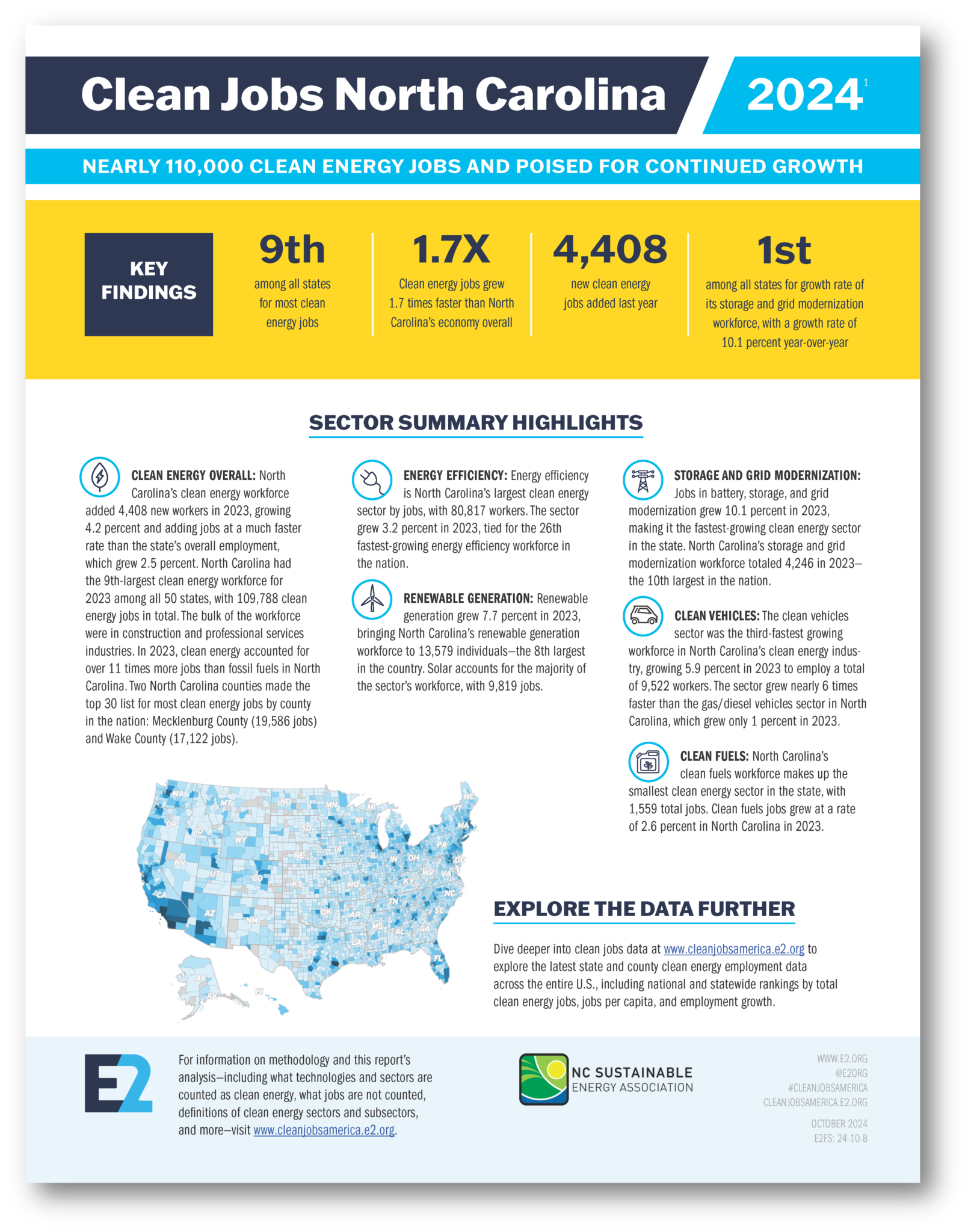
North Carolina Clean Economy Works | An Economic Impact Analysis of Major Clean Energy, Vehicle Projects

Date: March 21, 2024

Summary:

This analysis uses the original $86 billion in estimated capital expenditures that companies announced in investments nationwide for new developments and extrapolates another $20 billion in additional capital expenditures for project announcements that did not include a dollar amount or required an updated estimate based on available information. In addition to the direct benefits of these expenditures, new modeling from BW Research measures the broader economic benefits and the multiplier effect of the investments and jobs expected if the 210 announced projects were completed over the next five years.

When these broader economic benefits are factored in, BW’s modeling expects the nine large-scale North Carolina project announcements tracked by E2 between August 2022 and August 2023 to create or support 30,000 jobs and generate tens of billions of dollars in new wages, tax revenue, and economic growth.

These secondary economic benefits are far-reaching. When new clean energy projects and clean vehicle factories and thousands of new jobs come to a community, local restaurants sell more meals. Schools, police departments and local public works projects benefit from increases in local tax revenues. Local manufacturers and wholesalers sell more goods to feed the growing local supply chain. And small businesses such as accounting firms, construction contractors, landscaping companies and caterers see new revenue streams.

Together, these direct and indirect jobs and investments tell a statewide story of opportunity for domestic manufacturing, clean energy production, transportation and infrastructure modernization and American ingenuity, thanks to the clean energy incentives and investments made possible by the IRA.

They are also just the beginning as E2 continues to track new projects being announced every month

This field is for validation purposes and should be left unchanged.

Key Findings

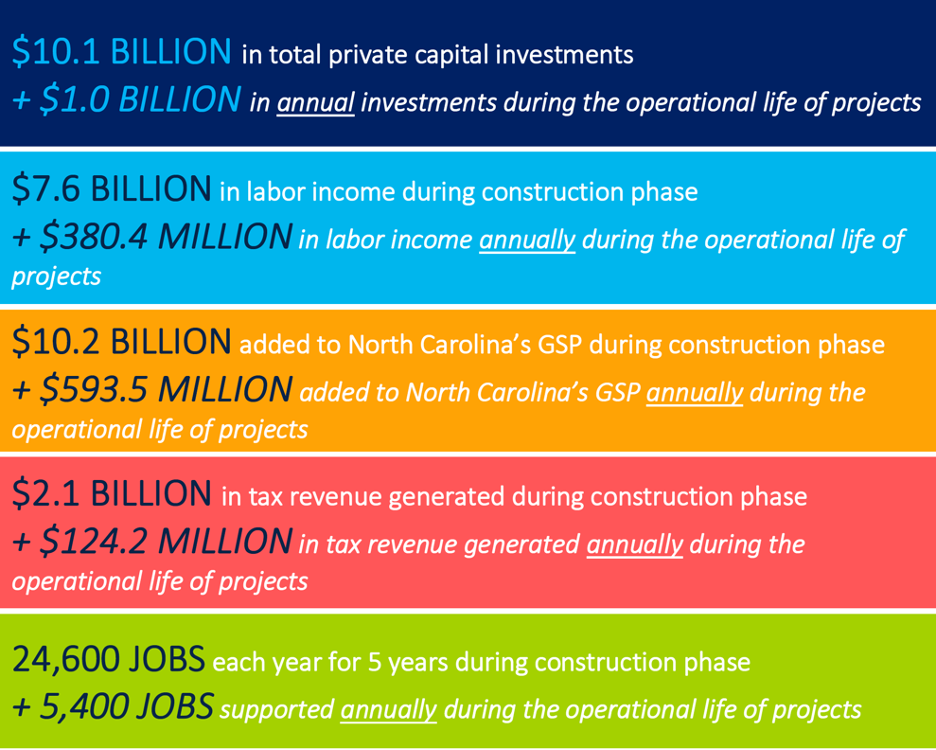
This report details the economic impacts resulting from the clean energy investments in North Carolina that were announced after the passing of the IRA, allowing for a more detailed examination of the economic benefits that the clean energy investments bring to the state. The nine major North Carolina projects tracked by E2 between August 2022-August 2023 will create or support nearly 30,000 jobs, including 24,600 jobs each year during construction and another 5,400 jobs each year after.

These private-sector investments and jobs will add $10.2 billion to North Carolina’s Gross State Product (GSP) while the projects are under construction, and another $593.5 million annually once they are up and running.

Additionally, these projects will result in $2.1 billion in new tax revenues for federal, state, and local governments while under construction, and an additional $124.2 million annually after.

COMBINED JOBS, WAGE, TAX AND GSP IMPACTS OF MAJOR CLEAN ENERGY PROJECTS ANNOUNCED IN FIRST YEAR OF THE IRA

TOTAL INVESTMENTS INTO AND ANNUAL JOBS SUPPORTED BY CLEAN ENERGY PROJECTS, DETAILED BY ENERGY SECTOR

Sector Total Construction Phase Jobs (Annual jobs for 5 years) Annual Operations Phase Jobs (Annual jobs for lifetime of projects)
EV 23,678 5,208
Electrification, Grid, and Transmission 303 32
Battery / Storage 588 124
Total 24,569 5,365
Sector Total Capital Investment ($millions) Extrapolated Capital Investment ($millions) Total Capital Investment ($millions) Annual Operational Investment ($millions)
EV $9,663.70 $- $9,663.70 $966.37
Electrification, Grid, and Transmission $- $146.40 $146.40 $13.42
Battery / Storage $240.00 $- $240.00 $24.00
Total Capital Investment $9,903.70 $146.40 $10,050.10 $1,003.79

Methodology

This analysis provides a thorough economic prediction of the impacts of the nine announcements by filling in the gaps of publicly announced information. Modeled impacts differ from initial estimates offered by companies announcing new projects, tracked by E2. One of the nine announcements provided no capital investment estimate and two provided no job creation estimate. Additionally, those estimates were inconsistently defined, lacking clarity on if they are direct jobs only or direct, indirect, and induced jobs, and if they were for construction or permanent positions.

To analyze these economic impacts from the clean energy programs and policies in the IRA, BW Research used IMPLAN economic modeling software to estimate the overall economic benefits from publicly sourced clean energy project announcements. BW Research developed a dozen economic impact models in total to represent six tracked sectors: Solar, Wind, Electric Vehicle (EV), Electricity Transmission & Distribution (Electric T&D), Battery Storage, and Clean Fuels. Based on this common methodology and assumptions, BW generated outputs at the national level, including earnings, tax revenue, employment and overall GDP value add.

For more information on methodology, see Appendix B in the report. For the list of all nine projects tracked by E2 in the first year of the IRA, see Appendix C.

For the latest full list of clean energy job announcements tracked by E2, visit https://e2.org/announcements.

About E2

E2 is a national, nonpartisan group of business leaders, investors, and professionals from every sector of the economy who advocate for smart policies that are good for the economy and good for the environment. E2 members have founded or funded more than 2,500 companies, created more than 600,000 jobs, and manage more than $100 billion in venture and private equity capital.

For additional insight into E2’s other reports, visit e2.org/reports.

View Report »

Georgia Clean Economy Works | An Economic Impact Analysis of Major Clean Energy, Vehicle Projects

Date: February 15, 2024

Summary:

This analysis uses the original $86 billion in estimated capital expenditures that companies announced in investments nationwide for new developments and extrapolates another $20 billion in additional capital expenditures for project announcements that did not include a dollar amount or required an updated estimate based on available information. In addition to the direct benefits of these expenditures, new modeling from BW Research measures the broader economic benefits and the multiplier effect of the investments and jobs expected if the 210 announced projects were completed over the next five years.

When these broader economic benefits are factored in, BW’s modeling for the 19 major Georgia projects tracked by E2 between August 2022 and August 2023 expects the projects to create or support almost  39,000 jobs and generate tens of billions of dollars in new wages, tax revenue, and economic growth.

These secondary economic benefits are far-reaching. When new clean energy projects and clean vehicle factories and thousands of new jobs come to a community, local restaurants sell more meals. Schools, police departments and local public works projects benefit from increases in local tax revenues. Local manufacturers and wholesalers sell more goods to feed the growing local supply chain. And small businesses such as accounting firms, construction contractors, landscaping companies and caterers see new revenue streams.

Together, these direct and indirect jobs and investments tell a statewide story of opportunity for domestic manufacturing, clean energy production, transportation and infrastructure modernization and American ingenuity, thanks to the clean energy incentives and investments made possible by the IRA.

They are also just the beginning as E2 continues to track new projects being announced every month

This field is for validation purposes and should be left unchanged.

Key Findings

This report details the economic impacts resulting from the clean energy investments in Georgia that were announced after the passing of the IRA, allowing for a more detailed examination of the economic benefits that the clean energy investments bring to the state. The 19 major Georgia projects tracked by E2 between August 2022 and August 2023 will create or support 38,600 jobs, including 31,800 jobs each year during construction and another 6,800 jobs each year after that. 

These private-sector investments and jobs will add $13.9 billion to Georgia’s Gross State Product (GSP) while the projects are under construction, and another $926.5 million annually once they are up and running. 

Additionally, these projects will result in $2.6 billion in new tax revenues for federal, state, and local governments while under construction, and an additional $175.4 million annually after that. 

COMBINED JOBS, WAGE, TAX AND GSP IMPACTS OF MAJOR CLEAN ENERGY PROJECTS ANNOUNCED IN FIRST YEAR OF THE IRA

TOTAL INVESTMENTS INTO AND ANNUAL JOBS SUPPORTED BY CLEAN ENERGY PROJECTS, DETAILED BY ENERGY SECTOR

Sector Total Construction Phase Jobs (Annual jobs for 5 years) Annual Operations Phase Jobs (Annual jobs for lifetime of projects)
Solar 7,639 1,723
EV 15,678 3,281
Battery Storage 8,443 1,813
Total 31,760 6,817
Sector Total Capital Investment ($billions) Extrapolated Capital Investment ($billions) Total Capital Investment ($billions) Annual Operational Investment ($billions)
Solar $2.65 $0.42 $3.07 $0.30
EV $6.29 $0.00 $6.29 $0.63
Battery Storage $3.39 $0.00 $3.39 $0.34
Total Capital Investment $12.33 $0.42 $12.75 $1.27

Methodology

This analysis provides a thorough economic prediction of the impacts of the 19 announcements by filling in the gaps of publicly announced information. Modeled impacts differ from initial estimates offered by companies announcing new projects, tracked by E2. Two of the 19 announcements provided no capital investment estimate and one provided no job creation estimate. Additionally, those estimates were inconsistently defined, lacking clarity on if they are direct jobs only or direct, indirect, and induced jobs, and if they were for construction or permanent positions. 

To analyze these economic impacts from the clean energy programs and policies in the IRA, BW Research used IMPLAN economic modeling software to estimate the overall economic benefits from publicly sourced clean energy project announcements. BW Research developed a dozen economic impact models in total to represent six tracked sectors: Solar, Wind, Electric Vehicle (EV), Electricity Transmission & Distribution (Electric T&D), Battery Storage, and Clean Fuels. Based on this common methodology and assumptions, BW generated outputs at the national level, including earnings, tax revenue, employment and overall GDP value add.

For more information on methodology, see Appendix B in the report. For the list of all 19 projects tracked by E2 in the first year of the IRA, see Appendix C.

For the latest full list of clean energy job announcements tracked by E2, visit https://e2.org/announcements.

About E2

E2 is a national, nonpartisan group of business leaders, investors, and professionals from every sector of the economy who advocate for smart policies that are good for the economy and good for the environment. E2 members have founded or funded more than 2,500 companies, created more than 600,000 jobs, and manage more than $100 billion in venture and private equity capital.

For additional insight into E2’s other reports, visit e2.org/reports.

View Report »

Benefits to Rural America from the Inflation Reduction Act: Driving Jobs, Investment, and Economic Resilience

Date: January 11, 2024

Summary:

The positive impacts of the IRA’s historic investment in America’s rural economic growth and resilience are transformative. In its first year, the IRA incentives have spurred 52 major rural manufacturing projects that are projected to create 67,000 rural jobs and nearly $2 billion in worker income, creating viable new career opportunities and revenues to sustain rural communities. In addition to spurring growth, these IRA funds are essential to ensuring that rural America has access to the benefits of the clean economy transition and that our farms and farming communities are more profitable and more resilient. Farmers and rural workers across multiple industries, as well as rural consumers, strongly favor these investments in clean energy, infrastructure, and agricultural resilience. The federal clean economy investments in the IRA position rural communities as leaders in building a thriving 21st century American economy. 

This field is for validation purposes and should be left unchanged.

KEY FINDINGS:

The report includes new data and on-the-ground perspectives across three areas of economic outcomes:

I. Section 1 presents new data from E2 and BW Research Partnership on how the IRA clean energy tax incentives are driving a revitalization of rural manufacturing. Findings include:

// One of every four large-scale clean energy projects announced in the first year of the IRA is located in demographically rural areas—more than 50 total projects in 21 states

//$20 billion in investments in rural areas

//More than 67,000 new jobs in rural counties—including more than 21,000 permanent jobs that will pay nearly $2 billion to workers each year

// Almost $5 billion in new tax revenues in the near term, with an additional $700 million in revenue every year of operation, that can help support schools, first responders, and other essential public services provided by federal, state, county, and local governments

//Nearly $3 billion to the nation’s GDP in every year that the projects are operational

II. Section 2 shows that $12 billion in clean energy loan and grant programs made possible by the IRA significantly accelerates access for rural Americans to the economic benefits of renewable energy, and is an important step in ensuring that rural America is not left behind in the global transition to a clean energy economy. These IRA funds:

// Help the nation’s more than 900 rural electricity co-ops supply cleaner, more efficient, and more affordable energy to their members

// Make clean energy and energy efficiency projects more accessible for local businesses, community organizations, farms, ranches, and municipal buildings and facilities that want them

III. Section 3 details the benefits of the IRA investment of $20 billion over five years through the U.S. Department of Agriculture’s popular and over-subscribed voluntary conservation programs for farmers and ranchers. These IRA funds:

// Help farmers in their efforts to cut input costs, improve crop resilience and soil health, and boost their bottom lines

//Invest in programs and solutions that are overwhelmingly supported by Americans regardless of political affiliation

// Represent only a small part of the need to meet the demand for this support in rural America

Methodology

The following applies to Section 1 of the report and APPENDIX IV: Details by Clean Energy Sector. 

In November 2023, E2 and BW Research Partnership produced an analysis of the economic benefits of 210 major clean energy projects announced in the first year of the IRA. 

This report includes a more detailed analysis of the 52 announced in rural counties as defined by the USDA. 

As with the national analysis, this rural analysis required filling in the gaps of publicly announced information. Modeled impacts differ from initial estimates offered by companies announcing new projects tracked by E2. Some of the announcements provided no capital investment estimate and others provided no job creation estimate. Additionally, those estimates were inconsistently defined, lacking clarity on whether they are direct jobs only or direct, indirect, and induced jobs, and if they were for construction or permanent positions.

For more information on methodology, including investment extrapolation methods and impact modeling assumptions, see Appendix III in the report. For the list of all 52 projects in rural areas tracked by E2 in the first year of the IRA, see Appendix I.

For the latest full list of clean energy job announcements tracked by E2, visit https://e2.org/announcements.

About E2

E2 is a national, nonpartisan group of business leaders, investors, and professionals from every sector of the economy who advocate for smart policies that are good for the economy and good for the environment. E2 members have founded or funded more than 2,500 companies, created more than 600,000 jobs, and manage more than $100 billion in venture and private equity capital. Our members and supporters include farmers and other rural business leaders, professionals in rural clean energy and leaders in Ag-tech.

For additional insight into E2’s other reports, visit e2.org/reports.

View Report »

Clean Jobs Pennsylvania 2023

Date: December 18, 2023

Pennsylvania’s clean energy economy grew 4.3 percent and added nearly 4,000 new workers in 2022. Clean energy now accounts for over one third of all energy industry jobs in Pennsylvania, a strong statement for the nation’s second largest energy producer.


Summary

  • ENERGY EFFICIENCY: Energy efficiency is Pennsylvania’s largest energy sector with 69,990 workers—the eleventh largest energy efficiency sector in the nation. While the sector remains just below its pre-pandemic high of 71,443, it is expected to top pre-pandemic levels in the year 2024.
  • RENEWABLE GENERATION: Renewable generation grew 8.6 percent and added nearly 1,000 jobs in 2022, led by jobs in solar (6,304) and wind energy (3,092). This is the first year that renewable generation has been the fastest growing sector in Pennsylvania’s clean energy economy.
  • STORAGE AND GRID MODERNIZATION: Pennsylvania is preparing for the future by investing in the battery storage and grid modernization industries, which grew 7.3 percent in 2022 and more than 15 percent in 2021. At 4,000 workers, the state’s storage and grid sector is the tenth largest nationwide and is a vital sector for maximizing the funds in the Infrastructure Investment and Jobs Act and Inflation Reduction Act.
  • CLEAN VEHICLES: Clean vehicle jobs continue to make a strong showing in Pennsylvania’s clean energy economy, growing 6 percent in 2022 and over 25 percent in 2021. At over 9,500 workers statewide, Pennsylvania has one of the largest clean vehicle workforces in the nation.
This field is for validation purposes and should be left unchanged.

Previous Reports

Clean Jobs Pennsylvania 2023 is the 8th clean energy jobs report for Pennsylvania from E2. Previous reports can be accessed in the below links.

Background

This is the eighth Clean Jobs Pennsylvania report produced by E2 and our partners. The 2023 report is based on analysis of the 2023 U.S. Energy and Employment Report (USEER), which was first released by the Department of Energy (DOE) in 2016. E2 was an original proponent of the DOE producing the USEER and was a partner on the reports produced by the Energy Futures Initiative (EFI) and National Association of State Energy Officials (NASEO) after the Trump administration abandoned it in 2017. For methodology questions, see pages 201-206 of the 2023 USEER.

For additional insight into E2’s Clean Jobs Pennsylvania or our other annual clean energy economic reports, visit e2.org/reports.

An FAQ is available at e2.org/reports/clean-jobs-america-faq.

View Report »

Clean Jobs New Jersey 2023

Date: December 5, 2023

New Jersey’s clean energy economy grew 6 percent and added over 3,000 new workers in 2022. Clean energy grew 2.5 times faster than the overall state economy and was the 4th fastest growing clean energy workforce in the nation.


Summary

  • ENERGY EFFICIENCY:Energy efficiency is New Jersey’s largest energy sector. With 36,332 workers employed, New Jersey has the fourth largest energy efficiency workforce in the U.S. However, the sector has ample opportunity for growth as employment numbers are still well below pre-pandemic highs of almost 38,000 workers employed.
  • RENEWABLE GENERATION: Renewable generation grew 4.2 percent in 2022, led by increased jobs in solar energy (8,781). Nationally, New Jersey has the 11th largest renewable generation workforce in the nation with almost 12,000 employed.
  • STORAGE AND GRID MODERNIZATION: Jobs in battery storage and grid modernization grew 8.5 percent in 2022 and have grown more than 15 percent since 2021.
  • CLEAN VEHICLES: Clean vehicle jobs are the fastest growing workforce in New Jersey’s entire energy industry, growing over 15 percent in 2022 and 40 percent since 2021. At nearly 6,000 workers statewide, New Jersey is 9th in the nation for the fastest growing clean vehicle workforce.
  • BIOFUELS: New Jersey’s biofuel jobs increased by 10.2 percent in 2022 and is the second fastest growing clean energy sector in the Garden state.
This field is for validation purposes and should be left unchanged.

Other Clean Jobs Reports

Clean Jobs New Jersey 2023 is the first standalone clean energy jobs report for New Jersey since 2019 from E2. Previous 2023 clean energy employment reports can be accessed in the below links.

Background

This is the first Clean Jobs New Jersey report produced by E2. The 2023 report is based on analysis of the 2023 U.S. Energy and Employment Report (USEER), which was first released by the Department of Energy (DOE) in 2016. E2 was an original proponent of the DOE producing the USEER and was a partner on the reports produced by the Energy Futures Initiative (EFI) and National Association of State Energy Officials (NASEO) after the Trump administration abandoned it in 2017. For methodology questions, see pages 201-206 of the 2023 USEER.

For additional insight into E2’s Clean Jobs New Jersey or our other annual clean energy economic reports, visit e2.org/reports.

An FAQ is available at e2.org/reports/clean-jobs-america-faq.

View Report »

Clean Jobs Georgia 2023

Date: November 27, 2023

Georgia’s clean energy economy grew 4.7 percent and added 3,517 new workers in 2022. Clean energy employment grew faster than overall energy employment (4.3 percent) and faster than employment in the overall economy (3.5 percent) in Georgia. The state’s 78,400 clean energy jobs is the sixteenth largest and thirteenth fastest growing clean energy workforce nationally. In 2022, the state employed 885 percent more clean energy workers than the fossil fuel industry’s 8,857 jobs.

Three Georgia counties were in the top fifteen for clean energy job density in the U.S. in 2022—Pulaski County ranked seventh, with over 22 percent of all workers employed in clean energy; Montgomery County ranked thirteenth, with nearly 15 percent of all workers employed in clean energy; and Jefferson County ranked fifteenth, with over 12 percent of all workers employed in clean energy.


Summary

  • RENEWABLE GENERATION: Georgia’s renewable generation jobs grew 7.1 percent in 2022, bringing the sector to 10,500 total jobs and making it Georgia’s second largest clean energy sector behind energy efficiency. The solar subsector accounted for most of the renewable energy jobs in the state, employing 7,761 individuals–accounting for nearly 74 percent of the sector’s total employment. 
  • ENERGY EFFICIENCY: Energy efficiency is Georgia’s largest clean energy sector with 55,605 workers as of the end of 2022. The sector grew 4.3 percent in 2022, ranking Georgia in the top ten for fastest growing energy efficiency workforce nationally. 
  • STORAGE AND GRID MODERNIZATION: Jobs in battery, storage, and grid modernization grew 8 percent in 2022 in Georgia— the second fastest growing clean energy sector workforce in the state. As of 2022, there were 4,369 total battery, storage, and grid modernization jobs in Georgia, the ninth largest workforce for the sector in the U.S. 
  • CLEAN VEHICLES: Clean vehicle jobs grew 2 percent in 2022 to employ a total of 7,452 individuals. The majority of the workforce is in the hybrid electric vehicles subsector (3,400 workers) and electric vehicles subsector (2,162 workers). However, since the federal Inflation Reduction Act passed, 15 major electric vehicle manufacturing facilities have been announced in Georgia, which is expected to add at least 9,000 jobs to the state’s clean vehicle workforce in the coming years.
  • BIOFUELS: Georgia’s biofuels sector grew 8.8 percent in 2022 to employ a total of 476 individuals. Employment in the sector was the smallest but fastest growing in Georgia’s clean energy economy.
This field is for validation purposes and should be left unchanged.

Other Clean Jobs Reports

Clean Jobs Georgia 2023 is the first standalone clean energy jobs report for Georgia from E2. Previous 2023 clean energy employment reports can be accessed in the below links.

Background

This is the first Clean Jobs Georgia report produced by E2. The 2023 report is based on analysis of the 2023 U.S. Energy and Employment Report (USEER), which was first released by the Department of Energy (DOE) in 2016. E2 was an original proponent of the DOE producing the USEER and was a partner on the reports produced by the Energy Futures Initiative (EFI) and National Association of State Energy Officials (NASEO) after the Trump administration abandoned it in 2017. For methodology questions, see pages 201-206 of the 2023 USEER.

For additional insight into E2’s Clean Jobs Georgia or our other annual clean energy economic reports, visit e2.org/reports.

An FAQ is available at e2.org/reports/clean-jobs-america-faq.

View Report »

Clean Jobs New York 2023

Date: November 20, 2023

New York’s clean energy economy grew 3.6 percent and added nearly 6,000 new workers in 2022. Clean energy now accounts for over 50 percent of all energy industry jobs in New York. The state’s 166,014-person clean energy workforce is the third largest nationally, behind California and Texas.

Summary

  • RENEWABLE ENERGY: Renewable generation grew 6.2 percent and added over 1,000 jobs in 2022, led by jobs in solar energy (14,200) and wind energy (4,300). The sector is the second fastest growing clean energy sector over the previous two years (17%), behind only clean vehicles.
  • ENERGY EFFICIENCY: Energy efficiency is New York’s largest energy sector with 126,000 workers. However, the sector has not yet recovered from the COVID-19 pandemic and remains just below its pre-pandemic high of 126,700.=
  • STORAGE AND GRID MODERNIZATION: Jobs in battery, storage, and grid modernization grew 8.3 percent in 2022. This sector has grown more than 15 percent since 2021. At 4,600 workers, the state’s storage and grid sector is the eighth largest in the nation.
  • CLEAN VEHICLES: Clean vehicle jobs are the fastest growing workforce in New York’s entire energy industry, growing 20 percent in 2022 and over 50 percent since 2021. At nearly 13,000 workers statewide, New York has the eighth largest clean vehicle workforce in the nation.
  • BIOFUELS: New York has the third largest biofuels workforce in the U.S., at 1,700. Biofuel jobs increased 3.2 percent in 2022 and over 9 percent since 2021.
This field is for validation purposes and should be left unchanged.

Previous Reports

Clean Jobs New York 2023 is the 2nd standalone clean energy jobs report for New York from E2. E2 has tracked Clean Energy jobs in the state since 2015, but has not done a standalone factsheet or report since 2016. The 2016 report can be accessed in the below link.

Background

This is the second Clean Jobs New York report produced by E2. The 2023 report is based on analysis of the 2023 U.S. Energy and Employment Report (USEER), which was first released by the Department of Energy (DOE) in 2016. E2 was an original proponent of the DOE producing the USEER and was a partner on the reports produced by the Energy Futures Initiative (EFI) and National Association of State Energy Officials (NASEO) after the Trump administration abandoned it in 2017. For methodology questions, see pages 201-206 of the 2023 USEER.

For additional insight into E2’s Clean Jobs New York or our other annual clean energy economic reports, visit e2.org/reports.

An FAQ is available at e2.org/reports/clean-jobs-america-faq.

View Report »

Clean Economy Works October 2023 | 13 New Projects Announced

Date: November 13, 2023

FOCUS: Toyota announces $8 billion EV battery plant expansion in Liberty, N.C.

North Carolina has been actively courting investments from Japan for more than 40 years. But since the state first opened its economic development office in Tokyo in 1978, no other investment comes close to matching what the Japanese carmaker Toyota announced on the last day of October – $8 billion to add eight EV lithium-ion battery production lines to its fast-growing plant in the small Piedmont town of Liberty.

Toyota’s Liberty, N.C., facility will have 7 million square feet, the equivalent of 121 football fields of battery production. (Photo courtesy of Toyota)

The project is expected to create 3,000 jobs. Toyota first announced it was building an EV factory in Liberty two years ago. October’s announcement was the third time it expanded on those plans, with the company’s total investments in North Carolina now expected to approach $14 billion. That represents the largest economic development project in North Carolina history, and it will help rejuvenate an area hit hard by the decline of the once-dominant textiles, tobacco and furniture industries.

“Toyota’s latest expansion in North Carolina is monumental,” North Carolina state senator Phil Berger said in a press release.

Toyota’s announcement is also by far the largest in terms of investment dollars that E2 has tracked across the entire country since the Inflation Reduction Act (IRA) was signed into law in August 2022. (The second-largest investment E2 has tracked across all states and sectors in that time was also in North Carolina: In September 2022, Durham-based Wolfspeed announced a $5 billion manufacturing facility for efficient silicon carbide materials and devices with applications in industries including renewables, energy storage and EVs.)

Elsewhere in the state last month, a company called Atuel said it will soon begin producing 5,000 fast DC car chargers annually in Greensboro, creating 400 jobs. Along the coast south of Wilmington, Epsilon Advanced Materials Inc. will invest nearly $650 million and create 500 jobs making battery components. Those jobs will have an average annual salary of $52,000 – about 12 percent higher than Brunswick County’s current average wage.

Not to be outdone, Indiana also racked up three big clean economy announcements last month. These include a $3.2 billion joint-venture battery gigafactory in Kokomo from Stellantis and Samsung and an $800 million solar manufacturing plant Canadian Solar is building near the Ohio River in Jeffersonville. That facility will be able to crank out about 20,000 panels a day. Combined, Indiana’s three announcements are expected to create 2,800 jobs.

Notably, all six announcements from both North Carolina and Indiana came from overseas, underscoring just how effective the IRA is at attracting foreign investments to small-town America. In addition to Japan, companies announcing investments in the Tar Heel and Hoosier states last month are based in the Netherlands, Korea, Canada, India, China and Austria.

Since the IRA was signed into law in August 2022, E2 has tracked 251 projects across 40 states representing more than $106 billion in investments that could help create more than 89,000 jobs. Nearly half of the announcements include companies headquartered overseas, creating opportunity and jobs here in the U.S.

For a complete rundown of all announcements E2 has tracked, please see here.

OCTOBER CLEAN ENERGY ANNOUNCEMENTS

IN OCTOBER, E2 TRACKED 13 PROJECT ANNOUNCEMENTS ACROSS 8 STATES THAT ARE EXPECTED TO DRIVE NEARLY $16 BILLION IN PRIVATE-SECTOR INVESTMENTS AND CREATE MORE THAN 7,700 JOBS.

CALIFORNIA (San Jose): Antora Energy announces U.S. thermal battery manufacturing facility; Oct. 24

  • Industry: Battery/Storage

GEORGIA (Dublin): EV parts supplier to build plant in Dublin; Oct. 31

  • Industry: EV
  • Jobs: 460
  • Investment: $176 million

GEORGIA (Norcross): Suniva upgrades manufacturing and restarts operations in Georgia; Oct. 11

  • Industry: EV
  • Jobs: 240

INDIANA (Kokomo): Stellantis, Samsung SDI announce Kokomo, Ind., as site for second U.S. StarPlus Energy gigafactory; Oct. 11

  • Industry: Battery/Storage
  • Jobs: 1,400
  • Investment: $3.2 billion

INDIANA (Jeffersonville): Gov. Holcomb announces Canadian Solar building new $800 million solar cell manufacturing facility in Southeast Indiana; Oct. 30

  • Industry: Solar
  • Jobs: 1,200
  • Investment: $800 million

INDIANA (Portage): Fronius USA expanding Portage manufacturing facility; Oct. 5

  • Industry: Solar
  • Jobs: 200

MICHIGAN (Holland): Toyota, LG Energy Solution announce $3 billion investment in West Michigan battery plant; Oct. 4

  • Industry: EV
  • Investment: $3 billion

NORTH CAROLINA (Brunswick County): Gov. Cooper announces 500 Jobs as global battery component supplier selects Brunswick County for first U.S. plant; Oct. 26

  • Industry: EV
  • Jobs: 500
  • Investment: $649.9 million

NORTH CAROLINA (Greensboro): Autel Energy to bring hundreds of jobs to Greensboro; Oct. 6

  • Industry: EV
  • Jobs: 400

NORTH CAROLINA (Liberty): Toyota supercharges North Carolina battery plant with new $8 billion investment; Oct. 31

  • Industry: EV
  • Jobs: 3,000
  • Investment: $8 billion

NEW MEXICO (Albuquerque): Solar array maker to build $49 million Albuquerque plant; Oct. 17

  • Industry: Solar
  • Jobs: 87
  • Investment: $49 million

TEXAS (Baytown): John Cockerill advances U.S. expansion of hydrogen in Houston area with launch of Baytown gigafactory; Oct. 30

  • Industry: Hydrogen
  • Jobs: 200

WEST VIRGINIA (South Charleston): Gestamp plans to invest $69.5 million for upgrades at South Charleston stamping plant; Oct. 11

  • Industry: EV
  • Jobs: 100
  • Investment: $75 million

TOTAL PROJECTS BY STATE

ALABAMA

  • Projects: 6
  • Investment: $1.603 billion
  • Jobs: 1,350

ARKANSAS

  • Projects: 2
  • Investment: $250 million
  • Jobs: 500

ARIZONA

  • Projects: 8
  • Investment: $5.901 billion
  • Jobs: 2,280

CALIFORNIA

  • Projects: 12
  • Investment: $1.6 billion
  • Jobs: 160

COLORADO

  • Projects: 7
  • Investment: $880 million
  • Jobs: 2,382 

CONNECTICUT

  • Projects: 4
  • Investment: $24.8 million
  • Jobs: 100 

FLORIDA

  • Projects: 2
  • Investment: $72 million
  • Jobs: 250

GEORGIA

  • Projects: 23
  • Investment: $14.577 billion
  • Jobs: 14,031

IDAHO

  • Projects: 2
  • Investment: N/A
  • Jobs: N/A 

ILLINOIS

  • Projects: 6
  • Investment: $2.064 billion
  • Jobs: 2,719

INDIANA

  • Projects: 10
  • Investment: 4,222
  • Jobs: $6.416 billion

KANSAS

  • Projects: 1
  • Investment: N/A
  • Jobs: N/A

KENTUCKY

  • Projects: 6
  • Investment: $646 million
  • Jobs: 1,129

LOUISIANA

  • Projects: 4
  • Investment: $1.214 billion
  • Jobs: 983

MASSACHUSETTS

  • Projects: 6
  • Investment: $45.7 million
  • Jobs: 1,041

MARYLAND

  • Projects: 1
  • Investment: $14 million
  • Jobs: 145 

MAINE

  • Projects: 1
  • Investment: $6 million
  • Jobs: 200

MICHIGAN

  • Projects: 20
  • Investment: $12.163 billion
  • Jobs: 10,107 

MINNESOTA

  • Projects: 3
  • Investment: $145 million
  • Jobs: 570

MISSOURI

  • Projects: 1
  • Investment: $100 million
  • Jobs: 250

MISSISSIPPI

  • Projects: 2
  • Investment: $115 million
  • Jobs: 340

NORTH CAROLINA

  • Projects: 13
  • Investment: $18.62 billion
  • Jobs: 7,606 

NEW HAMPSHIRE

  • Projects: 1
  • Investment: $16.3 million
  • Jobs: N/A

NEW MEXICO

  • Projects: 5
  • Investment: $1.243 billion
  • Jobs: 2,542

NEVADA

  • Projects: 6
  • Investment: $6.6 billion
  • Jobs: 5,250

NEW YORK

  • Projects: 10
  • Investment: $783 million
  • Jobs: 2,739

OHIO

  • Projects: 13
  • Investment: $6.395 billion
  • Jobs: 3,839

OKLAHOMA

  • Projects: 5
  • Investment: $2.45 billion
  • Jobs: 1,490

OREGON

  • Projects: 1
  • Investment: N/A
  • Jobs: N/A

PENNSYLVANIA

  • Projects: 2
  • Investment: $116.1 million
  • Jobs: 15 

PUERTO RICO

  • Projects: 1
  • Investment: N/A
  • Jobs: 800

RHODE ISLAND

  • Projects: 1
  • Investment: N/A
  • Jobs: N/A

SOUTH CAROLINA

  • Projects: 19
  • Investment: $11.071 billion
  • Jobs: 11,072

TENNESSEE

  • Projects: 13
  • Investment: $5.174 billion
  • Jobs: 4,110

TEXAS

  • Projects: 18
  • Investment: $6.769 billion
  • Jobs: 6,861

UTAH

  • Projects: 1
  • Investment: N/A
  • Jobs: N/A

VIRGINIA

  • Projects: 3
  • Investment: $45.5 million
  • Jobs: 149

VERMONT

  • Projects: 1
  • Investment: N/A
  • Jobs: 12

WISCONSIN

  • Projects: 6
  • Investment: $242 million
  • Jobs: 262

WEST VIRGINIA

  • Projects: 3
  • Investment: $1.335 billion
  • Jobs: 850

ABOUT THIS ANALYSIS

This analysis is based on publicly available information for new clean energy projects, expansions, and renewed productions only announced since the Inflation Reduction Act (IRA) passed on August 16, 2022. Projects that began development, were proposed, or applied for local and state approval before the passage of the IRA are not included. For more information on other projects that stand to benefit to benefit from clean energy investments in different ways, see other resources below from the White House, Climate Power, the Climate Action Campaign, American Clean Power, and Energy Innovation.

OTHER RESOURCES

Investing in America | Invest.gov | Interactive map that illustrates the impact of these record-breaking levels of public and private investment across states and territories under the Biden Administration.

Clean Energy Projects Tracker | ClimatePower.us | Climate Power’s analysis includes public announcements of clean energy developments that have been proposed, launched or advanced since the passage of the Inflation Reduction Act (IRA).

Climate Wins Here Map | ActOnClimate.com | Interactive map off federal investments made in nationwide through the IRA and Infrastructure Investment and Jobs Act.

Clean Energy Investing in America | CleanPower.org | Analysis of utility-scale  clean energy investments announced since August 16, 2022.

Federal Clean Energy Tax Credit Benefits By State | EnergyInnovation.org | Analysis of potential state-level benefits from the IRA on economic growth, jobs, and public health in the 48 contiguous states, focusing on clean electricity and clean vehicle tax credits.

View Report »

Clean Jobs New Mexico 2023

Date: November 13, 2023

Summary

New Mexico’s clean energy workforce added 713 new workers in 2022, for a total of 12,686 clean energy jobs, growing 6 percent, the fifth fastest-growing state for clean energy jobs, and adding jobs at a much faster rate than the state’s overall employment, which grew 3.2 percent. Most of the workforce were in the construction and professional services industries, accounting for 6,203 jobs and 3,752 jobs respectively. In 2022, clean energy accounted for one out of every five energy jobs. The top two New Mexico counties for the most clean energy jobs in the state: Bernalillo County (6,285 jobs) and Santa Fe (1,084 jobs).

  • RENEWABLE GENERATION: Renewable generation grew 4.8 percent in 2022, bringing New Mexico’s renewable generation workforce to 4,723 individuals. Solar and wind account for the majority of the sector’s workforce with 3,323 jobs and 1,109 jobs respectively.
  • ENERGY EFFICIENCY: Energy efficiency is New Mexico’s largest clean energy sector with 6,059 workers. The sector grew 6.1 percent in 2022, the second fastest growing energy efficiency workforce in the nation. 
  • STORAGE AND GRID MODERNIZATION: Jobs in battery, storage, and grid modernization grew 8.2 percent in 2022, making the sector the second fastest growing clean energy sector in the state behind clean fuels (biofuels). New Mexico’s storage and grid modernization workforce totaled 773 in 2022. 
  • CLEAN VEHICLES: The clean vehicles, growing 7.5 percent in 2022 to employ a total of 983 workers. The sector grew much faster than the gas/diesel vehicles sector in the state, which shrank 0.5 percent in 2022.
  • BIOFUELS: New Mexico’s biofuels workforce sector has the fastest growing workforce in New Mexico’s clean energy industry, growing 18.1 percent in 2022. However, it makes up the smallest clean energy sector in the state with 147 total jobs.
This field is for validation purposes and should be left unchanged.

Previous Reports

Clean Jobs New Mexico 2023 is the 3rd clean energy jobs report for New Mexico Carolina from E2. Previous reports can be accessed in the below links.

Background

This is the third annual Clean Jobs New Mexico report produced by E2 based on analysis of the 2023 U.S. Energy and Employment Report (USEER), which was first released by the Department of Energy (DOE) in 2016. E2 was an original proponent of the DOE producing the USEER and was a partner on the reports produced by the Energy Futures Initiative (EFI) and National Association of State Energy Officials (NASEO) after the Trump administration abandoned it in 2017. For methodology questions, see pages 201-206 of the 2023 USEER.

For additional insight into E2’s Clean Jobs New Mexico or our other annual clean energy economic reports, visit e2.org/reports.

An FAQ is available at e2.org/reports/clean-jobs-america-faq.

View Report »

Sign Up for Email Updates


"*" indicates required fields

This field is for validation purposes and should be left unchanged.

Our Latest Press Releases


Releases

REPORT: Colorado clean energy sector grew by 4 percent, added 2K jobs in 2024

DENVER, CO (Dec. 10, 2025) – Clean energy jobs grew more than five times faster in Colorado than the rest of the state's economy in 2024, raising the total number of clean energy workers in the state to 69,859 – 18th most in the country – according to the s...


Releases

STATEMENT: Federal Rollback of Auto Fuel Efficiency Standards Will Increase Costs for Consumers, Businesses

The National Highway Traffic Safety Administration (NHTSA) is expected to announce the Administration’s intent to weaken federal Corporate Average Fuel Economy (CAFE) standards for vehicles. Such a dramatic shift in policy would halt five decades of progres...


Releases

Companies Cancel $4.4 Billion in Clean Energy Projects; $28 Billion, 30K Jobs Lost in 2025

WASHINGTON –Businesses canceled, closed, and scaled back more than $4.4 billion worth of large-scale factories and clean energy projects from late-September through October, bringing the total cost of projects cancelled in the private-sector to over $28.7 b...


Donate Today