One Year Since the One Big Beautiful Bill | An Economic Impact Analysis Of America’s Clean Economy

Date: July 9, 2026

Summary:

On January 20, 2025, President Trump signed an executive order freezing the disbursement of funds appropriated through the Inflation Reduction Act (IRA) and Infrastructure Investment and Jobs Act (IIJA). That executive order, along with multiple others signed that day, signaled a distinct shift in U.S. energy policy away from supporting clean energy and clean vehicle manufacturing and renewable electricity generation in America in favor of traditional fossil fuels and other technologies.

That shift culminated with President Trump’s signing of the One Big Beautiful Bill Act (OBBBA) on July 4, 2025, which included major rollbacks of federal clean energy programs that were driving one of the biggest manufacturing and energy transitions in American history.

This report details the far-reaching economic impacts of clean energy investments cancelled by the private sector since the federal government began its attempts to slow or halt the growth of clean energy beginning in January 2025.

It builds on previous research by E2 and BW Research, based on publicly available information, showing the economy-wide job creation impact from the investments supported by the 2022 Inflation Reduction Act (IRA). These investments totaled at least $130 billion over two years in 338 major clean energy and electric vehicle projects that were directly tied to IRA legislation. All told, these projects were expected to create and support 621,000 jobs—including nearly 154,000 permanent jobs—throughout the economy (https://e2.org/reports/clean-economy-works-economic-impact-report-2024/)

New modeling from BW Research measures the broad lost economic benefits caused by cancelled, closed, or downsized clean energy projects since January 1, 2025. While the legislation itself has been a major setback to the U.S. transition to a cleaner economy, the Trump administration’s broader hostility toward clean energy – including permitting bans on solar and wind developments; government payoffs of companies to stop offshore wind projects and gutting of federal clean energy programs – has compounded the negative economic consequences of the OBBBA.

BW’s modeling shows that since January 1, 2025, large-scale clean energy manufacturing and generation projects canceled in the wake of this shift in US energy policy have cost the future US economy:

  • 468,000 jobs, including more than 343,000 permanent jobs and 125,000 construction jobs
  • $55 billion in lost GDP growth annually from cancelled manufacturing plants and other operations, in addition to $91 billion lost from cancelled construction work.
  • $12 billion foregone in annual tax revenue for federal, state, and local governments, in addition to nearly $20 billion in lost tax revenues just from construction activities.
  • $31 billion in lost annual wages for permanent workers

When new clean energy generation projects and manufacturing facilities are cancelled, closed, or downsized and thousands of jobs are lost from a community, fewer people are active in the local economy. Local restaurants sell fewer meals. Schools, fire departments and local public works projects miss out on new local tax revenues. Local manufacturers and wholesalers produce and sell fewer goods in a diminished local supply chain. Small businesses such as accounting firms, construction contractors, landscaping companies and caterers lose business opportunities.

Together, these lost direct and indirect jobs and investments tell a nationwide story of stalled progress in domestic manufacturing, clean energy production, transportation, and infrastructure modernization. They also reflect the broader economic costs of the policy and market shift away from clean energy that began in 2025—slowing private-sector momentum, delaying projects, and leaving communities without the jobs, investment, and economic benefits those projects were expected to deliver.

This field is for validation purposes and should be left unchanged.

Key Findings

The cancellation, closure, or downsizing of 216 major clean energy projects tracked by E2 from January 1, 2025 through May 2026 represent a significant reduction in planned private-sector investment and the economic activity those projects would have supported during their construction and operations phases.

The modeling estimates that these projects would have supported 468,000 jobs, including approximately 124,500 construction jobs annually during the construction period and 343,500 jobs annually during the operational years of the projects.

Clean energy project setbacks result in an estimated $90.8 billion less in GDP from the cancelled construction phases, and another $55.1 billion less GDP annually from cancelled, closed, or downsized operations. By comparison, that’s a bigger economic impact than the nation’s spectator sports industry.[1]

Additionally, the cancellation, closure, or downsizing of these projects will result in $19.6 billion less in tax revenues for federal, state, and local governments from cancelled construction activity, and $12.0 billion less in tax revenues annually from reduced operations.

COMBINED JOBS, WAGE, TAX AND GDP REDUCTIONS FROM MAJOR CLEAN ENERGY PROJECT CANCELLATIONS, DOWNSIZES, AND CLOSURES SINCE 2025

$68.2 BILLION reduction in total private capital investments during construction phase
+ $48.4 BILLION reduction in annual investments during the operational life of projects

$53.3 BILLION reduction in labor income during construction phase
+ $31.1 BILLION reduction in labor income annually during the operational life of projects

$90.8 BILLION reduction in U.S. GDP during construction phase
+ $55.1 BILLION reduction in U.S. GDP lost annually during the operational life of projects

$19.6 BILLION reduction in tax revenue lost during construction phase
+ $12.0 BILLION reduction in tax revenue lost annually during the operational life of projects

124,511 fewer jobs supported each year for 5 years during construction phase
+ 343,390 fewer jobs supported annually during the operational life of projects

[1] The Spectator Sports (NAICS 7112) industry’s GDP contribution is $54.8 billion. Data as of 2024, from JobsEQ.

Methodology

This analysis provides a thorough economic prediction of the impacts of the 216 project cancellation, closure, and downsizing announcements by filling in the gaps of publicly announced information. Modeled impacts differ from initial estimates offered by companies announcing canceled, closed, and downsized projects, tracked by E2. Eighteen of the 216 announcements provided no lost investment estimate and four provided no job loss estimate. Only lost capital investments for planned or under-construction projects were used as input into the construction phase model. Where lost operations jobs were available, they were used as input into the models. However, occasionally cancelled project job estimates can be inconsistently defined, lacking clarity on if they are direct jobs only or direct, indirect, and induced jobs, and if they were for construction or permanent positions.

For the latest full list of clean energy job announcements tracked by E2, visit https://e2.org/project-tracker.

About E2

E2 is a national, nonpartisan group of business leaders, investors, and professionals from every sector of the economy who advocate for smart policies that are good for the economy and good for the environment. Our members have founded or funded more than 2,500 companies, created more than 600,000 jobs, and manage more than $100 billion in venture and private equity capital. For more information, see www.e2.org or follow us on Twitter at @e2org.

View Report »

Why I’m Optimistic About 2026

Posted on January 29, 2026 by Bob Keefe

E2’s Executive Director Anticipates Even More Clean Energy Growth and Positive Climate Action in 2026 By Bob Keefe Look past the headlines, tune out the chaos, and 2026 seems poised to be another banner year for clean energy and climate action. Hard to believe? Understandably so. But consider: The smart money is still betting on […]

Clean Jobs New Mexico 2025

Date: December 22, 2025

Summary

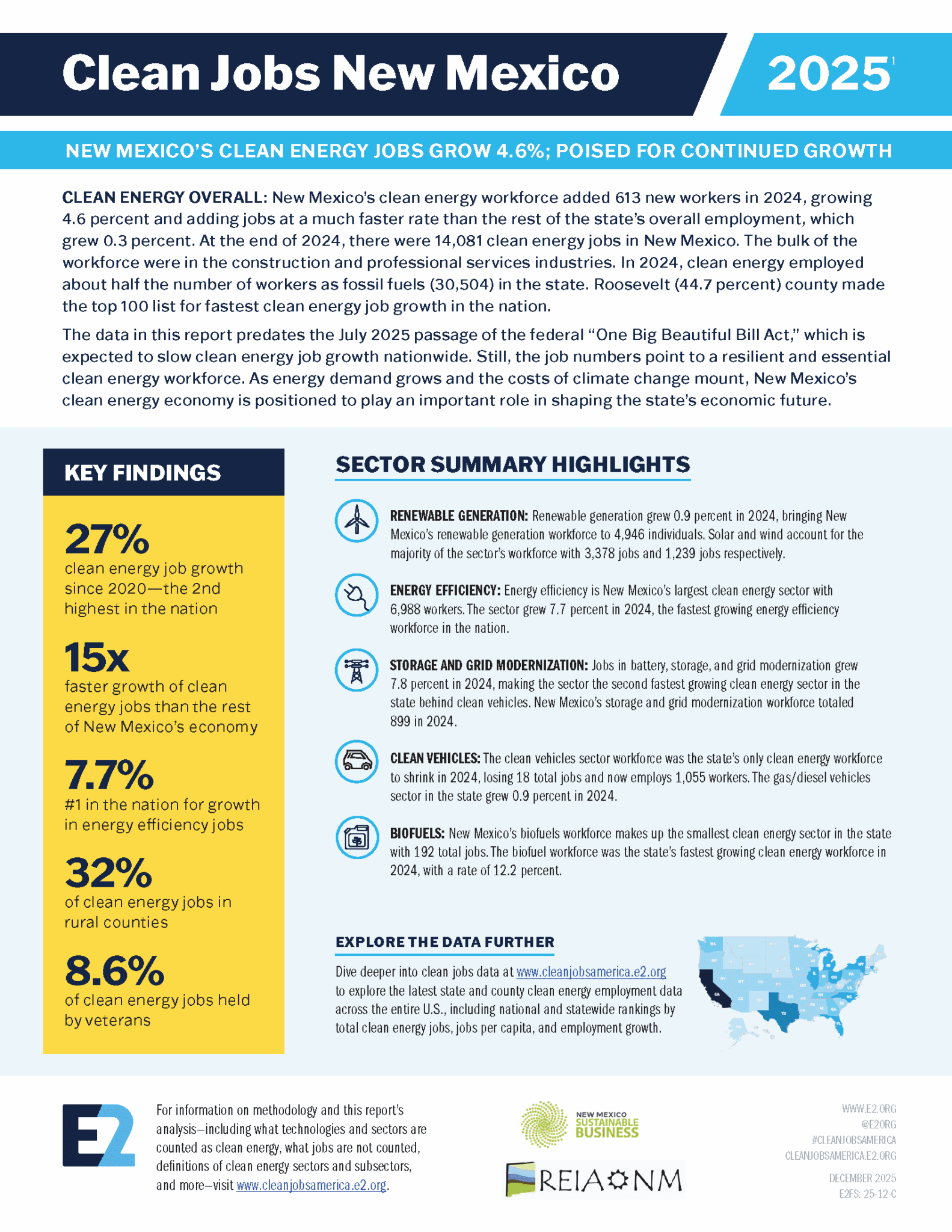
New Mexico’s clean energy workforce added 613 new workers in 2024, growing 4.6 percent and adding jobs at a much faster rate than the rest of the state’s overall employment, which grew 0.3 percent. At the end of 2024, there were 14,081 clean energy jobs in New Mexico. The bulk of the workforce were in the construction and professional services industries. In 2024, clean energy employed about half the number of workers as fossil fuels (30,504) in the state. Roosevelt (44.7 percent) county made the top 100 list for fastest clean energy job growth in the nation.

The data in this report predates the July 2025 passage of the federal “One Big Beautiful Bill Act,” which is expected to slow clean energy job growth nationwide. Still, the job numbers point to a resilient and essential clean energy workforce. As energy demand grows and the costs of climate change mount, New Mexico’s clean energy economy is positioned to play an important role in shaping the state’s economic future.

This field is for validation purposes and should be left unchanged.

Previous Reports

Clean Jobs New Mexico 2024 is the 5th clean energy jobs report for New Mexico from E2. Previous reports can be accessed in the below links.

Background

This is the fifth Clean Jobs New Mexico report produced by E2 based on analysis of the USEER, which was first released by the DOE in 2016. E2 was an original proponent of the DOE producing the USEER and was a partner on the reports produced by the Energy Futures Initiative (EFI) and National Association of State Energy Officials (NASEO) after the Trump administration decided to not produce it in 2017.

For additional insight on clean energy’s economic impact, visit e2.org/reports/ to access E2’s full slate of economic reports on the clean energy sector and related industries,

View Report »

REPORT: Colorado clean energy sector grew by 4 percent, added 2K jobs in 2024

DENVER, CO (Dec. 10, 2025) – Clean energy jobs grew more than five times faster in Colorado than the rest of the state’s economy in 2024, raising the total number of clean energy workers in the state to 69,859 – 18th most in the country – according to the second annual Clean Jobs Colorado report […]

Clean Jobs Colorado 2025

Date: December 10, 2025

Summary

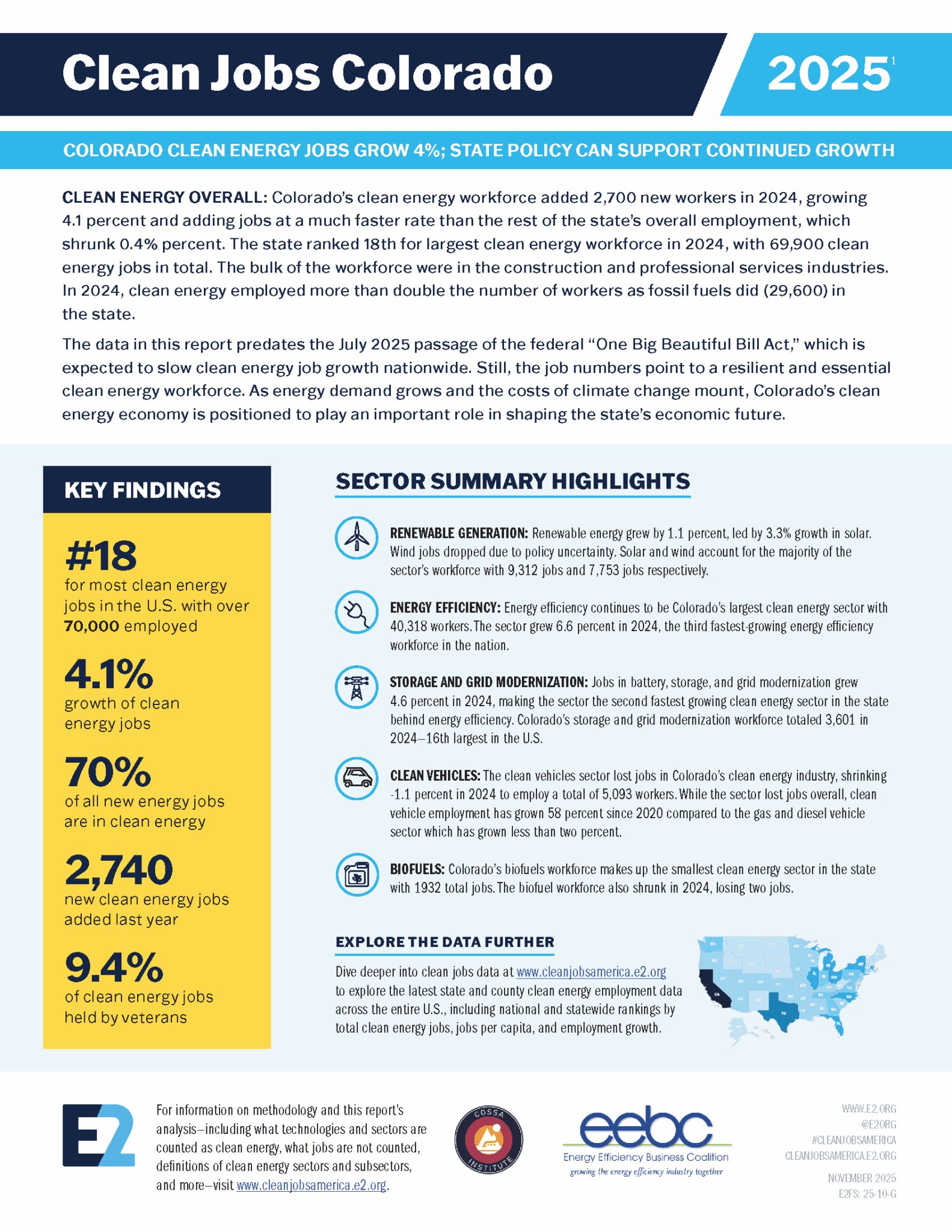
Colorado’s clean energy workforce added 2,700 new workers in 2024, growing 4.1 percent and adding jobs at a much faster rate than the rest of the state’s overall employment, which shrunk 0.4% percent. The state ranked 18th for largest clean energy workforce in 2024, with 69,900 clean energy jobs in total. The bulk of the workforce were in the construction and professional services industries. In 2024, clean energy employed more than double the number of workers as fossil fuels did (29,600) in the state. 

The data in this report predates the July 2025 passage of the federal “One Big Beautiful Bill Act,” which is expected to slow clean energy job growth nationwide. Still, the job numbers point to a resilient and essential clean energy workforce. As energy demand grows and the costs of climate change mount, Colorado’s clean energy economy is positioned to play an important role in shaping the state’s economic future.

This field is for validation purposes and should be left unchanged.

Previous Reports

Clean Jobs Colorado 2025 is the 9th clean energy jobs report for Colorado from E2. Previous reports can be accessed in the below links.

Background

This is the ninth Clean Jobs Colorado report produced by E2 based on analysis of the USEER, which was first released by the DOE in 2016. E2 was an original proponent of the DOE producing the USEER and was a partner on the reports produced by the Energy Futures Initiative (EFI) and National Association of State Energy Officials (NASEO) after the Trump administration decided to not produce it in 2017.

For additional insight on clean energy’s economic impact, visit e2.org/reports/ to access E2’s full slate of economic reports on the clean energy sector and related industries,

View Report »

Clean Jobs Pennsylvania 2025

Date: November 24, 2025

Summary

Pennsylvania’s clean energy sector employed 104,499 people at the end of 2024. By adding 3,722 workers, the clean energy job growth rate topped 3.7 percent, higher than the rest of Pennsylvania’s employment growth rate of 0.7 percent. More than 17,500 clean energy jobs have been created in Pennsylvania since 2020, an increase of more than 20 percent.

Most workers were in the construction and manufacturing industries. At the sector level, energy efficiency employed 76,209 people, while renewable energy employed more than 12,328 led by solar and wind.

While the state ranks No. 10 nationally for clean energy jobs, it sits behind five states with smaller populations: Illinois, Michigan, Massachusetts, Ohio, and North Carolina each have between 113,000 and 132,000 clean energy jobs. Four Pennsylvania counties made the Top 100 list for most clean energy jobs nationally: Allegheny (13,702 jobs), Montgomery (10,127), Philadelphia (9,652), and Lehigh (8,379).

Jobs data in this report predates the July 2025 passage of the One Big Beautiful Bill Act, which is forecast to slow clean energy job growth nationwide. Nevertheless, the story emerging from these numbers is one of a clean energy industry and workforce that is resilient and dynamic. As energy demand grows, Pennsylvania’s clean energy workers are positioned to play an increasingly important role in shaping the commonwealth’s evolving economic future.

This field is for validation purposes and should be left unchanged.

Previous Reports

Background

This is the tenth Clean Jobs Pennsylvania report produced by E2 based on analysis of the USEER, which was first released by the DOE in 2016. E2 was an original proponent of the DOE producing the USEER and was a partner on the reports produced by the Energy Futures Initiative (EFI) and National Association of State Energy Officials (NASEO) after the Trump administration decided to not produce it in 2017.

For additional insight on clean energy’s economic impact, visit e2.org/reports/ to access E2’s full slate of economic reports on the clean energy sector and related industries,

View Report »

Sign Up for Email Updates


"*" indicates required fields

This field is for validation purposes and should be left unchanged.

Our Latest Press Releases


Releases

Clean Energy Cancellations Cost U.S. 470,000 Jobs, Hundreds of Billions in GDP

One year after the One Big Beautiful Bill Act (OBBBA) was signed into law—rolling back tax credits and programs related to clean energy manufacturing and renewable electricity—a new economic analysis finds that large-scale clean energy projects abandoned si...


Releases

E2: Clean Energy Companies Announce Nearly $3 Billion in New Projects, Cancel $4 Billion

lean energy related companies announced 14 new manufacturing and utility-scale generation and storage projects totaling nearly $3 billion that would create 7,500 new jobs and add nearly 1 gigawatt (GW) in new capacity, according to E2’s latest Clean Economy...


Releases

Clean Energy Developers Announced 12 GW, $18B in Q1 Generation Investments Before Tax Credit Cliff — But Project Losses Are Mounting

Clean energy developers announced more than 50 new utility-scale generation and storage projects totaling over 12 gigawatts (GW) and $18 billion in investment during the first quarter of 2026, according to E2’s latest Clean Economy Works analysis tracking c...


Donate Today