Abandoning Businesses: Effects of the Repeal of the EPA’s Endangerment Finding for Vehicles and Trucks

Posted on February 12, 2026 by Daniel Baker

Why the EPA’s Repeal of the Endangerment Finding for Vehicles and Trucks is Bad for the Economy and Bad for the Environment By Daniel Baker To start, a couple of key facts. Greenhouse gases (GHG) are directly linked to climate change. A warmer planet is really, really bad for business.  That makes the EPA’s decision to officially reverse its stance on the scientifically established harms […]

E2 STATEMENT: Illinois General Assembly Passes Clean and Reliable Grid Affordability Act (CRGA Act), Solidifies State as a Clean Energy Leader, Bringing Billions in Benefits to Businesses & Residents

SPRINGFIELD (Oct. 31, 2025) – As of last night, both chambers of the Illinois General Assembly passed the Clean and Reliable Grid Affordability (CRGA) Act, a major milestone for clean energy. The bill now awaits the signature of Governor JB Pritzker, a supporter of the legislation. The energy omnibus is expected to deliver billions of […]

Bob Keefe, E2 Executive Director, Named To The 2025 TIME100 Climate List Of The 100 Most Influential Leaders Driving Business Climate Action

WASHINGTON (Oct. 30, 2025) – TIME named Bob Keefe, executive director for the national nonpartisan business group E2, to the 2025 TIME100 Climate list, recognizing the 100 most innovative leaders driving business climate action. For the third year in a row, TIME editors vetted people who delivered measurable progress with respect to the business of climate change, emphasizing tangible results over commitments.  In choosing Keefe, the magazine recognized his leadership of an […]

SURVEY: Businesses on Impact of Arrested IRA Investments

Date: October 15, 2024

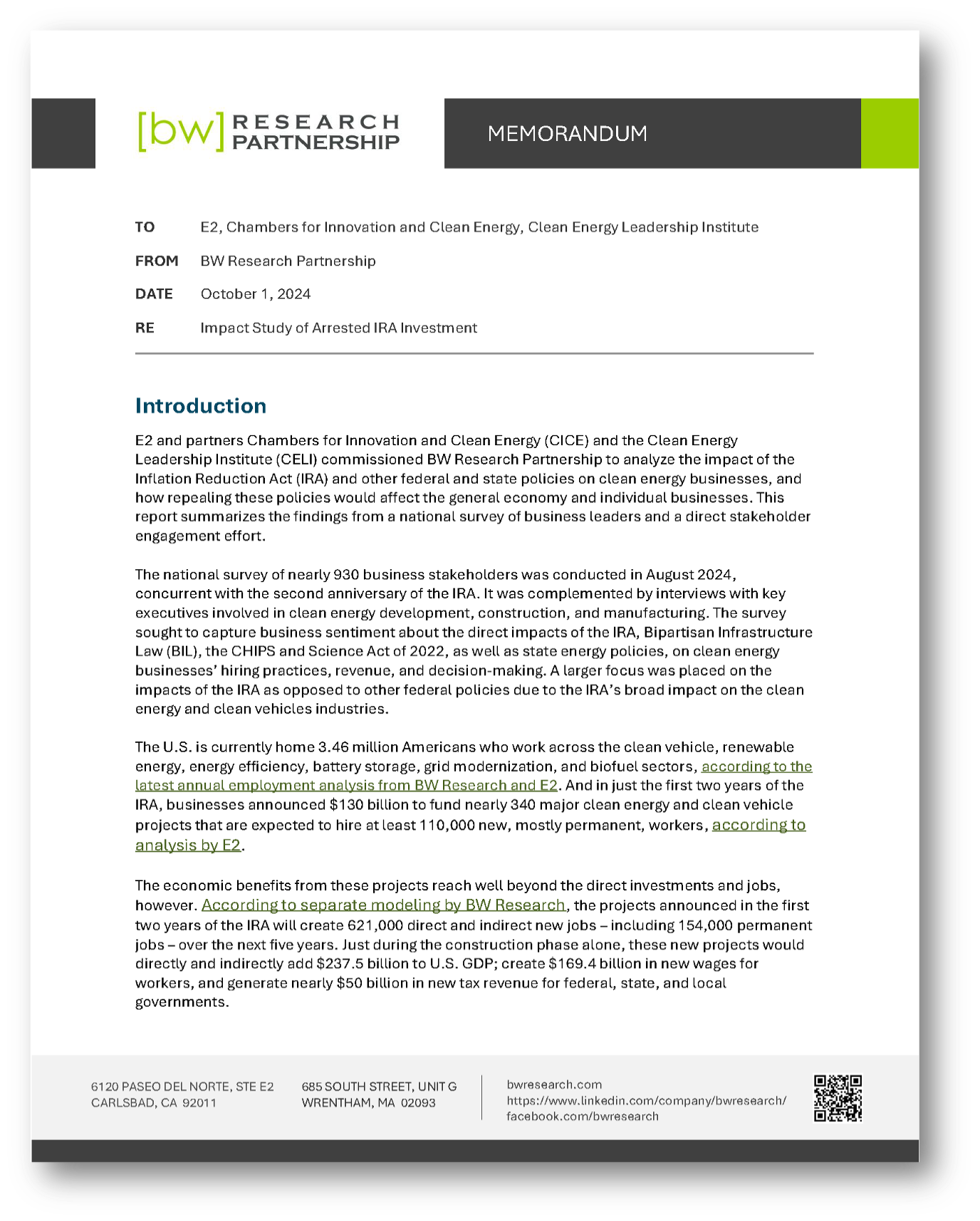
The U.S. is currently home 3.46 million Americans who work across the clean vehicle, renewable energy, energy efficiency, battery storage, grid modernization, and biofuel sectors, according to the latest annual employment analysis from BW Research and E2. And in just the first two years of the IRA, businesses announced $130 billion to fund nearly 340 major clean energy and clean vehicle projects that are expected to hire at least 110,000 new, mostly permanent, workers, according to analysis by E2.

The economic benefits from these projects reach well beyond the direct investments and jobs, however. According to separate modeling by BW Research, the projects announced in the first two years of the IRA will create 621,000 direct and indirect new jobs – including 154,000 permanent jobs – over the next five years. Just during the construction phase alone, these new projects would directly and indirectly add $237.5 billion to U.S. GDP; create $169.4 billion in new wages for workers, and generate nearly $50 billion in new tax revenue for federal, state, and local governments.

To gauge business sentiment on how repealing or rolling back the IRA would impact business investment, hiring, and expansion plans, BW Research focused its outreach on firms working with the following technologies: energy efficiency of buildings, renewable electricity generation, energy storage, grid, renewable fuels, and electric or alternative transportation. The survey captured impacts not just on new businesses or projects since the laws were signed but on long-established companies, with more than 60 percent of the surveyed firms saying they have been in business in the clean energy space for more than ten years.

The executive interviews conducted in parallel with the survey helped reveal other common themes that business owners and decision-makers have seen since the passage of the IRA, as well as key issues for them as they contemplate their businesses’ future. The stakeholder engagement process involved energy businesses in different technologies and regions of the country.

Lastly, the repeal or rollback of the IRA would have impacts that extend far beyond hiring, investment, and expansion plans. In addition to the benefits to businesses created by the IRA, the policy has sent a clear market signal for companies to invest, innovate, and expand in America.

If the policy is repealed, some executives surveyed said they would have to relocate their companies to another country. Others said they would go out of business entirely. Rural areas and small communities across America would be hurt the worst, since rural areas have seen the biggest uptick in clean energy projects, investments and jobs since the IRA.
This field is for validation purposes and should be left unchanged.

Key Findings

  • Repealing the IRA would hurt business or revenue.
    • More than half (53 percent) of firms said they would lose business or revenue as a direct result of an IRA repeal.
    • About 27 percent said they would lose projects or contracts.
    • About 21 percent of impacted firms said they would likely exit the clean energy space.
    • About 11 percent of firms said they would close their business entirely,
    • Nearly 9 percent of firms said they would have to relocate to another country.
  • Businesses would have to lay off employees and cut wages.46 million Americans currently work in clean energy sectors and nearly 150,000 new jobs are being added every year.
    • About 21 percent of firms said they would have to lay off workers if the IRA is repealed.
    • Nearly 15 percent of firms said they would have to lay off 10 or more workers;
    • More than 10 percent of firms said they would have to lay off 25 or more workers.
    • About 13 percent said they’d have to freeze wages or rescind offers to prospective employees.
  • The IRA is very important to business growth.
    • About 85 percent of respondents said the IRA was “very important” or “somewhat important” to growth.
    • Nearly 60 percent of respondents said have worked on, produced goods, or offered services related to clean energy projects directly impacted or funded by the IRA.
    • About 48 percent said that at least half of their business came from IRA-related projects.

Other Key Findings
(based on survey results and stakeholder interviews)

  • The IRA has had a major impact on reducing risk and uncertainty in clean energy markets. A repeal would lead to drastic scaling back of projects and affect investor confidence in the industry.
  • Rural areas and small communities would experience the largest negative effects of a repeal of the IRA. Rural regions have seen the biggest uptake in projects and economic benefits since the passing of the IRA.
  • A repeal of the IRA would disrupt the rapid increase in solar and battery installations as a result of higher installation and materials costs, lower supply as smaller companies leave the market, and lower demand from customers.
  • The IRA has led to the creation of good-quality jobs offering transition pathways for workers in fossil fuels and other industries, particularly in rural areas. The high rate of new project installations, also largely prevalent in rural areas, has brought about a high demand for skilled energy workers.

Methodology

The national survey of nearly 930 business stakeholders was conducted in August 2024, concurrent with the second anniversary of the IRA. It was complemented by interviews with key executives involved in clean energy development, construction, and manufacturing. The survey sought to capture business sentiment about the direct impacts of the IRA, Bipartisan Infrastructure Law (BIL), the CHIPS and Science Act of 2022, as well as state energy policies, on clean energy businesses’ hiring practices, revenue, and decision-making. A larger focus was placed on the impacts of the IRA as opposed to other federal policies due to the IRA’s broad impact on the clean energy and clean vehicles industries.

For full toplines and questions from the employer survey, see Appendix A in the full report.

About E2

E2 is a national, nonpartisan group of business leaders, investors, and professionals from every sector of the economy who advocate for smart policies that are good for the economy and good for the environment. E2 members have founded or funded more than 2,500 companies, created more than 600,000 jobs, and manage more than $100 billion in venture and private equity capital.

For additional insight into E2’s other reports, visit e2.org/reports.

View Report »

Clean Economy Works | An Economic Impact Analysis of Major Clean Energy Projects Announced Through Two Years of the Inflation Reduction Act

Date: October 15, 2024

Summary:

In the first two years under the IRA, businesses announced $130 billion in investments in 338 major clean energy and clean vehicle projects that are expected to create at least 110,000 jobs, according to E2. These projects include factories that produce electric vehicles, batteries, solar panels, wind turbine parts and other goods that benefit from tax credits and other policies created by the IRA.

But the economic benefits from these projects reach well beyond the direct investments and jobs. This analysis is designed to measure the broader indirect and induced economic benefits and the multiplier effect from the investments in these IRA-fueled clean economy projects.

According to this modeling, if completed the projects announced in the first two years of the IRA will create 621,000 direct and indirect new jobs – including 154,000 permanent jobs— throughout the economy over the next five years. This would add $237.5 billion to U.S. GDP; create $169.4 billion in new wages for workers and generate nearly $50 billion in new tax revenue for federal, state, and local governments.

This report builds on the research published in 2023 by E2 and BW Research, detailing the overall economic impacts of the 210 major clean economy projects announced in the first year of the IRA. In the second year of the IRA, an additional 128 clean energy projects were announced.

This analysis uses the original $130 billion in estimated capital expenditures that companies announced in investments for new developments and extrapolates another $32 billion in additional capital expenditures for project announcements that did not include a dollar amount or required an updated estimate based on available information.

Secondary economic benefits extend throughout the economy. When new clean energy projects and clean vehicle factories and thousands of new jobs come to a community, local restaurants sell more meals. Schools, police departments and local public works projects benefit from increases in local tax revenues. Local manufacturers and wholesalers sell more goods to feed the growing local supply chain. And small businesses such as accounting firms, construction contractors, landscaping companies and caterers see new revenue streams.

Together, these direct and indirect jobs and investments tell a nationwide story of opportunity for domestic manufacturing, clean energy production, transportation and infrastructure modernization and American ingenuity, thanks to the clean energy incentives and investments made possible by the IRA.

They are also just the beginning as E2 continues to track new projects being announced every month.

E2 Clean Economy Works project tracking. Available at https://e2.org/announcements/.

This field is for validation purposes and should be left unchanged.

Key Findings

This modeling shows that (if all projects are completed) the 338 major projects tracked by E2 between August 2022 to August 2024 will create or support more than 621,000 jobs, including 467,000 construction jobs each year during construction and another 154,000 jobs each year after that.

While the under construction, these projects will add $237.5 billion to the nation’s GDP, more than the U.S. telecommunications sector adds to GDP annually, and another $20.4 annually once they are up and running—more than the nation’s textile manufacturing industry.

Additionally, these projects will result in $49.8 billion in new tax revenues for federal, state, and local governments while under construction, and an additional $4.4 billion annually after that.

COMBINED ECONOMIC IMPACTS OF MAJOR CLEAN ENERGY PROJECTS ANNOUNCED OVER TWO YEARS OF THE IRA

    • $162 BILLION in total private capital investments
      +$17.5 BILLION in annual investments during operational life of projects
    • $169.4 BILLION in labor income during construction phase
      +$12.9 BILLION in labor income annually during operational life of projects
    • $237.5 BILLION added to U.S. GDP during construction phase
      +$20.4 BILLION added to U.S. GDP annually during operational life of projects
    • $49.8 BILLION in tax revenue generated during construction phase
      +$4.4 BILLION in tax revenue generated annually during operational life of projects
    • 467,000 JOBS each year for 5 years during construction phase
      +154,000 JOBS supported annually during operational life of projects

TOTAL INVESTMENTS INTO AND ANNUAL JOBS SUPPORTED BY CLEAN ENERGY PROJECTS, DETAILED BY ENERGY SECTOR

Sector Total Construction Phase Jobs (Annual jobs for 5 years) Annual Operations Phase Jobs (Annual jobs for lifetime of projects) Sector Announced Capital Investment ($billions) Extrapolated Capital Investment ($billions) Total Capital Investment ($billions) Annual Operational Investment ($billions)
Solar 66,736 21,882 Solar $15.94 $6.93 $22.87 $2.47
Wind 13,447 14,871 Wind $3.97 $1.38 $5.35 $1.66
EV 266,673 78,276 EV $79.22 $9.22 $88.44 $8.84
Electric T&D 6,626 2,502 Electric T&D $1.82 $0.51 $2.33 $0.33
Battery Storage 84,470 22,798 Battery Storage $23.27 $6.87 $30.14 $3.17
Clean Fuels 29,093 13,639 Clean Fuels $6.06 $6.85 $12.90 $1.07
Total 467,045 153,969 Total Capital Investment $130.27 $31.77 $162.04 $17.54

Methodology

This analysis provides a thorough economic prediction of the impacts of the 338 announcements by filling in the gaps of publicly announced information. Modeled impacts differ from initial estimates offered by companies announcing new projects, tracked by E2. Eighty-eight of the 338 announcements provided no capital investment estimate and ninety-four provided no job creation estimate. Additionally, those estimates were inconsistently defined, lacking clarity on if they are direct jobs only or direct, indirect, and induced jobs, and if they were for construction or permanent positions.

To analyze these economic impacts from the clean energy programs and policies in the IRA, BW Research used IMPLAN economic modeling software to estimate the overall economic benefits from publicly sourced clean energy project announcements. BW Research developed a dozen economic impact models in total to represent six tracked sectors: Solar, Wind, Electric Vehicle (EV), Electricity Transmission & Distribution (Electric T&D), Battery Storage, and Clean Fuels. Based on this common methodology and assumptions, BW generated outputs at the national level, including earnings, tax revenue, employment and overall GDP value add.

For more information on methodology, see Appendix C in the report. For the list of all 338 projects announced between August 15, 2022 and August 16, 2024, see Appendix D.

For the latest full list of clean energy job announcements tracked by E2, visit https://e2.org/announcements.

About E2

E2 is a national, nonpartisan group of business leaders, investors, and professionals from every sector of the economy who advocate for smart policies that are good for the economy and good for the environment. E2 members have founded or funded more than 2,500 companies, created more than 600,000 jobs, and manage more than $100 billion in venture and private equity capital.

For additional insight into E2’s other reports, visit e2.org/reports.

View Report »

Clean Economy Works | IRA Two-Year Review

Date: August 14, 2024

Summary:

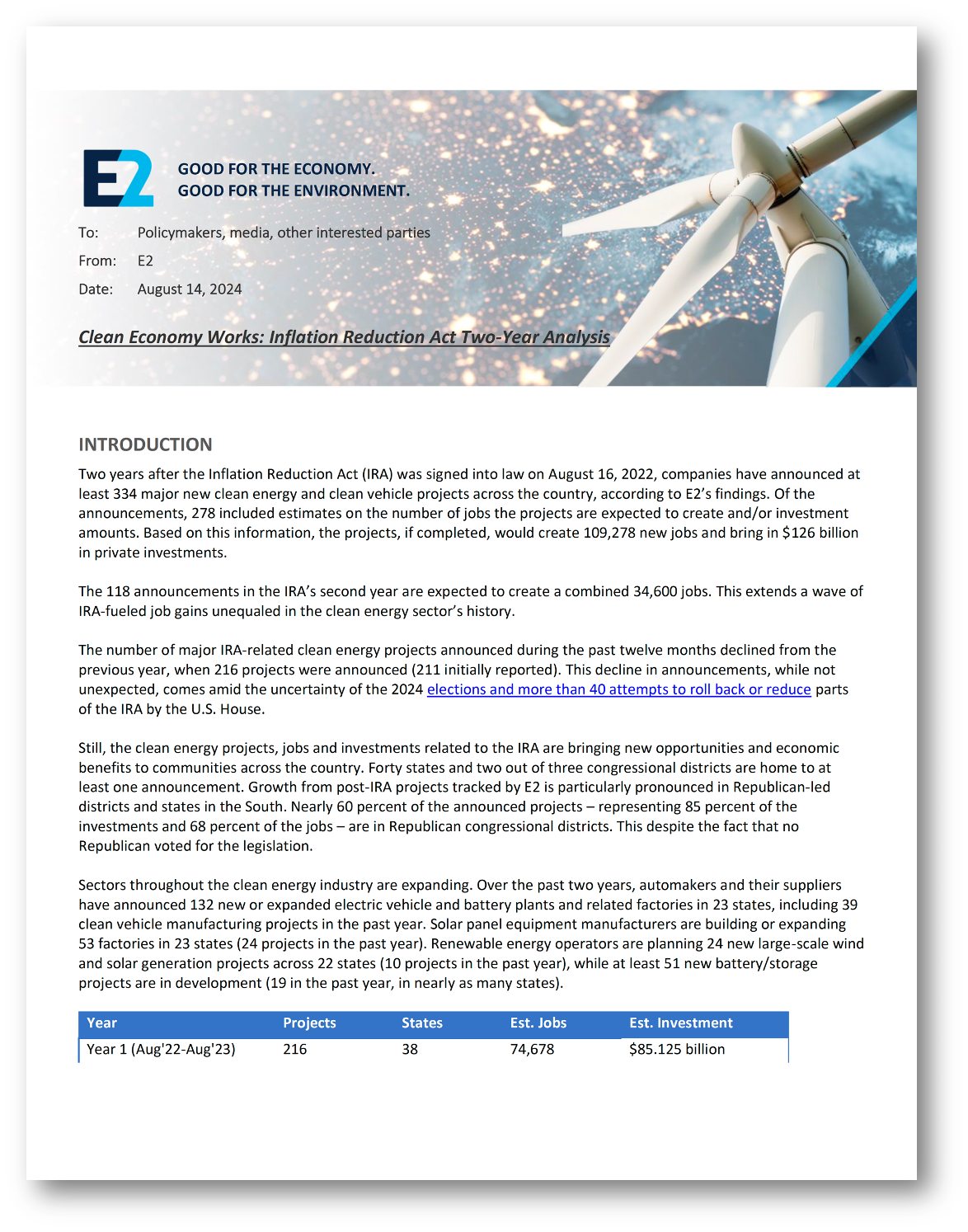
Two years after the Inflation Reduction Act (IRA) was signed into law on August 16, 2022, companies have announced at least 334 major new clean energy and clean vehicle projects across the country, according to E2’s findings. Of the announcements, 278 included estimates on the number of jobs the projects are expected to create and/or investment amounts. Based on this information, the projects, if completed, would create 109,278 new jobs and bring in $126 billion in private investments.

The 118 announcements in the IRA’s second year are expected to create a combined 34,600 jobs. This extends a wave of IRA-fueled job gains unequaled in the clean energy sector’s history.

The number of major IRA-related clean energy projects announced during the past twelve months declined from the previous year, when 216 projects were announced (211 initially reported). This decline in announcements, while not unexpected, comes amid the uncertainty of the 2024 elections and more than 40 attempts to roll back or reduce parts of the IRA by the U.S. House.

Still, the clean energy projects, jobs and investments related to the IRA are bringing new opportunities and economic benefits to communities across the country. Forty states and two out of three congressional districts are home to at least one announcement. Growth from post-IRA projects tracked by E2 is particularly pronounced in Republican-led districts and states in the South. Nearly 60 percent of the announced projects – representing 85 percent of the investments and 68 percent of the jobs – are in Republican congressional districts. This despite the fact that no Republican voted for the legislation.

Sectors throughout the clean energy industry are expanding. Over the past two years, automakers and their suppliers have announced 132 new or expanded electric vehicle and battery plants and related factories in 23 states, including 39 clean vehicle manufacturing projects in the past year. Solar panel equipment manufacturers are building or expanding 53 factories in 23 states (24 projects in the past year). Renewable energy operators are planning 24 new large-scale wind and solar generation projects across 22 states (10 projects in the past year), while at least 51 new battery/storage projects are in development (19 in the past year, in nearly as many states).

This field is for validation purposes and should be left unchanged.

Highlights

Year Projects States Est. Jobs Est. Investment
Year 1 (Aug’22-Aug’23) 216 38 74,678 $85.125 billion
Year 2 (Aug ’23-Aug ’24) 118 30 34,600 $40.835 billion
Total Since IRA 334 40 109,278 $125.961 billion

* 99 of the 334 announcements did not include investment estimates and 98 did not include job estimates.

  • More than 90 percent of all projects announced since the IRA are in the manufacturing sector.
  • Five states are home to 20 or more projects: Michigan, Georgia, South Carolina, Texas and North Carolina. Six others are home to at least 10: Ohio, Tennessee, California, New York, Indiana and Arizona. Three-dozen states are home to at least two projects.
  • Clean vehicles accounted for more than a third of all projects announced within the past year (45 projects announced).
  • Renewable energy companies announced 31 solar panel and equipment factories and major solar projects in the IRA’s second year, and at least four wind turbine factories or major wind projects.
  • Red states and Republican congressional districts are benefitting the most from the IRA. In its full two-year history, more than half of all projects were in Republican districts, and 19 of the top 20 congressional districts for clean energy investments are held by Republicans. Nearly 40 percent of all 435 U.S. congressional districts are home to at least one announced project.
  • The top congressional districts for clean energy investments are North Carolina’s 9th district with nearly $9.9 billion, represented by Republican Rep. Richard Hudson; Georgia’s 11th congressional district with $6.6 billion, represented by Republican Rep. Barry Loudermilk; and Nevada’s 2nd congressional district with $6.6 billion, represented by Republican Rep. Mark Amodei.
  • The top congressional districts that would see the largest clean energy employment growth from new clean energy projects are North Carolina’s 9th district with 5,660 estimated jobs, represented by Republican Rep. Barry Loudermilk; Nevada’s 2nd congressional district with $5,050 jobs, represented by Republican Rep. Mark Amodei; and South Carolina’s 2nd congressional district, represented by Republican Rep. Joe Wilson.
  • The congressional districts that are home to the most projects announced are: Ohio’s 9th congressional district with eight projects, represented by Democratic Rep. Marcy Kaptur; Georgia’s 1st congressional district with six projects, represented by Republican Rep. Earl Carter; North Carolina’s 9th congressional district with six projects, represented by Republican Rep. Richard Hudson; and South Carolina’s 5th congressional district with six projects, represented by Republican Rep. Ralph Norman.
  • Foreign companies led or were involved with about 160 projects announced since the IRA became law – nearly identical to the number of announced projects from U.S.-based companies.
  • South Korean companies have announced the most projects – about three-dozen in the past two years. Companies based in Michigan and California led announcements from domestic-based companies, with 22 each.

Methodology

The data used in this report is limited to information made publicly available by the companies announcing projects and may not be comprehensive of all major projects that began development after August 16, 2022, nor be exclusive of projects that did not publicly disclose specific plans prior to the passage of the Inflation Reduction Act (IRA). Projects that began development, were proposed, or applied for local and state approval before the passage of the IRA are not included. This analysis also does not include investments in which the federal government has provided financial resources for the complete project, lease sales, projects in which an announcement was made but lacked specific geographic information, etc. Details on projects came from news reports on new and related projects; press releases from companies announcing new developments; and government announcements. 99 of the 334 announcements (30 percent) included no estimated investment data and 98 of the 334 announcements (29 percent) included no job estimates, making this information conservative. Additionally, job estimates announced by companies are overwhelming for permanent jobs and only a handful of announcements since 2022 have included any estimates for temporary or construction jobs that would be created by the projects, meaning the direct employment impact from these projects will be significantly greater than that estimates reviewed in this analysis. Some announcements did not include specific locations that could be used to identify congressional districts.

For the latest full list of clean energy job announcements tracked by E2, visit https://e2.org/announcements.

About E2

E2 is a national, nonpartisan group of business leaders, investors, and professionals from every sector of the economy who advocate for smart policies that are good for the economy and good for the environment. E2 members have founded or funded more than 2,500 companies, created more than 600,000 jobs, and manage more than $100 billion in venture and private equity capital.

For additional insight into E2’s other reports, visit e2.org/reports.

View Report »

Arizona Clean Economy Works: 8 New Clean Energy, Vehicle Projects to Create 18K Jobs, Add $7B to GDP, Generate $5B in Wages for Arizona Workers

Date: July 3, 2024

Summary:

This analysis uses the original $86 billion in estimated capital expenditures that companies announced in investments nationwide for new developments and extrapolates another $20 billion in additional capital expenditures for project announcements that did not include a dollar amount or required an updated estimate based on available information. In addition to the direct benefits of these expenditures, new modeling from BW Research measures the broader economic benefits and the multiplier effect of the investments and jobs expected if the 210 announced projects were completed over the next five years.

When these broader economic benefits are factored in, BW’s modeling expects the 8 large-scale project announced in Arizona tracked by E2 between August 2022 and August 2023 to create or support more than 18,700 jobs and generate billions of dollars in new wages, tax revenue, and economic growth.

These secondary economic benefits are far-reaching. When new clean energy projects and clean vehicle factories and thousands of new jobs come to a community, local restaurants sell more meals. Schools, police departments and local public works projects benefit from increases in local tax revenues. Local manufacturers and wholesalers sell more goods to feed the growing local supply chain. And small businesses such as accounting firms, construction contractors, landscaping companies and caterers see new revenue streams.

Together, these direct and indirect jobs and investments tell a statewide story of opportunity for domestic manufacturing, clean energy production, transportation and infrastructure modernization and American ingenuity, thanks to the clean energy incentives and investments made possible by the IRA.

They are also just the beginning as E2 continues to track new projects being announced every month.

This field is for validation purposes and should be left unchanged.

Key Findings

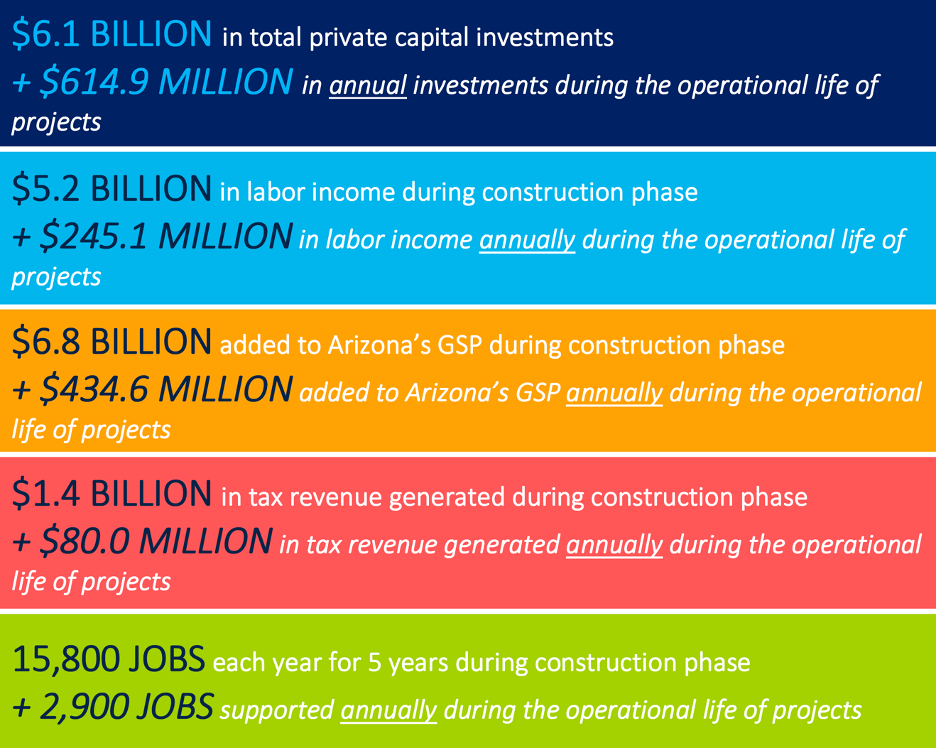
This report details the economic impacts resulting from the clean energy investments in Arizona that were announced after the passing of the IRA, allowing for a more detailed examination of the economic benefits that the clean energy investments bring to the state. The 8 major Arizona projects tracked by E2 between August 2022-August 2023 will create or support more than 18,700 jobs, including 15,800 jobs each year during construction and another 2,900 jobs each year after.

These private-sector investments and jobs will add $6.8 billion to Arizona’s Gross State Product (GSP) while the projects are under construction, and another $434.6 million annually once they are up and running.

Additionally, these projects will result in $1.4 billion in new tax revenues for federal, state, and local governments while under construction, and an additional $80.0 million annually after.

COMBINED JOBS, WAGE, TAX AND GSP IMPACTS OF MAJOR CLEAN ENERGY PROJECTS ANNOUNCED IN FIRST YEAR OF THE IRA

TOTAL INVESTMENTS INTO AND ANNUAL JOBS SUPPORTED BY CLEAN ENERGY PROJECTS, DETAILED BY ENERGY SECTOR

Sector Total Construction Phase Jobs (Annual jobs for 5 years) Annual Operations Phase Jobs (Annual jobs for lifetime of projects)
Battery / Storage 9,445 1,847
Solar 154 30
EV 6,173 1,052
Total 15,771 2,929


Sector Total Capital Investment ($millions) Extrapolated Capital Investment ($millions) Total Capital Investment ($millions) Annual Operational Investment ($millions)
EV $56 $- $56 $5.60
Battery / Storage $3,500.00 $182.36 $3,682.36 $368.24
Solar $60.00 $- $60.00 $5.94
Total Capital Investment $5,901.00 $248.07 $6,149.07 $614.85

Methodology

This analysis provides a thorough economic prediction of the impacts of the 8 announcements by filling in the gaps of publicly announced information. Modeled impacts differ from initial estimates offered by companies announcing new projects, tracked by E2. One of the eight announcements provided no capital investment estimate and two provided no job creation estimate. Additionally, those estimates were inconsistently defined, lacking clarity on if they are direct jobs only or direct, indirect, and induced jobs, and if they were for construction or permanent positions.

To analyze these economic impacts from the clean energy programs and policies in the IRA, BW Research used IMPLAN economic modeling software to estimate the overall economic benefits from publicly sourced clean energy project announcements. BW Research developed a dozen economic impact models in total to represent six tracked sectors: Solar, Wind, Electric Vehicle (EV), Electricity Transmission & Distribution (Electric T&D), Battery Storage, and Clean Fuels. Based on this common methodology and assumptions, BW generated outputs at the national level, including earnings, tax revenue, employment and overall GSP value add.

For more information on methodology, see Appendix B in the report. For the list of all 10 projects tracked by E2 in the first year of the IRA, see Appendix C.

For the latest full list of clean energy job announcements tracked by E2, visit https://e2.org/announcements.

About E2

E2 is a national, nonpartisan group of business leaders, investors, and professionals from every sector of the economy who advocate for smart policies that are good for the economy and good for the environment. E2 members have founded or funded more than 2,500 companies, created more than 600,000 jobs, and manage more than $100 billion in venture and private equity capital.

For additional insight into E2’s other reports, visit e2.org/reports.

View Report »

Sign Up for Email Updates


"*" indicates required fields

This field is for validation purposes and should be left unchanged.

Our Latest Press Releases


Releases

E2: Repealing EPA’s Endangerment Finding For Vehicle Emissions Raises Costs for Businesses and Consumers

The EPA officially revoked the endangerment finding for greenhouse gas (GHG) emissions and eliminated clean vehicle standards in a blow to both our economy and our environment.


Releases

E2: Companies Cancelled $34.8B, 38K Jobs for Clean Energy Projects in 2025, Outpacing New Investments 3-to-1

Businesses abandoned $5.1 billion in large-scale factories and clean energy projects in December, capping a turbulent year for the sector that saw nearly $35 billion in investments disappear along with more than 38,000 current and future jobs, according to ...


Releases

E2: Trump Administration’s Latest Attempt to Kill Offshore Wind Hurts Consumers, Businesses

The Trump administration is trying to halt offshore wind projects that are well-underway just two weeks after their initial attempt was deemed arbitrary and capricious by a federal judge.


Donate Today