Achieving California’s Clean Energy Targets: Where The Rubber Meets The Road

WHAT Profound change is afoot in the quest to meet California’s ambitious decarbonization targets and our state’s electric grid is a critical lynchpin; delivering zero-carbon electricity to California citizens and businesses is critical as we work to power our industries, buildings, and transportation sector with clean electricity.  Realizing 100% clean energy and statewide carbon neutrality […]

On the Climate Front: Tensions Where Green Jobs Meet Blue Collars

“Green energy workers make more money than Walmart clerks but less than union members doing similar tasks. A report commissioned by Environmental Entrepreneurs and other business groups found that in 2019 wind technicians made a median hourly wage of about $25 and solar installers somewhat less along with some health care and retirement benefits. The […]

Pennsylvania announces 191MW solar energy plan

Pennsylvania Gov. Tom Wolf said Monday that half of state government’s electricity will come from solar energy as of 2023.

The commitment – the largest among any governmental agency nationwide – will harness 191 megawatts from seven solar arrays in central Pennsylvania to cover 100% of the electricity needs for more than 400 accounts across 16 state agencies, the Department of General Services said

Penn. Makes Largest State Purchase of Solar Power

Harrisburg, P.A.  – Pennsylvania will be making the single-largest solar procurement by a state government in the country, Governor Tom Wolf announced today. The block of solar power purchasing agreements will supply about 50% of the state government’s electricity demands, exceeding the commitment made in the governors’ 2019 executive order. The following is a statement […]

Fight alongside the administration for a clean economy

Immediate and bold climate action is an economic imperative. We are falling behind China, which has outspent the U.S. in clean energy investments by hundreds of billions of dollars over the last decade. In doing so it has claimed the mantle of global leader in production, export, and installation of solar panels, wind turbines, batteries, […]

How We Decarbonize California’s Buildings

California’s building sector is responsible for a quarter of the state’s greenhouse gas emissions and decarbonizing our built environment presents a critical opportunity ripe for climate action. Over the last few years, state policymakers have made progress in tamping down building emission across California. And at the local level more than 40 cities and counties […]

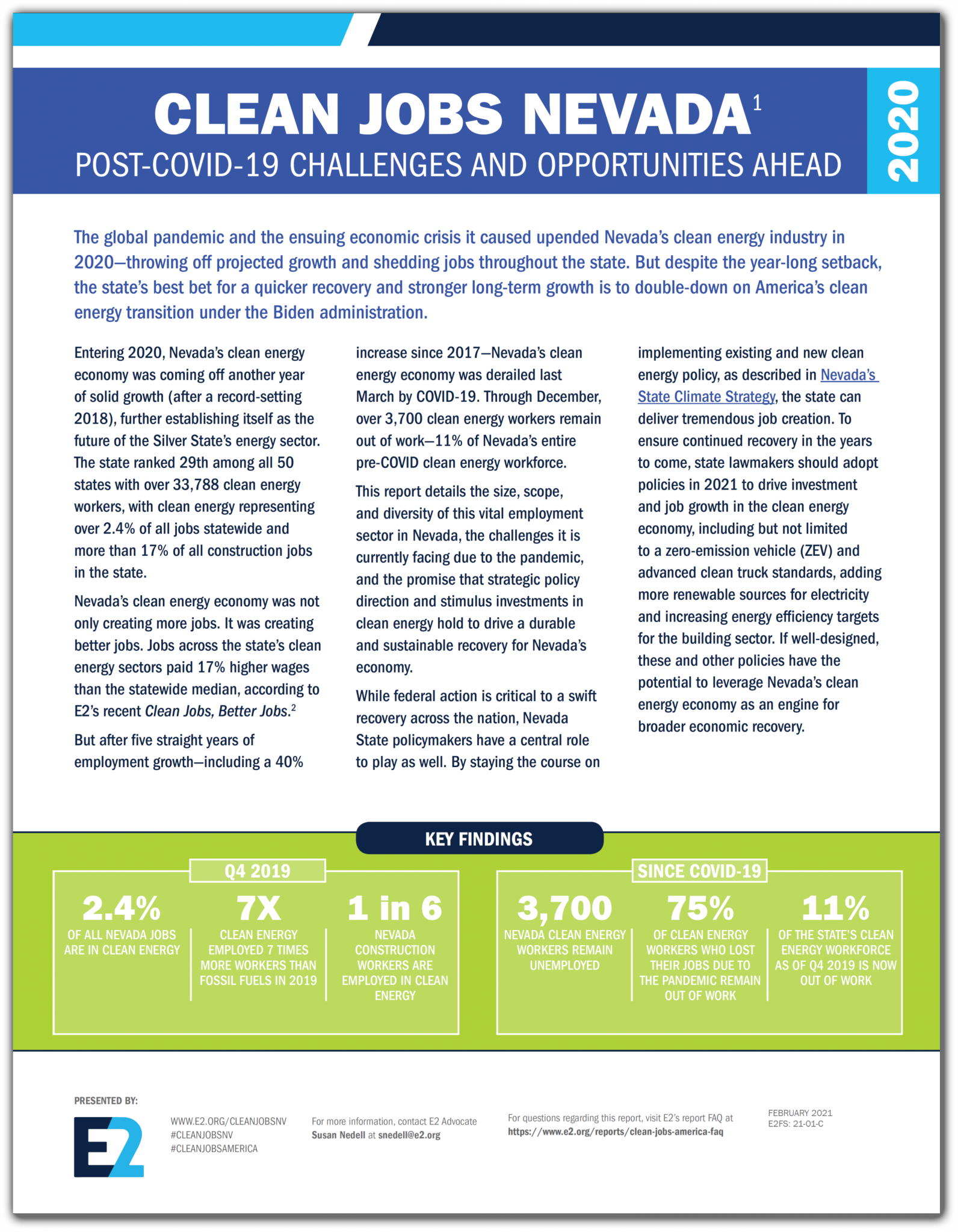
Clean Jobs Nevada 2020

Date: March 2, 2021

Nevada’s Post-COVID Challenges & Opportunities Ahead

Summary:

Driven by the impact of the COVID-19 pandemic and resulting economic crisis, Colorado experienced its first decline in clean energy jobs in 2020 since E2 began tracking the industry with this methodology in 2017. Colorado’s clean energy economy employed more than 58,000 workers at the end of 2020, down from 62,400 the year before, according to an analysis of Bureau of Labor Statistics data and the findings of a national survey of more than 35,000 businesses across the U.S. economy.

By May of last year, more than 7,500 clean energy workers in Colorado had lost their jobs since the COVID-19 pandemic began spreading widely, according to monthly analysis of unemployment data by E2 and partners.2 Since the sector’s losses peaked at the end of May 2020, jobs grew back by 6 percent. In fact, by the end of 2020 more than about 40 percent of the clean energy jobs lost between March and May had been regained, leaving the sector down about 7 percent (about 4,200 jobs) since COVID-19.

Thanks to smart state climate policy leadership, Colorado’s clean energy economy has proven to be a core part of the state’s economy—representing more than 2 percent of overall state employment. It has been resilient and robust in the face of crushing economy-wide pressures.

A  Bigger Picture

This report focuses solely on the energy sector of the economy and does not include jobs in retail trade, repair services, water or waste management, and indirect employment or induced employment.

This field is for validation purposes and should be left unchanged.

Findings

  • Small businesses are the backbone of Nevada’s clean energy economy. Nearly three out of every five (58%) clean energy workers were employed at companies with fewer than 20 employees;
  • 17% of construction jobs in Nevada were in clean energy occupations, from solar installers and site workers to electricians, HVAC technicians, lighting technicians, carpenters and others who work in energy efficiency;
  • Nevada ranked tenth in the country for clean energy unionization, with 9% of clean energy workers part of a union – behind only Washington, California, and Oregon in the West and well above the nation’s economywide average;
  • More than four in ten Nevada clean energy workers were of non-white or Hispanic ethnicity in 2019;
  • Clean energy accounts for 55% of all energy sector jobs in Nevada, and seven times more jobs than fossil fuels in the state;
  • Rural areas in Nevada are home to more than 1,300 of the state’s clean energy jobs.

Nevada Clean Energy Employment Q4 2019

Energy Efficiency 11,988 jobs
Renewable Energy 11,265
Solar Energy 10,101
Energy Storage 8,634
Clean Vehicles 1,299
Grid Modernization 465
Clean Fuels 138
Wind Energy 124
All Clean Energy Sectors 33,788 jobs

Looking for More Info?

This report follows E2’s Clean Jobs America analysis which found the clean energy jobs account for nearly 3.3 million jobs across all 50 states and the District of Columbia. Both reports expand on data from the U.S. Energy and Employment Report (USEER) produced by the Energy Futures Initiative (EFI) in partnership with the National Association of State Energy Officials (NASEO), using data collected and analyzed by the BW Research Partnership. E2 is a partner on the USEER, the fifth installment of the energy survey first released by the Department of Energy in 2016.

If you are looking for additional insight into E2’s Clean Jobs Nevada 2019 or our other Clean Jobs America reports, visit e2.org/reports. You can also contact E2 Communications Director Michael Timberlake ([email protected]). An FAQ is also available here to answer any questions.

Previous Reports

View Report »

Granholm’s Leadership “Just What America Needs Right now”

WASHINGTON – The U.S. Senate voted to confirm former Michigan Governor Jennifer Granholm as secretary of the U.S. Department of Energy, making her just the second woman to lead the department since its creation in 1977. As governor, Granholm helped steer Michigan’s economy toward clean energy and electric vehicles following the 2008 financial crisis, leading […]

Clean Jobs Oregon 2020

Date: February 18, 2021

The Promise of a Bright Future and Strong Economy

Summary:

Nurtured by smart clean energy policy over the past decade, including the Renewable Portfolio Standard, Clean Fuels Program and Coal to Clean, Oregon’s clean energy economy has fueled private sector job growth throughout the state. Heading into 2020, Oregon’s clean energy economy had firmly established itself as the powerhouse of the state’s energy sector and was only gaining steam. At the beginning of 2020, nearly 57,000 Oregonians worked in clean energy, representing 58% of all energy sector jobs and almost 3% of the statewide workforce. In fact, the clean energy economy was outpacing Oregon’s economy-wide job growth by over 60% and contributing to the local economy in every county and every state senate district. Companies surveyed across Oregon anticipated even more robust growth, projecting to add about 2,800 clean energy jobs in 2020. All that changed with the COVID-19 global pandemic and the economic recession it precipitated. Oregon’s clean energy economy has been hammered since the pandemic’s arrival in March, with over 6,000 of Oregon’s clean energy workers—10% of the state’s clean energy workforce pre-COVID—out of work at the beginning of 2021.

Clean Jobs Oregon details the size, scope, and diversity of this core sector of Oregon’s economy, the challenges it continues to face due to the pandemic, and the promise that strategic policy action and targeted stimulus investments in clean energy hold to drive a strong and durable recovery for Oregon’s economy. Complementing this report is E2’s recent Clean Jobs, Better Jobs report that shows wages and benefits in clean energy compare favorably to other industries; in fact, Oregon’s clean energy economy pays nearly 21% more than the state’s economy-wide median wage. Taken together, these reports demonstrate that—by leveraging clean energy’s job creation potential—Oregon policymakers can help stimulate an economic recovery, make progress towards achieving Oregon’s climate goals and create jobs that come with pay and benefits that are better than many of the jobs that have been lost

Federal policies from the Biden administration and Congress are crucial for economic recovery across the nation and in Oregon. However, Oregon policymakers have a critical role to play in facilitating recovery in the state’s clean energy sector to recuperate its recent job losses and position it for continued growth in the years to come. To help realize clean energy’s job creation potential in Oregon, state lawmakers should stay the course and ensure strong implementation of existing clean energy policies and regulations, including Gov. Kate Brown’s March 2020 Executive Order on Climate Action (EO 20-04). And by adopting additional policies in 2021 that will drive investment and job growth in the clean energy economy—such as a 100% clean electricity bill and a zero-emission truck standard called the Advanced Clean Trucks Rule—state officials can leverage Oregon’s clean energy economy as an engine for growth, both now and into the future.

A BIGGER PICTURE

This report focuses solely on the energy sector of the economy and does not include jobs in retail trade, repair services, water or waste management, and indirect employment or induced employment.

This field is for validation purposes and should be left unchanged.

Findings

  • Small businesses are the backbone of Oregon’s clean energy economy. More than eight in ten (83%) clean energy workers were employed at companies with fewer than 20 employees;
  • 3 in 10 construction jobs in Oregon are in clean energy occupations, from solar installers and site workers to electricians, HVAC technicians, lighting technicians, carpenters and others who work in energy efficiency;
  • Oregon ranked ninth in the country for clean energy unionization, with 9% of clean energy workers part of a union – behind only Washington and California in the West and well above the nation’s economywide average;
  • Nearly four in ten Oregon clean energy workers were of non-white or Hispanic ethnicity in 2019;
  • Clean energy accounts for 55% of all energy sector jobs in Oregon, 35 times more than fossil fuels;
  • Rural areas in Oregon are home to more than 10,000 of the state’s clean energy jobs.

Oregon Clean Energy Employment Q4 2019

Energy Efficiency 42,935 jobs
Renewable Energy 7,540 jobs
Solar Energy 5,759 jobs
Clean Vehicles 2,493 jobs
Grid Modernization 1,524 jobs
Wind Energy 1,407 jobs
Energy Storage 1,348 jobs
Clean Fuels 776 jobs
All Clean Energy Sectors 56,617 jobs

Looking for More Info?

This report follows E2’s Clean Jobs America analysis which found the clean energy jobs account for nearly 3.3 million jobs across all 50 states and the District of Columbia. Both reports expand on data from the U.S. Energy and Employment Report (USEER) produced by the Energy Futures Initiative (EFI) in partnership with the National Association of State Energy Officials (NASEO), using data collected and analyzed by the BW Research Partnership. E2 is a partner on the USEER, the fifth installment of the energy survey first released by the Department of Energy in 2016.

If you are looking for additional insight into E2’s Clean Jobs Oregon 2019 or our other Clean Jobs America reports, visit e2.org/reports. You can also contact E2 Communications Director Michael Timberlake ([email protected]). An FAQ is also available here to answer any questions.

View Report »

Support for HB 1965: Clean Cars Virginia

Passing Clean Cars Virginia would ensure Virginians are able to continue to buy any size and power of vehicle that best fits their needs, while also reducing harmful emissions from the transportation sector, improving air quality and creating economic opportunities for further investment and job creation in the Commonwealth.

Sign Up for Email Updates


"*" indicates required fields

This field is for validation purposes and should be left unchanged.

Our Latest Press Releases


Releases

Six Emerging Environmental Entrepreneurs Selected for National Fellowship

The E2 & 1 Hotels the fellowship program is designed to help early career environmentally-minded entrepreneurs and community leaders to create and implement unique projects at the intersection of the economy and environment. This year’s projects span a wide...


Releases

E2: Repealing EPA’s Endangerment Finding For Vehicle Emissions Raises Costs for Businesses and Consumers

The EPA officially revoked the endangerment finding for greenhouse gas (GHG) emissions and eliminated clean vehicle standards in a blow to both our economy and our environment.


Releases

E2: Companies Cancelled $34.8B, 38K Jobs for Clean Energy Projects in 2025, Outpacing New Investments 3-to-1

Businesses abandoned $5.1 billion in large-scale factories and clean energy projects in December, capping a turbulent year for the sector that saw nearly $35 billion in investments disappear along with more than 38,000 current and future jobs, according to ...


Donate Today