Clean Jobs Pennsylvania 2020

Date: September 23, 2020

Pennsylvania’s Key To Economic Recovery

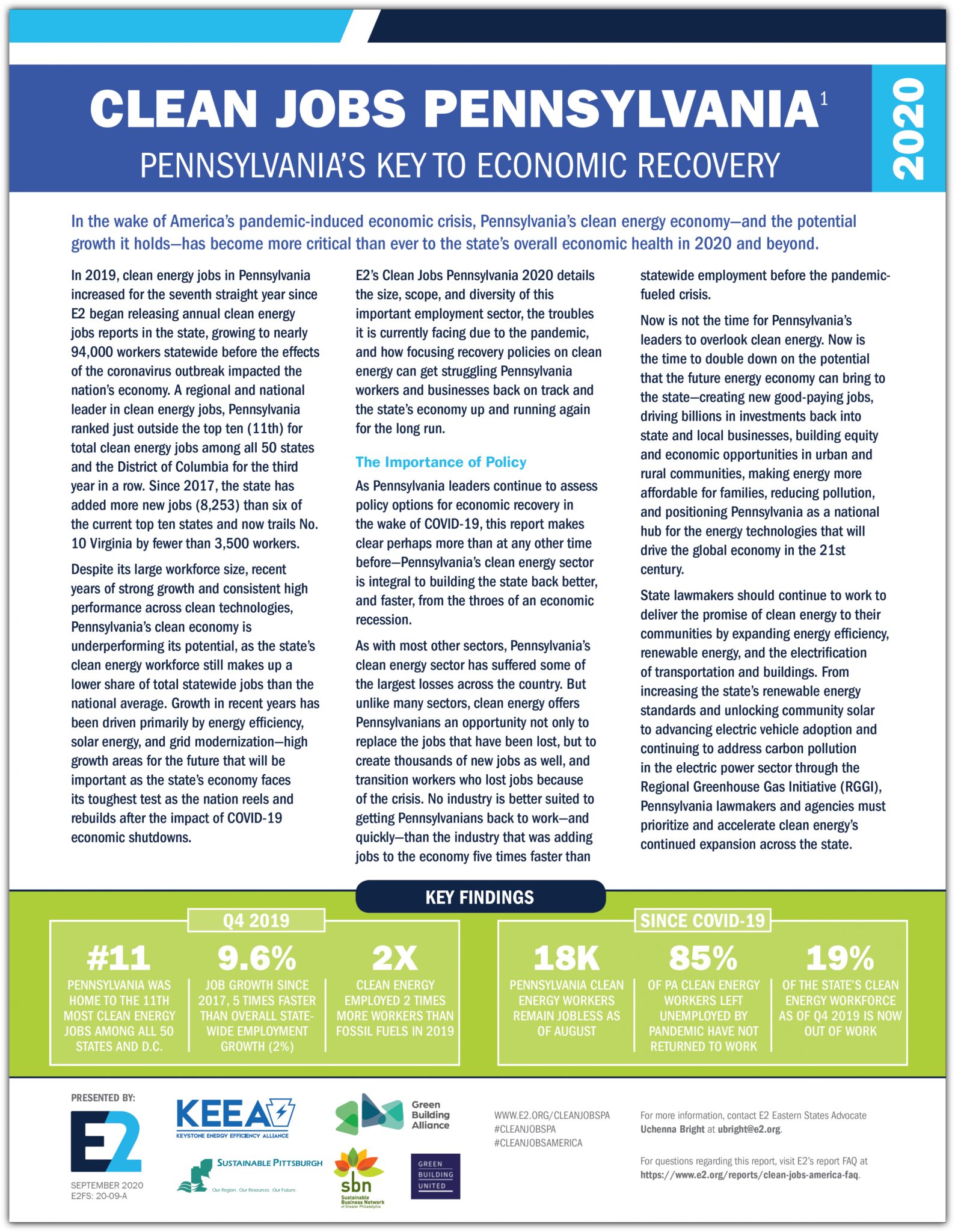
In 2019, clean energy jobs in Pennsylvania increased for the seventh straight year since E2 began releasing annual clean energy jobs reports in the state, growing to nearly 94,000 workers statewide before the effects of the coronavirus outbreak impacted the nation’s economy. A regional and national leader in clean energy jobs, Pennsylvania ranked just outside the top ten (11th) for total clean energy jobs among all 50 states and the District of Columbia for the third year in a row. Since 2017, the state has added more new jobs (8,253) than six of the current top ten states and now trails No. 10 Virginia by fewer than 3,500 workers.

Despite its large workforce size, recent years of strong growth and consistent high performance across clean technologies, Pennsylvania’s clean economy is underperforming its potential, as the state’s clean energy workforce still makes up a lower share of total statewide jobs than the national average. Growth in recent years has been driven primarily by energy efficiency, solar energy, and grid modernization—high growth areas for the future that will be important as the state’s economy faces its toughest test as the nation reels and rebuilds after the impact of COVID-19 economic shutdowns.

E2, the Keystone Energy Efficiency Alliance (KEEA), the Green Building Alliance (GBA), Green Building United, the Sustainable Business Network of Greater Philadelphia, and Sustainable Pittsburgh’s Clean Jobs Pennsylvania 2020 details the size, scope, and diversity of this important employment sector, the troubles it is currently facing due to the pandemic, and how focusing recovery policies on clean energy can get struggling Pennsylvania workers and businesses back on track and the state’s economy up and running again for the long run.

INDUSTRY JOB TOPLINES | Q4 2019

  • Energy Efficiency – 71,443 jobs
  • Renewable Energy – 9,744 jobs
    • Solar Energy – 5,173 jobs
    • Wind Energy – 2,937 jobs
  • Clean Vehicles – 7,541 jobs
  • Clean Storage – 1,770  jobs
  • Grid Modernization – 1,929  jobs
  • Clean Fuels – 1,436 jobs
  • ALL Clean Energy Sectors – 93,861 jobs

DOWNLOAD

The complete report is available for download at this link.

Looking for More Info?

The analysis expands on data from the 2020 U.S. Energy and Employment Report (USEER) produced by the Energy Futures Initiative (EFI) in partnership with the National Association of State Energy Officials (NASEO), using data collected and analyzed by the BW Research Partnership. The report was released in March 2020and is available at www.usenergyjobs.org. E2 is a partner on the USEER, the fifth installment of the energy survey first released by the Department of Energy in 2016 and subsequently abandoned under the Trump administration. Clean energy jobs have grown every year since the first report was released in 2016.

If you are looking for additional insight into E2’s Clean Jobs Pennsylvania 2020 or our other Clean Jobs America reports, visit e2.org/reports. You can also contact E2 Communications Director Michael Timberlake ([email protected]). An FAQ is also available here to answer any questions.

PAST CLEAN JOBS PENNSYLVANIA REPORTS

Clean Jobs Pennsylvania 2020 is the 5th statewide clean energy jobs report from E2. Previous reports can be accessed in the below links.

E2 MONTHLY UNEMPLOYMENT REPORTS

View Report »

Report: Clean Energy Employed 94,000 in PA Before Pandemic, 50K More than Fossil Fuels

PA was home to 11th most clean energy jobs before COVID-19 Jobs in renewables grew 11.8% from 2017-2019 as natural gas employment dropped 10% 18,000 jobs lost since COVID-19, wiping out 19% of industry’s workforce Pittsburgh (September 23, 2020) – Led by strong growth in solar energy, grid modernization, and energy efficiency, Pennsylvania added more […]

VERGE 20 Conference

Climate change is the most significant global threat we face today. It also represents an unprecedented opportunity to build a clean economy by electrifying and decarbonizing our world, equitably and profitably. Momentum is building as businesses and governments transform their organizations to be more efficient and resilient. The VERGE 20 online event is the leading […]

Clean Jobs Pennsylvania: Pennsylvania’s Key to Economic Recovery

Please join E2 to examine the findings of our just-released Clean Jobs Pennsylvania 2020 report. Our discussion will outline how 2019 marked the seventh straight year of growth in Pennsylvania clean energy jobs and why clean energy has the greatest potential to support future economic growth as we recover from the job losses suffered as […]

Clean Energy & COVID-19 Crisis | August 2020 Unemployment Analysis

Date: September 14, 2020

Clean Energy Unemployment Claims in COVID-19 Aftermath, August 2020

Nearly a half-a-million (490,300) clean energy employees remain out of work since the COVID-19 pandemic began in March.  Unfortunately for the clean energy sector, July’s anemic job growth continued through August as the sector added just 13,600 jobs in August,  according to the latest analysis of unemployment data by BW Research for E2, E4TheFuture, and the American Council on Renewable Energy (ACORE).

The 0.5% increase in jobs still leaves over 14% of the U.S. clean energy workforce unemployed despite widespread re-openings continuing and expanding across dozens of states. While August represents the third straight month of job growth for the industry after three months of devastating job losses, only one out of five jobs lost has returned while 23 states saw fewer than 100 added clean energy jobs in August.

Incorporating July’s revised figure of 10,400 added jobs, the sector’s current rate of growth since June’s short-lived surge when nationwide reopenings began is below job growth projections for 2020 before COVID-19. According to employer surveys conducted in late 2019, clean energy employers nationwide expected to add nearly 178,000 jobs in 2020 — or 14,800 every month.

While the August report shows some signs of growth, weekly unemployment claims remain at historic highs, and long-term and permanent unemployment rates continue to rise. With federal Paycheck Protection Program (PPP) funds all but exhausted, more layoffs could be imminent without congressional action.

Before March, clean energy had been one of the U.S. economy’s biggest and fastest-growing employment sectors, growing 10.4% since 2015 to 3.4 million jobs at the end of 2019. That made clean energy by far the biggest employer of workers in all energy occupations, employing nearly three times as many people as the fossil fuel industry.

By Industry Job Losses, August 2020

Sector March  April  May   June  July August Total 
Energy Efficiency -103,298 -309,584 -18,880 71,786 6,836 8,116 -345,024
Renewables -23,739 -71,705 -4,272 17,287 1,918 2,571 -77,942
Clean Vehicles -11,399 -35,070 -2,059 10,335 896 2,182 -35,116
Grid & Storage -6,517 -19,666 -1,166 4,561 428 482 -21,878
Clean Fuels -2,186 -10,390 -657 2,351 296 205 -10,381
INDUSTRY TOTAL -147,139 -446,416 -27,035 106,320 10,373 13,556 -490,341

States With Most Job Losses, August 2020

State Total Losses Percent of Clean Energy Workforce
California 84,439 15.30%
Georgia 27,058 31.30%
Florida 25,650 15.30%
Michigan 23,871 18.00%
Texas 23,406 9.50%
North Carolina 20,157 17.60%
Pennsylvania 18,290 18.80%
Washington 17,979 20.20%
Ohio 15,965 13.80%
New York 15,674 9.60%

Download

For a full breakdown of clean energy jobs losses in each state, download the full analysis here

Looking for More Info?

The analysis expands on data from the 2020 U.S. Energy and Employment Report (USEER) produced by the Energy Futures Initiative (EFI) in partnership with the National Association of State Energy Officials (NASEO), using data collected and analyzed by the BW Research Partnership. The report was released in March 2020 and is available at www.usenergyjobs.org. E2 is a partner on the USEER, the fifth installment of the energy survey first released by the Department of Energy in 2016 and subsequently abandoned under the Trump administration.

If you are looking for additional insight into this report or E2’s more than a dozen other annual clean energy employment reports, visit e2.org/reports. You can also contact E2 Communications Director Michael Timberlake ([email protected]).

Sign-Up for Email Updates

"*" indicates required fields

This field is for validation purposes and should be left unchanged.

View Report »

Nearly 500K Clean Energy Workers Remain Out of Work After Only 13K Jobs Returned in August

14% of clean energy workforce still jobless as industry nears slow season August growth rate far below 2020 projections made before COVID-19 WASHINGTON (September 14, 2020) – After three months of lackluster job growth, nearly 500,000 U.S. clean energy workers (490,341) remain jobless as the sector struggles to recover. Just 13,600 jobs were added in […]

Report: Clean Energy Employed 62,400 Coloradans in 2019

CO clean energy jobs grew 2X faster than overall statewide employment 25% of Mountain West’s clean energy jobs were in Colorado in 2019 Nearly 6,000 jobs lost since COVID-19, wiping out 9% of industry’s jobs DENVER (September 9, 2020) – Led by strong growth in solar energy, grid modernization, battery storage, and energy efficiency, Colorado […]

Clean Jobs Colorado 2020

Date: September 9, 2020

Clean Energy Trends & Insights for a Post-Coronavirus Recovery

Clean energy jobs in Colorado increased by more than 4% for the second year in a row, growing to 62,400 workers statewide at the end of 2019 ­before the COVID-19 pandemic rattled the nation’s – and Colorado’s economy. As the Mountain West’s leader in clean energy jobs, Colorado ranked in the top 20 for clean energy jobs among all 50 states and the District of Columbia.

Since 2017, the state has added more new jobs (5,400) than ten of the current top 20 states for overall clean energy jobs. Today, about one in every 50 jobs in Colorado is in a clean energy occupation.

As Colorado leaders continue to assess policy options for economic recovery in the wake of COVID-19, this report sets out to illustrate why the state’s once-booming clean energy economy is more critical to the future of Colorado’s economy than ever before and needs to be prioritized if the state wants to not only recover but thrive in the post-coronavirus economy.

E2 and COSSA’s Clean Jobs Colorado 2020 details the size, scope, and diversity of this important employment sector, the troubles it is currently facing due to the pandemic and how focusing recovery policies on clean energy can get Colorado workers and businesses back on track and the state’s economy up and running again for the long run.

INDUSTRY JOB TOPLINES | Q4 2019

  • Energy Efficiency – 36,092 jobs
  • Renewable Energy – 17,924 jobs
    • Solar Energy – 8,355 jobs
    • Wind Energy – 7,509 jobs
  • Clean Vehicles – 3,212 jobs
  • Clean Storage – 1,704  jobs
  • Grid Modernization – 1,369 jobs
  • Clean Fuels – 2,120 jobs
  • ALL Clean Energy Sectors – 62,420 jobs

DOWNLOAD

The complete report is available for download at this link.

Looking for More Info?

The analysis expands on data from the 2020 U.S. Energy and Employment Report (USEER) produced by the Energy Futures Initiative (EFI) in partnership with the National Association of State Energy Officials (NASEO), using data collected and analyzed by the BW Research Partnership. The report was released in March 2020and is available at www.usenergyjobs.org. E2 is a partner on the USEER, the fifth installment of the energy survey first released by the Department of Energy in 2016 and subsequently abandoned under the Trump administration. Clean energy jobs have grown every year since the first report was released in 2016.

If you are looking for additional insight into E2’s Clean Jobs Colorado 2020 or our other Clean Jobs America reports, visit e2.org/reports. You can also contact E2 Communications Director Michael Timberlake ([email protected]). An FAQ is also available here to answer any questions.

PAST CLEAN JOBS COLORADO REPORTS

Clean Jobs Colorado 2020 is the 5th statewide clean energy jobs report from E2. Previous reports can be accessed in the below links.

View Report »

Report: Pandemic wiped away Colorado’s clean jobs gains

E2 reported that 22% of the clean energy workforce in the Denver-Aurora area became unemployed, through an examination of unemployment claims. Nearly 84% of the total clean energy jobs in Colorado were in the efficiency and renewable energy fields. Professional services and construction were the most prevalent types of occupation.

Virtual Briefing: E2’s Clean Jobs Report Release

E2 (Environmental Entrepreneurs) and the Grand Junction Cleantech Business Coalition invite you to be the first to learn about E2’s 2020 Clean Jobs Colorado report, the latest, most comprehensive analysis of the state’s clean energy and energy efficiency workforce. As Colorado and Grand Junction wrestle with the coronavirus and its impact on jobs and the economy, learn […]

Sign Up for Email Updates


"*" indicates required fields

This field is for validation purposes and should be left unchanged.

Our Latest Press Releases


Releases

REPORT: Colorado clean energy sector grew by 4 percent, added 2K jobs in 2024

DENVER, CO (Dec. 10, 2025) – Clean energy jobs grew more than five times faster in Colorado than the rest of the state's economy in 2024, raising the total number of clean energy workers in the state to 69,859 – 18th most in the country – according to the s...


Releases

STATEMENT: Federal Rollback of Auto Fuel Efficiency Standards Will Increase Costs for Consumers, Businesses

The National Highway Traffic Safety Administration (NHTSA) is expected to announce the Administration’s intent to weaken federal Corporate Average Fuel Economy (CAFE) standards for vehicles. Such a dramatic shift in policy would halt five decades of progres...


Releases

Companies Cancel $4.4 Billion in Clean Energy Projects; $28 Billion, 30K Jobs Lost in 2025

WASHINGTON –Businesses canceled, closed, and scaled back more than $4.4 billion worth of large-scale factories and clean energy projects from late-September through October, bringing the total cost of projects cancelled in the private-sector to over $28.7 b...


Donate Today