Archives
E2 STATEMENT: Illinois General Assembly Passes Clean and Reliable Grid Affordability Act (CRGA Act), Solidifies State as a Clean Energy Leader, Bringing Billions in Benefits to Businesses & Residents
SPRINGFIELD (Oct. 31, 2025) – As of last night, both chambers of the Illinois General Assembly passed the Clean and Reliable Grid Affordability (CRGA) Act, a major milestone for clean energy. The bill now awaits the signature of Governor JB Pritzker, a supporter of the legislation. The energy omnibus is expected to deliver billions of […]
Co-op and Condo Green Retrofits Are Good for the Environment — and the Economy.
“Especially in New York City, buildings, particularly existing buildings, are one of our big challenges,” Uchenna Bright says. “Decarbonization and energy efficiency are still very much a huge market within the city, and there’s still a lot more work to be done there.”
Electric Trucks Are Just The Start. Congress, Let’s Get Rolling.
Electric pickup trucks are cool. But when it comes to building a cleaner economy and creating the jobs and other economic opportunities that come with it, so are heat pumps, Energy Star appliances and climate finance, the Biden administration showed this week. While up in Michigan the biggest game-changing electric vehicle since Tesla — the Ford F-150 Lightning — stole the […]
Achieving California’s Clean Energy Targets: Where The Rubber Meets The Road
WHAT Profound change is afoot in the quest to meet California’s ambitious decarbonization targets and our state’s electric grid is a critical lynchpin; delivering zero-carbon electricity to California citizens and businesses is critical as we work to power our industries, buildings, and transportation sector with clean electricity. Realizing 100% clean energy and statewide carbon neutrality […]
How We Decarbonize California’s Buildings
California’s building sector is responsible for a quarter of the state’s greenhouse gas emissions and decarbonizing our built environment presents a critical opportunity ripe for climate action. Over the last few years, state policymakers have made progress in tamping down building emission across California. And at the local level more than 40 cities and counties […]
Biden’s first 100 days: What’s coming on energy
Clean business group E2 echoed many of those proposals, along with an administration measure that encourages federal procurements of clean energy technologies. “As we look to the first 100 days of the administration, it is essential that President Biden follow through on his commitment to make clean energy the cornerstone of COVID-19 recovery efforts,” wrote […]
Energy Efficiency Jobs in America: 2020

America’s Largest Energy Sector is Poised to Power U.S. Recovery.
Energy Efficiency (EE)—the largest U.S. energy sector—can repower America’s economy as we work to overcome the economic effects of the pandemic. As lawmakers and policymakers seek to get America back to work after the COVID-19 health and economic crisis, every job matters. From 2015 to 2019, the energy efficiency sector became one of the biggest, fastest-growing, and most beneficial sectors for both our economy and our environment.
This report details the size of this important employment sector, the troubles it is facing due to COVID-19, and how focusing recovery policies on efficiency can help boost America’s economy— quickly and for the long run.
The 20210 Energy Efficiency Jobs in America report includes an 11-page national summary and individual factsheets for all 50 U.S. states and the District of Columbia that include more detailed findings including job totals for every congressional and legislative district, industry and technology breakdowns, and maps of every state’s top counties.
This annual report focuses solely on the energy sector of the economy. Jobs in retail trade, vehicle efficiency-related work, and the 4.2 million jobs related to efficient manufacturing processes are excluded from these numbers.
Download
To download the national summary, click here or the report cover above.
For all 51 individual factsheets, visit https://ee.e4thefuture.org/ or .
Previous Reports
- 2019 | Energy Efficiency Jobs in America
- 2018 | Energy Efficiency Jobs in America
- 2016 | Energy Efficiency Jobs in America
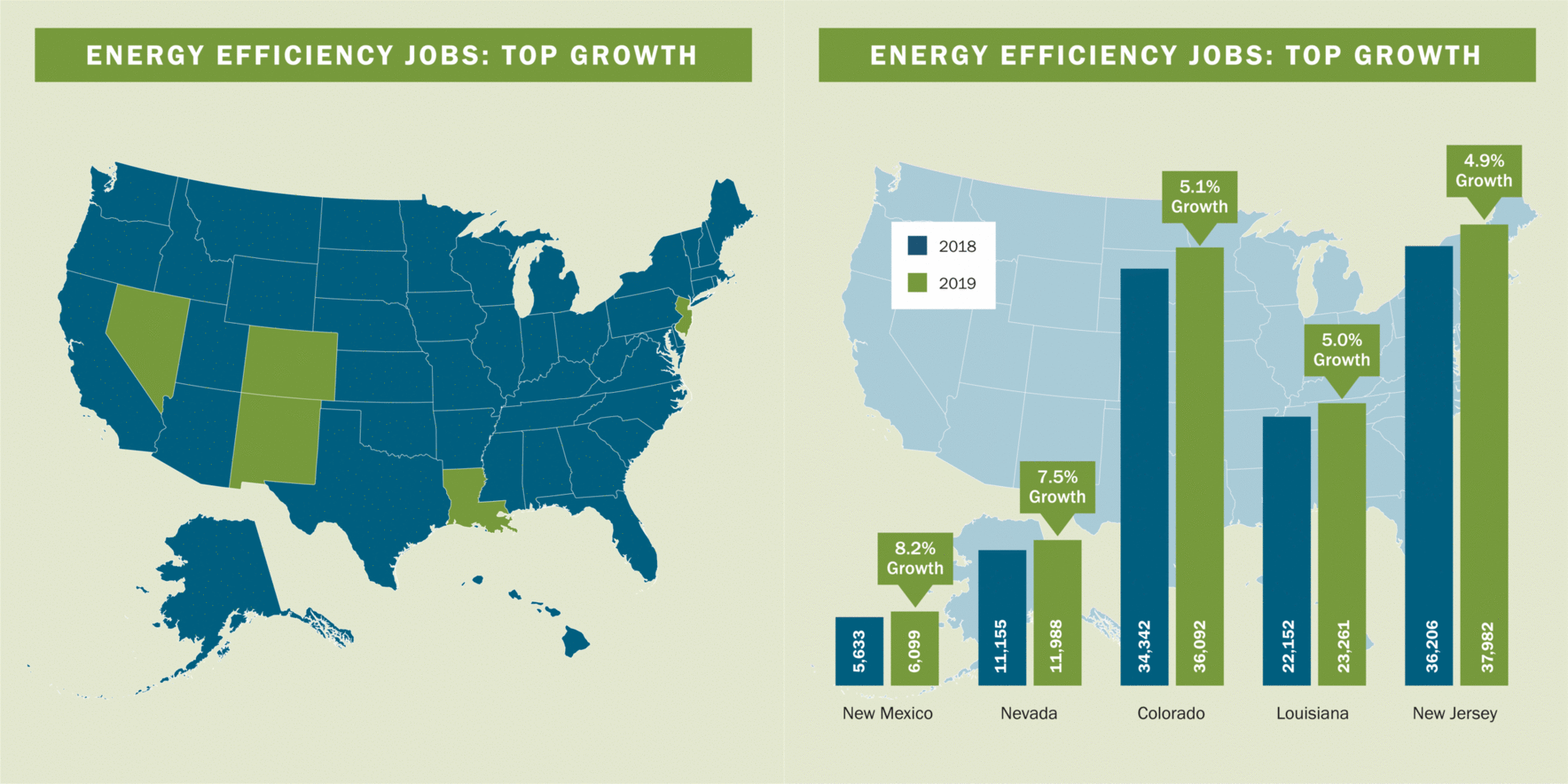
AMERICA’S TOP 10 STATES | 2019 Energy Efficiency Jobs

QUESTIONS & FAQ
For questions on this report, methodology, reported job numbers, or requests for specific additional data, email E2 Communications Director Michael Timberlake ([email protected]). An FAQ for the report, including answers to questions on methodology, is available here.
LOOKING FOR MORE?
If you are looking for additional insight into E4TheFuture and E2’s other research and publications on the energy economy, visit E4TheFuture’s Publications homepage or E2’s Reports homepage.
This report follows E2’s Clean Jobs America analysis which found the clean energy jobs account for nearly 3.4 million jobs across all 50 states and the District of Columbia. Both reports expand on data from the U.S. Energy and Employment Report (USEER) produced by the Energy Futures Initiative (EFI) in partnership with the National Association of State Energy Officials (NASEO), using data collected and analyzed by the BW Research Partnership. E2 and E4TheFuture is a partner on the USEER, the fifth installment of the energy survey first released by the Department of Energy in 2016.
View Report »Energy Efficiency Led US Energy Job Growth in 2019, is Best Bet to Lead Sector’s Recovery in 2021
28% of energy sector workers are in energy efficiency, 2X more than fossil fuels Entry-level wages in all sectors well exceed the national average 700,000 new jobs per year for 5 years could be created by $61 billion targeted stimulus WASHINGTON DC (November 19, 2020) – Energy efficiency — which led U.S. energy-sector job growth […]
Clean Jobs Pennsylvania 2020
Pennsylvania’s Key To Economic Recovery
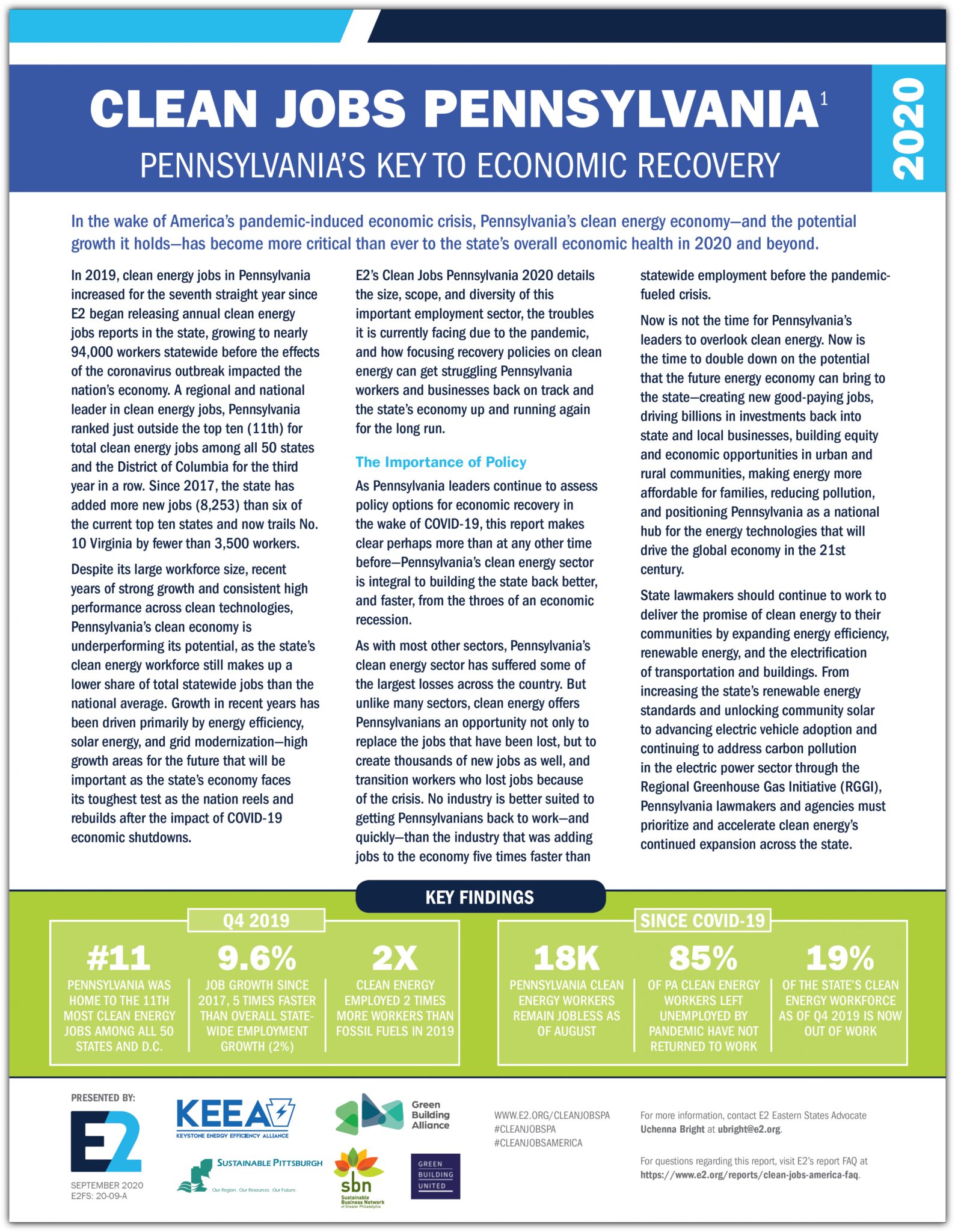
In 2019, clean energy jobs in Pennsylvania increased for the seventh straight year since E2 began releasing annual clean energy jobs reports in the state, growing to nearly 94,000 workers statewide before the effects of the coronavirus outbreak impacted the nation’s economy. A regional and national leader in clean energy jobs, Pennsylvania ranked just outside the top ten (11th) for total clean energy jobs among all 50 states and the District of Columbia for the third year in a row. Since 2017, the state has added more new jobs (8,253) than six of the current top ten states and now trails No. 10 Virginia by fewer than 3,500 workers.
Despite its large workforce size, recent years of strong growth and consistent high performance across clean technologies, Pennsylvania’s clean economy is underperforming its potential, as the state’s clean energy workforce still makes up a lower share of total statewide jobs than the national average. Growth in recent years has been driven primarily by energy efficiency, solar energy, and grid modernization—high growth areas for the future that will be important as the state’s economy faces its toughest test as the nation reels and rebuilds after the impact of COVID-19 economic shutdowns.
E2, the Keystone Energy Efficiency Alliance (KEEA), the Green Building Alliance (GBA), Green Building United, the Sustainable Business Network of Greater Philadelphia, and Sustainable Pittsburgh’s Clean Jobs Pennsylvania 2020 details the size, scope, and diversity of this important employment sector, the troubles it is currently facing due to the pandemic, and how focusing recovery policies on clean energy can get struggling Pennsylvania workers and businesses back on track and the state’s economy up and running again for the long run.
INDUSTRY JOB TOPLINES | Q4 2019
- Energy Efficiency – 71,443 jobs
- Renewable Energy – 9,744 jobs
- Solar Energy – 5,173 jobs
- Wind Energy – 2,937 jobs
- Clean Vehicles – 7,541 jobs
- Clean Storage – 1,770 jobs
- Grid Modernization – 1,929 jobs
- Clean Fuels – 1,436 jobs
- ALL Clean Energy Sectors – 93,861 jobs
DOWNLOAD
The complete report is available for download at this link.
Looking for More Info?
 The analysis expands on data from the 2020 U.S. Energy and Employment Report (USEER) produced by the Energy Futures Initiative (EFI) in partnership with the National Association of State Energy Officials (NASEO), using data collected and analyzed by the BW Research Partnership. The report was released in March 2020and is available at www.usenergyjobs.org. E2 is a partner on the USEER, the fifth installment of the energy survey first released by the Department of Energy in 2016 and subsequently abandoned under the Trump administration. Clean energy jobs have grown every year since the first report was released in 2016.
If you are looking for additional insight into E2’s Clean Jobs Pennsylvania 2020 or our other Clean Jobs America reports, visit e2.org/reports. You can also contact E2 Communications Director Michael Timberlake ([email protected]). An FAQ is also available here to answer any questions.
PAST CLEAN JOBS PENNSYLVANIA REPORTS
Clean Jobs Pennsylvania 2020 is the 5th statewide clean energy jobs report from E2. Previous reports can be accessed in the below links.
- Clean Jobs Pennsylvania 2019
- Clean Jobs Pennsylvania 2018
- Clean Jobs Pennsylvania 2017
- Clean Jobs Pennsylvania 2016
E2 MONTHLY UNEMPLOYMENT REPORTS
- Clean Energy & COVID-19 Economic Crisis | March 2020 Impact Analysis
- Clean Energy & COVID-19 Economic Crisis | April 2020 Impact Analysis
- Clean Energy & COVID-19 Economic Crisis | May 2020 Impact Analysis
- Clean Energy & COVID-19 Economic Crisis | June 2020 Impact Analysis
- Clean Energy & COVID-19 Economic Crisis | July 2020 Impact Analysis
- Clean Energy & COVID-19 Economic Crisis | August 2020 Impact Analysis
PASSED: AB841 Puts Thousands of Unemployed Clean Energy Employees Back to Work
Newly passed bill is type of policy California “needs to help its economic recovery” SACRAMENTO (September 1, 2020) – Late Monday night, the California legislature passed AB 841, a bill that swill streamline millions in investments to expand California’s electric vehicle (EV) charging infrastructure and make improvements to school energy efficiency upgrades. Following is a […]