Clean Jobs North Carolina 2023

Date: November 2, 2023

Summary

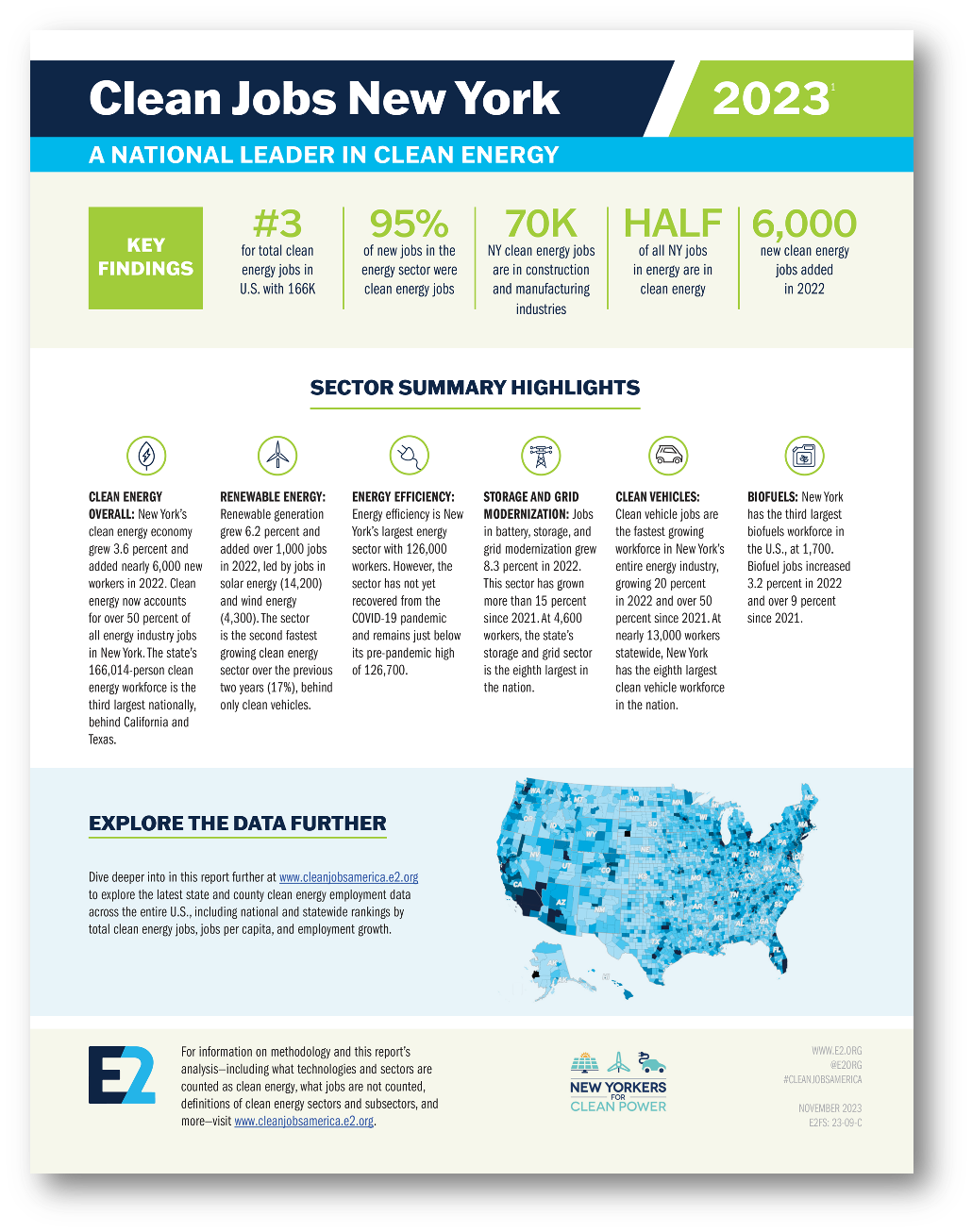
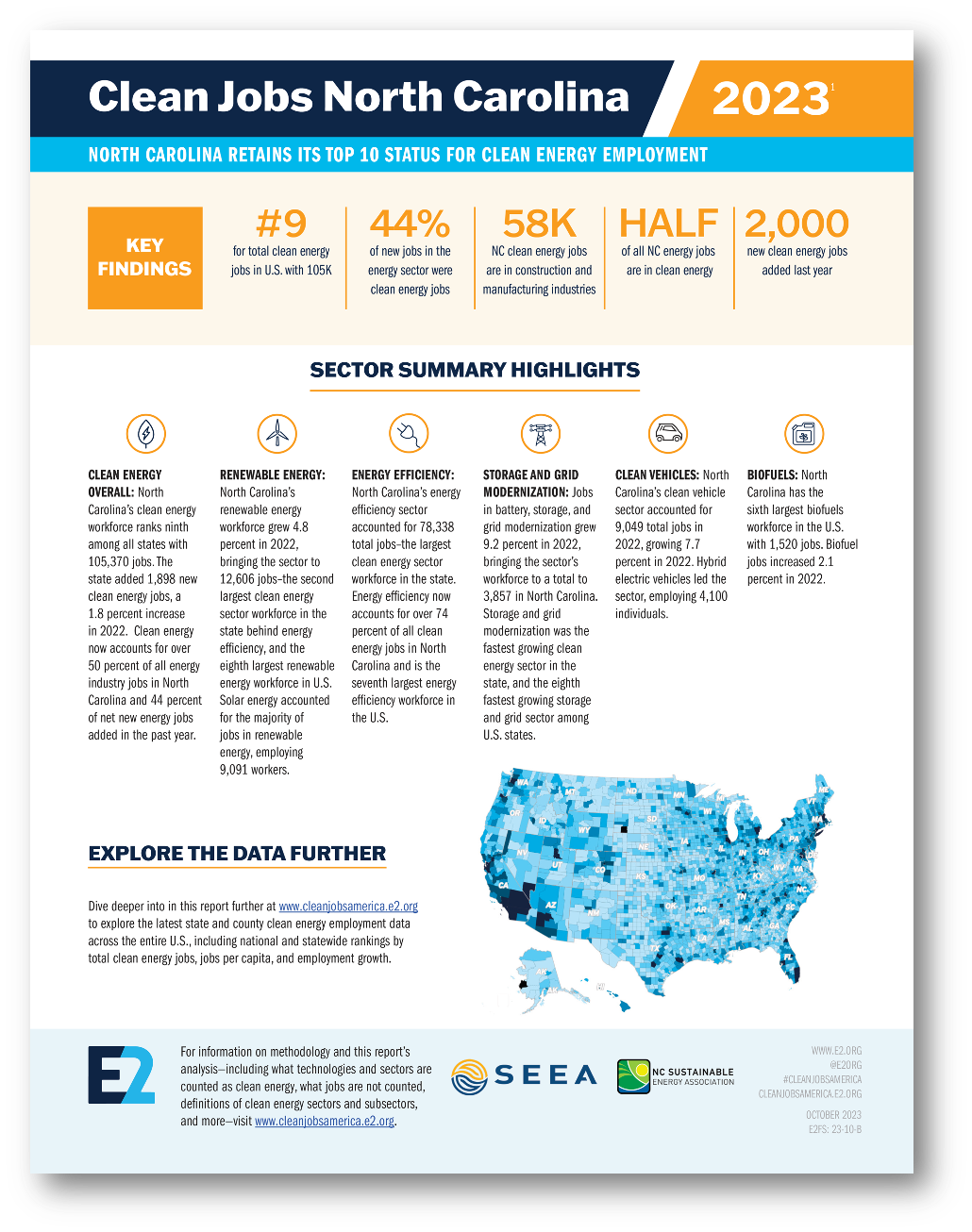
North Carolina’s clean energy workforce ranks ninth among all states with 105,370 jobs. The state added 1,898 new clean energy jobs, a 1.8 percent increase in 2022. Clean energy now accounts for over 50 percent of all energy industry jobs in North Carolina and 44 percent of net new energy jobs added in the past year. 

  • RENEWABLE ENERGY: North Carolina’s renewable energy workforce grew 4.8 percent in 2022, bringing the sector to 12,606 jobs–the second largest clean energy sector workforce in the state behind energy efficiency, and the eighth largest renewable energy workforce in U.S. Solar energy accounted for the majority of jobs in renewable energy, employing 9,091 workers. 
  • ENERGY EFFICIENCY: North Carolina’s energy efficiency sector accounted for 78,338 total jobs–the largest clean energy sector workforce in the state. Energy efficiency now accounts for over 74 percent of all clean energy jobs in North Carolina and is the seventh largest energy efficiency workforce in the U.S.
  • STORAGE AND GRID MODERNIZATION: Jobs in battery, storage, and grid modernization grew 9.2 percent in 2022, bringing the sector’s workforce to a total to 3,857 in North Carolina. Storage and grid modernization was the fastest growing clean energy sector in the state, and the eighth fastest growing storage and grid sector among U.S. states.
  • CLEAN VEHICLES: North Carolina’s clean vehicle sector accounted for 9,049 total jobs in 2022, growing 7.7 percent in 2022. Hybrid electric vehicles led the sector, employing 4,100 individuals. 
  • BIOFUELS: North Carolina has the sixth largest biofuels workforce in the U.S. with 1,520 jobs. Biofuel jobs increased 2.1 percent in 2022.
This field is for validation purposes and should be left unchanged.

Previous Reports

Clean Jobs North Carolina 2023 is the 5th clean energy jobs report for North Carolina from E2. Previous reports can be accessed in the below links.

Background

This is the fifth annual Clean Jobs North Carolina report produced by E2 based on analysis of the 2023 U.S. Energy and Employment Report (USEER), which was first released by the Department of Energy (DOE) in 2016. E2 was an original proponent of the DOE producing the USEER and was a partner on the reports produced by the Energy Futures Initiative (EFI) and National Association of State Energy Officials (NASEO) after the Trump administration abandoned it in 2017. For methodology questions, see pages 201-206 of the 2023 USEER.

For additional insight into E2’s Clean Jobs North Carolina or our other annual clean energy economic reports, visit e2.org/reports.

An FAQ is available at e2.org/reports/clean-jobs-america-faq.

View Report »

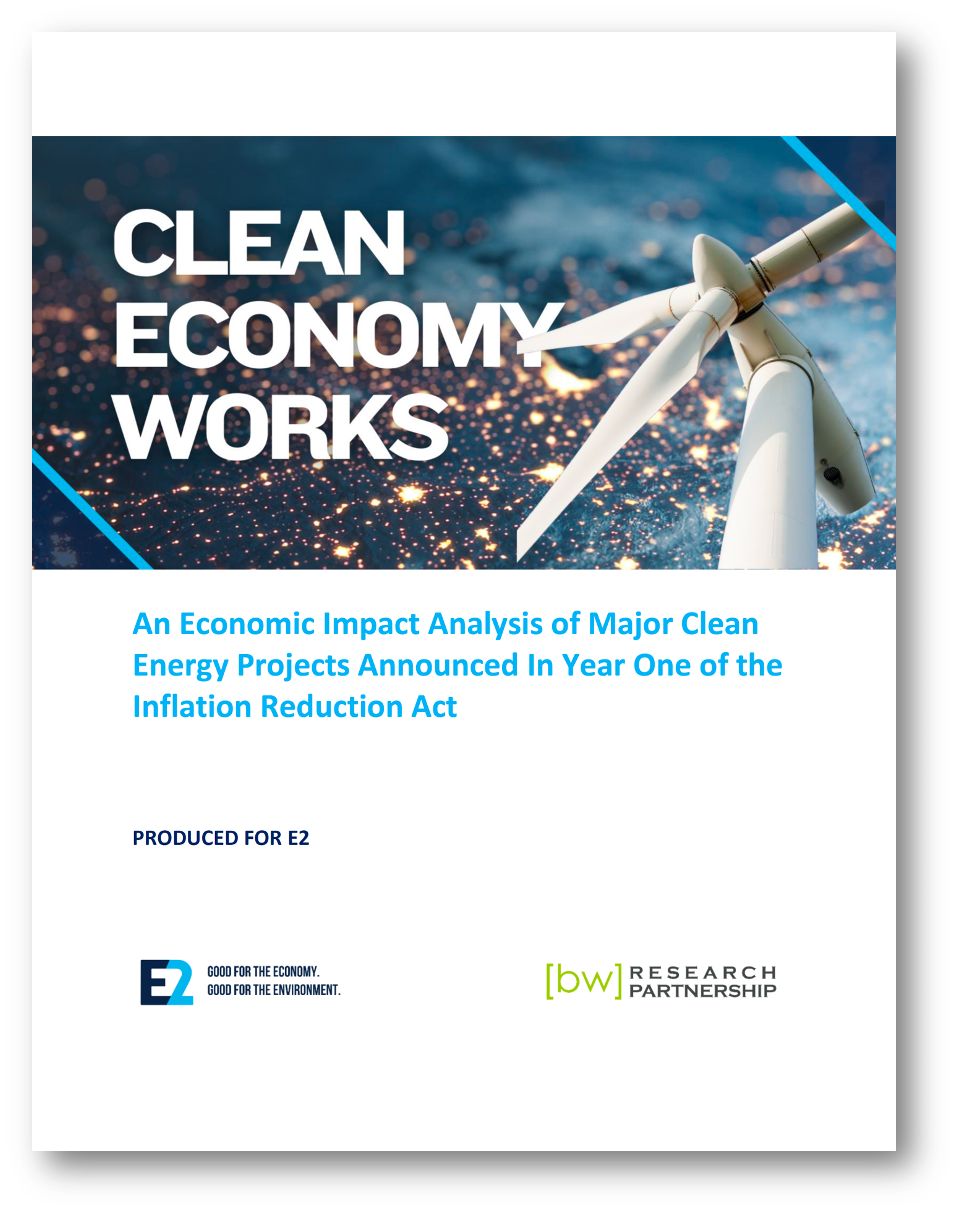
Clean Economy Works | An Economic Impact Analysis of Major Clean Energy Projects Announced In Year One of the Inflation Reduction Act

Date: November 1, 2023

Summary:

This analysis uses the original $86 billion in estimated capital expenditures that companies announced in investments for new developments and extrapolates another $20 billion in additional capital expenditures for project announcements that did not include a dollar amount or required an updated estimate based on available information. In addition to the direct benefits of these expenditures, new modeling from BW Research measures the broader economic benefits and the multiplier effect of the investments and jobs expected if the 210 announced projects were completed over the next five years.

When these broader economic benefits are factored in, BW’s modeling expects 403,000 new jobs—including nearly 100,000 permanent jobs—would be created and supported throughout the economy, $156 billion added to U.S. GDP, $111 billion in new wages for workers, and more than $32 billion generated in tax revenue for federal, state, and local governments. These benefits will continue long after the projects are built. For more details, see Key Findings below.

These secondary economic benefits are far-reaching. When new clean energy projects and clean vehicle factories and thousands of new jobs come to a community, local restaurants sell more meals. Schools, police departments and local public works projects benefit from increases in local tax revenues. Local manufacturers and wholesalers sell more goods to feed the growing local supply chain. And small businesses such as accounting firms, construction contractors, landscaping companies and caterers see new revenue streams.

Together, these direct and indirect jobs and investments tell a nationwide story of opportunity for domestic manufacturing, clean energy production, transportation and infrastructure modernization and American ingenuity, thanks to the clean energy incentives and investments made possible by the IRA.

They are also just the beginning as E2 continues to track new projects being announced every month

This field is for validation purposes and should be left unchanged.

Key Findings

This modeling shows that (if all projects are completed) the 210 major projects tracked by E2 between August 2022-August 2023 will create or support more than 400,000 jobs, including 303,500 construction jobs each year during construction and another 99,600 jobs each year after that.

These private-sector investments and jobs will add $155.5 billion to the nation’s GDP while the projects are under construction, and another $13.1 billion annually once they are up and running.

Additionally, these projects will result in $32.5 billion in new tax revenues for federal, state, and local governments while under construction, and an additional $2.9 billion annually after that.

COMBINED JOBS, WAGE, TAX AND GDP IMPACTS OF MAJOR CLEAN ENERGY PROJECTS ANNOUNCED IN FIRST YEAR OF THE IRA

TOTAL INVESTMENTS INTO AND ANNUAL JOBS SUPPORTED BY CLEAN ENERGY PROJECTS, DETAILED BY ENERGY SECTOR

Sector Total Construction Phase Jobs (Annual jobs for 5 years) Annual Operations Phase Jobs (Annual jobs for lifetime of projects) Sector Announced Capital Investment ($billions) Extrapolated Capital Investment ($billions) Total Capital Investment ($billions) Annual Operational Investment ($billions)
Solar 35,054 12,139 Solar $10.21 $1.94 $12.15 $1.35
Wind 7,046 5,933 Wind $1.64 $1.18 $2.82 $0.76
EV 185,673 54,500 EV $56.06 $5.52 $61.58 $6.16
Electric T&D 5,565 2,035 Electric T&D $1.46 $0.51 $1.97 $0.27
Battery Storage 48,795 13,633 Battery Storage $12.19 $5.61 $17.80 $1.90
Clean Fuels 21,322 11,342 Clean Fuels $5.09 $4.99 $10.08 $0.83
Total 303,455 99,584 Total Capital Investment $86.66 $19.74 $106.40 $11.27

Methodology

This analysis provides a thorough economic prediction of the impacts of the 210 announcements by filling in the gaps of publicly announced information. Modeled impacts differ from initial estimates offered by companies announcing new projects, tracked by E2. Fifty-six of the 210 announcements provided no capital investment estimate and sixty-eight provided no job creation estimate. Additionally, those estimates were inconsistently defined, lacking clarity on if they are direct jobs only or direct, indirect, and induced jobs, and if they were for construction or permanent positions.

To analyze these economic impacts from the clean energy programs and policies in the IRA, BW Research used IMPLAN economic modeling software to estimate the overall economic benefits from publicly sourced clean energy project announcements. BW Research developed a dozen economic impact models in total to represent six tracked sectors: Solar, Wind, Electric Vehicle (EV), Electricity Transmission & Distribution (Electric T&D), Battery Storage, and Clean Fuels. Based on this common methodology and assumptions, BW generated outputs at the national level, including earnings, tax revenue, employment and overall GDP value add.

For more information on methodology, see Appendix B in the report. For the list of all 210 projects tracked by E2 in the first year of the IRA, see Appendix C.

For the latest full list of clean energy job announcements tracked by E2, visit https://e2.org/announcements.

About E2

E2 is a national, nonpartisan group of business leaders, investors, and professionals from every sector of the economy who advocate for smart policies that are good for the economy and good for the environment. E2 members have founded or funded more than 2,500 companies, created more than 600,000 jobs, and manage more than $100 billion in venture and private equity capital.

For additional insight into E2’s other reports, visit e2.org/reports.

View Report »

Energy Efficiency Jobs In America 2023

Date: October 13, 2023

2.2+ MILLION AMERICANS WORK IN ENERGY EFFICIENCY

Summary

The stage is set for historic investments in energy efficiency (EE) to extend across all sectors of the U.S. economy, underscoring efficiency’s crucial role in addressing the serious pollution impacts of our built environment. To achieve U.S. climate goals, the EE workforce — already the largest

in the clean energy industry — must grow significantly. Prioritizing EE workforce development in every state is essential to meeting the demands of this moment and creating a more diverse workforce.

In construction, the largest subsector of workers within EE jobs, training and certifications help to ensure quality building performance. Efficiency construction workers are in high demand, and those with key credentials earn competitive salaries, contributing to better buildings and energy-efficient infrastructure.

This report serves as a baseline by which to measure future EE job growth enabled by large-scale investments, driven by energy policy.

Download

To download the national summary, click here or the report cover above.

For all 51 individual factsheets, visit https://ee.e4thefuture.org/ .

Previous Reports

QUESTIONS & FAQ

For questions on this report, methodology, reported job numbers, or requests for specific additional data, email E2 Communications Director Michael Timberlake ([email protected]). An FAQ for the report, including answers to questions on methodology, is available here.

View Report »

Clean Economy Works September 2023 | 13 New Projects Announced

Date: October 12, 2023

FOCUS: From opposite coasts, projects in green hydrogen, offshore wind jolt U.S. clean economy

From a Silicon Valley startup flush with venture capital to a hulking legacy shipyard in Virginia’s Hampton Roads region, at least 13 major clean energy projects were announced in September from coast to coast. Combined, they include $2.7 billion in private-sector investments that promise to create 6,100 jobs.

Workers speak with Virginia Gov. Glenn Youngkin at Lyon Shipyard. A new investment there will help the company service ships and vessels involved in the state’s fledgling offshore wind industry, creating 134 jobs. (Official Photo by Christian Martinez, Office of Governor Glenn Youngkin)

Out West, a startup called Verdegy announced it is building a 100,000-square-foot green hydrogen electrolyzer manufacturing plant. Founded only two years ago, Verdegy recently closed a $73 million Series B funding round. Now, it wants to double its workforce to service customers in heavy industries like chemicals, fertilizer, steel and e-fuels.

Verdegy said its advanced manufacturing plant could help dramatically scale up the production of electrolyzers that use renewable electricity to split hydrogen from oxygen molecules in water. With the U.S. Treasury Department finalizing guidance on requirements needed to qualify for the Inflation Reduction Act’s “45V” hydrogen tax credits, Verdegy could be poised for even more growth.

Back East, family-owned Lyon Shipyard announced a new $8.5 million investment to help it better serve commercial ships and vessels involved in Virginia’s fledgling offshore wind industry. The Norfolk, Va.-based company, founded in 1928, said its latest investment is expected to create 134 jobs. Lyon’s current job postings include openings for riggers, marine electricians, dockmasters, painters and machinists – creating new opportunities for workers in old-school occupations thanks to the new industry of clean energy.

At a ribbon-cutting ceremony in front of Lyon’s new 900-ton boat lift, Republican Virginia Gov. Glenn Youngkin sounded bullish about offshore wind’s potential. “In this emerging industry….we are going to see a thriving hub of activity,” he said.

The Biden administration seems to agree. It set a goal of developing 30 gigawatts of offshore wind capacity by 2030, enough to power more than 10 million homes. While high interest rates and a slowly developing supply chain have stunted industry growth, ports up and down the East Coast are competing to attract domestic offshore wind companies in a sector expected to be worth some $57 billion by the end of the decade.

In addition to green hydrogen and offshore wind, E2 tracked announcements from four other industries: solar, EV, battery and grid/transmission. The month’s largest announcement came from Chinese EV battery company Gotion. At a 150-acre site in Manteno, Ill., Gotion is planning a $2 billion gigfactory expected to create 2,600 jobs, though projects the company has announced in other states have received some pushback. Illinois Gov. JB Prizker called it “the most significant new manufacturing investment in Illinois in decades.”

Since the IRA was signed into law in August 2022, E2 has tracked 234 projects across 40 states representing nearly $91 billion in private-sector investments that could help create more than 80,000 jobs. For a complete rundown of all announcements E2 has tracked, please see here.

SPOTLIGHT: Using AI to help underserved communities address social and environmental issues

NIKHIL BHAMBI

Co-founder / CEO / vice chairperson
Narralytics, Inc
Bakersfield, California

What did you do early in your career?

I abstained from the innate pressures of entering the family business of being a doctor and got into investment banking. But by December 2019, I was burned out and looking to change careers. I intended to pursue a biotech career, but a few months later, COVID upends the world. It was really a period for me to find myself. I started applying to various nonprofits to use skills I gained as an investment banker for good. Eventually, I was volunteering for an environmental health equity think-tank called the Pittsburgh Platform. This was my “Sustainability 101” course.

What motivated you to make climate your career?

One of our team members was talking about the significance of green spaces. I rolled my eyes – how big of a deal can a park be, right? After the call, I looked at a map of urban heating in Richmond, Va. It showed summertime temperature differences between certain regions reached 18 degrees Fahrenheit. Then I realized that map was identical to another one showing Richmond’s formerly redlined neighborhoods. That was a lightbulb moment: Climate change isn’t just an environmental crisis. It’s a social crisis, too.

What did you do next?

I co-founded an early-stage climate tech company called Narralytics. We’re developing an AI-powered software platform that makes it easy, effective and financially compelling for U.S. businesses to use data to measure, report and optimize their social and environmental impacts within underserved communities. We’ve raised $275,000, we’re looking to raise another $500,000, and we’re hoping to commercialize by summer 2024.

What sets your company apart from other data analytics companies?

We record stories in frontline communities. Using enabling technologies like large language models and natural language processing, we take unstructured narratives and turn them into structured data and integrate it with our quantitative insights to ensure our analytics are ultimately contextualized, enriched and validated by the lived experiences of the communities we intend to serve. Our business hypothesis is simple: It’s that who is better to identify and co-develop solutions for systemic inefficiencies than the frontline communities which deal with these issues day-in, day-out.

Where are you piloting your product?

The model is most attuned to cities. Initially, the markets we’re going to be servicing are Watts and Compton, two neighborhoods in southern Los Angeles. But it’s challenging. I’m not a native of those communities, I’m an outsider. Compounding that, I’m representing a data analytics company. A lot of these communities have been poked and prodded by various institutions over the years with little to no change occurring. You have to combat a lot of skepticism.

What do you think about public investments like the IRA and the Justice40 Initiative?

Trillions of dollars will be spent over the next few decades decarbonizing the economy and instituting a just transition. There are probably good ways and less good ways to do that. And robust independent analysis and community engagement can help support better decision-making and allocate capital more efficiently and equitably. We did a line-by-line review of the IRA, and we estimated that in underserved urban communities, there can be as much as $78 billion allocated. That’s huge. It represents a shift in shift in philosophy in how we address the climate crisis.

How so?

The IRA signals something of a shift in U.S. policy away from globalization toward a more nationally focused industrial policy. Since the ’80s, the dominant paradigm has been that free markets and low barriers to international trade are the most effective and efficient way to allocate goods and

services. And it’s a paradigm in which the economy is, in some ways, de-politicized, with markets autonomous and self-correcting. But the last few years three developments have shaken some of this faith in globalization and free markets – COVID, the energy crisis in Europe, and finally the more general push toward supporting domestic industry and reducing outsourcing to countries that may have lower labor costs and labor standards. And I think it’s highly likely that Hamas’s attack on Israel, Iran’s purported backing of that attack, and the growing regional instability will lead to a spike and overall volatility in crude prices, further substantiating a shift toward a more nationally focused industrial policy.

What does this have to do with the IRA?

This means the IRA is poised to spur and accelerate the energy transition. I think the sustainability boom can have the same massive scale of the Industrial Revolution. But due to enabling technologies like artificial intelligence, like the Internet of Things and the prevalence of data, it will happen much more quickly. It will have the speed of the digital age.

TOTAL PROJECTS BY STATE

ALABAMA (6)
Investment: $1.603 billion
Jobs: 1,350
ARKANSAS (2)
Investment: $250 million
Jobs: 500
ARIZONA (8)
Investment: $5.901 billion
Jobs: 2,280
CALIFORNIA (11)
Investment: $1.6 billion
Jobs: 160
COLORADO (7)
Investment: $880 million
Jobs: 2,382
CONNECTICUT (4)
Investment: $24.8 million
Jobs: 100
FLORIDA (2)
Investment: $72 million
Jobs: 250
GEORGIA (21)
Investment: $14.401 billion
Jobs: 13,331
IDAHO (2)
Investment: N/A
Jobs: N/A
ILLINOIS (6)
Investment: $2.064 billion
Jobs: 2,719
INDIANA (7)
Investment: 1,422
Jobs: $2.416 billion
KANSAS (1)
Investment: N/A
Jobs: N/A
KENTUCKY (6)
Investment: $646 million
Jobs: 1,129
LOUISIANA (4)
Investment: $1.214 billion
Jobs: 983
MASSACHUSETTS (6)
Investment: $45.7 million
Jobs: 1,041
MARYLAND (1)
Investment: $14 million
Jobs: 145
MAINE (1)
Investment: $6 million
Jobs: 200
MICHIGAN (19)
Investment: $9.163 billion
Jobs: 10,107
MINNESOTA (3)
Investment: $145 million
Jobs: 570
MISSOURI (1)
Investment: $100 million
Jobs: 250
MISSISSIPPI (2)
Investment: $115 million
Jobs: 340
NORTH CAROLINA (10)
Investment: $9.973 billion
Jobs: 3,706
NEW HAMPSHIRE (1)
Investment: $16.3 million
Jobs: N/A
NEW MEXICO (4)
Investment: $1.194 billion
Jobs: 2,455
NEVADA (6)
Investment: $6.6 billion
Jobs: 5,250
NEW YORK (10)
Investment: $783 million
Jobs: 2,739
OHIO (13)
Investment: $6.395 billion
Jobs: 3,839
OKLAHOMA (5)
Investment: $2.45 billion
Jobs: 1,490
OREGON (1)
Investment: N/A
Jobs: N/A
PENNSYLVANIA (2)
Investment: $116.1 million
Jobs: 157
PUERTO RICO (1)
Investment: N/A
Jobs: 800
RHODE ISLAND (1)
Investment: N/A
Jobs: N/A
SOUTH CAROLINA (19)
Investment: $11.071 billion
Jobs: 11,072
TENNESSEE (13)
Investment: $5.174 billion
Jobs: 4,110
TEXAS (17)
Investment: $6.769 billion
Jobs: 6,661
UTAH (1)
Investment: N/A
Jobs: N/A
VIRGINIA (3)
Investment: $45.5 million
Jobs: 149
VERMONT (1)
Investment: N/A
Jobs: 12
WISCONSIN (6)
Investment: $242 million
Jobs: 262
WEST VIRGINIA (2)
Investment: $1.260 billion
Jobs: 750

SEPTEMBER CLEAN ENERGY ANNOUNCEMENTS

IN SEPTEMBER, E2 TRACKED 13 PROJECT ANNOUNCEMENTS ACROSS 11 STATES THAT ARE EXPECTED TO DRIVE MORE THAN $2.67 BILLION IN PRIVATE-SECTOR INVESTMENTS AND CREATE MORE THAN 6,100 JOBS.

ALABAMA (Lawrence County): OMCO Solar opens sixth U.S. factory producing racking and trackers; Sept. 12
Industry: Solar
Est. Investment: $10 million

CALIFORNIA (Newark): Verdagy to manufacture hydrogen electrolyzers in its new advanced Silicon Valley facility; Sept. 19
Industry: Hydrogen

ILLINOIS (Manteno): Catalyze announces solar and storage development agreement; Sept. 8
Industry: EV
Est. Jobs: 2,600
Est. Investment: $2 billion

ILLINOIS (Vernon): Gov. Pritzker and Gotion announce new $2 billion electric vehicle battery gigafactory in Kankakee County; Sept. 7
Industry: Solar

KENTUCKY (Hopkinsville): Ascend Elements and South Korean partners to build battery recycling facility in Hopkinsville; Sept. 26
Industry: Battery/Storage
Est. Jobs: 60
Est. Investment: $65 million

MICHIGAN (Battle Creek): Gov. Whitmer secures $63 million investment for Battle Creek by DENSO during economic development mission in Japan; Sept. 8
Industry: EV
Est. Investment: $63 million

NEW MEXICO (Santa Teresa): Taiwanese automotive component supplier to open facility in New Mexico; Sept. 21
Industry: EV
Est. Jobs: 350
Est. Investment: $99 million

OKLAHOMA (Bartlesville): Blue Whale Materials selects Bartlesville, Okla., for its first commercial-scale li-ion battery processing facility; Sept. 20
Industry: Battery/Storage
Est. Jobs: 90

RHODE ISLAND (Providence): ProvPort enters partnership to generate 1.7 megawatts of solar energy; Sept. 6
Industry: Solar

SOUTH CAROLINA (Fort Mill): Canada’s Silfab to set up solar cell factory in South Carolina; Sept. 19
Industry: Solar
Est. Jobs: 800
Est. Investment: $150 million

TEXAS (Wilmer): Chinese solar giant Trina is opening a 5-gigawatt factory in Texas; Sept. 11
Industry: Solar
Est. Jobs: 1,500
Est. Investment: $200 million

TEXAS (El Paso): Eaton’s $80 million investment to bring more than 600 jobs to El Paso; Sept. 12
Industry: Solar
Est. Jobs: 600
Est. Investment: $80 million

VIRGINIA (Norfolk): Ship repair facility to expand in Virginia; Sept. 20
Industry: Wind
Est. Jobs: 134
Est. Investment: 8.5 million

ABOUT THIS ANALYSIS

This analysis is based on publicly available information for new clean energy projects, expansions, and renewed productions only announced since the Inflation Reduction Act (IRA) passed on August 16, 2022. Projects that began development, were proposed, or applied for local and state approval before the passage of the IRA are not included. For more information on other projects that stand to benefit to benefit from clean energy investments in different ways, see other resources below from the White House, Climate Power, the Climate Action Campaign, American Clean Power, and Energy Innovation.

OTHER RESOURCES

Investing in America | Invest.gov | Interactive map that illustrates the impact of these record-breaking levels of public and private investment across states and territories under the Biden Administration.

Clean Energy Projects Tracker | ClimatePower.us | Climate Power’s analysis includes public announcements of clean energy developments that have been proposed, launched or advanced since the passage of the Inflation Reduction Act (IRA).

Climate Wins Here Map | ActOnClimate.com | Interactive map off federal investments made in nationwide through the IRA and Infrastructure Investment and Jobs Act.

Clean Energy Investing in America | CleanPower.org | Analysis of utility-scale  clean energy investments announced since August 16, 2022.

Federal Clean Energy Tax Credit Benefits By State | EnergyInnovation.org | Analysis of potential state-level benefits from the IRA on economic growth, jobs, and public health in the 48 contiguous states, focusing on clean electricity and clean vehicle tax credits.

View Report »

Clean Jobs Colorado 2023

Date: October 11, 2023

Summary:

Nearly 64,000 clean energy workers are employed in Colorado across every county after the sector added 2,700 workers last year.

Clean energy accounted for 4 percent of all net new jobs as the state’s clean energy workforce was powered by a 14 percent increase in clean vehicle jobs and a 6 percent increase in storage, battery, and grid modernization jobs. Since 2020, Colorado’s clean energy workforce has grown 11 percent faster than overall employment and 50 percent faster than employment in the overall energy industry.

Energy efficiency continued to lead the state’s overall energy workforce, accounting for close to a quarter of all energy jobs in Colorado and 56 percent of all clean energy jobs. Renewable energy came in second with 18,000 jobs followed by 4,600 jobs in clean vehicles—an increase of nearly 50% since 2020. Colorado was also one of only six states to have more than 5,000 workers in both solar and wind industries as the two sectors combined to account for more than 16,000 of all renewable energy jobs.

This field is for validation purposes and should be left unchanged.

Other Key Findings

  • Colorado was #18 nationally for total clean energy jobs
  • Colorado was #6 nationally in total wind and solar jobs
  • Denver and Colorado Springs led all metros for the most clean energy jobs, with 38,300 and 5,600 jobs respectively.
  • Denver County was home to the greatest number of clean energy workers with nearly 12,700 total jobs across all clean energy sectors, followed by Arapahoe County (7,300 jobs) and Jefferson County (6,100 jobs).
  • Yuma County led all counties in job growth with a more than 100 percent increase in clean energy jobs in 2022 as the county’s clean energy workforce grew to 142. Clear Creek County was second in clean energy job growth with a 60 percent jump, followed by Logan and Kit Carson counties that each saw a 30 percent increase in jobs.
  • Broomfield County and Logan County led all counties with the greatest number of clean energy jobs per capita with 82 and 67 clean energy workers per 1,000 overall county jobs respectively.
  • 22,000 Colorado clean energy jobs were in construction and manufacturing.

Clean Energy Employment, by sector

Energy Efficiency 35,847
Renewable Gen. 18,022
Clean Vehicles 4,693
Storage + Grid 3,240
Clean Fuels 1,978
TOTAL 63,780

Previous Reports

Clean Jobs Colorado 2023 is the 7th clean energy jobs report for Colorado from E2. Previous reports can be accessed in the below links.

Background

This is the seventh annual Clean Jobs Colorado report produced by E2 based on analysis of the USEER, which was first released by the DOE in 2016. E2 was an original proponent of the DOE producing the USEER and was a partner on the reports produced by the Energy Futures Initiative (EFI) and National Association of State Energy Officials (NASEO) after the Trump administration abandoned it in 2017.

For additional insight into E2’s Clean Jobs Colorado or our other annual clean energy economic reports, visit e2.org/reports.

An FAQ is available at e2.org/reports/clean-jobs-america-faq.

View Report »

Jobs in clean energy grow in Missouri, according to report

The number of Missourians employed in the clean energy sector is expected to continue to rise, according to a recent report from Clean Jobs Midwest. Missouri jobs in clean energy grew 4.5% in 2022. Thanks to federal climate investments passed last year, the industry is expected to continue its growth. “The clean energy industry is poised […]

New Jersey is ready for cleaner cars, cleaner air and climate action

“By adopting these standards, New Jersey will tap into a huge economic opportunity to mitigate the economic and human costs of the climate crisis and unchecked air pollution while also creating career pathways and high-quality jobs for the local New Jersey residents that are building our clean transportation future,” said Uchenna Bright, E2 Northeastern States […]

Michigan experiences growth in clean energy jobs, report says

A new report found that Michigan is leading the Midwest in clean energy jobs. Business leaders and Lt. Gov. Garlin Gilchrist II met Tuesday to discuss the economic opportunities for investing in renewable energy. Nearly 124,000 Michiganders work in clean energy. This 2022 number is up by 4.6% from the previous year, and it’s expected to grow even […]

Clean energy sector adds more jobs in South Dakota

Clean energy businesses in South Dakota added more than 190 workers in 2022, now employing 12,003 South Dakotans. That’s according to a new analysis of employment data released this week by the national, nonpartisan business group E2 (Environmental Entrepreneurs) and Evergreen Climate Innovations.  The energy efficiency sector continued to lead clean energy in total jobs […]

More Clean Energy Jobs Possible for Ohio?

he clean energy industry in the Midwest experienced substantial job growth in 2022, and it may see further expansion due to the Inflation Reduction Act. During an online event, experts and business leaders discussed the upcoming increase in clean energy jobs in the area. “Wires and pipes are the most important things that we’re going to […]

Wisconsin clean energy businesses grow to employ over 71K workers

Clean energy businesses in Wisconsin added more than 380 workers in 2022 and are now employing 71,489 Wisconsinites, according to a new analysis of employment data released by the national, nonpartisan business group Environmental Entrepreneurs (E2) and Evergreen Climate Innovations. The report comes after the one-year anniversary of the largest investment in climate and clean energy in history, […]

Sign Up for Email Updates


"*" indicates required fields

This field is for validation purposes and should be left unchanged.

Our Latest Press Releases


Releases

REPORT: Colorado clean energy sector grew by 4 percent, added 2K jobs in 2024

DENVER, CO (Dec. 10, 2025) – Clean energy jobs grew more than five times faster in Colorado than the rest of the state's economy in 2024, raising the total number of clean energy workers in the state to 69,859 – 18th most in the country – according to the s...


Releases

STATEMENT: Federal Rollback of Auto Fuel Efficiency Standards Will Increase Costs for Consumers, Businesses

The National Highway Traffic Safety Administration (NHTSA) is expected to announce the Administration’s intent to weaken federal Corporate Average Fuel Economy (CAFE) standards for vehicles. Such a dramatic shift in policy would halt five decades of progres...


Releases

Companies Cancel $4.4 Billion in Clean Energy Projects; $28 Billion, 30K Jobs Lost in 2025

WASHINGTON –Businesses canceled, closed, and scaled back more than $4.4 billion worth of large-scale factories and clean energy projects from late-September through October, bringing the total cost of projects cancelled in the private-sector to over $28.7 b...


Donate Today