2020 Ends With 429,000 Fewer Americans Employed in Clean Energy

**This memo has been revised and is available here. The numbers presented in the original Jan. 13, 2021 memo are based on data issued by the Bureau of Labor Statistics (BLS) on Jan. 8, 2020. An update to that data was made by the BLS in the Feb. 5, 2021  Employment Situation report** For first […]

Some Bright Spots for Clean Energy in Congressional Funding Package

Posted on December 21, 2020 by Bob Keefe

The 11th hour funding stimulus and spending package from Congress includes some bright spots for clean energy and climate action as we round out an otherwise dark year. It couldn’t come soon enough. American workers and companies are struggling — including those in the business of making our homes, buildings and electricity supplies cleaner. Since the start of […]

Report: Virginia’s 100% Clean Energy Law Insufficient to Tackle Climate Change

The economy has lost more than 450,000 jobs in clean energy and energy efficiency since the pandemic began, even after employment increases in recent months, according to data released Wednesday by E2, E4TheFuture, the American Council on Renewable Energy, and BW Research Partnership. In Virginia, the RMI and Energy Innovation scenario forecasts the addition of […]

At 11th Hour, Senate Begins Considering Bill that “Sabotages” Michigan’s EV Market

Statements from seven businesses and organizations opposed to HB 6233 LANSING (December 7, 2020) – At the very end of this year’s lame-duck session, Michigan state lawmakers are quietly considering a reckless new bill that directly prohibits the promotion, sale, and servicing of electric vehicles (EV) in Michigan by EV manufacturers – a blow to the […]

Energy Efficiency Jobs in America: 2020

Date: November 19, 2020

America’s Largest Energy Sector is Poised to Power U.S. Recovery.

Energy Efficiency (EE)—the largest U.S. energy sector—can repower America’s economy as we work to overcome the economic effects of the pandemic. As lawmakers and policymakers seek to get America back to work after the COVID-19 health and economic crisis, every job matters. From 2015 to 2019, the energy efficiency sector became one of the biggest, fastest-growing, and most beneficial sectors for both our economy and our environment.

This report details the size of this important employment sector, the troubles it is facing due to COVID-19, and how focusing recovery policies on efficiency can help boost America’s economy— quickly and for the long run.

The 20210 Energy Efficiency Jobs in America report includes an 11-page national summary and individual factsheets for all 50 U.S. states and the District of Columbia that include more detailed findings including job totals for every congressional and legislative district, industry and technology breakdowns, and maps of every state’s top counties.

This annual report focuses solely on the energy sector of the economy. Jobs in retail trade, vehicle efficiency-related work, and the 4.2 million jobs related to efficient manufacturing processes are excluded from these numbers.

Download

To download the national summary, click here or the report cover above.

For all 51 individual factsheets, visit https://ee.e4thefuture.org/ or  .

Previous Reports

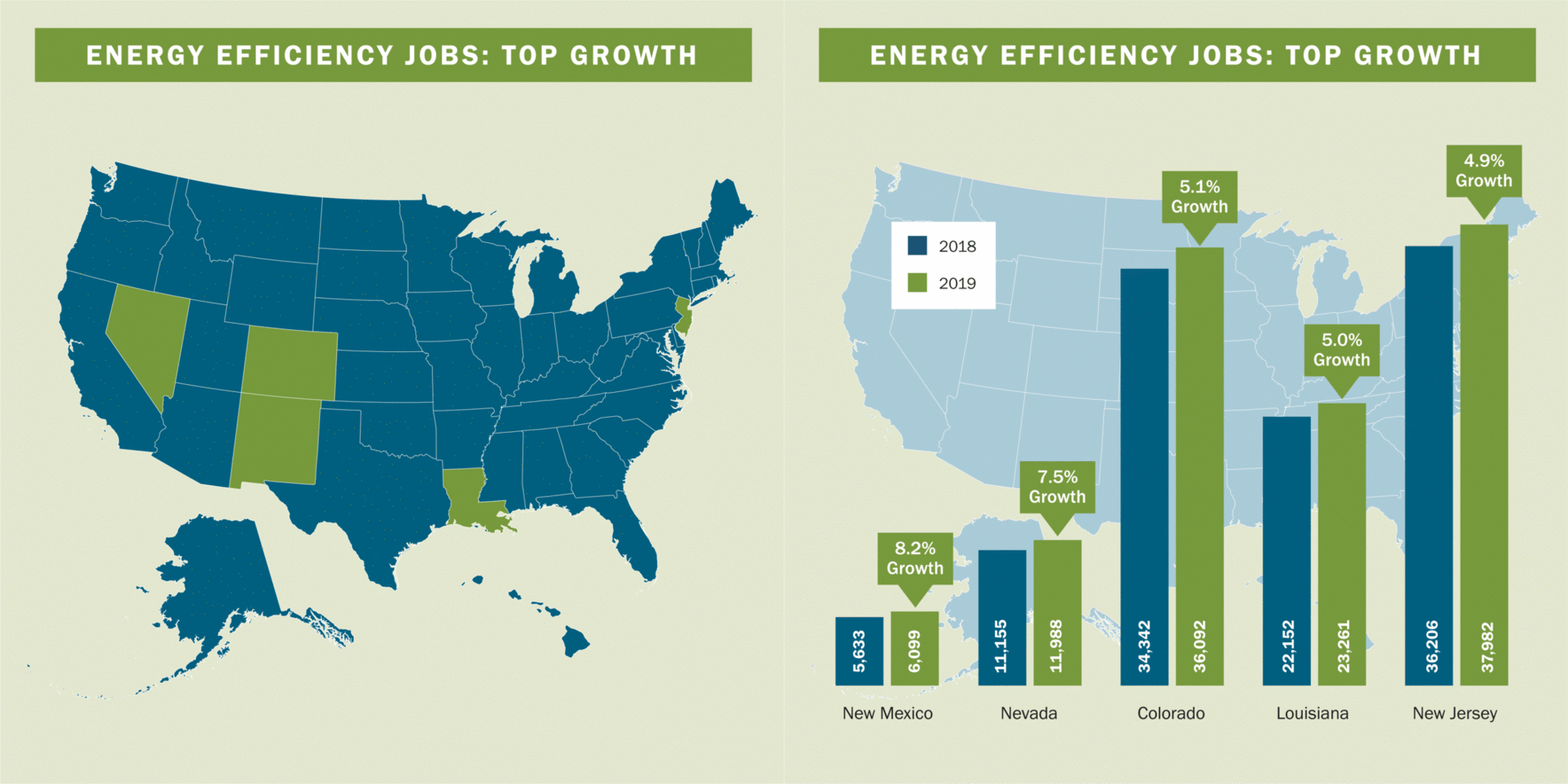
AMERICA’S TOP 10 STATES | 2019 Energy Efficiency Jobs

QUESTIONS & FAQ

For questions on this report, methodology, reported job numbers, or requests for specific additional data, email E2 Communications Director Michael Timberlake ([email protected]). An FAQ for the report, including answers to questions on methodology, is available here.

LOOKING FOR MORE?

If you are looking for additional insight into E4TheFuture and E2’s other research and publications on the energy economy, visit E4TheFuture’s Publications homepage or E2’s Reports homepage.

This report follows E2’s Clean Jobs America analysis which found the clean energy jobs account for nearly 3.4 million jobs across all 50 states and the District of Columbia. Both reports expand on data from the U.S. Energy and Employment Report (USEER) produced by the Energy Futures Initiative (EFI) in partnership with the National Association of State Energy Officials (NASEO), using data collected and analyzed by the BW Research Partnership. E2 and E4TheFuture is a partner on the USEER, the fifth installment of the energy survey first released by the Department of Energy in 2016.

View Report »

REPORT: Clean Energy Jobs Pay 25% More Than National Median

First-of-its-kind report shows clean energy jobs more likely to include health care, retirement benefits Median wages in solar, wind, grid modernization higher than jobs in coal, natural gas and petroleum fuels Findings support calls to power U.S. recovery with clean energy jobs WASHINGTON (October 22, 2020) –  Clean energy jobs paid 25% more than the […]

Oregon among U.S. leaders in pay premium for clean energy jobs

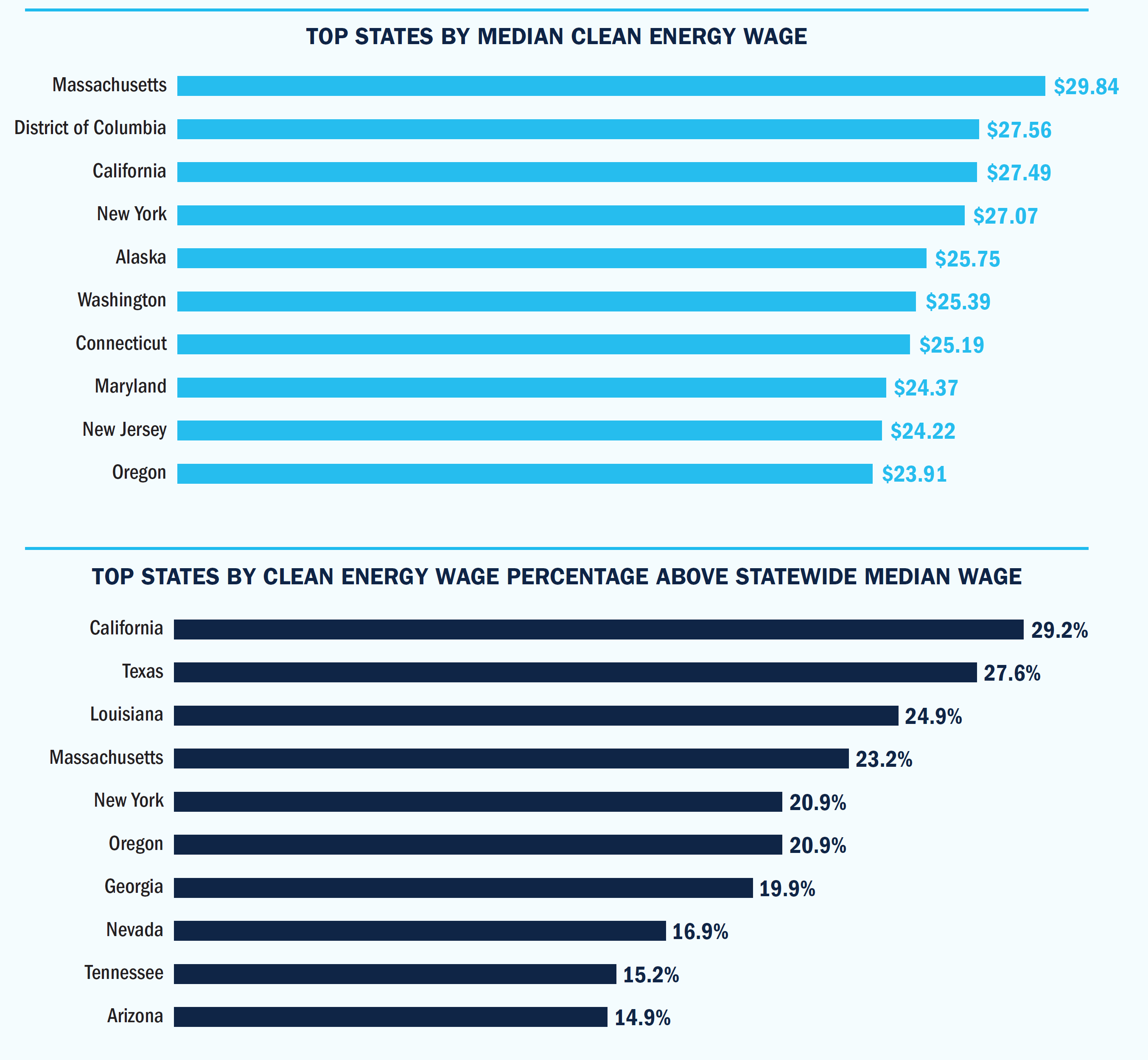
Oregon is among the top states in the country where “clean energy” jobs pay particularly well compared to the statewide median wage, according to a new report. The median hourly wage for clean energy jobs in Oregon in 2019 was $23.91, 20.9 percent higher than the median wage for all jobs.

Clean Jobs, Better Jobs

Date: October 22, 2020

About This Report

To understand the quality of employment opportunities in clean energy-related industries, E2 (Environmental Entrepreneurs), the American Council on Renewable Energy (ACORE), and the Clean Energy Leadership Institute (CELI) commissioned BW Research to analyze wages and benefits of occupations in clean energy industries in comparison to all occupations nationwide, sectors heavily impacted by the pandemic crisis, and other energy-related occupations.

This report analyzed clean energy wages, benefits and unionization rates across all five clean energy sectors (renewable energy generation, energy efficiency, clean fuels, clean vehicles, and grid modernization and storage) with detailed demographic data for 15 specific clean energy occupations, and how they compare with similar jobs in other industries. Also detailed in the report are state-specific wage findings for all 50 states and the District of Columbia.

Key Findings

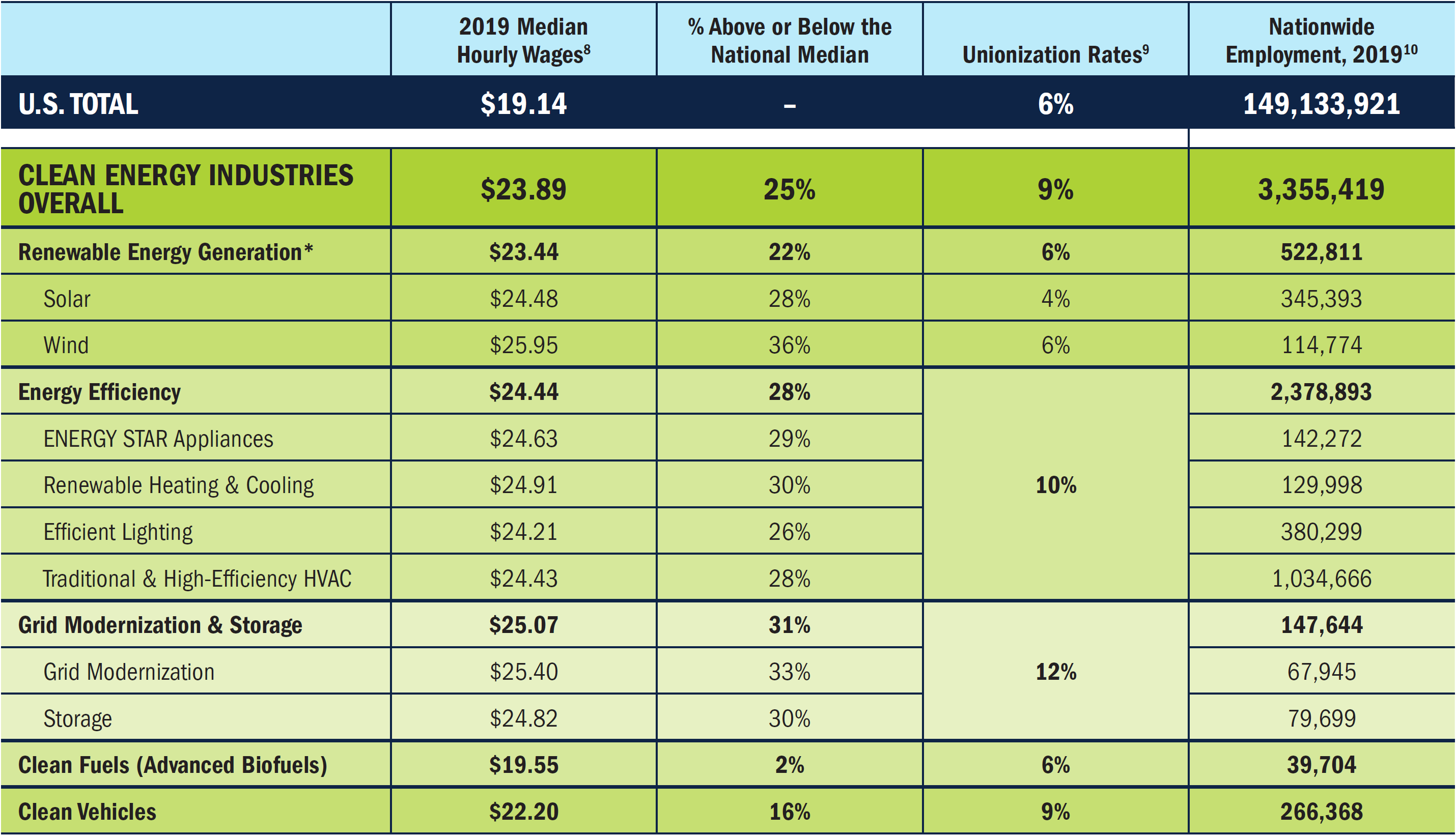
The Clean Jobs, Better Jobs report is the first comprehensive analysis of wages and benefits across the clean energy sector. According to the report, workers in renewable energy, energy efficiency, grid modernization and storage, clean fuels and clean vehicles earned a median hourly wage of $23.89 in 2019 compared with the national median wage of $19.14. In addition, jobs in many clean energy sectors are more likely to be unionized and come with health care and retirement benefits than the rest of the private sector, the analysis shows.

Clean Jobs, Better Jobs comes amid the growing national dialogue around clean energy as federal and state leaders look for ways to restart the economy. The findings underscore the opportunity to advance smart clean energy policies that create higher-wage opportunities putting Americans back to work quickly rebuilding a cleaner, more resilient and more equitable economy. The report also provides detailed wage, benefit, education and demographic data for 15 specific clean energy occupations, and how they compare with similar jobs in other industries outside of clean energy.

Overall, median wages in clean energy are significantly higher than median wages in sectors such as retail, services, recreation and accommodations, especially when it comes to entry-level wages. Solar energy workers earn $24.48 an hour, while wind and grid modernization jobs pay on average more than $25 an hour. Energy efficiency – the largest employer in the nation’s energy sector – supports a median hourly wage of $24.44, about 28% above the national median.

Many clean energy jobs also paid better than fossil fuel jobs. Jobs in coal, natural gas and petroleum fuels paid $24.37 an hour, while solar and wind jobs combined for a $24.85 median hourly wage. Clean energy industries also employed about three times more workers than fossil fuels did in 2019, and, unlike fossil fuel jobs, clean energy jobs are available in every state, regardless of geology or geography.

Before COVID-19, clean energy had been one of the nation’s fastest-growing sectors. At the end of 2019, clean energy employed nearly 3.4 million workers across 99% of U.S. counties, according to E2’s Clean Jobs America report.

Wages & Unionization Rates By Industry, 2019
States Most Impacted
Download

The complete report is available for download at this link.

Looking for More Info?
The analysis expands on data from the 2020 U.S. Energy and Employment Report (USEER) produced by the Energy Futures Initiative (EFI) in partnership with the National Association of State Energy Officials (NASEO), using data collected and analyzed by the BW Research Partnership. The report was released in March 2020 and is available at www.usenergyjobs.org. E2 is a partner on the USEER, the fifth installment of the energy survey first released by the Department of Energy in 2016 and subsequently abandoned under the Trump administration. Clean energy jobs have grown every year since the first report was released in 2016.

If you are looking for additional insight into this report or E2’s more than a dozen other annual clean energy employment reports, visit e2.org/reports. You can also contact E2 Communications Director Michael Timberlake ([email protected]).

Sign-Up for Email Updates

"*" indicates required fields

This field is for validation purposes and should be left unchanged.

View Report »

Sign Up for Email Updates


"*" indicates required fields

This field is for validation purposes and should be left unchanged.

Our Latest Press Releases


Releases

REPORT: Midwest clean energy jobs Fell in 2025 for the first time since pandemic

WASHINGTON —  Clean energy employment in the United States fell by nearly 37,000 jobs in 2025, the industry’s first annual decline after four consecutive years of growth, according to the 11th annual Clean Jobs America report released today by the national,...


Releases

REPORT: Clean energy jobs fell in 2025, ending four years of growth as federal rollbacks take a toll

WASHINGTON —  Clean energy employment in the United States fell by nearly 37,000 jobs in 2025, the industry’s first annual decline after four consecutive years of growth, according to the 11th annual Clean Jobs America report released today by the national,...


Releases

Senators Release Permitting Bill Text

Federal judge blocks illegal regulatory attacks on clean energy by the Trump administration, providing a preliminary victory for wind and solar energy -- the quickest-to-deploy power available that keeps electricity prices affordable for consumers and compa...


Donate Today