Build Back Better, Faster: How a federal stimulus focusing on clean energy can create millions of jobs and restart America’s economy

Date: July 15, 2020

Clean Energy Economic Stimulus Impacts

The coronavirus (COVID-19) pandemic has caused millions of Americans—including as many as 620,500 clean energy workers—to lose their jobs over just a few months. E2 and E4TheFuture partnered with BW Research Partnership on this economic impact assessment to demonstrate the potential for creating jobs from federal stimulus investments in three major sectors of the clean energy economy: Energy Efficiency, Renewable Energy, and Grid Modernization.

The clean energy industry is proven to provide a great return on stimulus investments. During the Great Recession, the American Recovery and Reinvestment Act of 2009 (ARRA) directed a portion of stimulus investments to supply chain components for major clean energy technology sectors such as advanced vehicles, batteries, renewable energy, carbon capture and sequestration, grid modernization, and energy efficiency. It is estimated that these $90 billion in strategic investments and incentives supported roughly 900,000 job-years from 2009 through 2015. These investments also set the stage for long-term job growth across the nation’s clean energy industry. By 2019, the clean energy workforce was 3.4 million workers strong and had been growing two times faster than nationwide employment since 2017.

Economic benefits of the proposed federal stimulus package include high-quality jobs for U.S. residents, labor income, boosts to local, state, and federal tax revenues, contributions to Gross Domestic Product (GDP), and energy cost savings. All these benefits ultimately translate to greater spending in the economy. Clean energy jobs are proven to be sustainable wage positions that are accessible to all localities across the U.S., regardless of geography, or politics, and provide new, equitable job opportunities that cannot be outsourced. Moreover, updates to the nation’s energy infrastructure are an investment in the collective economic future of Americans; the creation of a more resilient energy system is vital to economic growth and security.

This report looks at the first five years of economic impacts from a robust federal clean energy stimulus totaling $99.2 billion—with targeted and strategic investments in energy efficiency, renewable energy, and grid modernization. Our modeling finds that such an investment in our shared future would create 860,300 full time direct, indirect and induced jobs that will last for at least five years (a total of 4.3 million job-years). A stimulus of this level and the jobs it would create would also generate more than $66 billion in GDP each year for the next five years—resulting in $330 billion in economic activity, more than triple the amount of investment. These are jobs that would support sustainable wages and help bring the U.S. economy out of the severe recession.

By Industry Impacts

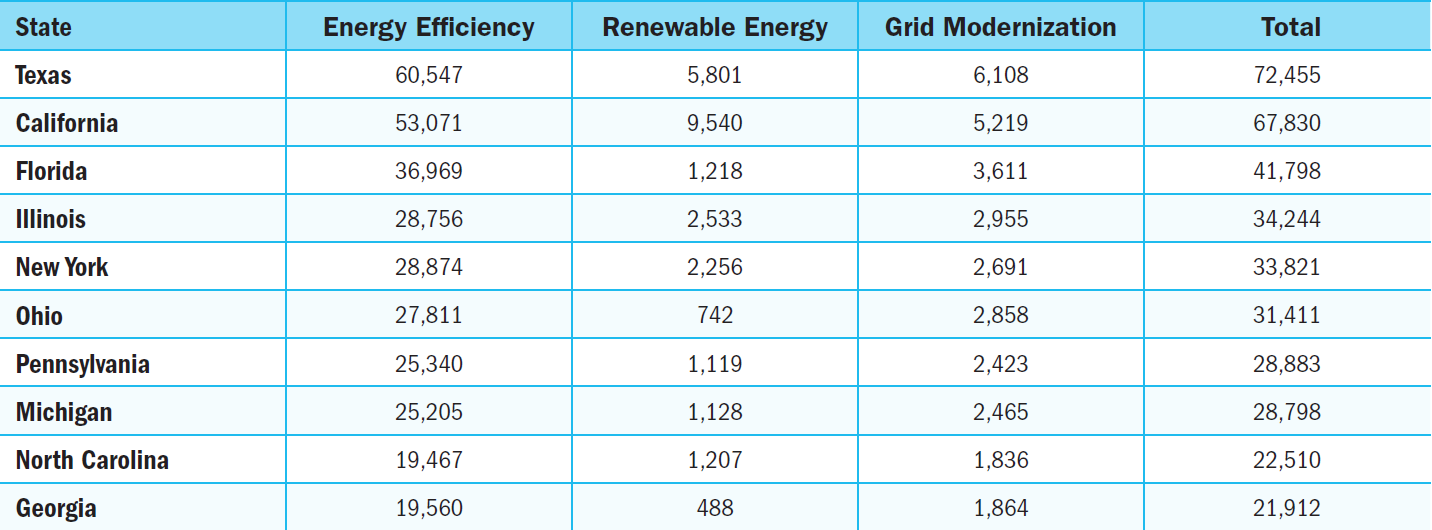
States Most Impacted
Download

The complete report is available for download at this link.

Looking for More Info?
The analysis expands on data from the 2020 U.S. Energy and Employment Report (USEER) produced by the Energy Futures Initiative (EFI) in partnership with the National Association of State Energy Officials (NASEO), using data collected and analyzed by the BW Research Partnership. The report was released in March 2020 and is available at www.usenergyjobs.org. E2 is a partner on the USEER, the fifth installment of the energy survey first released by the Department of Energy in 2016 and subsequently abandoned under the Trump administration. Clean energy jobs have grown every year since the first report was released in 2016.

If you are looking for additional insight into this report or E2’s more than a dozen other annual clean energy employment reports, visit e2.org/reports. You can also contact E2 Communications Director Michael Timberlake ([email protected]).

View Report »

Clean Jobs Midwest 2020

Date: June 25, 2020

Home to 744,000 Clean Energy Jobs

Prior to the COVID-19 crisis, clean energy companies employed more than 744,000 Midwesterners and clean energy jobs were growing in nearly every state, according to the latest available data. Across the region in 2019, the industry added more than 7,500 new jobs. At the end of 2019, more people in the Midwest worked in clean energy than the combined workforce of real estate agents and brokers, computer programmers, web developers, and waiters and waitresses. However, according to a recent analysis of U.S. Department of Labor unemployment data, in just the first three months after the pandemic began more than 131,600 workers in clean energy-related companies lost their jobs.

MIDWEST HIGHLIGHTS

  • Energy Efficiency – 534,567 jobs
  • Renewable Energy – 87,307 jobs
  • Grid & Storage – 26,251 jobs
  • Clean Vehicles – 87,993 jobs
  • Clean Fuels – 7,923 jobs
  • ALL Clean Energy Sectors – 744,041 jobs

OTHER KEY FINDINGS

The Midwest’s largest clean energy employer was energy efficiency. The sector has been home to more than 70 percent of all the region’s clean energy jobs. Last year, the Midwest also saw job growth rate increases in clean fuels (2.9 percent), grid and storage (3.4 percent), and renewable energy generation (2.7 percent).

Clean energy jobs are found in every corner of the region. While big cities like Chicago (88,930 jobs), Detroit (55,470 jobs), and Minneapolis (38,920 jobs) were some of the largest hubs for clean energy jobs, more than one in five — or more than 158,000 — were at the end of 2019 located in rural areas.

Thousands of Midwestern companies hire clean energy workers every year. Before the crisis hit, these employers anticipated adding nearly 37,000 clean energy jobs in 2020 — a nearly 5 percent growth rate.

DOWNLOAD

The complete report along with interactive breakdowns for all states is available at this link.

LOOKING FOR MORE INFO?

This report follows E2’s Clean Jobs America analysis which found the clean energy jobs account for nearly 3.3 million jobs across all 50 states and the District of Columbia. Both reports expand on data from the 2020 U.S. Energy and Employment Report (USEER) produced by the Energy Futures Initiative (EFI) in partnership with the National Association of State Energy Officials (NASEO), using data collected and analyzed by the BW Research Partnership. E2 is a partner on the USEER, the fifth installment of the energy survey first released by the Department of Energy in 2016. Clean energy jobs have grown every year since the first report was released in 2016.

If you are looking for additional insight into E2’s Clean Jobs Midwest or our other Clean Jobs America reports, visit e2.org/reports. You can also contact E2 Communications Director Michael Timberlake ([email protected]). An FAQ is also available here to answer any questions.

View Report »

Gov. Sisolak Advances Clean Cars at Critical Time for Industry, Workers

Statement from E2 Mountain West Advocate Susan Nedell CARSON CITY (June 22, 2020) – Governor Steve Sisolak today announced Nevada will begin a low-emission (LEV) and zero-emission vehicle (ZEV) rulemaking process. If implemented, Nevada would become the 14th state, not including the District of Columbia, to adopt Clean Cars Standards. Nevada has already joined nearly […]

27,000+ More Clean Energy Jobs Lost in May

620,500 clean energy workers jobless since COVID-19 hit CA, FL, GA, TX, WA, MI among hardest-hit states Report comes as Congress debates economic stimulus; runs contrary to findings of flawed Bureau of Labor Statistics report WASHINGTON, DC (June 15, 2020) – As Congress this week begins debating economic stimulus support for the energy industry, a […]

Climate change is looming. But America has lost 600,000 clean energy jobs

Before the arrival of COVID-19, nearly 3.4 million Americans worked in clean energy — three times the workforce of the U.S. fossil fuel industry, according to Environmental Entrepreneurs. The Bureau of Labor Statistics projected last year that the country’s two fastest growing jobs over the next decade would be solar panel installer and wind turbine technician.

Economic Stimulus: What it means for business in the clean economy

The COVID-19 pandemic has affected all corners of the economy, and clean energy and clean economy businesses are no exception. Please join E2 to learn more about the just-passed CARES economic stimulus package, what it means to businesses and their and workers, and what E2 is doing to make sure the next economic stimulus package and other […]

New Details / Cap and Trade: It’s not over yet

In a release, Ian Hill, co-founder of Oregon-based SeQuential Biofuels and E2 Pacific Northwest member said Brown’s executive order represents a critical opportunity for Oregon’s economy and a commitment to action on behalf of Oregonians threatened by the fires, droughts, flooding, and other catastrophic impacts of escalating climate change. “The long-term health of our economy […]

Sign Up for Email Updates


"*" indicates required fields

This field is for validation purposes and should be left unchanged.

Our Latest Press Releases


Releases

House Republicans Launch Push to Reinstate Clean Energy Tax Credits

“Amid soaring electricity costs and tens of billions in clean energy projects getting cancelled and delayed across the country, this is a modest – but smart – step back in the right direction."


Releases

E2: Federal Judge Temporarily Lifts Regulatory Blockade Of Wind and Solar Projects

Federal judge blocks illegal regulatory attacks on clean energy by the Trump administration, providing a preliminary victory for wind and solar energy -- the quickest-to-deploy power available that keeps electricity prices affordable for consumers and compa...


Releases

Six Emerging Environmental Entrepreneurs Selected for National Fellowship

The E2 & 1 Hotels the fellowship program is designed to help early career environmentally-minded entrepreneurs and community leaders to create and implement unique projects at the intersection of the economy and environment. This year’s projects span a wide...


Donate Today