Clean Jobs Pennsylvania 2025

Date: November 24, 2025

Summary

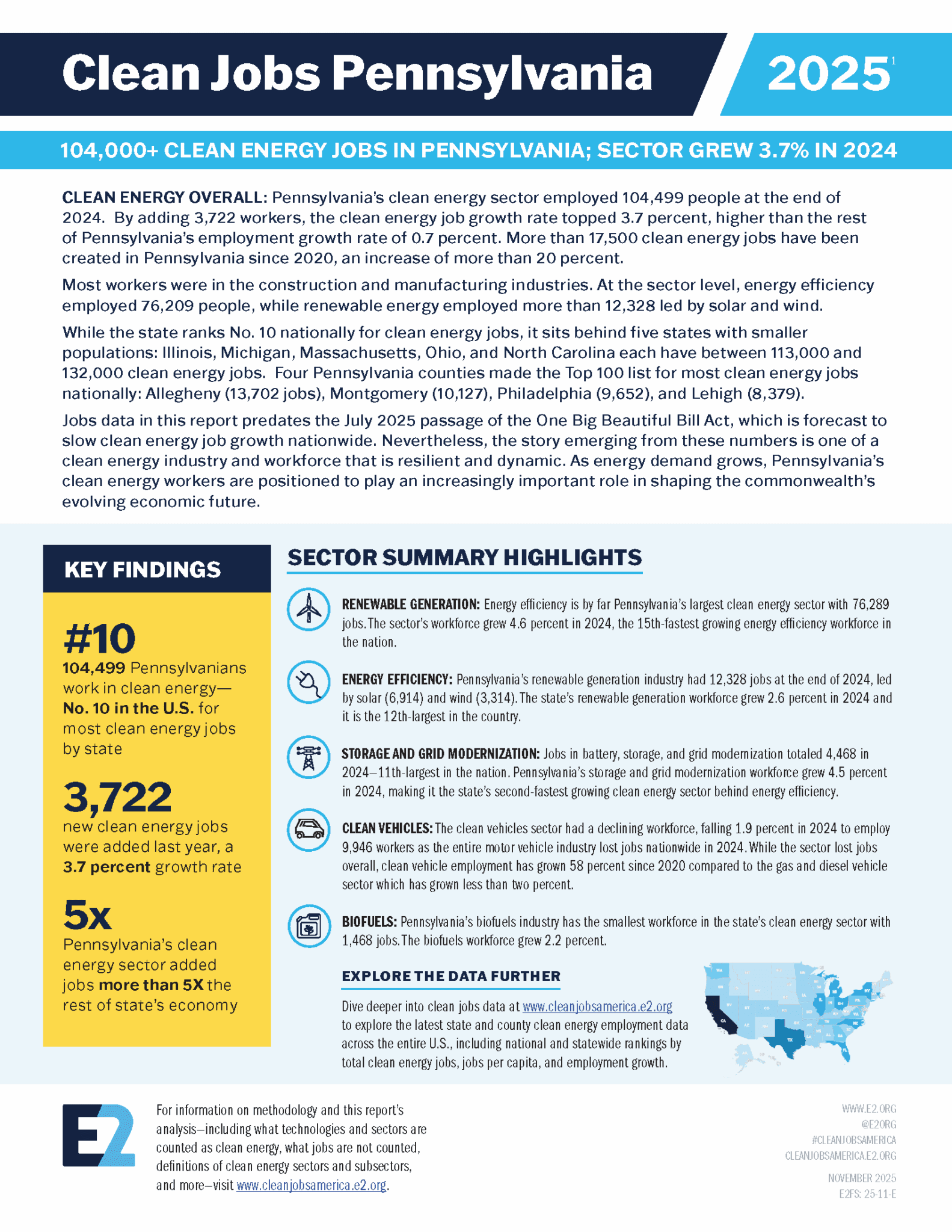
Pennsylvania’s clean energy sector employed 104,499 people at the end of 2024. By adding 3,722 workers, the clean energy job growth rate topped 3.7 percent, higher than the rest of Pennsylvania’s employment growth rate of 0.7 percent. More than 17,500 clean energy jobs have been created in Pennsylvania since 2020, an increase of more than 20 percent.

Most workers were in the construction and manufacturing industries. At the sector level, energy efficiency employed 76,209 people, while renewable energy employed more than 12,328 led by solar and wind.

While the state ranks No. 10 nationally for clean energy jobs, it sits behind five states with smaller populations: Illinois, Michigan, Massachusetts, Ohio, and North Carolina each have between 113,000 and 132,000 clean energy jobs. Four Pennsylvania counties made the Top 100 list for most clean energy jobs nationally: Allegheny (13,702 jobs), Montgomery (10,127), Philadelphia (9,652), and Lehigh (8,379).

Jobs data in this report predates the July 2025 passage of the One Big Beautiful Bill Act, which is forecast to slow clean energy job growth nationwide. Nevertheless, the story emerging from these numbers is one of a clean energy industry and workforce that is resilient and dynamic. As energy demand grows, Pennsylvania’s clean energy workers are positioned to play an increasingly important role in shaping the commonwealth’s evolving economic future.
This field is for validation purposes and should be left unchanged.

Previous Reports

Background

This is the tenth Clean Jobs Pennsylvania report produced by E2 based on analysis of the USEER, which was first released by the DOE in 2016. E2 was an original proponent of the DOE producing the USEER and was a partner on the reports produced by the Energy Futures Initiative (EFI) and National Association of State Energy Officials (NASEO) after the Trump administration decided to not produce it in 2017.

For additional insight on clean energy’s economic impact, visit e2.org/reports/ to access E2’s full slate of economic reports on the clean energy sector and related industries,
View Report »

Clean Jobs Georgia 2025

Date: November 18, 2025

Summary

Georgia’s clean energy workforce added 3,292 new workers in 2024, growing 4 percent and adding jobs at a rate more than 5 times faster than the state’s overall employment, which grew at less than 0.8 percent. The state ranked 15th for largest clean energy workforce in 2024, with 85,535 clean energy jobs in total. The bulk of the workforce were in the construction and manufacturing industries, with about 43,800 and 13,200 workers respectively. In 2024, clean energy accounted for over seven times more jobs than fossil fuels in Georgia while three Georgia counties made the top 100 list for counties with the most clean energy jobs in the nation: Fulton County (15,976 jobs), Cobb County (7,778 jobs), and Gwinnett County (7,321 jobs).

It’s important to note that the jobs data in this report predates the July 2025 passage of the One Big Beautiful Bill Act, which has been forecast to slow clean energy job growth nationwide. Still, these numbers point to a resilient and increasingly essential industry and workforce. As energy demand grows, Georgia’s clean energy companies and workers are positioned to play an even greater role in shaping the state’s economic future.

This field is for validation purposes and should be left unchanged.

Previous Reports

Clean Jobs Georgia 2025 is the 3rd clean energy jobs report for Georgia from E2. Previous reports can be accessed in the below links.

Background

This is the third Clean Jobs Georgia report produced by E2 based on analysis of the USEER, which was first released by the DOE in 2016. E2 was an original proponent of the DOE producing the USEER and was a partner on the reports produced by the Energy Futures Initiative (EFI) and National Association of State Energy Officials (NASEO) after the Trump administration decided to not produce it in 2017.

For additional insight on clean energy’s economic impact, visit e2.org/reports/ to access E2’s full slate of economic reports on the clean energy sector and related industries,
View Report »

Clean Jobs North Carolina 2025

Date: November 13, 2025

Summary

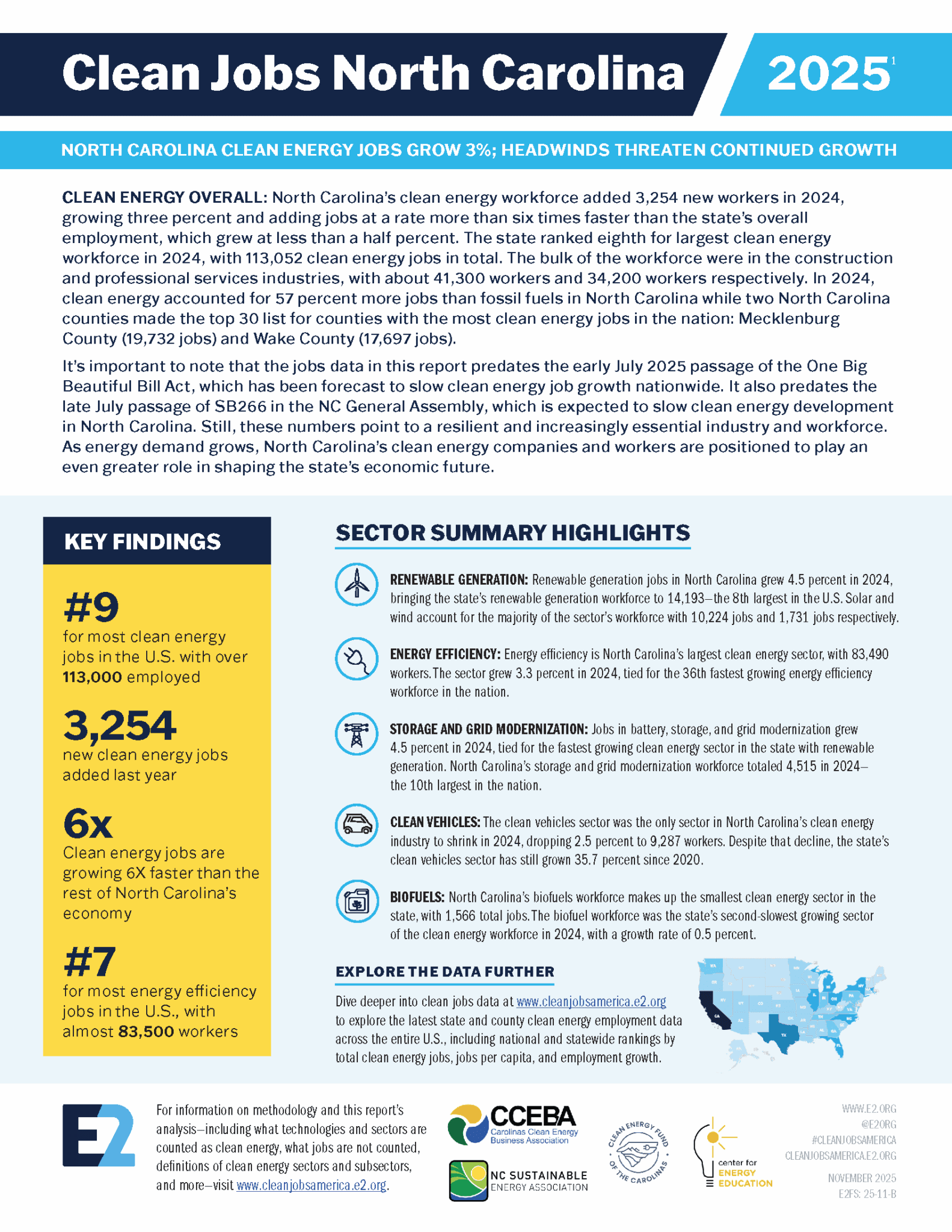
North Carolina’s clean energy workforce added 3,254 new workers in 2024, growing three percent and adding jobs at a rate more than six times faster than the state’s overall employment, which grew at less than a half percent. The state ranked eighth for largest clean energy workforce in 2024, with 113,052 clean energy jobs in total. The bulk of the workforce were in the construction and professional services industries, with about 41,300 workers and 34,200 workers respectively. In 2024, clean energy accounted for 57 percent more jobs than fossil fuels in North Carolina while two North Carolina counties made the top 30 list for counties with the most clean energy jobs in the nation: Mecklenburg County (19,732 jobs) and Wake County (17,697 jobs).

It’s important to note that the jobs data in this report predates the early July 2025 passage of the One Big Beautiful Bill Act, which has been forecast to slow clean energy job growth nationwide. It also predates the late July passage of SB266 in the NC General Assembly, which is expected to slow clean energy development in North Carolina. Still, these numbers point to a resilient and increasingly essential industry and workforce. As energy demand grows, North Carolina’s clean energy companies and workers are positioned to play an even greater role in shaping the state’s economic future.

This field is for validation purposes and should be left unchanged.

Previous Reports

Clean Jobs North Carolina 2025 is the 7th clean energy jobs report for North Carolina from E2. Previous reports can be accessed in the below links.

Background

This is the seventh Clean Jobs North Carolina report produced by E2 based on analysis of the USEER, which was first released by the DOE in 2016. E2 was an original proponent of the DOE producing the USEER and was a partner on the reports produced by the Energy Futures Initiative (EFI) and National Association of State Energy Officials (NASEO) after the Trump administration decided to not produce it in 2017.

For additional insight on clean energy’s economic impact, visit e2.org/reports/ to access E2’s full slate of economic reports on the clean energy sector and related industries,

View Report »

Clean Jobs California 2025

Date: November 5, 2025

Summary

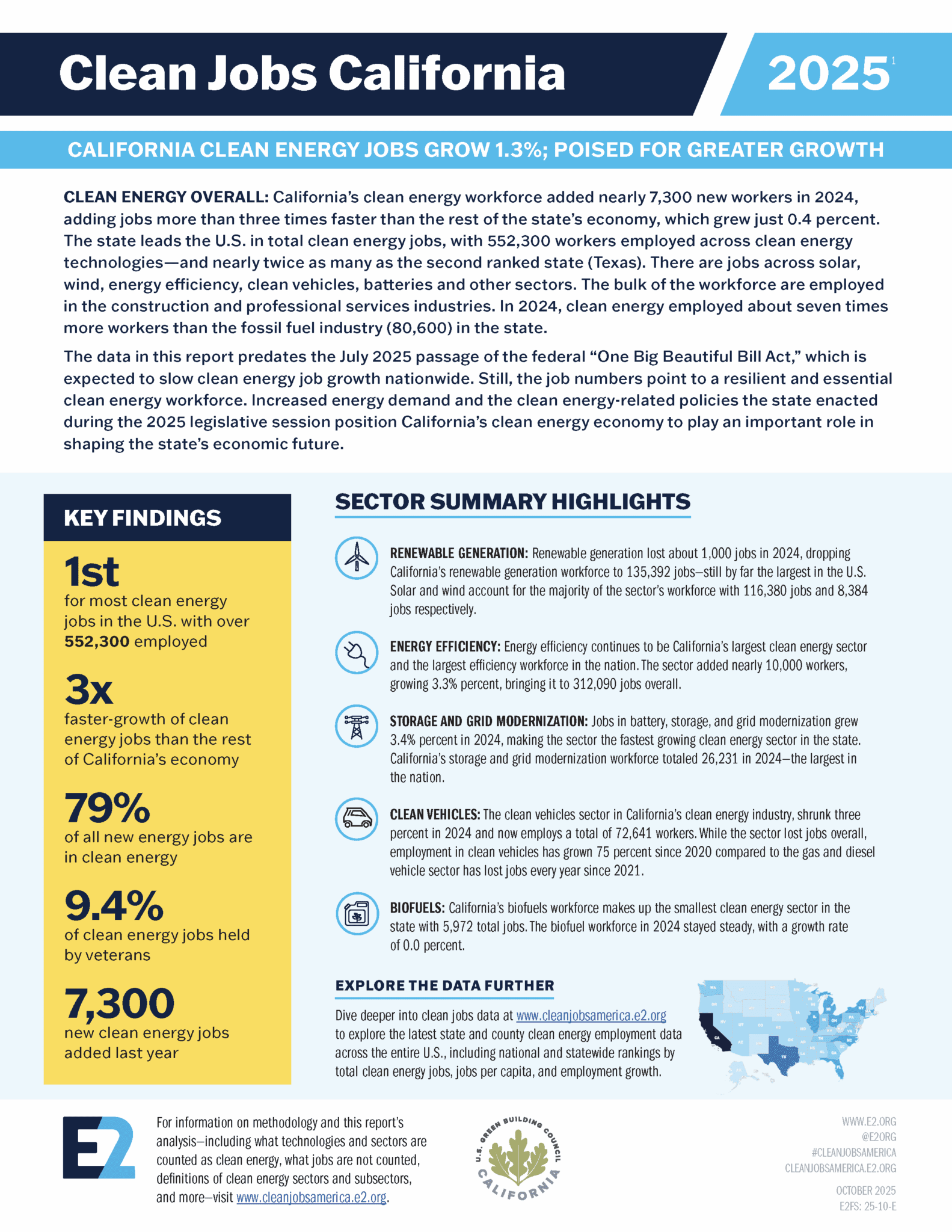
California’s clean energy workforce added nearly 7,300 new workers in 2024, adding jobs more than three times faster than the rest of the state’s economy, which grew just 0.4 percent. The state leads the U.S. in total clean energy jobs, with 552,300 workers employed across clean energy technologies—and nearly twice as many as the second ranked state (Texas). There are jobs across solar, wind, energy efficiency, clean vehicles, batteries and other sectors. The bulk of the workforce are employed in the construction and professional services industries. In 2024, clean energy employed about seven times more workers than the fossil fuel industry (80,600) in the state.

The data in this report predates the July 2025 passage of the federal “One Big Beautiful Bill Act,” which is expected to slow clean energy job growth nationwide. Still, the job numbers point to a resilient and essential clean energy workforce. Increased energy demand and the clean energy-related policies the state enacted during the 2025 legislative session position California’s clean energy economy to play an important role in shaping the state’s economic future.

This field is for validation purposes and should be left unchanged.

Previous Reports

Clean Jobs California is the 6th clean energy jobs report for California from E2. For additional insight into E2’s clean energy jobs numbers, including interactive state and county data for all of the U.S., visit cleanjobsamerica.e2.org.

Previous California-specific reports can be accessed in the below links.

Background

This is the sixth Clean Jobs California report produced by E2 based on analysis of the USEER, which was first released by the DOE in 2016. E2 was an original proponent of the DOE producing the USEER and was a partner on the reports produced by the Energy Futures Initiative (EFI) and National Association of State Energy Officials (NASEO) after the Trump administration decided to not produce it in 2017.

For additional insight on clean energy’s economic impact, visit e2.org/reports/ to access E2’s full slate of economic reports on the clean energy sector and related industries,

View Report »

E2 STATEMENT: Illinois General Assembly Passes Clean and Reliable Grid Affordability Act (CRGA Act), Solidifies State as a Clean Energy Leader, Bringing Billions in Benefits to Businesses & Residents

SPRINGFIELD (Oct. 31, 2025) – As of last night, both chambers of the Illinois General Assembly passed the Clean and Reliable Grid Affordability (CRGA) Act, a major milestone for clean energy. The bill now awaits the signature of Governor JB Pritzker, a supporter of the legislation. The energy omnibus is expected to deliver billions of […]

Bob Keefe, E2 Executive Director, Named To The 2025 TIME100 Climate List Of The 100 Most Influential Leaders Driving Business Climate Action

WASHINGTON (Oct. 30, 2025) – TIME named Bob Keefe, executive director for the national nonpartisan business group E2, to the 2025 TIME100 Climate list, recognizing the 100 most innovative leaders driving business climate action. For the third year in a row, TIME editors vetted people who delivered measurable progress with respect to the business of climate change, emphasizing tangible results over commitments.  In choosing Keefe, the magazine recognized his leadership of an […]

Clean Jobs Midwest 2025

Date: October 15, 2025

Summary

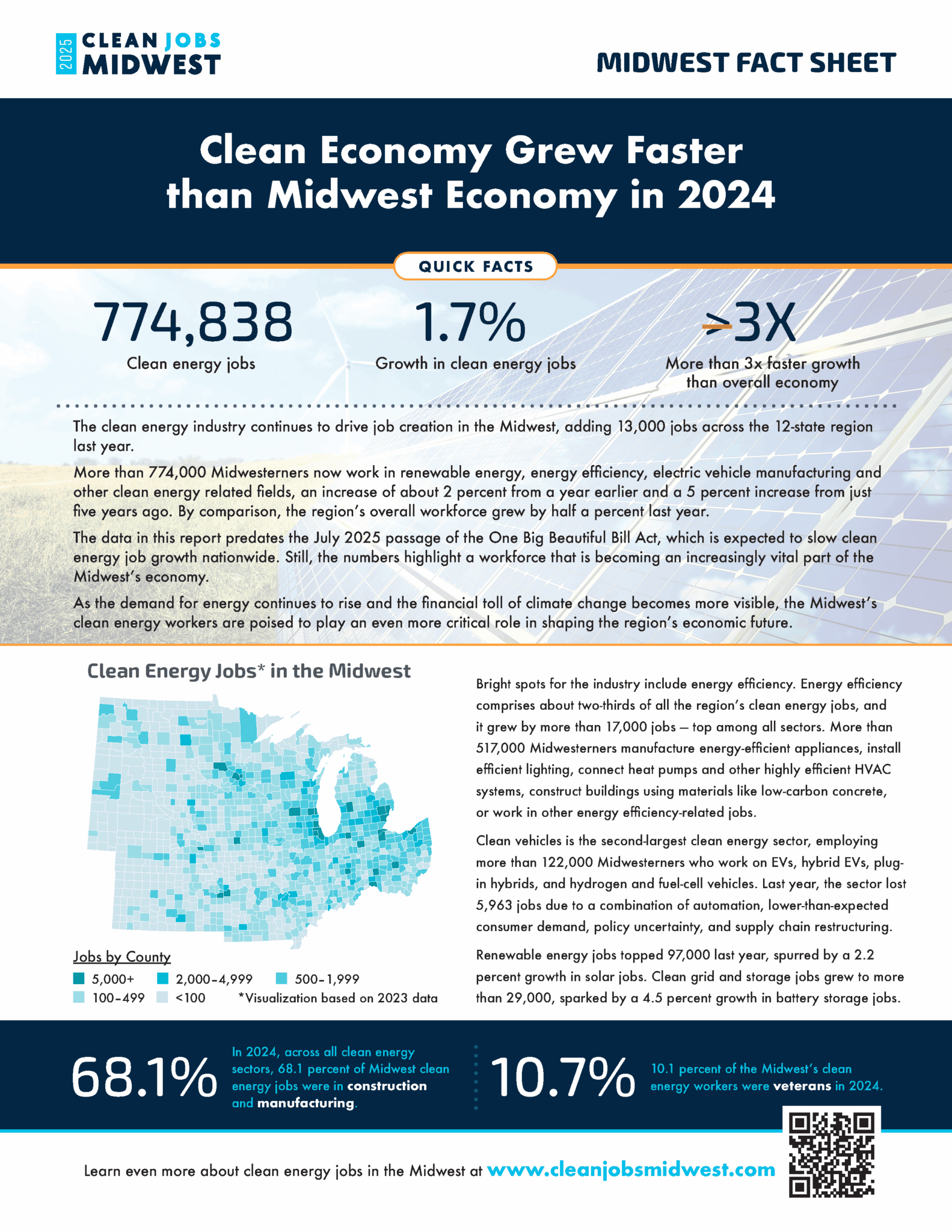
The clean energy industry continues to drive job creation in the Midwest, adding 13,000 jobs across the 12-state region last year. 

More than 774,000 Midwesterners now work in renewable energy, energy efficiency, electric vehicle manufacturing and other clean energy related fields, an increase of about 2 percent from a year earlier and a 5 percent increase from just five years ago. By comparison, the region’s overall workforce grew by half a percent last year. 

The data in this report predates the July 2025 passage of the One Big Beautiful Bill Act, which is expected to slow clean energy job growth nationwide. Still, the numbers highlight a workforce that is becoming an increasingly vital part of the Midwest’s economy. 

As the demand for energy continues to rise and the financial toll of climate change becomes more visible, the Midwest’s clean energy workers are poised to play an even more critical role in shaping the region’s economic future. 

BY THE NUMBERS

  • Energy Efficiency – 517,316  jobs
  • Clean Vehicles – 122,296
  • Renewable Energy – 97,070
  • Grid & Storage – 29,711
  • Clean Fuels – 8,485
  • Total Clean Energy – 774,838  jobs

SECTOR FINDINGS

Bright spots for the industry include energy efficiency. Energy efficiency comprises about two-thirds of all the region’s clean energy jobs, and it grew by more than 17,000 jobs — top among all sectors. More than 517,000 Midwesterners manufacture energy-efficient appliances, install efficient lighting, connect heat pumps and other highly efficient HVAC systems, construct buildings using materials like low-carbon concrete, or work in other energy efficiency-related jobs. 

Clean vehicles is the second-largest clean energy sector, employing more than 122,000 Midwesterners who work on EVs, hybrid EVs, plug-in hybrids, and hydrogen and fuel-cell vehicles. Last year, the sector lost 5,963 jobs due to a combination of automation, lower-than-expected consumer demand, policy uncertainty, and supply chain restructuring. 

Renewable energy jobs topped 97,000 last year, spurred by a 2.2 percent growth in solar jobs. Clean grid and storage jobs grew to more than 29,000, sparked by a 4.5 percent growth in battery storage jobs. 

DOWNLOAD

The complete report along with interactive breakdowns for all states is available at this link.

PREVIOUS CLEAN JOBS MIDWEST REPORTS

0

total clean energy jobs

Quick Facts

0

new jobs

0

faster growth than overall economy

View Report »

Sign Up for Email Updates


"*" indicates required fields

This field is for validation purposes and should be left unchanged.

Our Latest Press Releases


Releases

E2: Repealing EPA’s Endangerment Finding For Vehicle Emissions Raises Costs for Businesses and Consumers

The EPA officially revoked the endangerment finding for greenhouse gas (GHG) emissions and eliminated clean vehicle standards in a blow to both our economy and our environment.


Releases

E2: Companies Cancelled $34.8B, 38K Jobs for Clean Energy Projects in 2025, Outpacing New Investments 3-to-1

Businesses abandoned $5.1 billion in large-scale factories and clean energy projects in December, capping a turbulent year for the sector that saw nearly $35 billion in investments disappear along with more than 38,000 current and future jobs, according to ...


Releases

E2: Trump Administration’s Latest Attempt to Kill Offshore Wind Hurts Consumers, Businesses

The Trump administration is trying to halt offshore wind projects that are well-underway just two weeks after their initial attempt was deemed arbitrary and capricious by a federal judge.


Donate Today