District-By-District | Clean Jobs California 2021
Date: August 20, 2021

Clean Jobs California | District-By-District

According to E2’s analysis, as of 2021 more than 484,000 Californians worked in clean energy and more than $102 billion in public and private clean energy related investments have been injected into the state. California’s climate policies – including its leading Renewables Portfolio Standard and transportation electrification policies such as Advanced Clean Trucks (ACT) rule and the Advanced Clean Cars (ACC) program – are key to this economic growth and future growth as well.

California’s Statewide 2021 Clean Energy Jobs Report
Who Are My Representatives?

Almost 50 percent of the $8.3 billion in clean energy investments from California’s Greenhouse Gas Reduction Funds have benefited disadvantaged and low-income communities and households across the state. The state’s climate policies funded by the Greenhouse Gas Reduction Fund have cut emissions by the equivalent of taking 14 million cars off the road.

How to Download: Use the tables below to locate and download all 120 factsheets for every California state legislative district. Each factsheet details out the district-specific jobs and economic impact resulting from California’s climate policies.

California State Senate

California State Assembly

District Assembly Member
District 1Megan Dahle
District 2Jim Wood
District 3James Gallagher
District 4Cecilia Aguiar-Curry
District 5Frank Bigelow
District 6Kevin Kiley
District 7Kevin McCarty
District 8Ken Cooley
District 9Jim Cooper
District 10Marc Levine
District 11Jim Frazier
District 12Heath Flora
District 13Carlos Villapudua
District 14Tim Grayson
District 15Buffy Wicks
District 16Rebecca Bauer-Kahan
District 17David Chiu
District 18Vacant
District 19Phil Ting
District 20Bill Quirk
District 21Adam Gray
District 22Kevin Mullin
District 23Jim Patterson
District 24Marc Berman
District 25Alex Lee
District 26Devon Mathis
District 27Ash Kalra
District 28Evan Low
District 29Mark Stone
District 30Robert Rivas
District 31Joaquin Arambula
District 32Rudy Salas
District 33Thurston Smith
District 34Vince Fong
District 35Jordan Cunningham
District 36Tom Lackey
District 37Steve Bennett
District 38Suzette Martinez Valladares
District 39Luz M. Rivas
District 40James Ramos
District Assembly Member
District 41Chris Holden
District 42Chad Mayes
District 43Laura Friedman
District 44Jacqui Irwin
District 45Jesse Gabriel
District 46Adrin Nazarian
District 47Eloise Gómez Reyes
District 48Blanca Rubio
District 49Edwin Chau
District 50Richard Bloom
District 51Wendy Carrillo
District 52Freddie Rodriguez
District 53Miguel Santiago
District 54Isaac Bryan
District 55Phillip Chen
District 56Eduardo Garcia
District 57Lisa Calderon
District 58Cristina Garcia
District 59Reginald Byron Jones-Sawyer, Sr.
District 60Sabrina Cervantes
District 61Jose Medina
District 62Autumn Burke
District 63Anthony Rendon
District 64Mike Gipson
District 65Sharon Quirk-Sirva
District 66Al Muratsuchi
District 67Kelly Seyarto
District 68Steven Choi
District 69Tom Daly
District 70Patrick O’Donnell
District 71Randy Voepel
District 72Janet Nguyen
District 73Laurie Davies
District 74Cottie Petrie-Norris
District 75Marie Waldron
District 76Tasha Boerner Horvath
District 77Brian Maienschein
District 78Christopher Ward
District 79Akilah Weber
District 80Lorena Gonzalez

Looking for More Info?

For more information on the source and methodology used to compile the numbers on this sheet, please see Understanding The Numbers or visit https://e2.org/reports/caclimateleadership/sources.

Statewide Jobs Report

For details on clean energy’s statewide impact on jobs in California, including data at the county, metro, congressional district levels, and for details by subsector and value chain, visit E2’s Clean Jobs California 2021 report page.

U.S. Energy & Employment Report (USEER)

This district-by-district report follows E2’s Clean Jobs America analysis which found the clean energy jobs account for over 3 million jobs across all 50 states and the District of Columbia. Both reports expand on data from the U.S. Energy and Employment Report (USEER) produced by the Energy Futures Initiative (EFI) in partnership with the National Association of State Energy Officials (NASEO), using data collected and analyzed by the BW Research Partnership. E2 is a partner on the USEER, the fifth installment of the energy survey first released by the Department of Energy in 2016. Additional methodology on the private and public investment number and Greenhouse Gas Reduction Fund investments can be found in our About The Numbers reference document.

For additional information, visit e2.org/reports or contact E2 communications director Michael Timberlake at ([email protected]). An FAQ is also available here.

View Report »
Minnesota clean energy proponents see 100,000 workers in a few years

The pandemic drove employment in Minnesota’s renewable energy and conservation businesses down 10% to 55,329 last year, disrupting several years of double-digit growth. … The report was released by sponsors E2 (Environmental Entrepreneurs) and nonprofits Clean Energy Trust and Clean Energy Economy Minnesota amid revelations that wind-and-solar power have become the cheapest forms of electrical […]

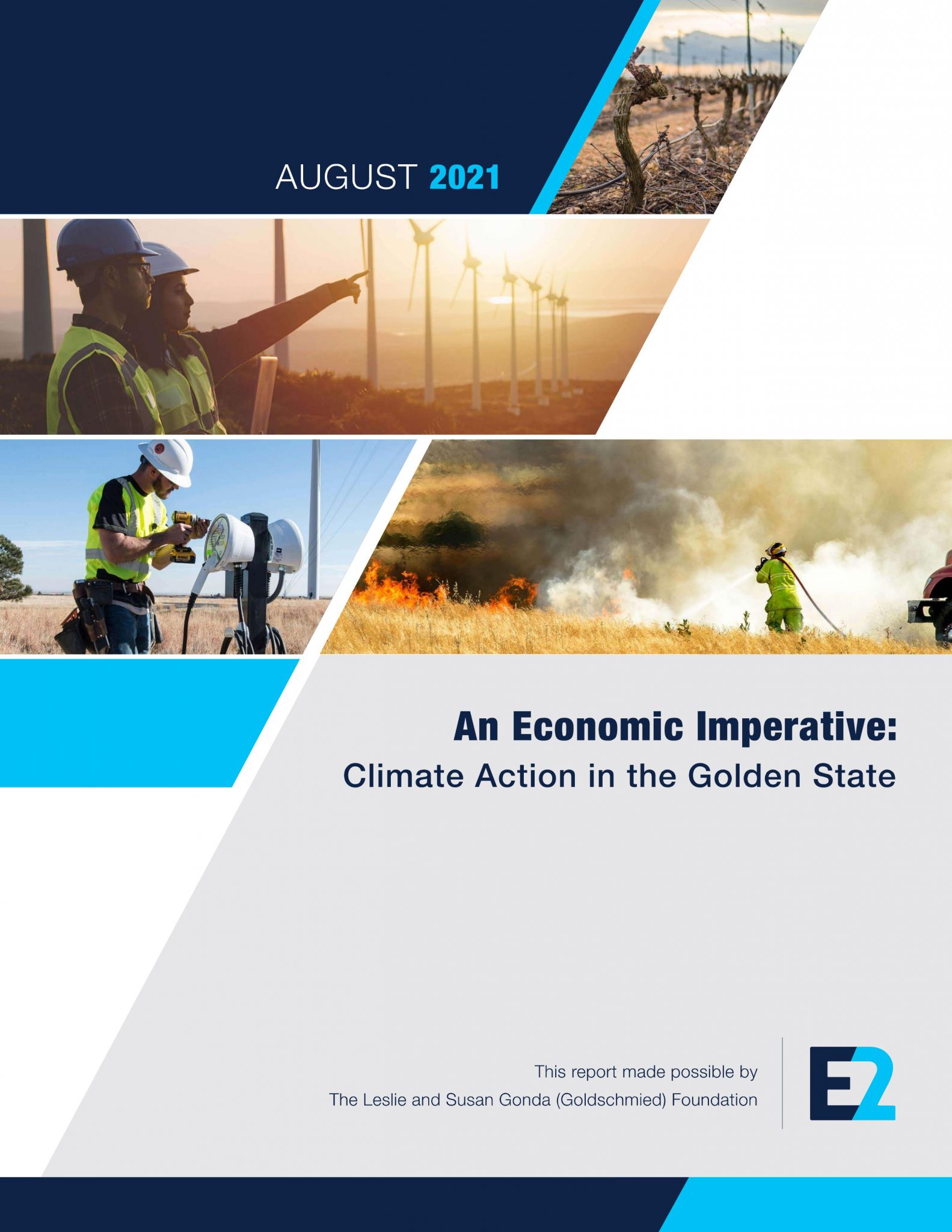
An Economic Imperative: Climate Action in the Golden State

Date: August 16, 2021

Summary:

California is already suffering dire economic impacts from the effects of climate change, presenting significant business and economic risk to the world’s fifth largest economy. The costs of extreme climate events such as wildfires and droughts have risen steadily throughout the past decade, and are projected to increase dramatically in California if current trajectories continue. These costs are being borne by everyone who lives, pays taxes, buys insurance, or works in California.

At the same time, aggressively addressing climate change — reducing greenhouse gas emissions while growing the state’s clean energy economy — presents one of the greatest economic opportunities of the 21st century. Ambitious climate action produces robust job creation, sustainable economic growth, and California leading global innovation across a wide range of industry sectors. Members of Congress can seize this opportunity by passing a bold American Jobs Plan anchored in clean energy investments; California lawmakers must build on existing state climate policy leadership to ensure the state remains a nexus of investment and innovation in the 21st-century economy.

This field is for validation purposes and should be left unchanged.

Findings

  • $55 Billion in direct property damage from California wildfires, 2017 – 2020
  • $47 billion in economic activity in California’s clean ocean economy under threat from sea level rise and ocean warming
  • $50.5 billion in overall production value of California’s 77,500 farms, which now face regular threats from droughts and other climate change-related impacts.
  • 484,980 jobs – Nearly a half million Californians are employed in the clean energy economy, representing 285 of the state’s construction workers and 3% of California’s economy-wide workforce
  • #1 export – Electric vehicles were the state’s most valuable export in 2020, producing nearly $5.7 billion in revenue

About this Report

This report reviews and compares the damage to California’s economy from recent climate-related disasters and risks from future unabated climate change to the potential impact specific climate action policies could have on job and economic growth in the state’s core industries such as technology, construction, agriculture, and tourism. The report, made possible by the Leslie and Susan Gonda (Goldschmied) Foundation, uses publicly-available information and data from previous E2 analysis, BW Research, state and federal agencies, the University of California system, and other sources.

Looking for More Info?

If you are looking for additional insight into the clean economy and how it drives job growth, please see E2’s other clean energy employment reports, visit e2.org/reports.

View Report »

An ambitious ACF rule will boost California’s economy — state regulators must capitalize on the opportunity

Posted on August 13, 2021 by Kai Diep

By E2 Interns: Kai Diep and Andrea Guerra California regulators have a critical opportunity to drive economic growth in the state’s blossoming zero-emission vehicle (ZEV) industry and help achieve state climate targets by advancing a strong Advanced Clean Fleets (ACF) rule with a 100% electric truck sales requirement by 2035. This ambitious yet achievable goal […]

Missouri clean energy jobs rebounding after decline last year

Missouri’s clean energy job market faced a considerable decline during 2020’s economic downturn but still managed to bounce back by the end of the year, according to a recent study. More than 9,300 clean energy workers filed for unemployment in Missouri at the peak of the economic crisis tied to the COVID-19 pandemic, according to the 2020 Clean Jobs Midwest report from […]

Michigan’s clean energy sector recovering from pandemic

The COVID-19 pandemic hit the Midwest clean energy job market hard, with more than 17,000 workers at one point filing for unemployment. But the industry appears to be rebounding, according to an analysis of employment data released by the nonpartisan business group E2 (Environmental Entrepreneurs) and Clean Energy Trust. Clean energy companies employed 113,456 Michiganders at the […]

Clean energy job sector trying to recover from pandemic

According to the nonpartisan business group E2, or Environmental Entrepreneurs, more than 115,000 Illinoisans worked in the clean energy sector at the end of last year, with workers in all of the state’s 102 counties. The final 2020 job numbers show an 8.2% drop in Illinois’ clean energy workforce from 2019, representing more than 10,000 […]

Clean Jobs Midwest 2021

Date: August 11, 2021

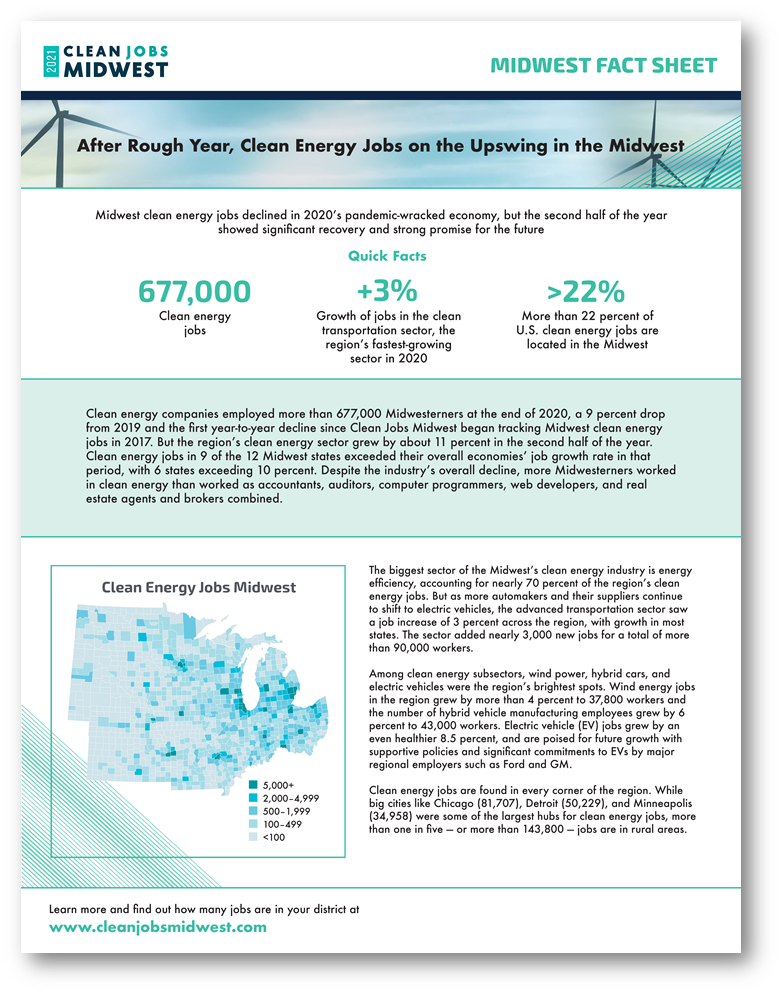
After Rough Year, Clean Energy Jobs on the Upswing in the Midwest

More than 677,900 Midwesterners worked in clean energy and clean vehicles at the end of 2020, making the sector a major – and promising – part of the region’s economy, according to this comprehensive analysis of employment data.

Like most of the economy, clean energy was hit hard by the COVID-19 pandemic and economic downturn in 2020. According to this year’s Clean Jobs Midwest, 2020 was the first year-to-year decline since E2 and Clean Energy Trust began tracking Midwest clean energy jobs. At one point, more than 131,600 Midwest clean energy workers had filed for unemployment, but the sector surged back 10.7 percent in the second half of the year to recover more than half of the jobs initially lost. The final 2020 job numbers represent an 8.9 percent drop in the Midwest clean energy workforce from 2019, or 66,100 jobs. Last year’s job losses were a dramatic change of pace for the industry. Last year’s job losses were a dramatic change of pace for the industry. In the 3 years leading up to 2020, for example, clean energy jobs grew almost 4 times as fast as overall employment.

MIDWEST HIGHLIGHTS

  • Energy Efficiency – 470,651 jobs
  • Clean Vehicles – 90,652 jobs
  • Renewable Energy – 84,881  jobs
  • Grid & Storage – 24,209 jobs
  • Clean Fuels – 7,525 jobs
  • ALL Clean Energy Sectors – 677,918 jobs

OTHER KEY FINDINGS

The biggest sector of the Midwest’s clean energy industry is energy efficiency, accounting for nearly 70 percent of the region’s clean energy jobs. But as more automakers and their suppliers continue to shift to electric vehicles, the advanced transportation sector saw a job increase of 3 percent across the region, with growth in most states. The sector added nearly 3,000 new jobs for a total of more than 90,000 workers.

Among clean energy subsectors, wind power, hybrid cars, and electric vehicles were the region’s brightest spots. Wind energy jobs in the region grew by more than 4 percent to 37,800 workers and the number of hybrid vehicle manufacturing employees grew by 6 percent to 43,000 workers. Electric vehicle (EV) jobs grew by an even healthier 8.5 percent, and are poised for future growth with supportive policies and significant commitments to EVs by major regional employers such as Ford and GM.

Clean energy jobs are found in every corner of the region. While big cities like Chicago (81,707), Detroit (50,229), and Minneapolis (34,958) were some of the largest hubs for clean energy jobs, more than one in five — or more than 143,800 — jobs are in rural areas.

DOWNLOAD

The complete report along with interactive breakdowns for all states is available at this link.

View Report »

E2 Action Alert: Support The California Climate Crisis Act (AB 1395)

Please review this E2 action alert letter and add your e-signature by using the fields below and clicking the ADD YOUR SIGNATURE button. Note that your are signing on as an individual and not as a representative of your employer.

Deadline to sign on is Sunday, August 15, 2021

Sign Up for Email Updates


"*" indicates required fields

This field is for validation purposes and should be left unchanged.

Our Latest Press Releases


Releases

Six Emerging Environmental Entrepreneurs Selected for National Fellowship

The E2 & 1 Hotels the fellowship program is designed to help early career environmentally-minded entrepreneurs and community leaders to create and implement unique projects at the intersection of the economy and environment. This year’s projects span a wide...


Releases

E2: Repealing EPA’s Endangerment Finding For Vehicle Emissions Raises Costs for Businesses and Consumers

The EPA officially revoked the endangerment finding for greenhouse gas (GHG) emissions and eliminated clean vehicle standards in a blow to both our economy and our environment.


Releases

E2: Companies Cancelled $34.8B, 38K Jobs for Clean Energy Projects in 2025, Outpacing New Investments 3-to-1

Businesses abandoned $5.1 billion in large-scale factories and clean energy projects in December, capping a turbulent year for the sector that saw nearly $35 billion in investments disappear along with more than 38,000 current and future jobs, according to ...


Donate Today