Clean energy sector surges

More than 113,400 Michiganders worked in alternative energy at the end of 2020, according to a study released by the Environmental Entrepreneurs (E2) and Clean Energy Trust. The report comes as the U.S. Congress and the Biden administration are considering legislation to boost federal investments in clean energy and clean vehicles, and as the state […]

Too few women, people of color in clean energy industry, report contends

There’s a dearth of women and people of color working in clean energy, a problem within one of the fastest-growing sectors in the U.S. Women make up less than 30% of all workers in clean energy, and racial and ethnic minorities account for 4 in 10 clean energy jobs. Groups underrepresented in the industry lost […]

Illinois’ Clean Energy bill sets path for future

Last year, Illinois’ solar industry had almost 6,000 jobs, according to Clean Energy Trust and Environmental Entrepreneurs, but it’s lost hundreds of positions since because of uncertain government support.

E2: ‘The face of clean energy is predominantly White and male’

People of color and women are “vastly underrepresented” in clean energy jobs compared to the U.S. workforce at large, and many underrepresented groups lost ground between 2017 and 2020, according to a report released last week by BW Research Partnership, E2, and a coalition of clean energy industry groups.

House Pay-Fors “Fiscally Responsible”, Essential For a Resilient US Economy

 WASHINGTON –  The House Ways and Means Committee unveiled its list of revenue priorities and tax reforms (or “pay-fors”) it will rely on to fund the $3.5 trillion reconciliation bill. Statement from Sandra Purohit, director of federal advocacy for the national, nonpartisan business group E2 (Environmental Entrepreneurs): “The cost of going small is too high. […]

Illinois House Passes Historic Climate Bill To Boost Economy

Illinois set to remain regional leader in clean energy job growth through bold renewable energy policies, funding for workforce training and equity SPRINGFIELD, IL  – Last night the Illinois House passed energy legislation that makes Illinois the first state in the Midwest to commit to 100% carbon-free power by 2045. This critical step for Illinois’ […]

Women, Black, and Hispanic/Latino Workers Underrepresented in US Clean Energy

Women, Black, and Hispanic/Latino Workers Underrepresented in US Clean Energy WASHINGTON – As Congress considers the most significant domestic investment ever made to speed America’s transition to clean energy, a new employment report from a collaboration of business, equity, and energy organizations highlights the need for Congress to include funding to advance diversity in clean energy […]

U.S. clean energy sector must expand hiring beyond white men -report

(Reuters) – U.S. clean energy jobs are overwhelmingly dominated by white men, and efforts to boost industries like renewable energy and electric vehicles should make sure that women and people of color are not overlooked, a report published on Thursday said. More than 60% of workers that hold jobs in clean energy industries like electric […]

Help Wanted: Diversity in Clean Energy

Date: September 9, 2021

Clean Energy has a Diversity Problem

Summary

Despite its broad range of businesses, including construction, utilities, manufacturing, professional services, and repair and maintenance, the clean energy sector is dominated by white men. Given the incredible job growth of the energy sector over the past decade, this lack of diversity threatens to cause women, Hispanic and Latino workers, and Black workers in particular to miss out on one of America’s great economic expansions.

About 61 percent of clean energy workers across America are white non-Hispanics. Black and Hispanic/Latino workers are more poorly represented in clean energy than they are across the rest of the economy, with Black people composing 8 percent of the clean energy workforce (compared with 13 percent economy-wide) and Hispanic/Latinos making up 16.5 percent (versus 18 percent economy-wide). Women represent less than 30 percent of all workers in the sector despite accounting for nearly half (48 percent) of the U.S. labor force as a whole.

As the United States looks to build back a better, cleaner, more equitable economy, a renewed focus on increasing diversity in the clean energy sector should be an economic imperative. Both the transition to a low-carbon energy system and proposed state and federal stimulus to boost the economy have the potential to create millions of new jobs across the United States. Policies that support the energy sector and its low-carbon transition should focus on the inclusion of women and underrepresented ethnic and racial groups, particularly Black workers (who are often the most poorly represented in the sector), so that economic benefits are more equitably shared.

This field is for validation purposes and should be left unchanged.

Findings

The study expands on data from the 2021 U.S. Energy and Employment Report (USEER) produced by the U.S. Department of Energy. Among the report’s key findings:

  • Black workers represent about 8 percent of the clean energy labor force, compared with about 13 percent of the nation’s total workforce.
  • Hispanic/Latino workers represent nearly 17 percent of the clean energy workforce, slightly less than the 18 percent they represent in the overall national workforce.
  • Racial and ethnic minorities account for nearly four in ten U.S. clean energy workers.
  • About 8 percent of clean energy workers are Asian, slightly higher than their presence in the national workforce, while Pacific Islanders and Alaska and other native Americans each make up about 1 percent of the clean energy workforce.
  • Women hold about 27 percent of clean energy jobs, compared with 48 percent of all jobs nationally.
  • Renewable energy employs the highest share of Hispanic or Latino workers in the U.S. energy sector.
  • Black, Asian, Indigenous, and multiracial workers account for about 27 percent of clean energy jobs.

The full report includes national and state-by-state breakdowns on demographics across all clean energy sectors, multi-year demographic trends, comparisons to other energy sectors including fossil fuels and gas and diesel vehicles, and specific findings on individual occupations.

U.S. Labor Force Demographics, 2020

Demographic Overall US Labor Force Total Energy Workforce Clean Energy Workforce Fossil Fuel Workforce
White 76% 74% 73% 74%
Black/African-American 13% 10% 8% 9%
Asian 7% 7% 8% 6%
Native Hawaiian or other Pacific Islander <1% 1% 1% <1%
American Indian or Alaska Native <1% 2% 1% 2%
Two or more races 2% 8% 8% 9%
People of Color 22% 28% 26% 26%
Hispanic/Latino 18% 16% 17% 13%
Women 48% 25% 27% 27%

Policies Matter

This analysis indicates that more needs to be done to address racial inequities in clean energy and the broader economy. As we rebuild the U.S. economy in the wake of COVID-19, we have a chance to do it in ways that create new opportunities for people of color. As Congress and state lawmakers focus on clean energy’s role in the recovery, they should focus as well on rebuilding the economy more equitably.

President Biden’s Justice40 initiative mandating that 40 percent of the benefits from federal climate action go to disadvantaged communities is a step in the right direction. But there are many steps lawmakers can take—right now—to ensure greater diversity in the clean energy workforce in the months and years ahead.

Read the report’s policy recommendations starting on page 24.

Background

This is the first-ever comprehensive report on diversity in the U.S. clean energy workforce. This analysis was conducted by BW Research Partnership for E2, the Alliance to Save Energy, the American Association of Blacks in Energy, Black Owners of Solar Services (BOSS), and Energy Efficiency for All. Early drafts of this report were also reviewed by the Policy Committee of BOSS. It expands on data from the 2021 U.S. Energy and Employment Report (USEER) produced by the Department of Energy, using data collected and analyzed by BW Research Partnership. The USEER analyzes data from the U.S. Bureau of Labor Statistics Quarterly Census of Employment and Wages to track employment across many energy production, transmission, and distribution subsectors. For further methodology questions, see pages 201–206 of the USEER.

Other sources of data are noted throughout.

View Report »

Illinois Senate Passes “Critical Boost” for State’s Economy, Clean Energy Future

Bill takes steps for Illinois to remain regional leader in clean energy job growth through bold renewable energy policies, funding for workforce training and equity but falls short on climate action  SPRINGFIELD — Last night the Illinois Senate passed comprehensive energy legislation that would make Illinois the first state in the Midwest to commit to 100 percent carbon-free power by 2045. However, the bill lacks a […]

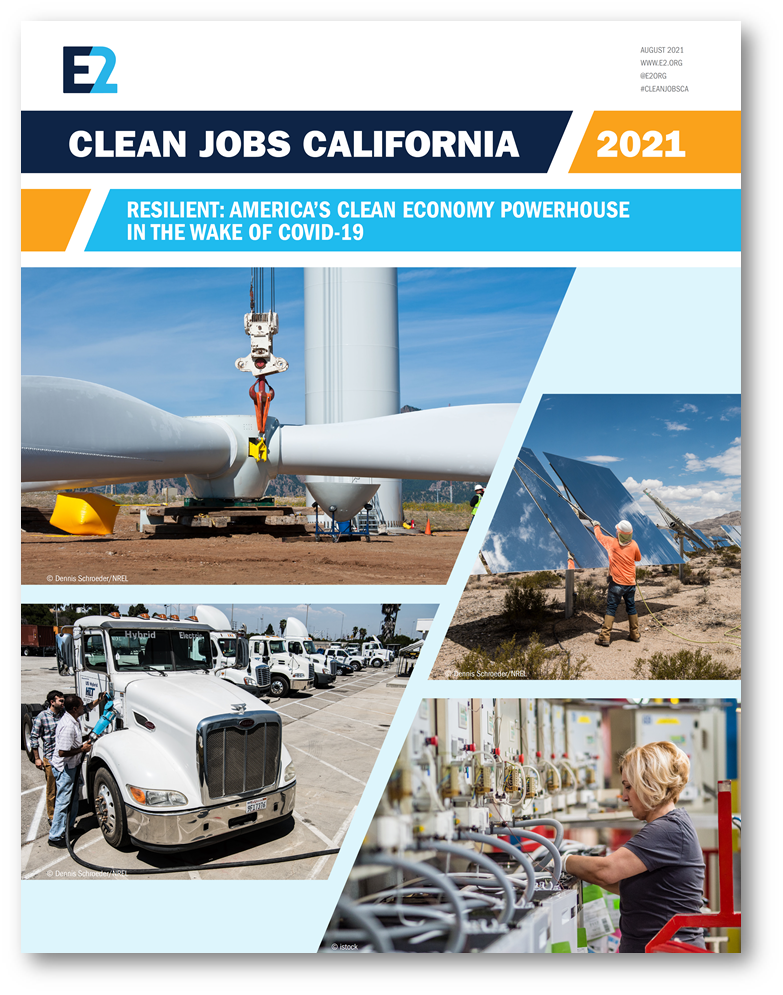
Clean Jobs California 2021

Date: August 25, 2021

America’s Clean Energy Powerhouse in the Wake of Covid-19

Summary:

Driven by the unforeseeable impact of last year’s pandemic and resulting economic crisis, California experienced its first decline in clean energy jobs in 2020 since E2 began tracking such occupations. California’s clean energy economy employed about 480,000 Californians at the end of 2020, down from 537,000 the year before.

However, since the sector’s losses peaked at the end of May 2020, jobs grew back by more than 13 percent compared to less than 6 percent in statewide economy overall. In fact, by the end of 2020 more than half of the clean energy jobs lost between March and May had been regained, leaving the sector down just 9 percent (about 52,000 jobs) since COVID-19.  Thanks to decades of smart state climate policy leadership, California’s clean energy economy has proven to not only be a core part of the state’s economy – representing 3 percent of overall state employment – but resilient and robust in the face of crushing economy-wide pressures.

This field is for validation purposes and should be left unchanged.

Findings

Despite the overall decline, clean energy remains the biggest job creator across America’s energy sector:

  • Clean energy employs nearly six times as many workers as work in fossil fuel extraction and generation
  • More Californians still work in clean energy than work as registered nurses, accountants, lawyers, software designers, or truck drivers.
  • Median hourly wages for clean energy jobs also are about 29 percent higher than the statewide median wage.
  • Over half of the state’s clean energy jobs – 244,790 – were in construction with the clean energy economy employing 28 percent of the state’s entire construction workforce.

Colorado Clean Energy Employment, 2020

Energy Efficiency 283,839
Renewables 130,403
Clean Vehicles 42,503
Storage and Grid 22,638
Clean Fuels 5,597
TOTAL 484,980

Policies Matter

While clean energy suffered like many sectors of the economy in 2020, the prospects for growth are greater than ever as detailed in this report.  Smart public policy leadership created the market environment to position California’s clean energy economy as a global leader over the last 20 years. Furthermore, policies that drive clean energy investments and job growth can also help mitigate the human toll and the economic cost of climate including the over $100 billion lost to extreme weather events in the U.S. in the last year alone. Climate risk is business risk.

Members of Congress can turn risk into opportunity by passing a robust American Jobs Plan anchored in clean energy investments to fund grid modernization, energy efficiency and electric vehicle charging networks at scale to form the backbone of a cleaner, more resilient economy. California lawmakers must build on existing state climate policy leadership to ensure the state remains a hub of job growth and innovation. Lawmakers must codify our state’s carbon neutrality goals while tightening our emissions mitigation targets, and continue to build out complementary policies to drive climate action to meet these goals.

Background

This is the fourth annual Clean Jobs California report produced by E2 based on analysis of the USEER, which was first released by the DOE in 2016. E2 was an original proponent of the DOE producing the USEER and was a partner on the reports produced by the Energy Futures Initiative (EFI) and National Association of State Energy Officials (NASEO) after the Trump administration abandoned it in 2017.

For additional insight into E2’s Clean Jobs California or our other annual clean energy economic reports, visit e2.org/reports.

An FAQ is available at www.e2.org/reports/clean-jobs-america-faq/.

Previous Reports

Clean Jobs California 2021 is the 4th clean energy jobs report for California from E2. Previous reports can be accessed in the below links.

View Report »

Clean energy jobs poised for continued growth in Wisconsin

For the first time since Clean Jobs Midwest began tracking Wisconsin clean energy jobs in 2017, Wisconsin clean energy jobs declined during 2020’s pandemic-wracked economy. However, the second half of the year showed significant recovery and a strong promise for the future. Clean energy companies employed 69,343 Wisconsinites at the end of 2020, a 9.6% drop […]

Sign Up for Email Updates


"*" indicates required fields

This field is for validation purposes and should be left unchanged.

Our Latest Press Releases


Releases

Clean Energy Developers Announced 12 GW, $18B in Q1 Generation Investments Before Tax Credit Cliff — But Project Losses Are Mounting

Clean energy developers announced more than 50 new utility-scale generation and storage projects totaling over 12 gigawatts (GW) and $18 billion in investment during the first quarter of 2026, according to E2’s latest Clean Economy Works analysis tracking c...


Releases

House Republicans Launch Push to Reinstate Clean Energy Tax Credits

“Amid soaring electricity costs and tens of billions in clean energy projects getting cancelled and delayed across the country, this is a modest – but smart – step back in the right direction."


Donate Today