In an article warning against Iowa legislation to gut energy efficiency, Williams cites E2 data: “The legislation would “stifle a growing, prosperous industry” in Iowa, the sustainability-focused business group Environmental Entrepreneurs (E2) has warned. In 2016, more than 20,000 Iowans worked in energy efficiency jobs such as retrofitting homes and businesses to make them more energy efficient. Clean […]
Clean energy creates jobs, supports local tax bases and infrastructure development, while providing new opportunities for farmers—driving economic benefits that are becoming ever more apparent. In rural communities facing economic challenges, investments in wind, solar, and energy efficiency are growing. This report from E2 focuses on one part of America – the rural Midwest – that exemplifies the growth in clean energy jobs in rural areas nationwide.
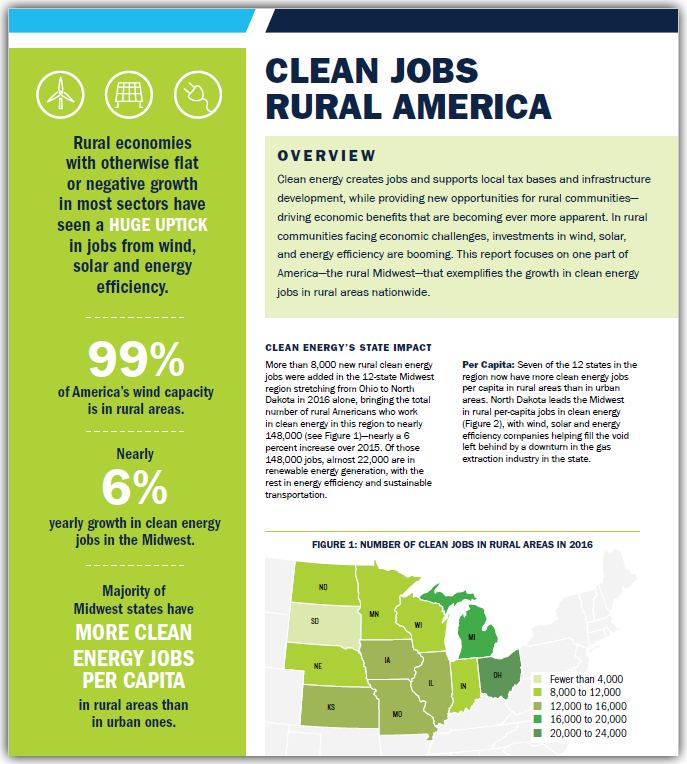
More than 8,000 new rural clean energy jobs were added in the 12-state Midwest region stretching from Ohio to North Dakota in 2016 alone, bringing the total number of rural Americans who work in clean energy in this region to nearly 148,000 (see Figure 1)—nearly a 6 percent increase over 2015. Of those 148,000 jobs, almost 22,000 are in renewable energy generation, with the rest in energy efficiency and sustainable transportation.
Key Findings
Majority of Midwest states have more clean energy jobs per capita in rural areas than urban ones
Clean energy employment represents a bright spot in rural communities that have otherwise lost population and jobs
Clean energy jobs in the Midwest are growing 6% a year
99% of U.S. wind capacity is in rural areas
Nearly 150,000 rural Midwesterners work in clean energy, including almost 22,000 in renewable energy generation
More than 8,000 new rural clean energy jobs were added in rural Midwest areas in 2016 alone
Looking for More Info?
This report follows E2’s Clean Jobs America analysis which found the clean energy jobs account for nearly 3.3 million jobs across all 50 states and the District of Columbia. Both reports expand on data from the U.S. Energy and Employment Report (USEER) produced by the Energy Futures Initiative (EFI) in partnership with the National Association of State Energy Officials (NASEO), using data collected and analyzed by the BW Research Partnership. E2 is a partner on the USEER, the fourth installment of the energy survey first released by the Department of Energy in 2016. Clean energy jobs have grown every year since the first report was released in 2016.
If you are looking for additional insight into E2’s Clean Jobs Rural Midwest 2018 or our other Clean Jobs America reports, visit e2.org/reports. You can also contact E2 Communications Director Michael Timberlake ([email protected]). An FAQ is also available here to answer any questions.
Illinois’ clean energy economy is clearly thriving.
But where is all this economic activity happening?
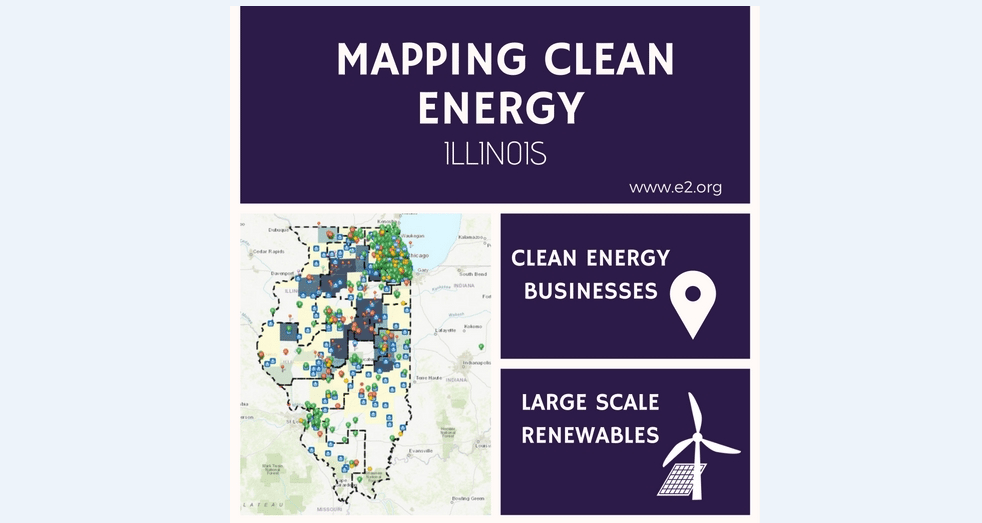
That’s exactly what E2 — along with our partners at FracTracker Alliance — attempted to find out with this interactive map showing the location of more than 1,000 clean energy businesses across the state as well as sites where renewable energy is generated.
The purpose of this map is to help policymakers, press and individuals better understand the scope of Illinois’s clean energy economy – and how much room it has to grow.
On the map you’ll find:
Clean energy businesses: Locations of energy efficiency and solar, wind and geothermal installers.
Renewable energy infrastructure: Existing and proposed utility-scale wind, solar and hydroelectric generation facilities larger than 1 MW as well as schools with solar energy generation and public EV fueling stations.
Income per capita and legislative and congressional district boundaries.
Key Takeaways from the Map:
There are nearly 1,000 businesses displayed in the map, which includes energy efficiency contractors and renewable energy (solar, wind and geothermal) installers, covering the vast majority of the state.
Half the state already has utility-scale renewable energy projects, with many utility-scale projects in the queue waiting to be built.
We’ve done our best to capture as many businesses as possible but we know we’ve missed some. This map isn’t comprehensive; it represents one snapshot in time of an industry to show how robust it is. If you know we’ve missed something, please send an email to Micaela Preskill at [email protected] and we’ll add it to the map.
How to Use the Map:
When viewing the map, zoom in to see the intricacies of what’s happening in each part of the state. If you click “Layers” on the black bar at the top of the map you will see a drop-down menu, which you can use to make data appear or disappear on the map.
For more information about what you’re seeing, click directly on the map. A pop-up box will appear to show you specifics. Use the arrows on the top right of the pop-up box to see all the information that applies to that spot on the map. For example, if you click on a pin representing a energy efficiency contractor, you’ll see information about that business. You can also use the arrow to see what legislative districts that business is in.
Michigan’s clean energy economy is clearly thriving.
But where is all this economic activity happening?
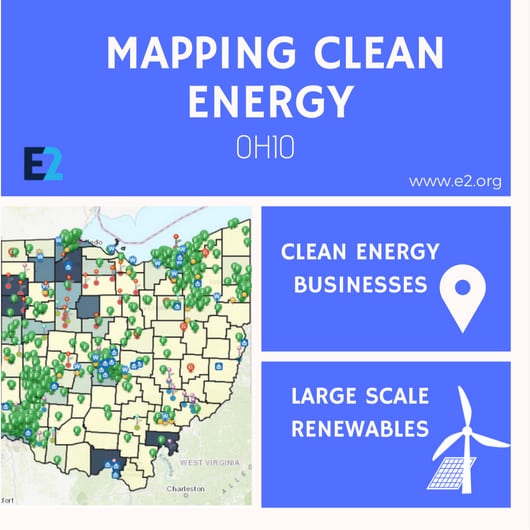
That’s exactly what E2 — along with our partners at FracTracker Alliance — attempted to find out with this series of interactive maps showing the location of more than 1,200 clean energy businesses across the state as well as sites where renewable energy is generated.
Since Michigan passed legislation in 2008 requiring utilities to generate 10% of their electricity from renewables by 2015, we’ve seen the state’s clean energy economy grow. Then in December of 2016 lawmakers decided to uphold and improve aspects of the state’s clean energy standards. The renewable portfolio standard was increased and new energy efficiency incentives were created to push utilities to do more. With recently strengthened laws, it is no surprise that Michigan’s clean energy sector – as seen on this series of maps – is so robust.
The purpose of these maps is to help policymakers, press and individuals better understand the scope of Michigan’s clean energy economy – and how much room it has to grow.
Key Takeaways
There are over 1,200 businesses displayed in the map, which includes energy efficiency contractors and renewable energy (solar, wind, and geothermal) installers, covering all 38 state senate districts and all 110 state house districts.
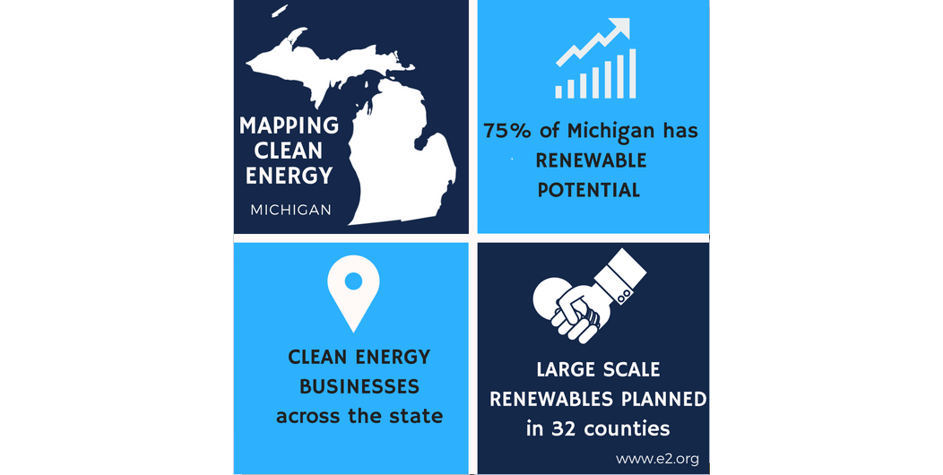
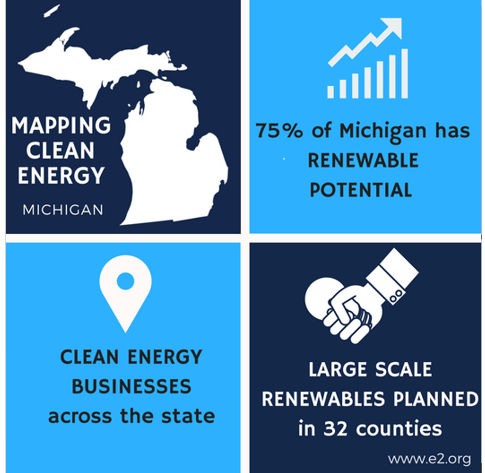
Approximately 75 percent of the state has potential for either wind, solar or geothermal power.
32 counties already have large-scale renewable energy projects, which many more projects in the queue waiting to be built
We’ve done our best to capture as many businesses as possible but if you know we’ve missed something, please send an email to Micaela Preskill ([email protected]) and we’ll add it to the map. This map isn’t comprehensive; it represents one snapshot in time of an industry to help you understand just how robust it is, and where it still has room to grow.
How to Use the Maps:
We’ve created 3 maps to show different parts of Michigan’s clean energy economy. One map shows clean energy businesses, one shows renewable energy utility-scale infrastructure, and one shows renewable energy potential.
When viewing the map, zoom in to see the intricacies of what’s happening in each part of the state. If you click “Layers” on the black bar at the top of the map you will see a drop-down menu, which you can use to make data appear or disappear on the map.
For more information about what you’re seeing, click directly on the map. A pop-up box will appear to show you specifics. Use the arrows on the top right of the pop-up box to see all the information that applies to that spot on the map. For example, if you click on a pin representing a energy efficiency contractor, you’ll see information about that business. You can also use the arrow to see what legislative districts that business is in.
The Maps
The Clean Energy Business Map shows locations of energy efficiency contractors and solar, wind and geothermal installers.
Clean Energy Businesses
The Renewable Energy Infrastructure Map shows utility-scale wind and solar generation facilities larger than 1 MW and schools with solar energy generation.
Renewable Energy Infrastructure
The Renewable Potential Map shows the potential for wind, geothermal and solar power generation.
SPRINGFIELD, IL (May 3, 2018) – The national, nonpartisan business group E2 (Environmental Entrepreneurs) today unveiled an interactive map pinpointing where renewable energy is being generated across Illinois, the location of public EV charging stations and schools with solar panels, and where nearly 1,000 Illinois clean energy businesses (solar, wind, and geothermal) are growing. “E2 created this […]
E2 San Diego Chapter Director, Carl Nettleton, draws attention to the business innovation abounding in the San Diego-Tijuana border region. In particular, he notes increased corporate sustainability initiatives such as energy efficiency and the use of renewables employed by the multinational manufacturing companies.
E&E News discusses the current status and issues facing Oregon’s effort to launch a California-style cap-and-trade system. “Those who are opposed just want to buy more time,” said Erik Wohlgemuth, chief operating officer of sustainability nonprofit Future 500, who is lobbying state lawmakers in Salem today with the group Environmental Entrepreneurs. “This has been studied, […]
With the Oregon State Legislature considering two versions of a bill to establish a statewide Cap-and-Invest program, E2 members from across the state sent this letter to all Oregon legislators urging both chambers to support this bill that will empower Oregon to continue its progress in combating climate change and to assert its position as […]
New Jersey Assemblymember, Andrew Zwicker, writes an op-ed instilling hope in a future in clean energy. Clean energy is already a tremendous job-driver in New Jersey. Three times more New Jerseyans work in solar- and wind-related jobs as do in fossil fuel electric generation. An analysis by ReThink Energy NJ and Environmental Entrepreneurs (E2), a national, […]
This past summer, Xcel Energy and a wide group of stakeholders at the Public Utilities Commission (PUC), filed a “Stipulation” – a proposed update to Xcel’s Electric Resource Plan. It is an agreement between Xcel, its customers, Colorado businesses, local environmental organizations and others on how and where Xcel sources its power. The plan would […]
But what, exactly, does the economic activity happening all across the state look like?
E2 — along with our partners at FracTracker Alliance, and in continuing partnership with New Yorkers for Clean Power and the Alliance for Clean Energy New York — attempted to find out.
We compiled a series of four maps showing the location of clean energy businesses across the state as well as sites where renewable energy is generated.
The purpose of the maps is to help policymakers, press and individuals better understand the scope of New York’s clean energy economy — and how much room it has to grow.
Map user’s guide
When viewing the map, note the “Layers” option on the black bar at the top of the map. Click the drop-down menu to select different layers of information. When a layer is selected, a description of that layer is displayed in the left-hand column.
E2’s Pennsylvania Clean Energy Map shows the location of clean energy businesses across the state as well as sites where renewable energy is generated.
The purpose of the map is to help policymakers, press and individuals better understand the scope of Pennsylvania’s clean energy economy – and how much room it has to grow.
Here’s the map:
Rural areas hubs of clean energy activity
As our map shows, as of June 2016 Pennsylvania had more than 2,500 megawatts (MW) of renewable energy capacity from solar, wind and small hydroelectric plants.
Of that capacity, about half – or 1,300 MW – comes from wind, while nearly 1,000 MW comes from small hydroelectric plants. The remaining 240 MW comes from solar photovoltaic (PV) projects – i.e., the solar panels that you see on rooftops and in fields.
The majority of clean energy businesses are located in the Philadelphia and Pittsburgh metro areas and surrounding counties. However, as the map shows, less-urban counties actually have the most renewable energy generating capacity.
For example, Lancaster County has the largest renewable energy generating capacity in the state, with 720-plus MW. Lancaster Countyis a solar leader. Its 1,000 solar systems and its nearly 50 MW of solar PV power generating capacity are both tops in the state, mainly due to the large number of farms now using solar energy.
Chester County is the state’s No. 2 solar county with more than 800 solar systems and 21 MW of generating capacity.
Cambria County’s Highland Wind Farm was developed on an old strip mine. (Photo courtesy of EverPower Wind Holdings)
Further west, Somerset and Cambria counties are Nos. 2-3 when it comes to overall renewable energy generating capacity, with 360-plus MW and about 250 MW, respectively. Both rely on wind for most of their renewable energy capacity.
The 62.5 MW Highland Wind Farm in Cambria County, for example, was brought online in 2009 by EverPower Wind Holdings. Situated on a reclaimed strip mine, nine full-time workers maintain and operate its 25 turbines.
Top 10 counties in PA for renewable energy generation
Ranking
County
Total Renewable Generation (MW)
1
Lancaster
774
2
Somerset
364
3
Cambria
248
4
Blair
157
5
Schuylkill
148
6
Wyoming
143
7
Bucks
130
8
Fayette
103
9
Tioga
101
10
Delaware
84
At Focus Farm, a turkey farm in Lewisburg, a rooftop solar array installed by Energy Independent Solutions helped create jobs in a rural part of Central Pennsylvania. (Photo courtesy of EIS Solar)
6,000 clean energy businesses in Pennsylvania
As outlined in E2’s “Clean Jobs PA” report, there are 66,000 clean energy jobs at nearly 6,000 clean energy businesses in Pennsylvania. This was based on data collected from the U.S. Bureau of Labor Statistics and from a BW Research Partners survey of hundreds of Pennsylvania companies.
Map user’s guide
When viewing the map, note the “Layers” option on the black bar at the top of the map. Click the drop-down menu to select different layers of information. When a layer is selected, a description of that layer is displayed in the left-hand column.
The Clean Energy Businesses layer shows locations of businesses involved in the solar, energy efficiency, geothermal, and “other” sectors. See “Registry” for the types of businesses included. When clicking the icon on the map, the user can view information about that particular business.
The Utility-ScaleRenewable Energy Facilities layer shows utility-scale wind, solar and hydroelectric generation facilities larger than 1 MW. This information is derived from the U.S. Energy Information Agency, retrieved July 2016. [Source: http://www.eia.gov/maps/layer_info-m.cfm, Power Plants data set, last updated 7/7/2016]
The Commercial and Residential PV Systems layer shows 7,035 commercial and residential solar PV generation facilities. To protect the privacy of individual home and business owners, the icons are randomly placed within the zip code region of each address. Exact addresses for these locations are not shown, and when the map is enlarged, these icons disappear.
[Note: Data for the Commercial and Residential PV Systems Data layer was retrieved from a Right-to-Know Request from the Pennsylvania Department of Environmental Protection by the Mid-Atlantic Renewable Energy Association (MAREA) of all the solar PV systems that received Pennsylvania Sunshine Grant money through the closure of that program in December 2013. As of June 28, 2016, there were 8,518 solar PV systems in Pennsylvania registered with PJM, so almost 1,500 of these systems do not appear on the map because their locations are not available.]
State and House Districts layers outline Pennsylvania state legislative districts.
More about the map
The Clean Energy Map of PA includes companies from E2’s jobs report survey. The map also includes data from Conservation Service Providers registered with the Pennsylvania Public Utility Commission to provide services under Act 129, as well as data obtained via internet searches of clean energy companies throughout the state.
The map is a dynamic, “living” tool. It will continually capture and update information on companies helping expand Pennsylvania’s clean energy economy. Every month, we add clean energy companies to the map. (However, it is important to note that we do not endorse or vet companies that choose to be included in the map.)
DENVER, CO (Dec. 10, 2025) – Clean energy jobs grew more than five times faster in Colorado than the rest of the state's economy in 2024, raising the total number of clean energy workers in the state to 69,859 – 18th most in the country – according to the s...
The National Highway Traffic Safety Administration (NHTSA) is expected to announce the Administration’s intent to weaken federal Corporate Average Fuel Economy (CAFE) standards for vehicles. Such a dramatic shift in policy would halt five decades of progres...
WASHINGTON –Businesses canceled, closed, and scaled back more than $4.4 billion worth of large-scale factories and clean energy projects from late-September through October, bringing the total cost of projects cancelled in the private-sector to over $28.7 b...
December 2 2025
Donate Today
Make a donation to help E2 advance policies that are good for the economy and good for the environment. Your donation is 100% tax-deductible from our partner, the NRDC.
Please contact E2 Membership Director Ying Li at [email protected] or 212-727-4437 for stock and wire transfer instructions.
For stocks, alert us to the transfer and provide the name of the stock and the number of shares being donated. This will help us track your donation internally and enable NRDC to provide an accurate gift receipt in a timely fashion.
Donations to E2 go directly to NRDC, a 501(c)3, and are fully tax-deductible (Federal Tax ID: 13-2654926). E2 collects no funds. NRDC provides full-time staffing dedicated to E2, as well as administrative, communications, legislative and analyst/policy support for the work of E2.
By Check
Make personal, Foundation or Donor Advised Fund checks payable to NRDC (indicate your donation is for E2 Membership to expedite processing) and send to:
Natural Resources Defense Council
Attn: Gift Processing
40 West 20th Street, 11th floor
New York, NY 10011