
Archives
Clean Energy & COVID-19 Crisis | June 2020 Unemployment Analysis
 Clean Energy Unemployment Claims in COVID-19 Aftermath, June 2020
The U.S. clean energy sector added 106,320 jobs in June, leaving over half a million (514,270) clean energy workers out of work despite nationwide re-openings. Despite the gains in June, there remains a nearly 15 percent decline over pre-COVID-19 employment levels, according to the latest analysis of unemployment data by BW Research for E2, E4TheFuture, and the American Council on Renewable Energy (ACORE).
In all, clean energy employment is still down 15 percent from the start of the year, when nearly 3.4 million Americans worked in renewable energy, energy efficiency, clean vehicles and fuels and other clean energy sectors.
While the June jobs improvement is an encouraging sign of clean energy’s ability to quickly put Americans back to work, resuming a robust recovery in one of the nation’s biggest employment sectors anytime soon remains unlikely without direct action by Congress. Only one out of every six clean energy jobs lost since March returned in June, and as federal Paycheck Protection Program (PPP) funds are exhausted and states are forced to close businesses again in the face of COVID-19’s resurgence, more layoffs could be imminent without congressional action. According to the analysis, as many as 2.3 million clean energy workers are employed by small businesses that received PPP loans.
Other troubling trends include a sharp increase in permanent job losses, rising initial weekly unemployment claims, and COVID-19 cases spiking in states with some of the largest clean energy workforces, according to the analysis.
Before March, clean energy had been one of the U.S. economy’s biggest and fastest-growing employment sectors, growing 10.4% since 2015 to 3.4 million jobs at the end of 2019. That made clean energy by far the biggest employer of workers in all energy occupations, employing nearly three times as many people as the fossil fuel industry.
By Industry Job Losses, June 2020
| SECTOR | MARCH | APRIL | MAY | JUNE | TOTAL |
| Energy Efficiency | -103,298 | -309,584 | -18,880 | +71,786 | -359,976 |
| Renewables | -23,739 | -71,705 | -4,272 | +17,287 | -82,429 |
| Clean Vehicles | -11,399 | -35,070 | -2,059 | +10,335 | -38,193 |
| Grid & Storage | -6,517 | -19,666 | -1,166 | +4,561 | -22,788 |
| Clean Fuels | -2,186 | -10,390 | -657 | +2,351 | -10,882 |
| INDUSTRY TOTAL | -147,139 | -446,416 | -27,035 | +106,320 | -514,270 |
State With Most Job Losses, May 2020
| State | March | April | May | June | Total Claims |
| US TOTAL | -147,139 | -446,416 | -27,035 | +106,320 | -514,270 |
| California | -27,583 | -77,815 | -4,313 | +19,831 | -89,881 |
| Texas | -5,965 | -25,170 | -1,709 | +7,997 | -24,847 |
| Florida | -3,963 | -25,949 | -2,563 | +5,832 | -26,643 |
| Michigan | -7,867 | -22,245 | -1,012 | +6,465 | -31,124 |
| Georgia | -1,909 | -25,282 | -1,741 | +1,579 | -27,353 |
| North Carolina | -9,124 | -17,138 | -955 | +5,837 | -21,380 |
| Pennsylvania | -8,283 | -12,780 | -571 | +2,689 | -18,945 |
| Washington | -5,646 | -14,433 | -1,163 | +2,729 | -18,513 |
| New York | -6,006 | -13,868 | -848 | +3,314 | -17,408 |
| Ohio | -6,929 | -12,879 | -612 | +3,387 | -16,582 |
For a full breakdown of clean energy jobs losses in each state, see the full analysis here.
Download
The complete report is available for download at this link.
Looking for More Info?
 The analysis expands on data from the 2020 U.S. Energy and Employment Report (USEER) produced by the Energy Futures Initiative (EFI) in partnership with the National Association of State Energy Officials (NASEO), using data collected and analyzed by the BW Research Partnership. The report was released in March 2020 and is available at www.usenergyjobs.org. E2 is a partner on the USEER, the fifth installment of the energy survey first released by the Department of Energy in 2016 and subsequently abandoned under the Trump administration.
If you are looking for additional insight into this report or E2’s more than a dozen other annual clean energy employment reports, visit e2.org/reports. You can also contact E2 Communications Director Michael Timberlake ([email protected]).
Sign-Up for Email Updates
"*" indicates required fields
View Report »
Sign-Up for Email Updates
"*" indicates required fields
House Infrastructure Bill Meets the “Severity of the Challenges” U.S. Faces; Clean Energy Stimulus Needed Next
Statement from Director of Federal Advocacy, Sandra Purohit WASHINGTON (July 1, 2020) – The House of Representatives today passed the “Moving Forward Act” (H.R. 2), a $1.5 trillion infrastructure bill that prioritizes clean energy to combat the looming threat of climate change and accelerates America’s economic recovery. The bill includes investments in clean energy, clean […]
Time is Now to Embrace Clean Energy, House Dems Climate Action Plan
WASHINGTON – The House Select Committee on the Climate Crisis called on the need for investments in the clean energy economy, making it a focal point of the Committee’s Climate Crisis Action Plan released today. If enacted, the Plan would achieve net zero carbon emissions in the U.S. by 2050. Addressing climate change by unlocking […]
Clean Jobs Midwest 2020
 Home to 744,000 Clean Energy Jobs
Prior to the COVID-19 crisis, clean energy companies employed more than 744,000 Midwesterners and clean energy jobs were growing in nearly every state, according to the latest available data. Across the region in 2019, the industry added more than 7,500 new jobs. At the end of 2019, more people in the Midwest worked in clean energy than the combined workforce of real estate agents and brokers, computer programmers, web developers, and waiters and waitresses. However, according to a recent analysis of U.S. Department of Labor unemployment data, in just the first three months after the pandemic began more than 131,600 workers in clean energy-related companies lost their jobs.
MIDWEST HIGHLIGHTS
- Energy Efficiency – 534,567 jobs
- Renewable Energy – 87,307 jobs
- Grid & Storage – 26,251 jobs
- Clean Vehicles – 87,993 jobs
- Clean Fuels – 7,923 jobs
- ALL Clean Energy Sectors – 744,041 jobs
OTHER KEY FINDINGS
The Midwest’s largest clean energy employer was energy efficiency. The sector has been home to more than 70 percent of all the region’s clean energy jobs. Last year, the Midwest also saw job growth rate increases in clean fuels (2.9 percent), grid and storage (3.4 percent), and renewable energy generation (2.7 percent).
Clean energy jobs are found in every corner of the region. While big cities like Chicago (88,930 jobs), Detroit (55,470 jobs), and Minneapolis (38,920 jobs) were some of the largest hubs for clean energy jobs, more than one in five — or more than 158,000 — were at the end of 2019 located in rural areas.
Thousands of Midwestern companies hire clean energy workers every year. Before the crisis hit, these employers anticipated adding nearly 37,000 clean energy jobs in 2020 — a nearly 5 percent growth rate.
DOWNLOAD
The complete report along with interactive breakdowns for all states is available at this link.
LOOKING FOR MORE INFO?

This report follows E2’s Clean Jobs America analysis which found the clean energy jobs account for nearly 3.3 million jobs across all 50 states and the District of Columbia. Both reports expand on data from the 2020 U.S. Energy and Employment Report (USEER) produced by the Energy Futures Initiative (EFI) in partnership with the National Association of State Energy Officials (NASEO), using data collected and analyzed by the BW Research Partnership. E2 is a partner on the USEER, the fifth installment of the energy survey first released by the Department of Energy in 2016. Clean energy jobs have grown every year since the first report was released in 2016.
If you are looking for additional insight into E2’s Clean Jobs Midwest or our other Clean Jobs America reports, visit e2.org/reports. You can also contact E2 Communications Director Michael Timberlake ([email protected]). An FAQ is also available here to answer any questions.
View Report »Clean Jobs California 2020
 America’s Clean Energy Powerhouse in the Wake of COVID-19
After a fifth straight year of job growth since E2 (Environmental Entrepreneurs) began tracking U.S. clean energy employment, California’s clean energy economy is facing a torrent of job losses and work freezes so significant it could set the industry back years. What had been one of the nation’s fastest-growing job sectors over the last five years is now one of the fastest-shrinking in the wake of COVID-19-related shutdowns disrupting supply chains and building energy efficiency projects, halting new developments and emptying project pipelines, and slowing investments while wrecking financial outlooks.
Entering 2020, California’s clean energy economy had grown for five straight years since this annual report was first released with clean energy jobs growing to make up 3 percent of the state’s entire workforce.
E2’s Clean Jobs California 2020 details the sheer size of this important employment sector, the troubles it is currently facing due to COVID-19 and how focusing recovery policies on clean energy can get the Golden State’s economy humming again—quickly and for the long run.
INDUSTRY JOB TOPLINES | Q4 2019
- Energy Efficiency – 323,529 jobs
- Renewable Energy –142,957 jobs
- Solar Energy – 124,817 jobs
- Wind Energy – 2,520 jobs
- Clean Vehicles – 40,627 jobs
- Clean Storage – 17,397 jobs
- Grid Modernization – 6,625 jobs
- ALL Clean Energy Sectors – 536,919 jobs
DOWNLOAD
The complete report is available for download at this link.
Looking for More Info?
 The analysis expands on data from the 2020 U.S. Energy and Employment Report (USEER) produced by the Energy Futures Initiative (EFI) in partnership with the National Association of State Energy Officials (NASEO), using data collected and analyzed by the BW Research Partnership. The report was released in March 2020and is available at www.usenergyjobs.org. E2 is a partner on the USEER, the fifth installment of the energy survey first released by the Department of Energy in 2016 and subsequently abandoned under the Trump administration. Clean energy jobs have grown every year since the first report was released in 2016.
If you are looking for additional insight into E2’s Clean Jobs California 2020 or our other Clean Jobs America reports, visit e2.org/reports. You can also contact E2 Communications Director Michael Timberlake ([email protected]). An FAQ is also available here to answer any questions.
PAST CLEAN JOBS AMERICA REPORTS
Clean Jobs America 2020 is the 3rd clean energy jobs report for California from E2. Previous reports can be accessed in the below links.
View Report »Gov. Sisolak Advances Clean Cars at Critical Time for Industry, Workers
Statement from E2 Mountain West Advocate Susan Nedell CARSON CITY (June 22, 2020) – Governor Steve Sisolak today announced Nevada will begin a low-emission (LEV) and zero-emission vehicle (ZEV) rulemaking process. If implemented, Nevada would become the 14th state, not including the District of Columbia, to adopt Clean Cars Standards. Nevada has already joined nearly […]
‘Clean Cars Nevada’ initiative mandates auto dealers offer more electric vehicles by 2025
Governor Steve Sisolak announced Nevada will consider adopting new standards requiring a higher percentage of vehicles sold in-state be electric. “Its really looking to the future; electric vehicles coming, spur it on, bring it a lot of benefits to all people whether or not you decide to buy an electric vehicle,” said Susan Nedell, of […]
Clean Energy & COVID-19 Crisis | May 2020 Unemployment Analysis
 Clean Energy Unemployment Claims in COVID-19 Aftermath, May 2020
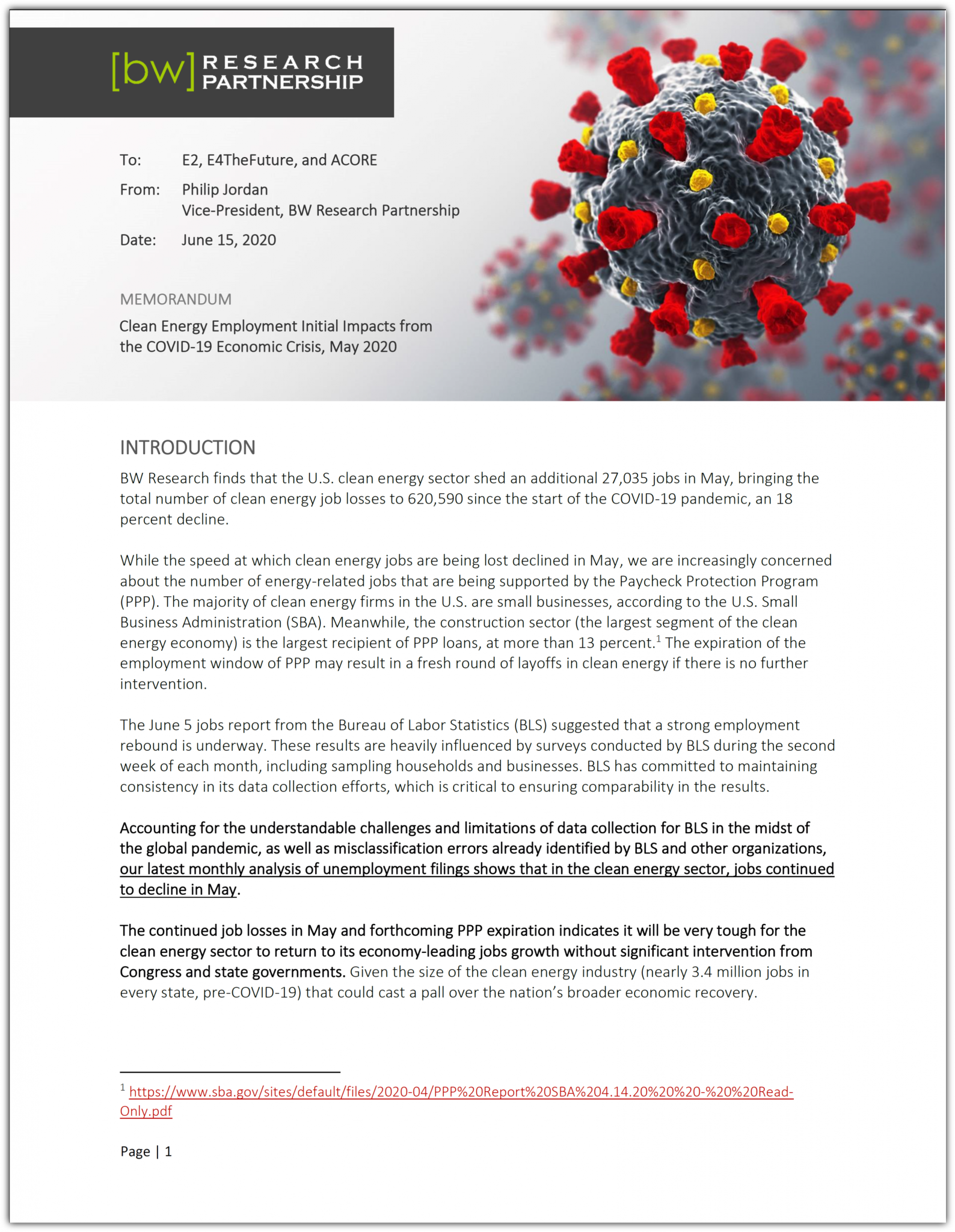
More than 620,000 U.S. clean clean energy workers have lost their jobs since March after 27,000 new workers filed unemployment claims in May, according to the latest analysis of unemployment data by BW Research for E2, E4TheFuture, and the American Council on Renewable Energy (ACORE).
The analysis of Department of Labor data found that 620,590 workers in clean energy occupations, representing 18.5% of the industry’s workforce, filed for unemployment benefits in March, April, and May. The number of jobs lost is more than double the number of clean energy jobs created since 2017.
While the speed at which clean energy jobs are being lost declined in May, there are increasing concerns about the number of energy-related jobs that are being supported by the Paycheck Protection Program (PPP). The majority of clean energy firms in the U.S. are small businesses, according to the U.S. Small Business Administration (SBA). Meanwhile, the construction sector (the largest segment of the clean energy economy) is the largest recipient of PPP loans, at more than 13 percent. The expiration of the employment window of PPP may result in a fresh round of layoffs in clean energy if there is no further intervention.
The continued job losses in May and forthcoming PPP expiration indicates it will be very tough for the clean energy sector to return to its economy-leading jobs growth without significant intervention from Congress and state governments. Given the size of the clean energy industry (nearly 3.4 million jobs in every state, pre-COVID-19) that could cast a pall over the nation’s broader economic recovery.
Before March, clean energy had been one of the U.S. economy’s biggest and fastest-growing employment sectors, growing 10.4% since 2015 to 3.4 million jobs at the end of 2019. That made clean energy by far the biggest employer of workers in all energy occupations, employing nearly three times as many people as the fossil fuel industry.
By Industry Job Losses, May 2020
| Sector | March Claims (adj) | April Claims (adj) | May Claims | Total |
| Energy Efficiency | 103,298 | 309,584 | 18,880 | 431,762 |
| Renewables | 23,739 | 71,705 | 4,272 | 99,717 |
| Clean Vehicles | 11,399 | 35,070 | 2,059 | 48,528 |
| Grid & Storage | 6,517 | 19,666 | 1,166 | 27,349 |
| Clean Fuels | 2,186 | 10,390 | 657 | 13,233 |
| TOTAL | 147,139 | 446,416 | 27,035 | 620,590 |
State With Most Job Losses, May 2020
| State | March Claims (adj) | April Claims (adj) | May Claims | Total Claims |
| US TOTAL | 147,139 | 446,416 | 27,035 | 620,590 |
| California | 27,583 | 77,815 | 4,313 | 109,712 |
| Texas | 5,965 | 25,170 | 1,709 | 32,844 |
| Florida | 3,963 | 25,949 | 2,563 | 32,475 |
| Michigan | 7,867 | 22,245 | 1,012 | 31,124 |
| Georgia | 1,909 | 25,282 | 1,741 | 28,932 |
| North Carolina | 9,124 | 17,138 | 955 | 27,217 |
| Pennsylvania | 8,283 | 12,780 | 571 | 21,634 |
| Washington | 5,646 | 14,433 | 1,163 | 21,242 |
| New York | 6,006 | 13,868 | 848 | 20,722 |
| Ohio | 6,929 | 12,879 | 612 | 20,420 |
For a full breakdown of clean energy jobs losses in each state, see the full analysis here.
Download
The complete report is available for download at this link.
Listen
A live press conference was held announcing the report’s findings on June 15, featuring:
- Bob Keefe, executive director, Environmental Entrepreneurs (E2);
- Pat Stanton, director of policy, E4TheFuture;
- Gregory Wetstone, president & CEO, American Council on Renewable Energy (ACORE);
- Phil Jordan, vice-president and principal, BW Research;
To download and listen to the one-hour press conference, click here.
Looking for More Info?
The analysis expands on data from the 2020 U.S. Energy and Employment Report (USEER) produced by the Energy Futures Initiative (EFI) in partnership with the National Association of State Energy Officials (NASEO), using data collected and analyzed by the BW Research Partnership. The report was released in March 2020 and is available at www.usenergyjobs.org. E2 is a partner on the USEER, the fifth installment of the energy survey first released by the Department of Energy in 2016 and subsequently abandoned under the Trump administration.
If you are looking for additional insight into this report or E2’s more than a dozen other annual clean energy employment reports, visit e2.org/reports. You can also contact E2 Communications Director Michael Timberlake ([email protected]).
Sign-Up for Email Updates
"*" indicates required fields
View Report »
Sign-Up for Email Updates
"*" indicates required fields
Good for California’s Economy and Environment: E2 Business Community Supports Accelerating the Transition to Zero-Emission Trucks
California is indisputably a world leader on climate action — and that commitment to reducing greenhouse gas emissions has driven substantial economic growth, from $66 billion in clean energy investments to nearly 540,000 clean energy jobs. With the state’s transportation sector — and the fossil fuels that power it — accounting for nearly half of […]
Support a Robust Advanced Clean Trucks Rule in California
As the California Air Resources Board considers the Advanced Clean Trucks rule to bring clean trucks to market at the scale necessary to help California meet its 2030 emission reduction target and achieve its goal of carbon-neutrality by 2045, 268 California private sector leaders, investors, entrepreneurs, and other business professionals signed onto this E2 letter […]
Clean Energy & COVID-19 Crisis | April 2020 Unemployment Analysis
 Clean Energy Unemployment Claims in COVID-19 Aftermath, April 2020
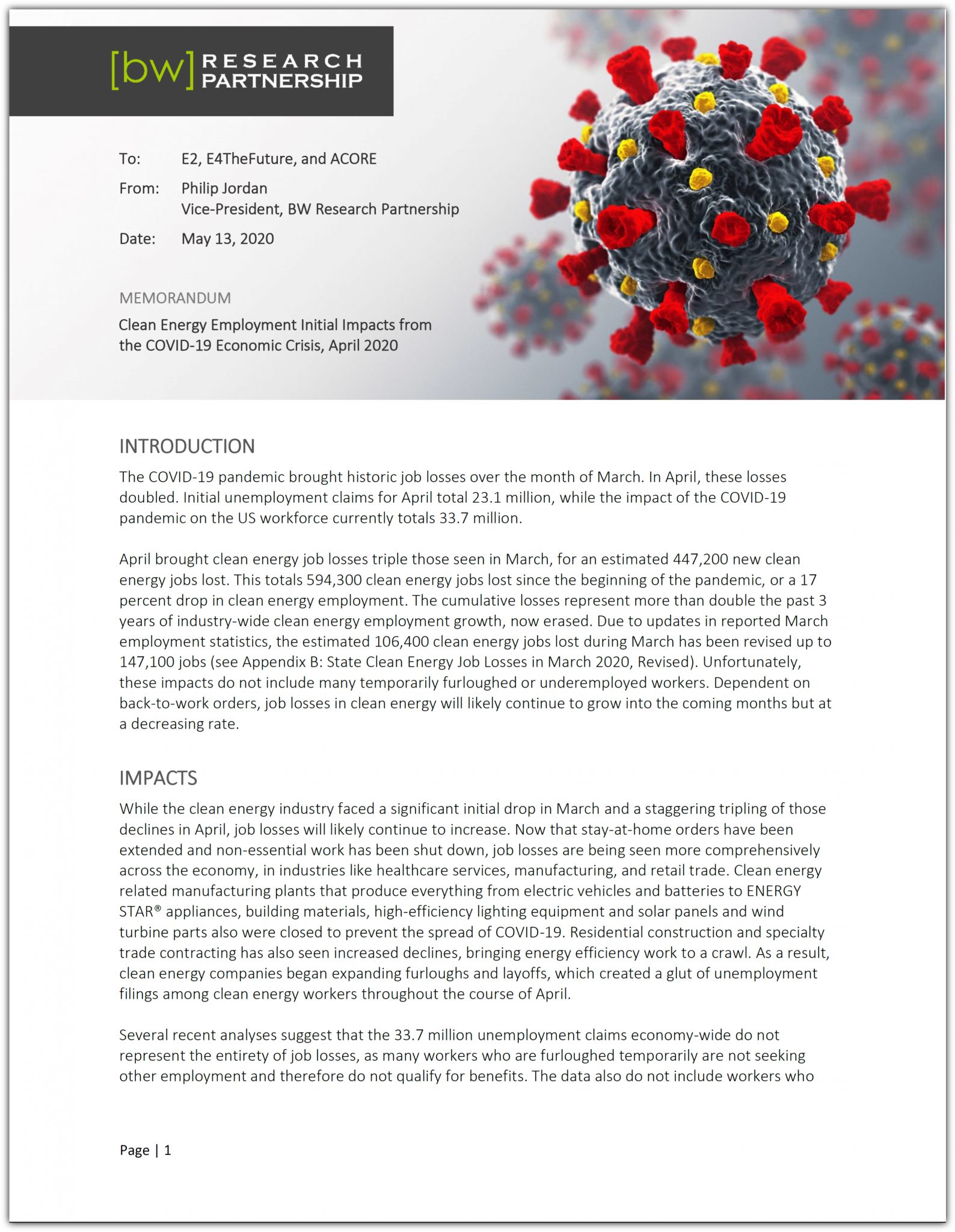
Nearly 600,000 U.S. clean clean energy workers have lost their jobs since March after 447,208 new workers filed unemployment claims in April, according to the latest analysis of unemployment data by BW Research for E2, E4TheFuture, and the American Council on Renewable Energy.
The analysis of Department of Labor data found that 594,347 workers in clean energy occupations, representing 17.8% of the industry’s workforce, filed for unemployment benefits in April and March. The number of jobs lost is more than double the number of clean energy jobs created since 2017. Before March, clean energy had been one of the U.S. economy’s biggest and fastest-growing employment sectors, growing 10.4% since 2015 to 3.4 million jobs at the end of 2019. That made clean energy by far the biggest employer of workers in all energy occupations, employing nearly three times as many people as the fossil fuel industry.
The job losses are across a wide variety of occupations, and in every state. Energy efficiency workers are losing their jobs after being shut out of homes and buildings to prevent the spread of the coronavirus. Solar and wind turbine companies are laying off workers as they’re unable to access panels and parts stranded in shut-down factories and as financing disappears. Factory workers are being let go as assembly lines for Energy Star appliances and electric and hybrid vehicles are ground to a halt.
By Industry Job Losses, April 2020
| Sector | March Claims (adj*) | April Claims | Total Claims |
| Energy Efficiency | 103,298 | 310,188 | 413,486 |
| Renewables | 23,739 | 71,835 | 95,574 |
| Clean Vehicles | 11,339 | 35,101 | 46,501 |
| Grid & Storage | 6,517 | 19,685 | 26,202 |
| Clean Fuels | 2,186 | 10,398 | 12,584 |
| INDUSTRY TOTAL | 147,139 | 447,208 | 594,347 |
State With Most Job Losses, April 2020
| State | March Claims (adj.*) | April Claims | Total Claims |
| US TOTAL | 147,139 | 447,208 | 594,347 |
| California | 27,583 | 77,860 | 105,443 |
| Texas | 5,965 | 25,227 | 31,192 |
| Michigan | 7,867 | 22,284 | 30,150 |
| Florida | 3,963 | 25,915 | 29,878 |
| Georgia | 1,909 | 25,251 | 27,161 |
| North Carolina | 9,124 | 17,293 | 26,417 |
| Pennsylvania | 8,283 | 12,810 | 21,093 |
| New York | 6,006 | 14,398 | 20,405 |
| Washington | 5,646 | 14,593 | 20,239 |
| Ohio | 6,929 | 12,869 | 19,798 |
For a full breakdown of clean energy jobs losses in each state, see the full analysis here.
Download
The complete report is available for download at this link.
Listen
A live press conference was held announcing the report’s findings on May 13, featuring:
- Bob Keefe, executive director, Environmental Entrepreneurs (E2);
- Pat Stanton, director of policy, E4TheFuture;
- Gregory Wetstone, president & CEO, American Council on Renewable Energy (ACORE);
- Phil Jordan, vice-president and principal, BW Research;
To download and listen to the one-hour press conference, click here.
Looking for More Info?
The analysis expands on data from the 2020 U.S. Energy and Employment Report (USEER) produced by the Energy Futures Initiative (EFI) in partnership with the National Association of State Energy Officials (NASEO), using data collected and analyzed by the BW Research Partnership. The report was released in March 2020 and is available at www.usenergyjobs.org. E2 is a partner on the USEER, the fifth installment of the energy survey first released by the Department of Energy in 2016 and subsequently abandoned under the Trump administration.
If you are looking for additional insight into this report or E2’s more than a dozen other annual clean energy employment reports, visit e2.org/reports. You can also contact E2 Communications Director Michael Timberlake ([email protected]).
Sign-Up for Email Updates
"*" indicates required fields
View Report »
Sign-Up for Email Updates
"*" indicates required fields