Energy-Efficiency Jobs Continue to Boom in Ohio
According to a report released Monday, Ohio added more than 2,000 energy-efficiency jobs in 2018. That’s a nearly 5% increase – compared with the overall state employment growth rate of less than 1%.

According to a report released Monday, Ohio added more than 2,000 energy-efficiency jobs in 2018. That’s a nearly 5% increase – compared with the overall state employment growth rate of less than 1%.
Energy efficiency is the fastest-growing segment of U.S. energy-sector employment, now employing more than 2.3 million Americans, according to a new analysis from E4TheFuture and the national, nonpartisan business group E2 (Environmental Entrepreneurs). Energy efficiency workers now account for 28% of all U.S. energy jobs. … “We all know energy efficiency saves consumers and businesses money with […]
The number of energy efficiency jobs grew 3.4 percent in the United States last year, more than double the average annual growth rate for jobs overall, according to a study by Massachusetts-based residential clean energy advocate E4TheFuture and Washington-based clean energy business advocacy group E2.
The number of energy efficiency jobs in Michigan grew 2.9 percent in 2018 and the industry now employs 85,061 workers in the state, ranking it the eighth highest in the nation, according to a new report from Environmental Entrepreneurs. … Earlier this year, E2 released its Clean Jobs Midwest report that showed a 4 percent increase to […]
The Tampa-St. Petersburg-Clearwater metro area has the second highest number of energy efficiency jobs in Florida behind only Miami-Fort Lauderdale in 2018, a recent report found. The study, which was conducted by E4 the Future and E2, found the Tampa Bay area had 15,286 energy efficiency jobs in 2018.
Nearly 2.5 million Americans, including 3,690 employees in Chattanooga, worked in energy efficiency-related jobs in 2018. The third annual “Energy Efficiency Jobs in America” report from the national, nonpartisan business group E2 (Environmental Entrepreneurs) said energy efficiency accounted for one of every four energy jobs last year and was the fastest growing part of the […]
The number of energy efficiency jobs grew 3.4 percent in the United States last year, more than double the average annual growth rate for jobs overall, according to a study by Massachusetts-based residential clean energy advocate E4TheFuture and Washington-based clean energy business advocacy group E2.
Industry now employs 2.3 million Americans; grew 3.4% in 2018 28% of U.S. energy workers are employed by energy efficiency businesses Top 10 States: Calif., Texas, N.Y., Fla., Ill., N.C., Mass., Mich., Ohio, Va. EE employs 2X as many Americans as fossil fuel industries LOS ANGELES – Energy efficiency is the fastest-growing segment of U.S. […]
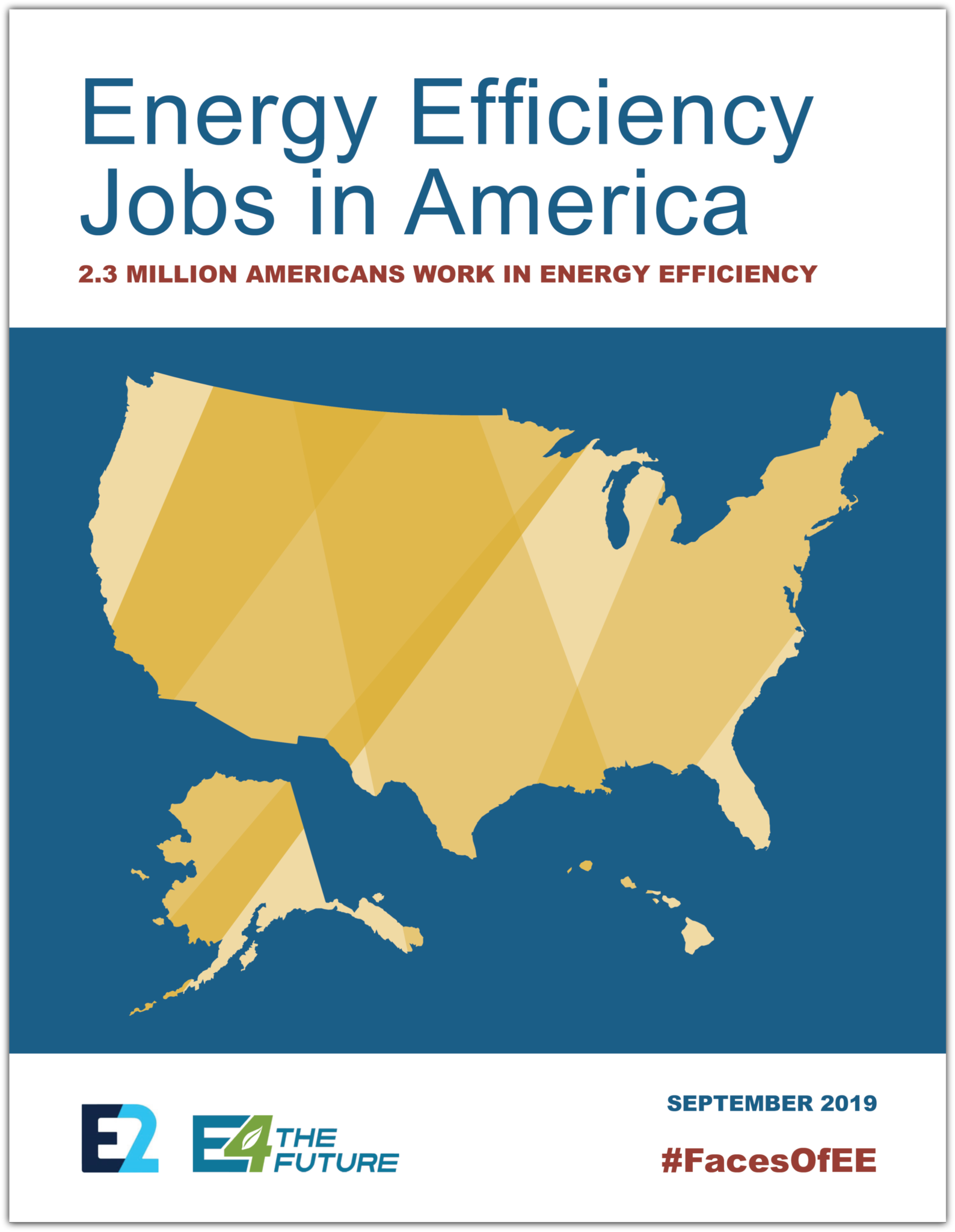 Leading America’s Energy Workforce
For the second year in a row, energy efficiency is America’s fastest-growing energy industry — accounting for about half (76,000) of the sector’s entire job growth in 2018 (151,700) — now eclipsing 2.3 million American workers.
Led by a growth rate double the nationwide average, energy efficiency is currently responsible for one out of every four jobs in the energy sector while employing more Americans than the entire fossil fuel industry in 41 states and the District of Columbia. Nationwide, energy efficiency businesses employs twice the number of workers as fossil fuels.
This sector’s consistently strong year-over-year job growth—and growing integration in the economic value chain and built environment—is turning the industry into the energy sector’s most viable (and efficient) job creator. Across every time zone, state, county line, and even zip code, energy efficiency solutions are advancing economic opportunities for American workers and their families. Jobs that will grow locally, jobs that cannot be outsourced.
The 2019 Energy Efficiency Jobs in America report includes an 7-page national summary and individual factsheets for all 50 U.S. states and the District of Columbia that include more detailed findings including job totals for every congressional and legislative district, industry and technology breakdowns, and maps of every state’s top counties.
Alabama | Alaska | Arizona | Arkansas | California | Colorado | Connecticut | Delaware |District of Columbia| Florida | Georgia | Hawaii | Idaho | Illinois | Indiana | Iowa| Kansas | Kentucky | Louisiana | Maine | Maryland |Massachusetts | Michigan| Minnesota | Mississippi | Missouri | Montana | Nebraska | Nevada | New Hampshire | New Jersey | New Mexico | New York | North Carolina | North Dakota | Ohio | Oklahoma | Oregon| Pennsylvania | Rhode Island | South Carolina | South Dakota | Tennessee | Texas | Utah | Vermont | Virginia | Washington | West Virginia | Wisconsin | Wyoming |
This annual report focuses solely on the energy sector of the economy. Jobs in retail trade, vehicle efficiency-related work, and the 4.2 million jobs related to efficient manufacturing processes are excluded from these numbers.
According to the 2019 Energy Efficiency Jobs in America, America’s energy efficiency sector:


For questions on this report, methodology, reported job numbers, or requests for specific additional data, email E2 Communications Director Michael Timberlake ([email protected]). An FAQ for the report, including answers to questions on methodology, is available here.
If you are looking for additional insight into E4The Future and E2’s other research and publications on the energy economy, visit E4TheFuture’s Publications homepage or E2’s Reports homepage.
This report follows E2’s Clean Jobs America analysis which found the clean energy jobs account for nearly 3.3 million jobs across all 50 states and the District of Columbia. Both reports expand on data from the U.S. Energy and Employment Report (USEER) produced by the Energy Futures Initiative (EFI) in partnership with the National Association of State Energy Officials (NASEO), using data collected and analyzed by the BW Research Partnership. E2 is a partner on the USEER, the fourth installment of the energy survey first released by the Department of Energy in 2016. Clean energy jobs have grown every year since the first report was released in 2016.
Energy Efficiency Jobs in America is only one in a series of state and industry reports produced by E2 and our partners.
Clean Jobs for Western Colorado: E2’s 2019 Clean Jobs report release & panel discussion E2 and the Grand Junction Cleantech Business Coalition are co-hosting the release of E2’s 2019 Clean Jobs Colorado report detailing the economic importance of clean jobs to Western Colorado. You’ll get the latest data on clean tech jobs, network […]
Job growth outpaces national (1.5%) and statewide rates (2.4%) Clean energy employs 26K more workers than fossil fuels in CO Jackson, Denver, Boulder, Broomfield, Alamosa counties lead state in clean jobs per capita. Growth rate led by clean vehicles (22.5%) and energy efficiency (7.2%) GRAND JUNCTION (September 12, 2019) – Nearly 60,000 Coloradans now work […]
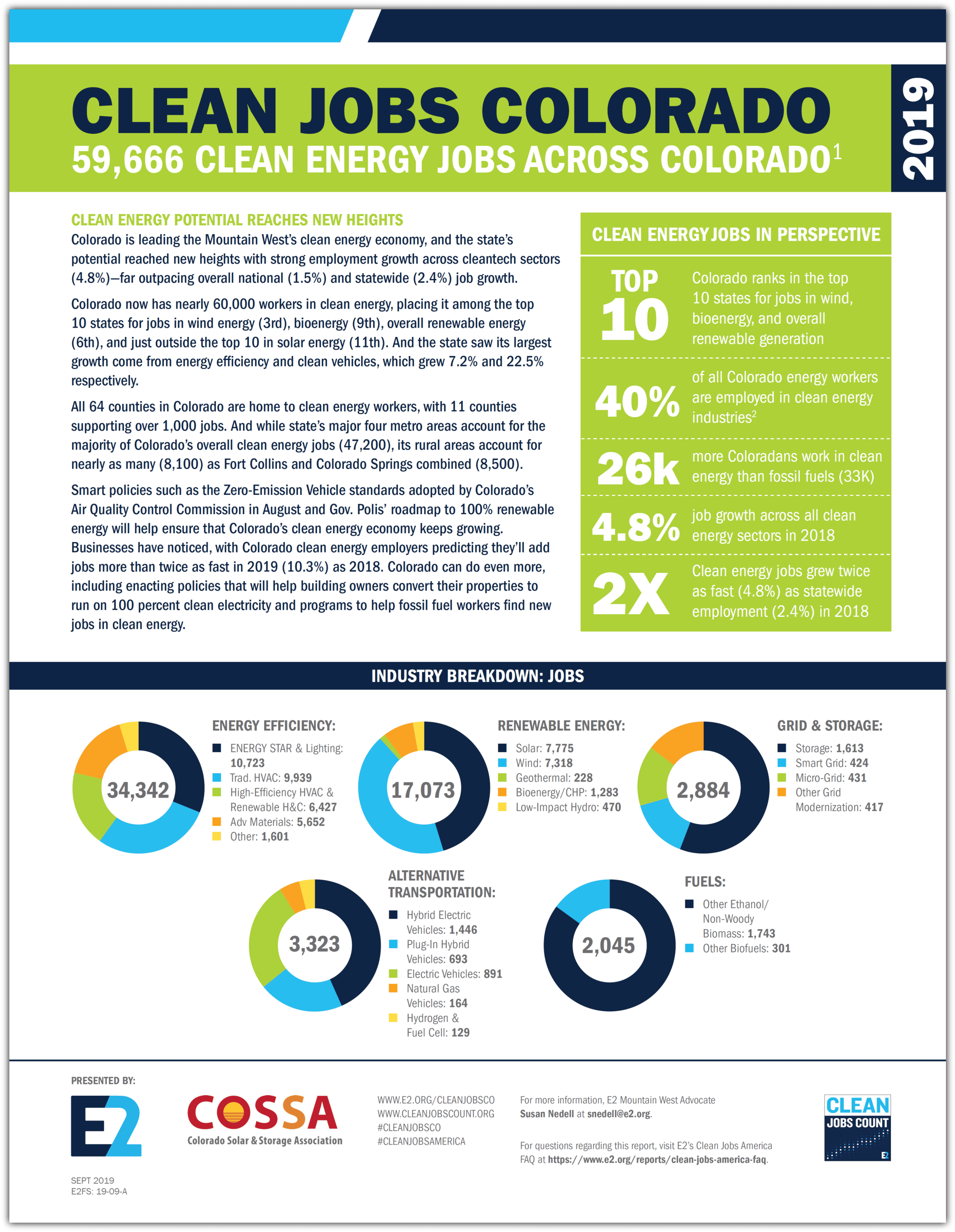
Colorado is leading the Mountain West’s clean energy economy.
With nearly 60,000 clean energy workers now, the state’s potential reached new heights in 2018 with strong employment growth across cleantech sectors (4.8%)—far outpacing overall national (1.5%) and statewide (2.4%) job growth.
According to Clean Jobs Colorado 2019 (downloadable PDF) report, Colorado’s is now among the top 10 states for jobs in three sectors: wind energy (3rd), bioenergy (9th), and overall renewable energy (6th). The state fell just outside the Top 10 in solar energy (11th). However, the majority of Colorado’s clean energy job growth came from energy efficiency and clean vehicles, which grew 7.2% and 22.5%respectively.
Analyzing the state geographically,the employment analysis found that while Denver and Boulder accounted for nearly one out of every three clean jobs in the state, about 20 percent (29,000) are in areas outside the Denver, Boulder, Colorado Springs, and Fort Collins metro areas. Additionally, all 64 counties in the state are home to clean energy workers, with 11 counties supporting at least 1,100. Denver led all counties with more than 13,200 jobs, followed by Arapahoe (7,600) and Jefferson (5,800) counties. By density, Jackson, Denver, and Boulder counties led the state in clean jobs per 1,000 employable residents. All 64 counties in Colorado are home to clean energy workers, with 11 counties supporting over 1,000 jobs.
Smart policies such as the Zero-Emission Vehicle standards adopted by Colorado’s Air Quality Control Commission in August and Gov. Polis’ roadmap to 100% renewable energy will help ensure that Colorado’s clean energy economy keeps growing. And businesses have noticed, with Colorado clean energy employers predicting they’ll add jobs more than twice as fast in 2019 (10.3%) as 2018.
This report follows E2’s Clean Jobs America analysis which found the clean energy jobs account for nearly 3.3 million jobs across all 50 states and the District of Columbia. Both reports expand on data from the U.S. Energy and Employment Report (USEER) produced by the Energy Futures Initiative (EFI) in partnership with the National Association of State Energy Officials (NASEO), using data collected and analyzed by the BW Research Partnership. E2 is a partner on the USEER, the fourth installment of the energy survey first released by the Department of Energy in 2016. Clean energy jobs have grown every year since the first report was released in 2016.
If you are looking for additional insight into E2’s Clean Jobs Colorado 2019 or our other Clean Jobs America reports, visit e2.org/reports. You can also contact E2 Communications Director Michael Timberlake ([email protected]). An FAQ is also available here to answer any questions.
The complete report is available for download at this link.
Clean Jobs North Carolina is only one in a series of state and industry reports produced by E2 and our partners.