Washington Ranks 14th in U.S. for Clean Energy Jobs – REPORT

84,000 workers employed in cleantech fields, 11X more than fossil fuels Clean energy accounts for more than 5 out of 10 energy jobs in Washington WA ranks among top 15 states in 10 clean energy sectors Jefferson, Benton counties lead state in clean energy jobs per capita OLYMPIA (December 18, 2019) – Washington now ranks […]

Clean Jobs Washington 2019

Date: December 18, 2019

Clean Energy Economy Integral to Evergreen State

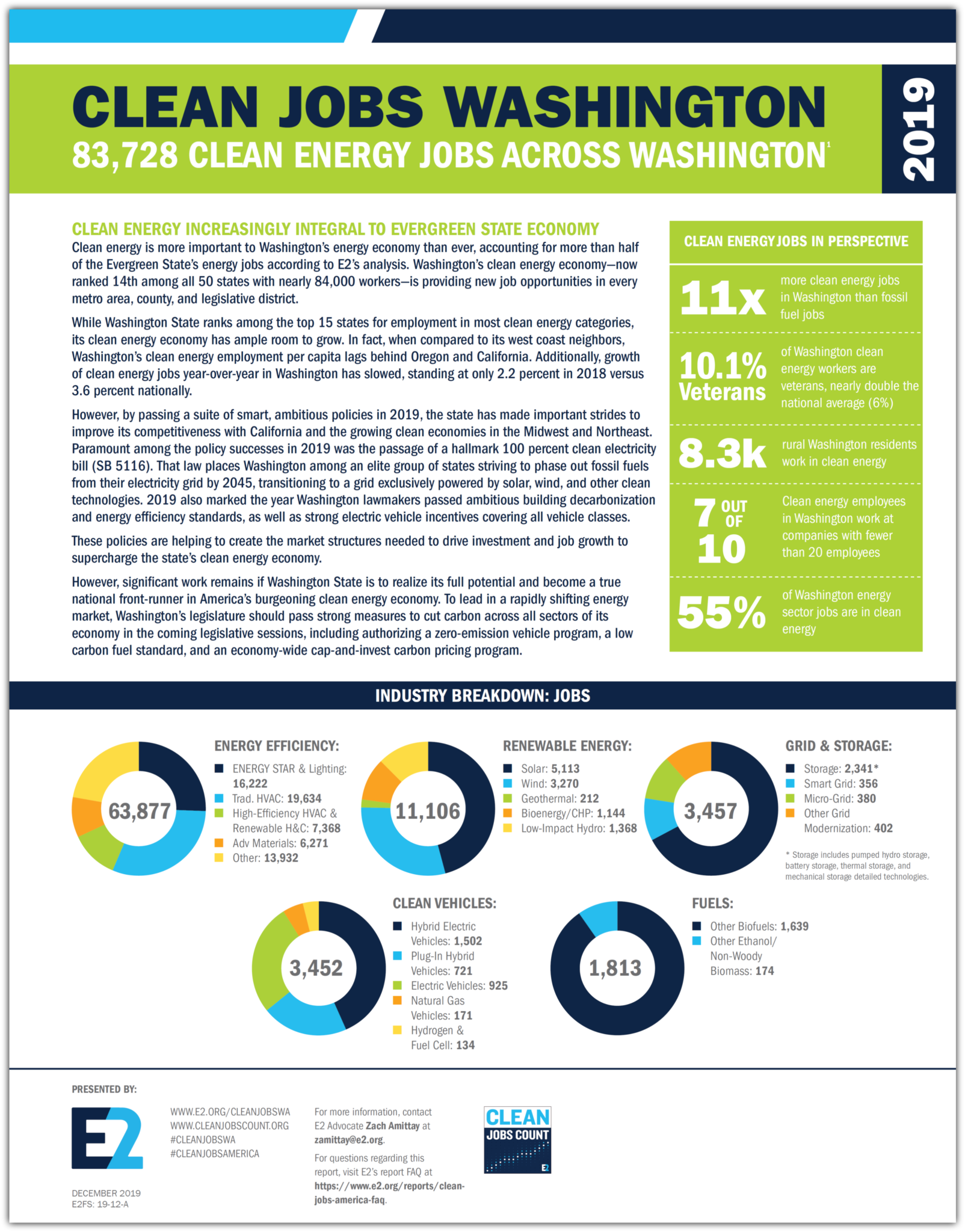
Clean energy is increasingly integral to Washington’s economic growth, as more than five out of every ten jobs in the Evergreen State’s energy economy are now in clean energy industries.  

Led by energy efficiency (63K) and renewable energy (11K), Washington’s clean energy economy—now ranked 14th among all 50 states with nearly 84,000 workers—is providing new job opportunities in every metro area, county, and legislative district.While Washington State ranks among the top 15 states for employment in most clean energy categories, its clean energy economy has ample room to grow. In fact, when compared to its west coast neighbors, Washington’s clean energy employment per capita lags behind Oregon and California.

However, by passing a suite of smart, ambitious policies in 2019, the state has made important strides to improve its competitiveness with California and the growing clean economies in the Midwest and Northeast. Paramount among the policy successes in 2019 was the passage of a hallmark 100 percent clean electricity bill (SB 5116).

But significant work remains if Washington State is to realize its full potential and become a true national front-runner in America’s burgeoning clean energy economy. To lead in a rapidly shifting energy market, Washington’s legislature should pass strong measures to cut carbon across all sectors of its economy in the coming legislative sessions, including authorizing a zero-emission vehicle program, a low carbon fuel standard, and an economy-wide cap-and-invest carbon pricing program.

A BIGGER PICTURE

This report focuses solely on the energy sector of the economy and does not include jobs in retail trade, repair services, water or waste management, and indirect employment or induced employment.

HOW WASHINGTON STACKS UP NATIONALLY

Washington ranks among the top 15 states for employment in 10 clean energy categories.

  • #11 Total Renewable energy
  • #13 Energy Efficiency
  • #6 Clean Storage
  • #11 Geothermal
  • #12 Bioenergy
  • #3 Small Hydropower
  • #10 Wind Energy
  • #2 Other Biofuels
  • #12 Total Transmission, Storage & Distribution
  • #14 Total Clean Energy

WASHINGTON CLEAN JOB SECTOR TOPLINES

  • Energy Efficiency – 63,877 jobs
  • Renewable Energy – 11,106 jobs
  • Solar Energy – 5,113 jobs
  • Clean Vehicles – 3,452 jobs
  • Wind Energy – 3,270 jobs
  • Energy Storage – 2,341 jobs
  • Clean Fuels – 1,813 jobs
  • Grid Modernization – 1,138 jobs
  • ALL Clean Energy Sectors – 83,728 jobs

HIGHLIGHTS

According to Clean Jobs Washington 2019:

  • Seven out of every ten (69.9%) clean energy workers are employed by businesses with fewer than 20 total employees.
  • Construction (64.3%) accounts for the majority of clean energy jobs.
  • If counted as a single metro area, Washington’s rural areas rank second in the state for clean energy jobs, behind only the Seattle-Tacoma-Bellevue metro.
  • 3,457 Washington residents now work in grid modernization (1,138) and energy storage (2,341)
  • 10.1% of Washington residents employed in clean energy are veterans, nearly double the national average (6%).
  • Of the top 10 counties by clean energy jobs per capita, five have populations under 100,000.
  • Washington’s clean vehicle job growth (21.4%) outpaced the sector’s national average (15.4%)
  • Clean energy employs 11X more Washington residents all fossil fuels combined (7,304).
  • 55% of Washington energy sector employees  (153,425) work in clean energy (83,728)
  • Less than 12,000 jobs separates Washington (#14) from the #10 state for clean energy employment (Virginia)
  • 45% of Washington’s clean energy jobs are based outside the Seattle metro area

DOWNLOAD

The complete report is available for download at this link.

Looking For More Info?

U.S. Energy & Employment Report (USEER)

This report follows E2’s Clean Jobs America analysis which found the clean energy jobs account for nearly 3.3 million jobs across all 50 states and the District of Columbia. Both reports expand on data from the U.S. Energy and Employment Report (USEER) produced by the Energy Futures Initiative (EFI) in partnership with the National Association of State Energy Officials (NASEO), using data collected and analyzed by the BW Research Partnership. E2 is a partner on the USEER, the fourth installment of the energy survey first released by the Department of Energy in 2016. Clean energy jobs have grown every year since the first report was released in 2016.

If you are looking for additional insight into E2’s Clean Jobs California 2019 or our other Clean Jobs America reports, visit e2.org/reports. You can also contact E2 Communications Director Michael Timberlake ([email protected]). An FAQ is also available here to answer any questions.

Other E2 Clean Jobs Reports

Clean Jobs Washington is only one in a series of state and industry reports produced by E2 and our partners.

View Report »

West Coast legislators are at a solar crossroad

Oregon was positioned to pass a statewide cap-and-trade bill similar to California’s, which puts a price on carbon emissions and other pollutants. HB 2020 was intended to have state industries purchase allowances to determine how much pollution they’re afforded annually and reinvest that capital into the state. “On California climate investments it’s the same idea […]

U.S. Workers, Businesses Would Reap Benefits from 100% Clean Economy

Statement from E2 Federal Advocacy Director Sandra Purohit WASHINGTON (November 21, 2019) – Rep. Donald McEachin (D-VA) with more than 150 House Representatives cosponsors today introduced the “100% Clean Economy Act of 2019,” a bill that would authorize new federal requirements aimed at ensuring the U.S. reaches a 100 percent clean economy by 2050. The following is […]

Oregon Renewable Energy Employs 5X More Workers than Fossil Fuels – REPORT

55,400 clean energy jobs at businesses  across Oregon SALEM (November 18, 2019) – Clean energy jobs now account for nearly 60 percent of all energy industry jobs in Oregon with employment of 55,406 Oregonians, according to a new analysis of energy employment data by the national nonpartisan business group E2 (Environmental Entrepreneurs). Clean energy businesses […]

Clean Jobs Oregon 2019

Date: November 20, 2019
Clean Energy Lead’s Oregon Energy Economy

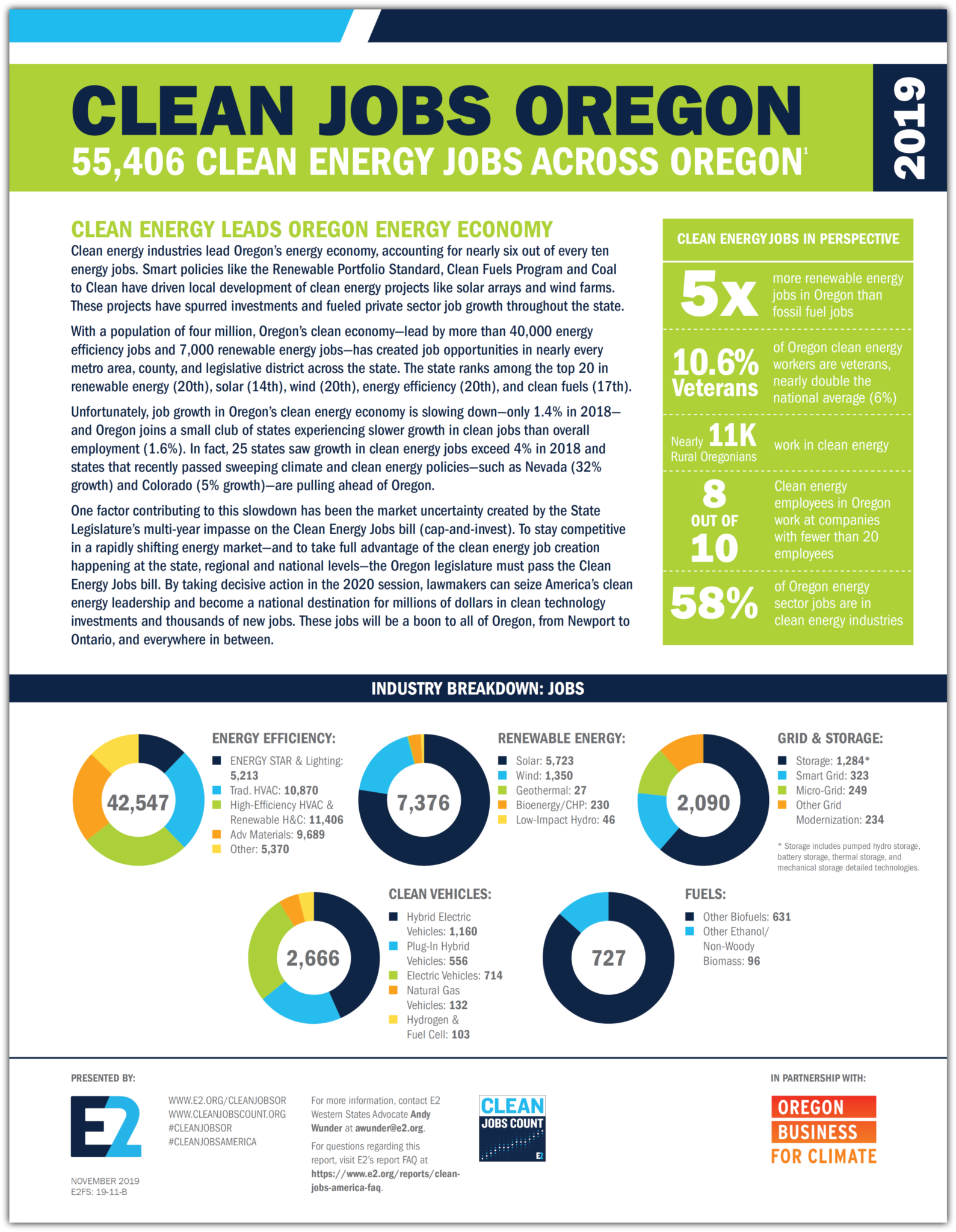
Clean energy industries lead Oregon’s energy economy, accounting for nearly six out of every ten energy jobs.

With a population of four million, Oregon’s clean economy—lead by more than 40,000 energy efficiency jobs and 7,000 renewable energy jobs—has created job opportunities in nearly every metro area, county, and legislative district across the state. The state ranks among the top 20 in renewable energy (20th), solar (14th), wind (20th), energy efficiency (20th), and clean fuels (17th).

Unfortunately, job growth in Oregon’s clean energy economy is slowing down—only 1.4% in 2018—and Oregon joins a small club of states experiencing slower growth in clean jobs than overall employment (1.6%). In fact, 25 states saw growth in clean energy jobs exceed 4% in 2018 and states that recently passed sweeping climate and clean energy policies—such as Nevada (32% growth) and Colorado (5% growth)—are pulling ahead of Oregon.

To stay competitive in a rapidly shifting energy market, the Oregon legislature must take decisive action in the 2020 session, so the state can seize America’s clean energy leadership and become a national destination for millions of dollars in clean technology investments and thousands of new jobs.

A BIGGER PICTURE

This report focuses solely on the energy sector of the economy and does not include jobs in retail trade, repair services, water or waste management, and indirect employment or induced employment.

OREGON JOB SECTOR TOPLINES

  • Energy Efficiency – 42,547 jobs
  • Renewable Energy – 7,376  jobs
  • Solar Energy – 5,726 jobs
  • Clean Vehicles – 2,666 jobs
  • Wind Energy – 1,350 jobs
  • Energy Storage – 1,284 jobs
  • Grid Modernization – 806 jobs
  • Clean Fuels – 727 jobs
  • ALL Clean Energy Sectors – 55,406 jobs

HIGHLIGHTS

According to Clean Jobs Oregon 2019:

  • Clean energy employs 50X more Oregonians than all fossil fuels combined (1,422). Renewable energy employs 5X more than fossil fuels.
  • 58% of Oregon energy sector employees  (95,806) work in clean energy (55,406)
  • 3 out of 5 Oregon energy efficiency employees work in construction and repairs 
  • 50% of Oregon’s clean energy jobs are based outside the Portland metro area
  • 1 out of every 4 Oregon construction workers are employed in energy efficiency
  • Nearly 11,000 rural Oregonians work in clean energy, or about 1 in every 5 clean energy jobs.
  • More than 83% of Oregon clean energy workers are employed by businesses with fewer than 20 employees
  • Construction (58.9%) and manufacturing services (13.1%) make up the majority of clean energy jobs.
  • 2,090 Oregonians now work in grid modernization (806) and energy storage (1,284)
  • 10.6% of Oregonians employed in clean energy are veterans \

DOWNLOAD

The complete report is available for download at this link.

Looking For More Info?

District-By-District Economic Impact

For details on clean energy’s overall economic impact in Oregon, visit E2’s District-By-District: Clean Jobs Oregon 2019  report page to download 120 individual factsheets for all 120 state legislative districts. The factsheets detail the investments in clean energy, jobs created, emissions, reduced, and cap and trade funds implemented in each district.

U.S. Energy & Employment Report (USEER)
This report follows E2’s Clean Jobs America analysis which found the clean energy jobs account for nearly 3.3 million jobs across all 50 states and the District of Columbia. Both reports expand on data from the U.S. Energy and Employment Report (USEER) produced by the Energy Futures Initiative (EFI) in partnership with the National Association of State Energy Officials (NASEO), using data collected and analyzed by the BW Research Partnership. E2 is a partner on the USEER, the fourth installment of the energy survey first released by the Department of Energy in 2016. Clean energy jobs have grown every year since the first report was released in 2016.

If you are looking for additional insight into E2’s Clean Jobs California 2019 or our other Clean Jobs America reports, visit e2.org/reports. You can also contact E2 Communications Director Michael Timberlake ([email protected]). An FAQ is also available here to answer any questions.

Other E2 Clean Jobs Reports

Clean Jobs Oregon is only one in a series of state and industry reports produced by E2 and our partners.

View Report »
District-By-District | Clean Jobs Oregon 2019

Date: November 20, 2019

Clean Jobs Oregon| District-By-District

According to an analysis of every Oregon state senate district, more than 55,400 Oregonians now work in clean energy industries and more than $6.7 billion has been invested in wind and solar energy projects – generating $258 million in public revenue.

Oregon’s Statewide 2019 Clean Energy Jobs Report
Who Are My Representatives?

This job growth and development has been driven by smart policies like the Renewable Portfolio Standard, Clean Fuels Program and Coal to Clean.

But this growth is only scratching the surface of what Oregon’s clean energy economy can achieve according to this latest analysis. By passing the state a cap and invest program during the 2020 legislative cycle, Oregon could nearly double its total clean energy jobs (adding 50,000), increase real GDP 2.5% by 2050, and generate $4.5 billion in proceeds to be invested in communities throughout Oregon by 2030.

To learn more about the current economic benefits clean energy is providing in every Oregon senate district, click on the Senator’s name and district linked in the below table.

How to Download: Use the tables below to locate and download all 30 factsheets for every Oregon state senate district. Each factsheet details out the district-specific jobs and economic impact resulting from Oregon’s climate policies.

Oregon State Senate

Looking for More Info?

Statewide Jobs Report

For details on clean energy’s statewide impact on jobs in California, including at the county and metro levels, breakdowns for each clean tech subsector, by congressional districts, and information on how the jobs spread across the state’s value chain, visit E2’s Clean Jobs Oregon 2019 report page to download .

U.S. Energy & Employment Report (USEER)

This district-by-district report follows E2’s Clean Jobs America analysis which found the clean energy jobs account for nearly 3.3 million jobs across all 50 states and the District of Columbia. Both reports expand on data from the U.S. Energy and Employment Report (USEER) produced by the Energy Futures Initiative (EFI) in partnership with the National Association of State Energy Officials (NASEO), using data collected and analyzed by the BW Research Partnership. E2 is a partner on the USEER, the fourth installment of the energy survey first released by the Department of Energy in 2016. Clean energy jobs have grown every year since the first report was released in 2016.

If you are looking for additional insight into E2’s District-by-District | Clean Jobs California 2019 or our other Clean Jobs America reports, visit e2.org/reports. You can also contact E2 Communications Director Michael Timberlake ([email protected]). An FAQ is also available here to answer any questions.

Other Clean Jobs Reports

District-by-District | Clean Jobs Oregon 2019 is only one in a series of state and industry reports produced by E2 and our partners.

View Report »
Investing in Michigan’s Water Infrastructure – An Economic Opportunity

Date: November 14, 2019

Michigan water infrastructure report cover

PROTECTING THE ECONOMY, CREATING NEW JOBS, AND DRIVING GROWTH

Michigan has for decades underinvested in its water infrastructure at the expense of the economy and the health of families in the state. To ensure Michigan’s economy continues to grow — and that all Michiganders enjoy a high quality of life — this gap should be closed.

Fortunately, investing an additional $12.2 billion in Michigan’s own water infrastructure needs on top of existing expenditures would over the next two decades help create nearly 90,000 direct job-years in multiple industries — including good jobs for veterans — while generating about $441.3 million in additional earned income for state residents annually.

This essential spending would also help businesses in the state’s water services industry become national leaders in developing and commercializing new water technologies, just as early-mover states like California have become national leaders in clean tech. And it would ensure that all Michigan industries, whether they are directly or indirectly reliant on clean, affordable water, are in the best position possible for decades of ongoing growth.

But first, we must fix the system.

REPORT TOPLINES

  • $12 billion in new spending is needed to update critical water infrastructure in Michigan and avoid more long-term economic and health damage to the state
  • New expenditures directly lead to the creation of 89,880 full-time job-years
  • Those 90,000 direct jobs would generate $8.8 billion in new wages workers and their families can inject into their local economies
  • New jobs and wages will generate $694 million in total tax revenue over two decades, with more than 80 percent going to local and state municipalities ($560 million)
  • Michigan is currently spending $22,000 a day on bottled water for Flint, Michigan alone. Continuing to underfund and defer critical maintenance improvements to water systems across the state risks similar impacts in other cities.
  • While the cost of improving Michigan’s safe drinking water systems is greater than the direct economic benefits, this report focuses only on one small piece of the economic benefits – the direct additional jobs and spending. E2 and BW Research did not analyze indirect or induced benefits like improved health outcomes for citizens, long-term benefits on younger populations, and economic activity created by improving clean water access for businesses.

METHODOLOGY

For the jobs, income and tax revenue data, E2 contracted BW Research which used the Emsi Input-Output model that traces spending and infrastructural developments through the economy to determine the economic impact of the change in water infrastructure spending in the state of Michigan.45

The cumulative effects of the initial job change are quantified and the results are categorized into direct, indirect and induced effects.

  • Direct effects show the change in the economy associated with the initial job creation (or loss), or how the industry experiences the change (i.e., workers digging ditches to replace pipe).
  • Indirect effects include all the backward linkages, or the supply chain responses as a result of the initial job change (i.e., water pipe manufacturers).
  • Induced effects refer to household spending and are the result of workers who are responsible for the direct and indirect effects spending their wages (i.e., direct and indirect workers spend income on clothes, food, healthcare, etc.).

DOWNLOAD

The complete report is available for download at this link.


View Report »

Repowering our Workforce: Clean Energy Job Training in Illinois

The clean energy economy is strong in Illinois employing over 123,000 people, thanks to state policy like the Future Energy Jobs Act of 2016. But one barrier to growing this industry is recruiting and training workers. Fortunately, expanding workforce training programs are a focus of the Clean Energy Jobs Act that is currently in front […]

E2 1 Hotels Fellowship: 2018-2019 Fellow Showcase

The E2 1Hotels Fellowship supports emerging business leaders develop and implement projects that amplify the business and economic case for smart policies to address pressing environmental issues. This will be the final webinar showcasing our 2018-2019 class of fellows who have been working on a diverse set of issues ranging from clean water, energy and agriculture. […]

Editorial: Clean energy is good business in North Carolina

North Carolina ranks sixth in the nation in jobs related to energy efficiency, a national advocacy group for conservation and renewable energy reports. According to E4TheFuture and Environmental Entrepreneurs, North Carolina employs 86,559 in energy-efficient jobs, an increase of 3% over the previous year, or 2,500 jobs. Energy-efficiency workers account for 41% of all energy-related […]

AP: New Mexico utility touts energy efficiency, job creation

Executives with New Mexico’s largest electric utility are touting energy efficiency, pointing to a recent report from a clean energy group that shows more than a quarter of energy sector jobs in the state are related to improving efficiency. Statistics compiled by the energy industry group E4TheFuture indicate New Mexico led all states with an 11.5% […]

Sign Up for Email Updates


"*" indicates required fields

This field is for validation purposes and should be left unchanged.

Our Latest Press Releases


Releases

REPORT: Colorado clean energy sector grew by 4 percent, added 2K jobs in 2024

DENVER, CO (Dec. 10, 2025) – Clean energy jobs grew more than five times faster in Colorado than the rest of the state's economy in 2024, raising the total number of clean energy workers in the state to 69,859 – 18th most in the country – according to the s...


Releases

STATEMENT: Federal Rollback of Auto Fuel Efficiency Standards Will Increase Costs for Consumers, Businesses

The National Highway Traffic Safety Administration (NHTSA) is expected to announce the Administration’s intent to weaken federal Corporate Average Fuel Economy (CAFE) standards for vehicles. Such a dramatic shift in policy would halt five decades of progres...


Releases

Companies Cancel $4.4 Billion in Clean Energy Projects; $28 Billion, 30K Jobs Lost in 2025

WASHINGTON –Businesses canceled, closed, and scaled back more than $4.4 billion worth of large-scale factories and clean energy projects from late-September through October, bringing the total cost of projects cancelled in the private-sector to over $28.7 b...


Donate Today