Clean Jobs Massachusetts 2019

Date: April 24, 2019

Leading the Northeast Clean Energy Transition

Massachusetts’ clean energy economy is open for business.

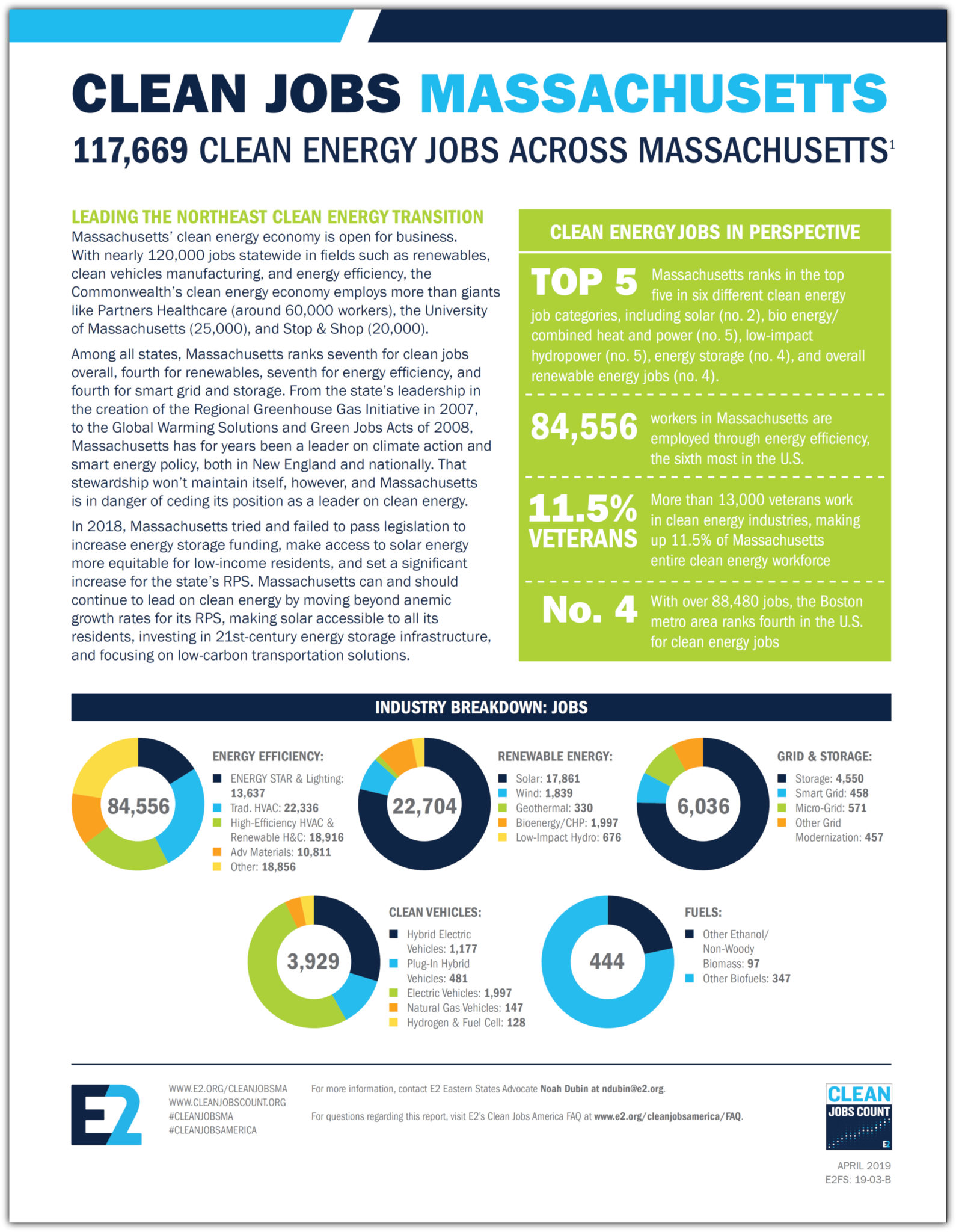
With nearly 120,000 jobs statewide in fields such as renewables, clean vehicles manufacturing, and energy efficiency, the Commonwealth’s clean energy economy employs more than giants like Partners Healthcare (around 60,000 workers), the University of Massachusetts (25,000), and Stop & Shop (20,000).

According to the 2019 Clean Jobs Massachusetts analysis (downloadable PDF) Massachusetts ranks seventh for total clean jobs among all U.S. States, including second in solar energy behind only California. In fact, Massachusetts’ strong solar energy industry employs over 50% more workers than the third ranked state (New York). While over 82,000 Massachusetts clean jobs are in the Boston metro area (which ranks fourth in the U.S.), 29% of the state’s jobs are outside Boston.

MASSACHUSETTS JOB SECTOR TOPLINES

  • Energy Efficiency – 84,556 jobs
  • Renewable Energy – 22,704 jobs
  • Solar Energy – 17,861 jobs
  • Energy Storage – 4,550 jobs
  • Clean Vehicles – 3,929 jobs
  • Wind Energy – 1,839 jobs
  • Grid Modernization – 1,486 jobs
  • ALL Clean Energy Sectors – 117,669 jobs

OTHER HIGHLIGHTS

  • Every single Massachusetts Congressional District supports over 10,300 clean energy jobs
  • Massachusetts ranks among the Top 5 states in six clean energy categories, including including solar (no. 2), bio energy/combined heat and power (no. 5), low-impact
    hydropower (no. 5), energy storage (no. 4), and overall
    renewable energy jobs (no. 4).
  • All 14 Counties employ workers in clean energy
  • 11.5% of clean energy workers in Massachusetts are veterans
  • Clean energy employs over 13X more workers in Massachusetts than fossil fuels (8,725)
  • 55 percent of clean jobs are in the construction and manufacturing sectors
  • 11 out of Massachusetts’ 14 counties support more than 10 clean energy workers per 1,000 employable residents, with three above 20 jobs per 1,000 employable residents.

Looking for More Info?

This report follows E2’s Clean Jobs America analysis which found the clean energy jobs account for nearly 3.3 million jobs across all 50 states and the District of Columbia. Both reports expand on data from the U.S. Energy and Employment Report (USEER) produced by the Energy Futures Initiative (EFI) in partnership with the National Association of State Energy Officials (NASEO), using data collected and analyzed by the BW Research Partnership. E2 is a partner on the USEER, the fourth installment of the energy survey first released by the Department of Energy in 2016. Clean energy jobs have grown every year since the first report was released in 2016.

If you are looking for additional insight into E2’s Clean Jobs Massachusetts 2019 or our other Clean Jobs America reports, visit e2.org/reports. You can also contact E2 Communications Director Michael Timberlake ([email protected]). An FAQ is also available here to answer any questions.

DOWNLOAD

The complete report is available for download at this link.

OTHER CLEAN JOBS REPORTS

Clean Jobs Massachusetts is only one in a series of state and industry reports produced by E2 and our partners.

View Report »

Clean Jobs New York 2019

Date: April 24, 2019

Clean Jobs Rise in the Empire State

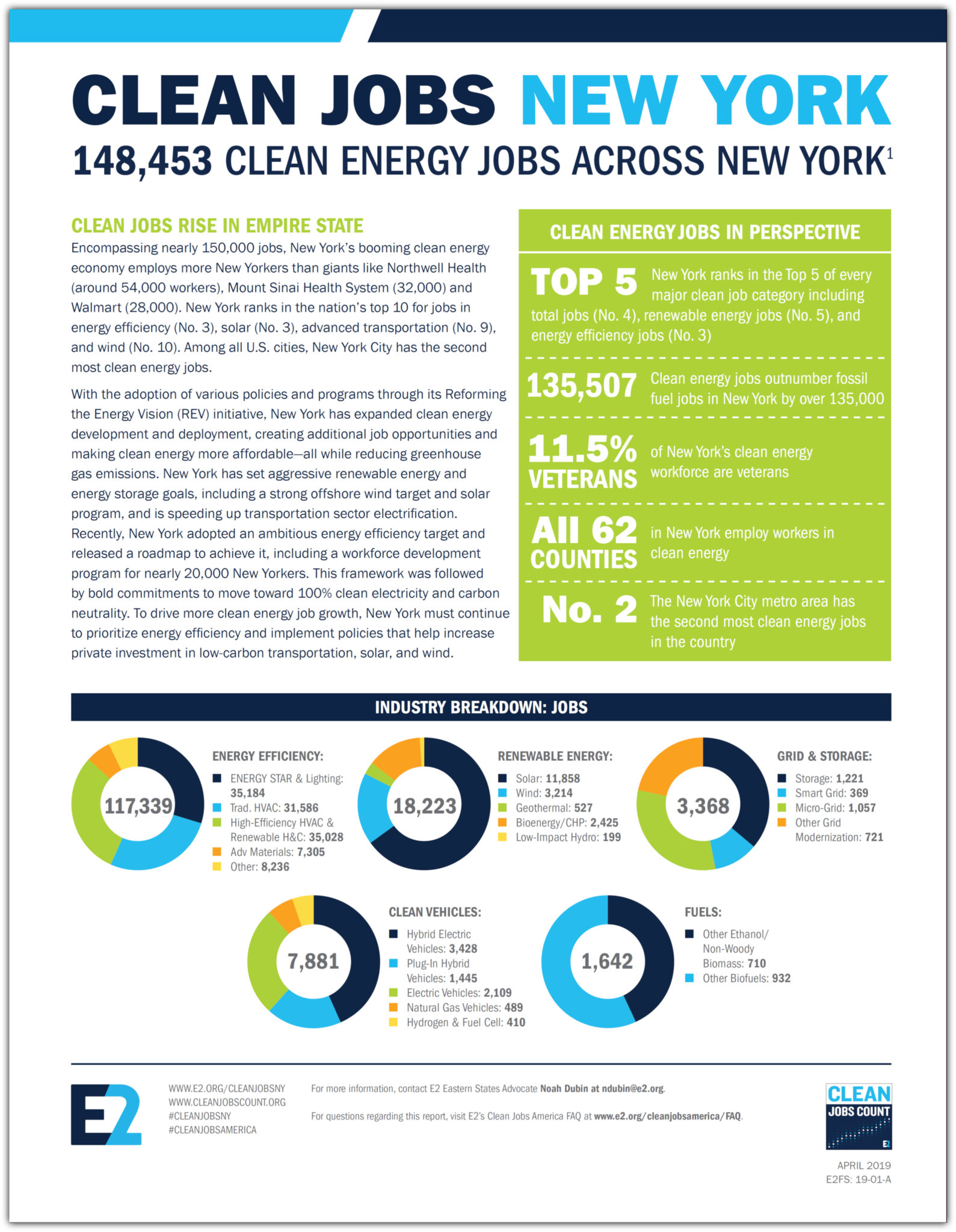
Encompassing nearly 150,000 jobs, New York’s booming clean energy economy employs more New Yorkers than giants like Northwell Health (around 54,000 workers), Mount Sinai Health System (32,000) and Walmart (28,000).

According to the 2019 Clean Jobs New York analysis (downloadable PDF) of energy jobs data by the national nonpartisan business group E2 (Environmental Entrepreneurs), New York’s clean energy economy now ranks in the nation’s top 10 for jobs in energy efficiency (No. 3), solar (No. 3), advanced transportation (No. 9), and wind (No. 10).

While New York City has the second most clean energy jobs in the U.S. with more than 96,000, behind only Los Angeles, clean energy’s impact reaches far beyond New York’s major metropolitan areas. One out of every seven clean energy workers are employed counties with population below 300,000 while 9,500 jobs are in the state’s rural areas.

NEW YORK JOB SECTOR TOPLINES

  • Energy Efficiency – 117,339 jobs
  • Renewable Energy – 18,223 jobs
  • Energy Storage – 1,221 jobs
  • Solar Energy – 11,858 jobs
  • Clean Vehicles – 7,881 jobs
  • Wind Energy – 3,214 jobs
  • Grid Modernization – 2,147 jobs
  • ALL Clean Energy Sectors – 148,453 jobs

OTHER HIGHLIGHTS

  • New York ranks in the Top 5 of every major clean job category including total jobs (No. 4), renewable energy jobs (No. 5), and energy efficiency jobs (No. 3)
  • All 62 Counties employ workers in clean energy
  • Clean energy jobs outnumber fossil fuel jobs in New York by more than 135,000
  • 11.5% of clean energy workers in New York are veterans
  • 50 percent of New York clean energy employees work in the construction and manufacturing sectors
  • 8 counties support more than 10 clean energy jobs per 1,000 employable residents and Saratoga County has the 2nd highest clean energy jobs density with nearly 20 jobs per 1,000 employable residents—trailing only New York County (30.08)

Looking for More Info?

This report follows E2’s 2019 Clean Jobs America analysis which found the clean energy jobs account for nearly 3.3 million jobs across all 50 states and the District of Columbia. Both reports expand on data from the U.S. Energy and Employment Report (USEER) produced by the Energy Futures Initiative (EFI) in partnership with the National Association of State Energy Officials (NASEO), using data collected and analyzed by the BW Research Partnership. E2 is a partner on the USEER, the fourth installment of the energy survey first released by the Department of Energy in 2016. Clean energy jobs have grown every year since the first report was released in 2016.

If you are looking for additional insight into E2’s Clean Jobs New York 2019 or our other Clean Jobs America reports, visit e2.org/reports. You can also contact E2 Communications Director Michael Timberlake ([email protected]). An FAQ is also available here to answer any questions.

DOWNLOAD

The complete report is available for download at this link.

OTHER CLEAN JOBS REPORTS

Clean Jobs New York is only one in a series of state and industry reports produced by E2 and our partners.


View Report »

Clean Jobs Midwest 2019

Date: April 9, 2019

Home to 737,00 Clean Energy Jobs

Midwest Clean Energy Jobs Grow Faster Than Rest of Nation

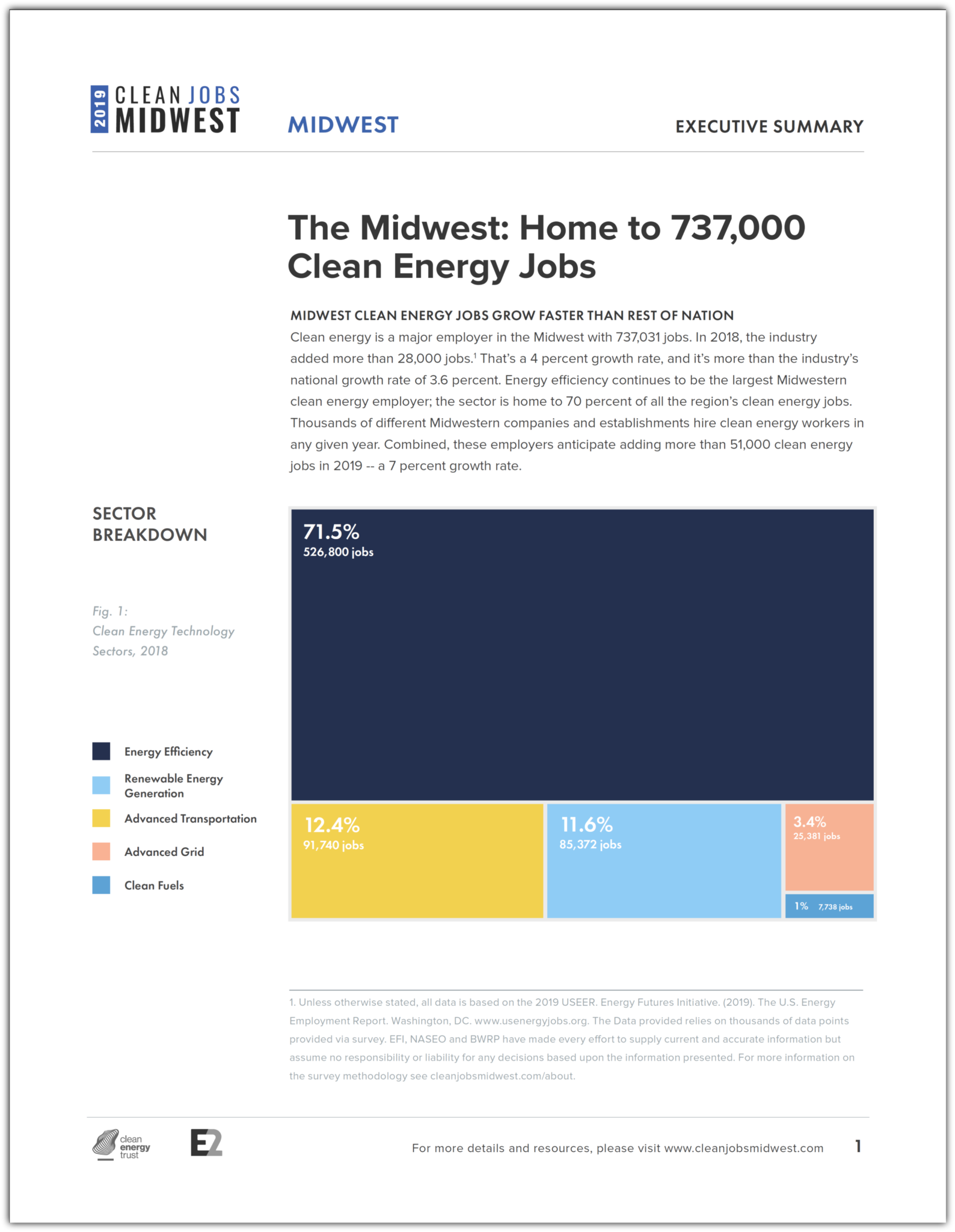
Clean energy is a major employer in the Midwest with 737,031 jobs. In 2018, the industry added more than 28,000 jobs.

That’s a 4 percent growth rate, and it’s more than the industry’s national growth rate of 3.6 percent. Energy efficiency continues to be the largest Midwestern clean energy employer; the sector is home to 70 percent of all the region’s clean energy jobs. Thousands of different Midwestern companies and establishments hire clean energy workers in any given year. Combined, these employers anticipate adding more than 51,000 clean energy jobs in 2019 — a 7 percent growth rate.

MIDWEST HIGHLIGHTS

  • Energy Efficiency – 526,800 jobs
  • Renewable Energy – 85,372 jobs
  • Energy Storage – 13,136 jobs
  • Solar Energy – 38,911 jobs
  • Wind Energy – 35,932 jobs
  • Clean Vehicles – 91,740 jobs
  • Grid Modernization – 12,245 jobs
  • ALL Clean Energy Sectors – 737,031 jobs

OTHER KEY FINDINGS

  • More than 25,000 Midwesterners now work in grid modernization (12,200) and energy storage (13,100).
  • Construction (41.5%) and manufacturing (30.6%) make up the majority of clean energy jobs categorized by value chain.
  • Clean fuels technologies employ nearly 8,000 workers in the 12-state region.
  • Combined, solar (38,900) and wind (35,900) account for 88 percent of renewable energy jobs in the Midwest.
  • Fossil fuels employ (187,700) barely a quarter the number of clean energy workers overall in the Midwest (737,030).
  • Electric power generation jobs using fossil fuels (62,600) employed 20,000 less workers than renewable energy generation (85,300).
  • Small businesses are driving the region’s clean energy sectors, with 4 percent of clean energy businesses employing fewer than 20 individuals.
  • 11.1 percent of Midwesterners employed in clean energy are veterans, compared to the national average of six percent.

LOOKING FOR MORE INFO?

This report follows E2’s Clean Jobs America analysis which found the clean energy jobs account for nearly 3.3 million jobs across all 50 states and the District of Columbia. Both reports expand on data from the 2019 U.S. Energy and Employment Report (USEER) produced by the Energy Futures Initiative (EFI) in partnership with the National Association of State Energy Officials (NASEO), using data collected and analyzed by the BW Research Partnership. E2 is a partner on the USEER, the fourth installment of the energy survey first released by the Department of Energy in 2016. Clean energy jobs have grown every year since the first report was released in 2016.

If you are looking for additional insight into E2’s Clean Jobs Midwest or our other Clean Jobs America reports, visit e2.org/reports. You can also contact E2 Communications Director Michael Timberlake ([email protected]). An FAQ is also available here to answer any questions.

DOWNLOAD

Updated Clean Jobs Midwest report and interactive pages for all states can always be found at www.CleanJobsMidwest.com.

For the 2019 report specifically, click here to download or visit the resources page at www.cleanjobsmidwest.com to find all the state-specific summaries going back to 2016.

OTHER CLEAN JOBS REPORTS

Clean Jobs Midwest is only one in a series of state and industry reports produced by E2 and our partners.


View Report »

Clean Jobs Nevada 2019

Date: April 4, 2019

32% clean energy job growth in 2018 leads all U.S., positions Nevada to become energy storage hub
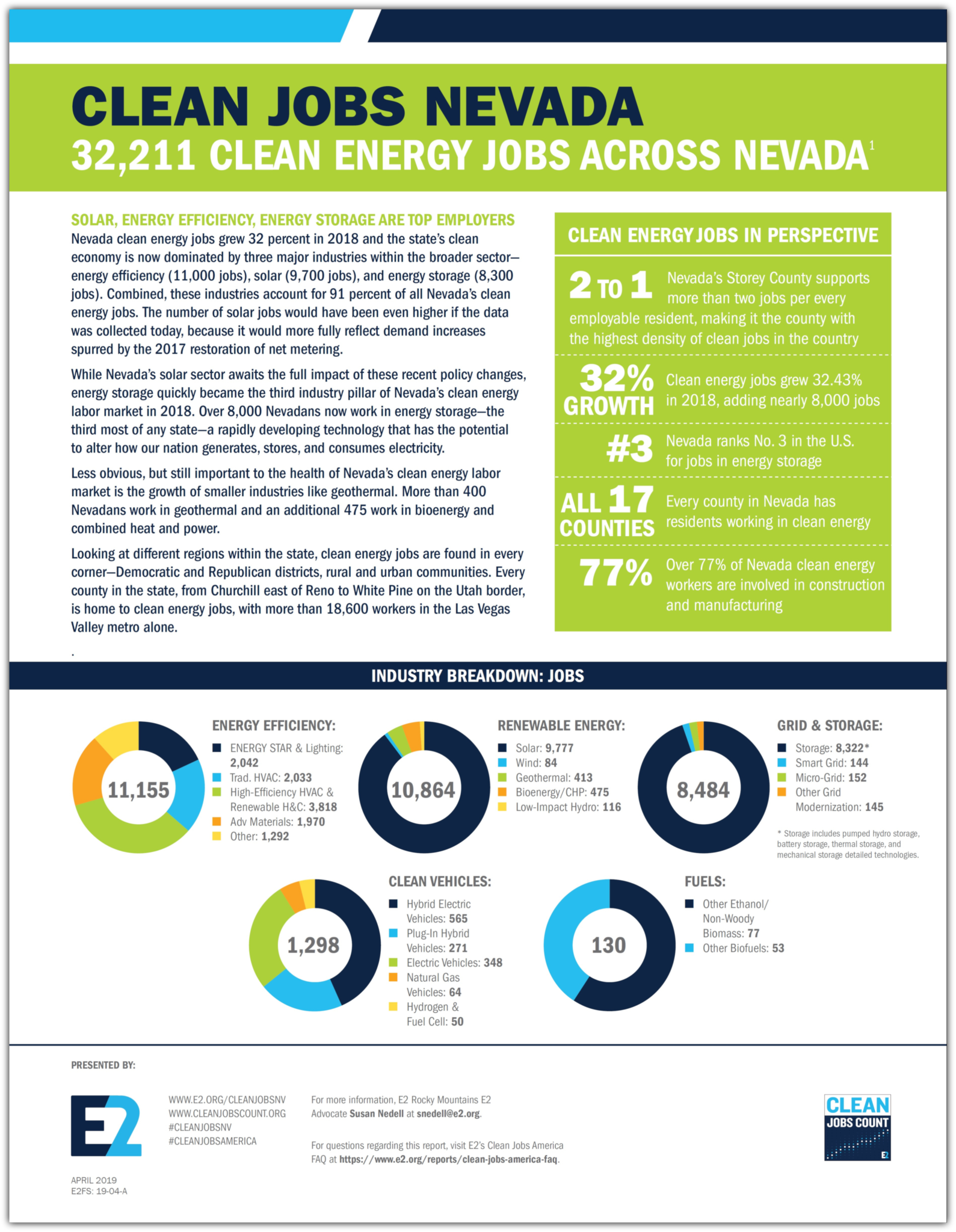
According to the 2019 Clean Jobs Nevada analysis (downloadable PDF) of energy jobs data by the national nonpartisan business group E2 (Environmental Entrepreneurs), Nevada’s clean energy economy exploded in 2018 — adding nearly 8,000 jobs and making the state no. 1 clean energy job growth (32.4%).

Overall, clean energy jobs totaled more than 32,000 at the end of 2018, with the biggest benefactor being Storey County near Reno, home to Tesla’s Gigafactory battery plant. More than 8,100 Nevadans now work in clean energy in Storey County – giving it the highest density of clean energy jobs in the country, with 2,300 jobs per 1,000 employable residents.

Nevada’s wider clean economy is now dominated by three major industries within the broader sector— energy efficiency (11,000 jobs), solar (9,700 jobs), and energy storage (8,300 jobs). Combined, these industries account for 91 percent of all Nevada’s clean energy jobs. The number of solar jobs would have been even higher if the data was collected today, because it would more fully reflect demand increases spurred by the 2017 restoration of net metering.

NEVADA JOB SECTOR TOPLINES

  • Energy Efficiency – 11,155 obs
  • Renewable Energy – 10,864 jobs
  • Energy Storage – 8,322 jobs
  • Solar Energy – 9,777 jobs
  • Clean Vehicles – 1,298 jobs
  • Grid Modernization – 441 jobs
  • ALL Clean Energy Sectors – 32,211 jobs

OTHER HIGHLIGHTS

  • Storey County is home to more than two jobs per every employable resident
  • Nevada ranks 3rd among all U.S. states for jobs in energy storage
  • Clean energy employs 5X more Nevadans than fossil fuels
  • 77 percent of jobs are in the construction and manufacturing sectors
  • The Las Vegas Valley and Reno-Sparks metro areas account for 92 percent of Nevada’s clean jobs
  • All 17 counties in Nevada are home to jobs in clean energy
  • Nearly 11,000 Nevadans work in renewable energy
  • Nevada’s 413 geothermal jobs rank in the top 10 nationally
  • Churchill, Douglas, and Lincoln counties all support more than 20 clean energy jobs per 1000 employable residents
  • 1,300 Nevadans work in non-sales positions involving hybrid and electric vehicles and clean fuels

Looking for More Info?
This report follows E2’s Clean Jobs America analysis which found the clean energy jobs account for nearly 3.3 million jobs across all 50 states and the District of Columbia. Both reports expand on data from the 2019 U.S. Energy and Employment Report (USEER) produced by the Energy Futures Initiative (EFI) in partnership with the National Association of State Energy Officials (NASEO), using data collected and analyzed by the BW Research Partnership. E2 is a partner on the USEER, the fourth installment of the energy survey first released by the Department of Energy in 2016. Clean energy jobs have grown every year since the first report was released in 2016.

If you are looking for additional insight into E2’s Clean Jobs Nevada 2019 or our other Clean Jobs America reports, visit e2.org/reports. You can also contact E2 Communications Director Michael Timberlake ([email protected]). An FAQ is also available here to answer any questions.

DOWNLOAD

The complete report is available for download at this link.

OTHER CLEAN JOBS REPORTS

Clean Jobs Nevada is only one in a series of state and industry reports produced by E2 and our partners.

View Report »

ACORE’s Renewable Energy Policy Forum

ACORE’s Renewable Energy Policy Forum is the nation’s leading pan-technology renewable energy policy summit. The forum brings industry leaders and policymakers together to discuss energy and tax policy, debate key issues in the changing electricity marketplace, and identify priorities for Congress, the states, and relevant agencies. For 20% off tickets, please use discount code: E2PF

Clean Energy Jobs in America 2019: How Clean Energy is Powering American Job Growth

Clean energy now employs about 3.3 million Americans. That’s more Americans than work as school teachers, as waiters and waitresses – and about three times as many Americans than work in oil, gas, coal and other fossil fuel industries. Please join E2 to learn about the findings of the recently released 2019 US Energy Employment Report (USEER) […]

Clean Jobs America 2019

Date: March 13, 2019

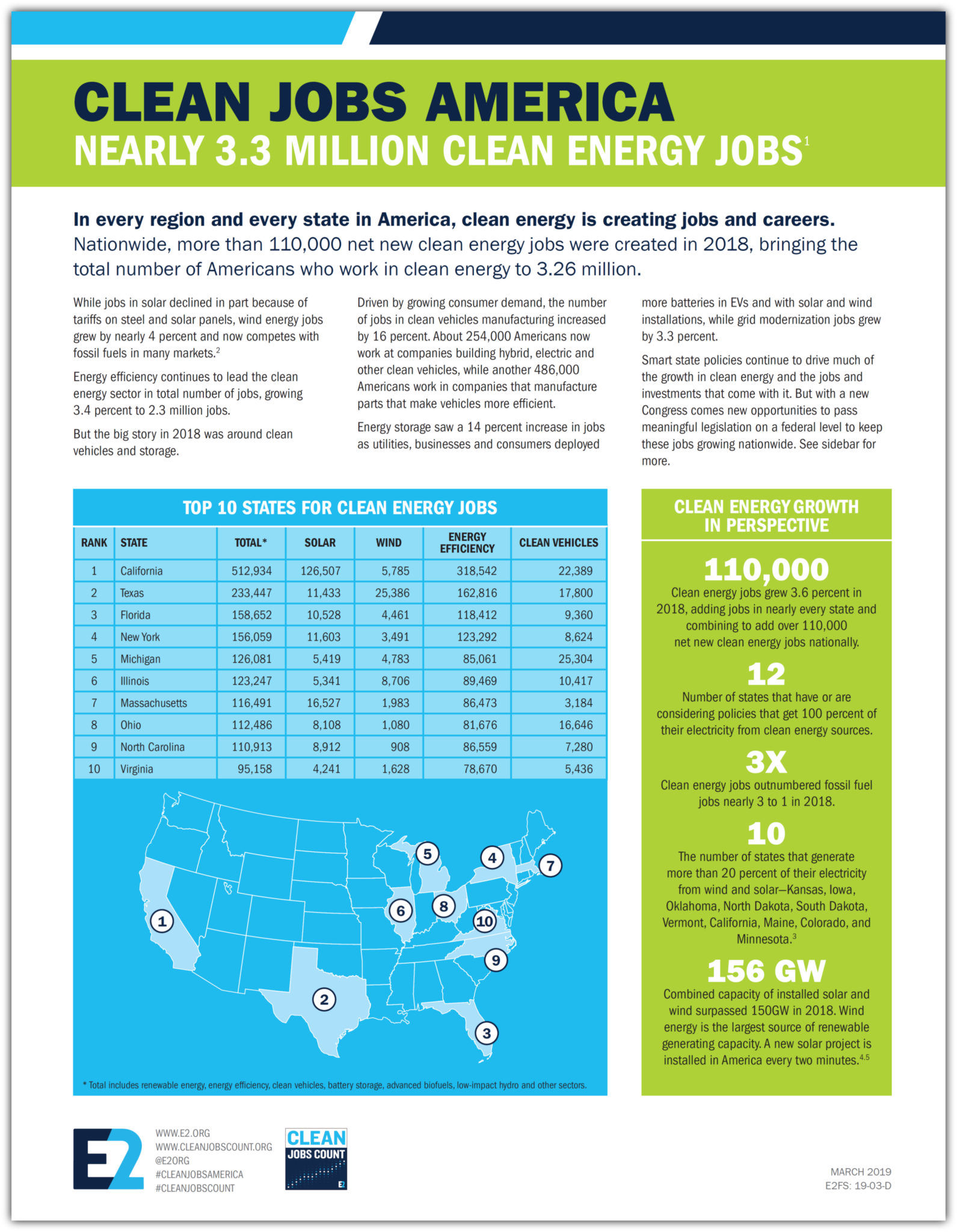
In every region and every state in America, clean energy is creating jobs and careers.

According to the 2019 Clean Jobs America analysis of energy jobs data by the national nonpartisan business group E2, nearly every U.S. state saw an increase in clean energy jobs in 2018, combining to add about 110,000 net new jobs for a growth rate of 3.6 percent.

Overall, clean energy jobs totaled more than 3.26 million at the end of 2018, growing despite the impact of the Trump administration’s tariffs on solar panels and market uncertainty from the administration’s inaction and planned rollbacks of energy efficiency and clean vehicles policies. Clean jobs outnumber fossil fuels jobs nearly three to one (3.26M to 1.17M) and clean energy employers said they anticipate 6 percent job growth for 2019.

INDUSTRY JOB TOPLINES

  • Energy Efficiency – 2,324,865 jobs
  • Renewable Energy – 508,484 jobs
  • Solar Energy – 334,992 jobs
  • Wind Energy – 111,166 jobs
  • Clean Vehicles – 253,599 jobs
  • Clean Storage – 74,569 jobs
  • Grid Modernization – 64,377 jobs
  • ALL US Clean Energy Sectors – 3,264,383 jobs

DOWNLOAD

The complete report is available for download at this link.

OTHER HIGHLIGHTS

  • Solar alone employs more than twice the number of coal workers
  • Wind and solar account for nearly 2 out of every 5 construction jobs in the electric generation sector
  • Not included in the clean vehicles sector are 486,000 employees in the motor vehicle industry who work with parts making vehicles more fuel efficient
  • Jobs in grid modernization grew 3.3 percent in 2018, adding more than 2,000 jobs
  • More Americans work in energy efficiency (2.3 million) than there are waiters and waitresses in America’s bars and restaurants (2.25 million)
  • All but two of America’s 3,007 counties are home to jobs in clean energy
  • More than one out of every three employees working in the energy sector (from traditional energy to motor vehicles) are involved in energy efficiency
  • After two years of losses, solar energy employers predict 8 percent job growth for 2019
  • Two-thirds of U.S. clean energy jobs (67%) are involved in construction and manufacturing
  • There are now more Americans working in clean energy than there are school teachers

Looking for More Info?

The analysis expands on data from the 2019 U.S. Energy and Employment Report (USEER) produced by the Energy Futures Initiative (EFI) in partnership with the National Association of State Energy Officials (NASEO), using data collected and analyzed by the BW Research Partnership. The report was released in March 2019 and is available at www.usenergyjobs.org. E2 is a partner on the USEER, the fourth installment of the energy survey first released by the Department of Energy in 2016 and subsequently abandoned under the Trump administration. Clean energy jobs have grown every year since the first report was released in 2016.

If you are looking for additional insight into E2’s Clean Jobs America 2019 or our other Clean Jobs America reports, visit e2.org/reports. You can also contact E2 Communications Director Michael Timberlake ([email protected]). An FAQ is also available here to answer any questions.

WEBINAR

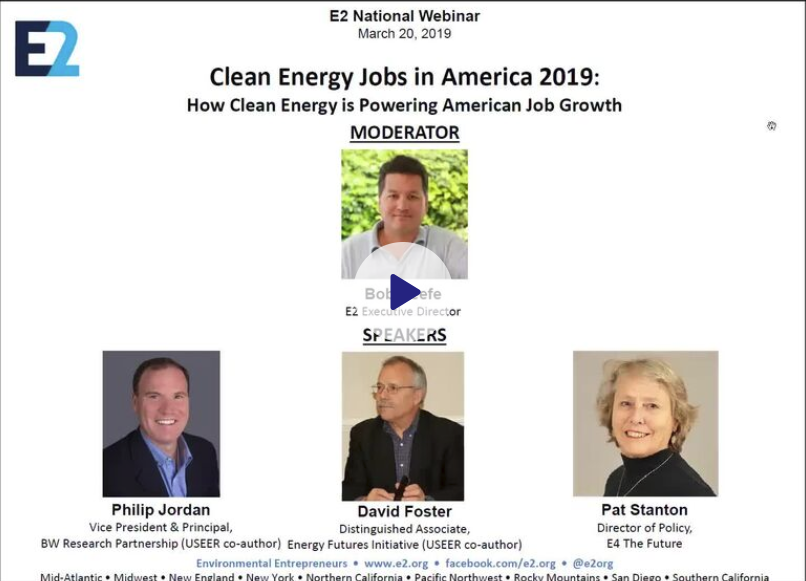
On March 20, E2 held a for a webinar on the findings of the 2019 Clean Jobs America report and the just-released 2019 US Energy Employment Report (USEER).

The panel discussion — featuring USEER co-authors David Foster and Phillip Jordan from the Energy Futures Initiatives and BW Research along with E4TheFuture director Pat Stanton and E2 executive director Bob Keefe — focused on the importance of state and federal policies to keep clean jobs growing and how E2 is using this data to help advance policies that are good for the economy and good for the environment.

A full recording of the webinar and presentation is available at this link or on the right.

PAST CLEAN JOBS AMERICA REPORTS

Clean Jobs America 2019 is the 4th national clean energy jobs report from E2. Previous reports can be accessed in the below links.

View Report »

San Diego Solar Experience

Over a dozen nonprofit organizations and industry experts are coming together to provide unbiased, educational information for San Diego families considering a less expensive and more sustainable electricity option. The events will educate about upcoming SDG&E rate changes, how solar and energy storage work, available state and federal incentives and much more. Location IBEW Local […]

District-By-District | 2019 Clean Energy Jobs in Oregon

Date: January 22, 2019

Despite a population of just 4 million, Oregon’s clean energy economy ranks 14th in solar jobs and in the top 21 in energy efficiency, wind energy, clean fuels, grid and storage, renewable energy, and total clean energy jobs.

Thanks to policies like the Renewables Portfolio Standard, Clean Fuels Program and Coal to Clean that are driving development of infrastructure projects like solar arrays and wind farms, more than 55,000 Oregonians across every county in the state work in the clean energy sector according to E2’s Clean Jobs Oregon 2018 report released in December.

But these statewide numbers only tell part of the clean energy success story in Oregon. Below is a district-by-district look at the jobs and economic benefits that have resulted from Oregon’s climate policies.

Clean Jobs | District-By-District

Analysis of Clean Energy’s Economic Benefits Across Oregon (updated for 2019)

Iberdrola Renewables’ Klondike III windfarm in Oregon // Credit: NREL

Oregon’s Statewide 2018 Clean Energy Jobs Report
Who Are My Representatives?


View Report »

Clean Jobs Oregon 2018

Date: December 13, 2018

OREGON POISED TO BUILD ON CLEAN ENERGY SUCCESS IN 2019

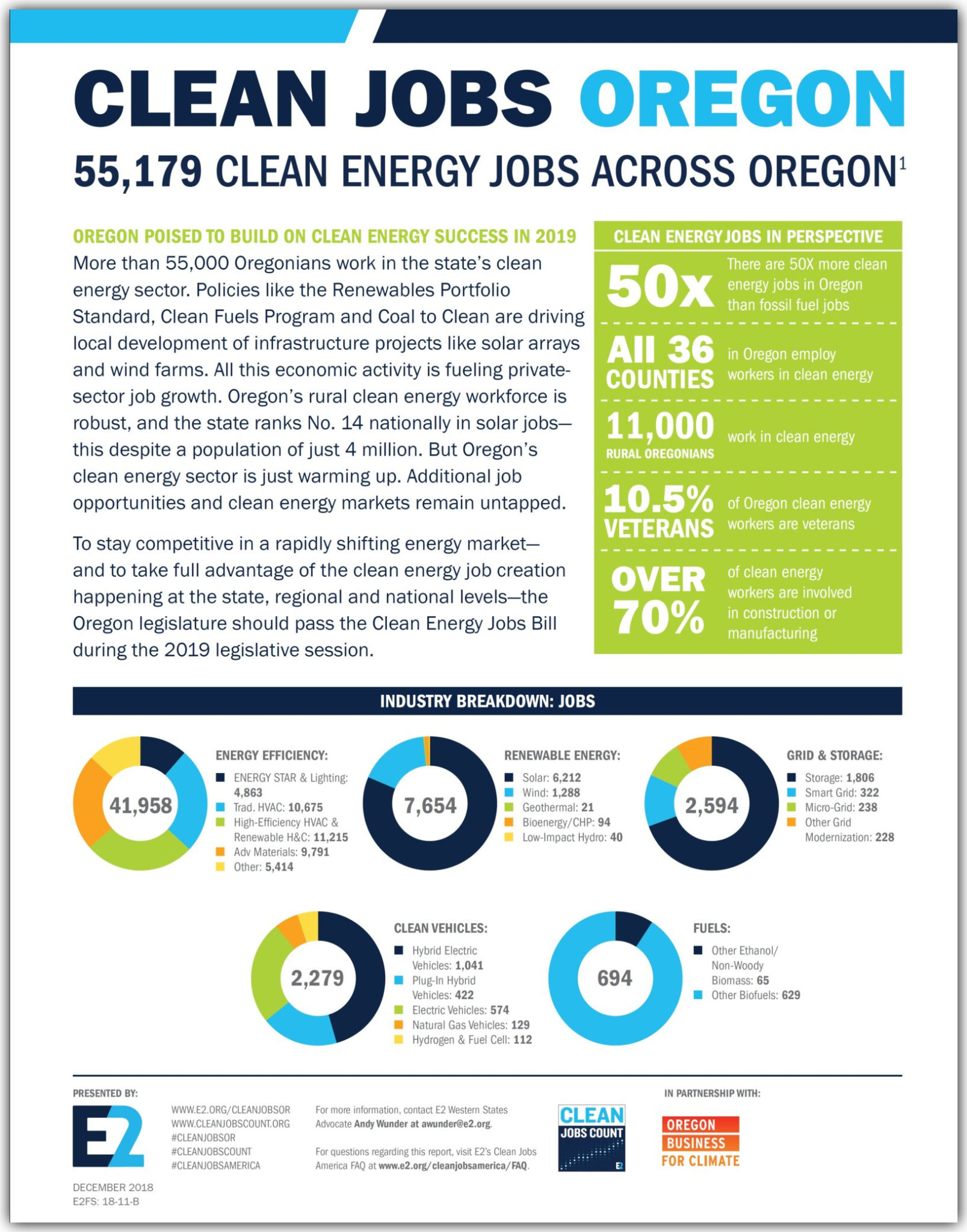
More than 55,000 Oregonians work in the state’s clean energy sector. Policies like the Renewables Portfolio Standard, Clean Fuels Program and Coal to Clean are driving local development of infrastructure projects like solar arrays and wind farms. All this economic activity is fueling private-sector job growth. Oregon’s rural clean energy workforce is robust, and the state ranks No. 14 nationally in solar jobs—this despite a population of just 4 million. But Oregon’s clean energy sector is just warming up. Additional job opportunities and clean energy markets remain untapped.

To stay competitive in a rapidly shifting energy market—and to take full advantage of the clean energy job creation happening at the state, regional and national levels—the Oregon legislature should pass the Clean Energy Jobs Bill during the 2019 legislative session.

A BIGGER PICTURE

This report focuses solely on the energy sector of the economy and does not include jobs in retail trade, repair services, water or waste

management, and indirect employment or induced employment.

HIGHLIGHTS:

  • Energy Efficiency Jobs – 41,958
  • Renewable Energy Jobs – 7,654
  • Solar Jobs – 6,212
  • Wind Jobs – 1,288
  • Energy Storage Jobs – 2,594
  • Clean Vehicle Jobs – 2,279
  • TOTAL Oregon Clean Energy Jobs – 55,179

LOOKING FOR MORE INFO?

For an even deeper dive into the breakdown of clean energy jobs for Oregon visit E2’s District-By-District Clean Energy Jobs in Oregon page for factsheets on jobs in every Oregon state legislative district.

Visit e2.org/reports or see Clean Jobs Count for a full interactive jobs breakdown of every U.S. state and clean energy industry. You can also contact E2 Communications Director Michael Timberlake ([email protected]). An FAQ is also available here to answer any questions.

DOWNLOAD

The complete report is available for download here.


View Report »

Offshore Wind: Generating Economic Benefits on the East Coast

Date: August 30, 2018

REPORT

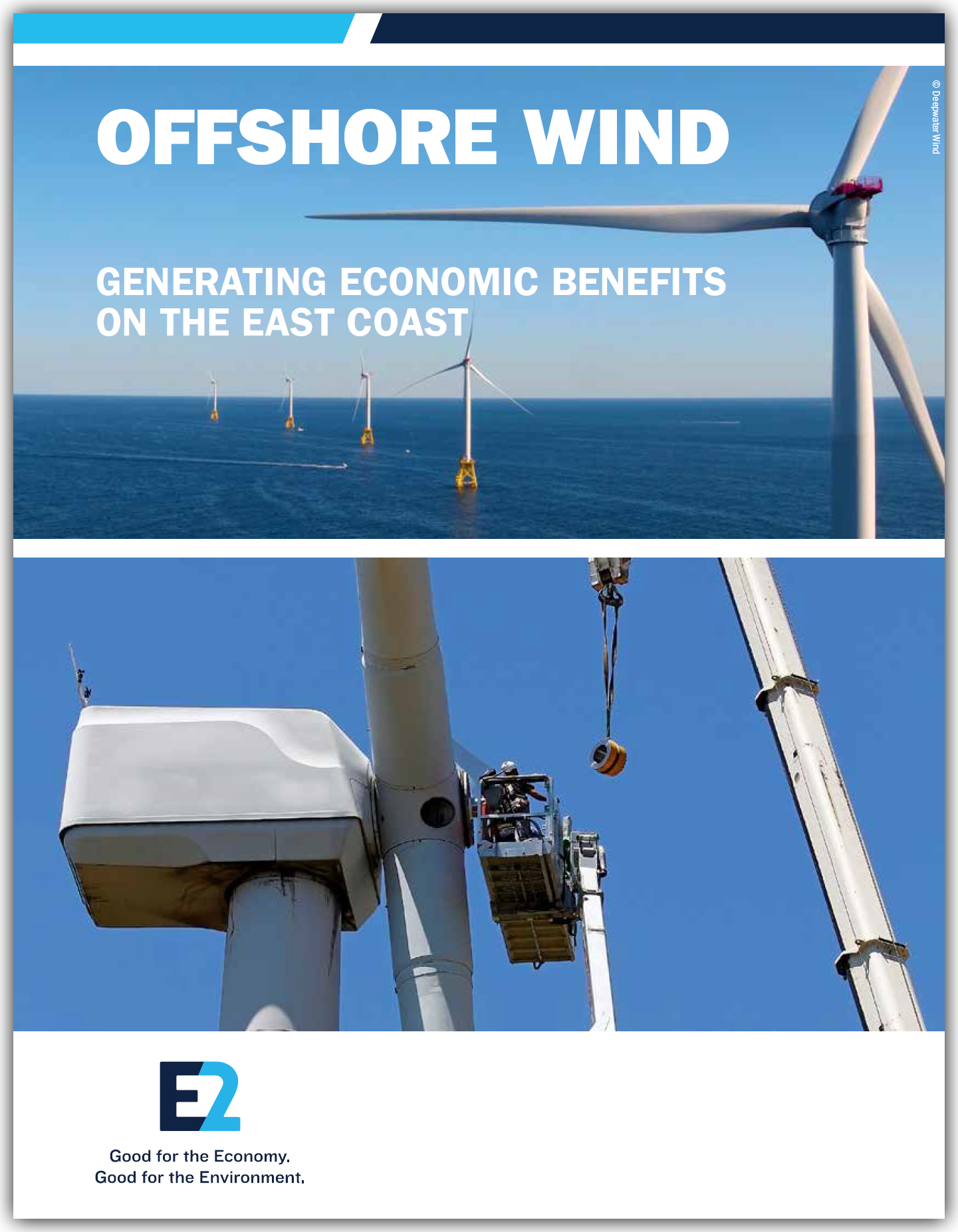
The U.S. offshore wind industry is poised for substantial growth, thanks to falling costs and increasing recognition by state and federal policy makers that there are tremendous economic benefits in harnessing clean, renewable energy offshore. BW Research, on behalf of E2, found that if each of the five states below added an average-sized offshore wind energy farm (352 MW) nearly 25,000 construction and operational jobs would be created up and down the eastern seaboard. The Department of Interior is developing lease sales for a strong pipeline of projects in this region—28 in total—which could equal 23,735 MW of new generating capacity, which if all developed would result in tens of thousands of more jobs and added economic benefits for those states. Through its expected growth over the next several years, offshore wind energy has the potential to significantly add to the Gross Regional Product (GRP) and state and federal tax revenues of South and North Carolina, Virginia, New Jersey, and New York.

OFFSHORE WIND ECONOMIC POTENTIAL:

  • If New York, New Jersey, Virginia, North Carolina, and South Carolina added an average-sized offshore wind energy farm (352 MW), nearly 25,000 jobs and $3.6 billion would be added to the states’ economies.
    • South Carolina – 5,647 jobs and $878 million economic benefits
    • North Carolina – 5,522 jobs and $710 million economic benefits
    • Virginia – 4,377 jobs and $641 million economic benefits
    • New Jersey – 4,313 jobs and $702 million economic benefits
    • New York – 4,063 jobs and $737 million economic benefits

OFFSHORE DRILLING’S ECONOMIC RISK

  • A one-month beach and fishing closure due to an oil spill off the coasts of New York, New Jersey, Virginia, North Carolina, and South Carolina would cost over $2.7 billion in GDP and $1.3 billion in lost wages.
    • South Carolina – $117 million in lost wages and $314 million in GDP
    • North Carolina – $57 million in lost wages and $120 million in GDP
    • Virginia – $90 million in lost wages and $175 million in GDP
    • New Jersey – $163 million in lost wages and $307 million in GDP
    • New York – $870 million in lost wages and $1.8 billion in GDP

LOOKING FOR MORE INFO?

If you are looking for additional insight into E2’s Offshore  Wind report, including specific info about a state or to connect with business leaders on the East Coast who support increased offshore wind development and policies that grow clean energy jobs, contact E2 Communications Director Michael Timberlake ([email protected]).

The complete report is available here.


View Report »

Mapping Clean Energy: Missouri

Date: June 6, 2018

Missouri’s clean energy economy is clearly thriving.

But where is all this economic activity happening?

That’s exactly what E2 — along with our partners at FracTracker Alliance — attempted to find out with this series of interactive maps showing the location of more than 400 clean energy businesses across the state as well as sites where renewable energy is generated.

The purpose of these maps is to help policymakers, the media, and individuals better understand the scope of Missouri’s clean energy economy – and how much room it has to grow.

Key Takeaways:

  • There are over 400 businessesdisplayed in the map, which includes energy efficiency contractors and renewable energy (solar, wind, and geothermal) installers, covering all 34 state senate districts.
  • Approximately 75 percent of the state has above average potential for solar power
  • There is 702 MW of utility-scale wind and solar capacity currently installed with 458 MW of wind and solar capacity proposed to be built.

We’ve done our best to capture as many businesses as possible but if you know we’ve missed something, please send an email to Micaela Preskill ([email protected]) and we’ll add it to the map. This map isn’t comprehensive; it represents one snapshot in time of an industry to help you understand just how robust it is, and where it still has room to grow.

How to Use the Maps:

We’ve created 3 maps to show different parts of Missouri’s clean energy economy. One map shows clean energy businesses, one shows renewable energy utility-scale infrastructure, and one shows renewable energy potential.

When viewing the map, zoom in to see the intricacies of what’s happening in each part of the state. If you click “Layers” on the black bar at the top of the map you will see a drop-down menu, which you can use to make data appear or disappear on the map.

For more information about what you’re seeing, click directly on the map. A pop-up box will appear to show you specifics. Use the arrows on the top right of the pop-up box to see all the information that applies to that spot on the map. For example, if you click on a pin representing a energy efficiency contractor, you’ll see information about that business. You can also use the arrow to see what legislative districts that business is in.

The Maps

The Clean Energy Business Map shows locations of energy efficiency contractors and solar, wind and geothermal installers.

The Renewable Energy Infrastructure Map shows utility-scale wind and solar generation facilities larger than 1 MW and schools with solar energy generation.

The Renewable Potential Map shows the potential for wind, geothermal and solar power generation.

Other Resources:

Missouri supports 55, 251 clean energy jobs – 2017 Clean Jobs Midwest Report
Nearly 3.2 million Americans work in clean energy – Clean Jobs America

View Report »

Sign Up for Email Updates


"*" indicates required fields

This field is for validation purposes and should be left unchanged.

Our Latest Press Releases


Releases

Six Emerging Environmental Entrepreneurs Selected for National Fellowship

The E2 & 1 Hotels the fellowship program is designed to help early career environmentally-minded entrepreneurs and community leaders to create and implement unique projects at the intersection of the economy and environment. This year’s projects span a wide...


Releases

E2: Repealing EPA’s Endangerment Finding For Vehicle Emissions Raises Costs for Businesses and Consumers

The EPA officially revoked the endangerment finding for greenhouse gas (GHG) emissions and eliminated clean vehicle standards in a blow to both our economy and our environment.


Releases

E2: Companies Cancelled $34.8B, 38K Jobs for Clean Energy Projects in 2025, Outpacing New Investments 3-to-1

Businesses abandoned $5.1 billion in large-scale factories and clean energy projects in December, capping a turbulent year for the sector that saw nearly $35 billion in investments disappear along with more than 38,000 current and future jobs, according to ...


Donate Today