New state-by-state data reveals jobs lost to pandemic and details ongoing recovery WASHINGTON— A new report finds that while more than 2.1 million Americans now work in energy efficiency — which is more than work in any other sector of the U.S. energy industry, including oil, gas and coal — energy efficiency employment still has not […]
The efficiency sector provides more jobs than any other in the U.S. energy industry but employment has not returned to pre-pandemic levels, according to a report released Tuesday by nonpartisan business group E2 and clean energy nonprofit E4TheFuture… …The E2 and E4TheFuture employment report highlighted the sector’s importance and challenges. Pre-pandemic, the efficiency sector was […]
The U.S. energy efficiency workforce climbed to 2,115,533 people as of June 2021, up slightly from a year earlier but still creeping toward full recovery at a relatively glacial pace, per pre-pandemic data from Environmental Entrepreneurs (E2) and E4TheFuture, which partnered in putting together the report. Given its consistent growth in the previous years, pre-pandemic […]
And more than 1,000 business leaders signed onto one of three letters backing both the budget and infrastructure bills, in campaigns organized by the American Sustainable Business Council, Environmental Entrepreneurs and Clean Energy for America.
More than 113,400 Michiganders worked in alternative energy at the end of 2020, according to a study released by the Environmental Entrepreneurs (E2) and Clean Energy Trust. The report comes as the U.S. Congress and the Biden administration are considering legislation to boost federal investments in clean energy and clean vehicles, and as the state […]
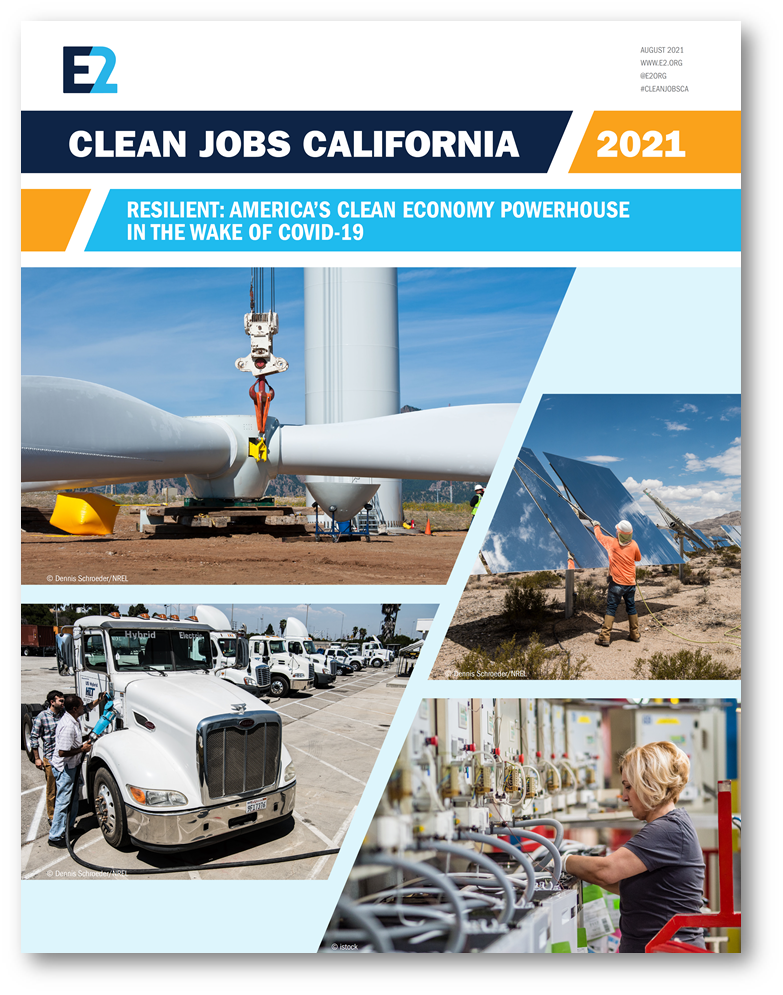
America’s Clean Energy Powerhouse in the Wake of Covid-19
Summary:
Driven by the unforeseeable impact of last year’s pandemic and resulting economic crisis, California experienced its first decline in clean energy jobs in 2020 since E2 began tracking such occupations. California’s clean energy economy employed about 480,000 Californians at the end of 2020, down from 537,000 the year before.
However, since the sector’s losses peaked at the end of May 2020, jobs grew back by more than 13 percent compared to less than 6 percent in statewide economy overall. In fact, by the end of 2020 more than half of the clean energy jobs lost between March and May had been regained, leaving the sector down just 9 percent (about 52,000 jobs) since COVID-19. Thanks to decades of smart state climate policy leadership, California’s clean energy economy has proven to not only be a core part of the state’s economy – representing 3 percent of overall state employment – but resilient and robust in the face of crushing economy-wide pressures.
Findings
Despite the overall decline, clean energy remains the biggest job creator across America’s energy sector:
Clean energy employs nearly six times as many workers as work in fossil fuel extraction and generation
More Californians still work in clean energy than work as registered nurses, accountants, lawyers, software designers, or truck drivers.
Median hourly wages for clean energy jobs also are about 29 percent higher than the statewide median wage.
Over half of the state’s clean energy jobs – 244,790 – were in construction with the clean energy economy employing 28 percent of the state’s entire construction workforce.
Colorado Clean Energy Employment, 2020
Energy Efficiency
283,839
Renewables
130,403
Clean Vehicles
42,503
Storage and Grid
22,638
Clean Fuels
5,597
TOTAL
484,980
Policies Matter
While clean energy suffered like many sectors of the economy in 2020, the prospects for growth are greater than ever as detailed in this report. Smart public policy leadership created the market environment to position California’s clean energy economy as a global leader over the last 20 years. Furthermore, policies that drive clean energy investments and job growth can also help mitigate the human toll and the economic cost of climate including the over $100 billion lost to extreme weather events in the U.S. in the last year alone. Climate risk is business risk.
Members of Congress can turn risk into opportunity by passing a robust American Jobs Plan anchored in clean energy investments to fund grid modernization, energy efficiency and electric vehicle charging networks at scale to form the backbone of a cleaner, more resilient economy. California lawmakers must build on existing state climate policy leadership to ensure the state remains a hub of job growth and innovation. Lawmakers must codify our state’s carbon neutrality goals while tightening our emissions mitigation targets, and continue to build out complementary policies to drive climate action to meet these goals.
Background
This is the fourth annual Clean Jobs California report produced by E2 based on analysis of the USEER, which was first released by the DOE in 2016. E2 was an original proponent of the DOE producing the USEER and was a partner on the reports produced by the Energy Futures Initiative (EFI) and National Association of State Energy Officials (NASEO) after the Trump administration abandoned it in 2017.
For additional insight into E2’s Clean Jobs California or our other annual clean energy economic reports, visit e2.org/reports.
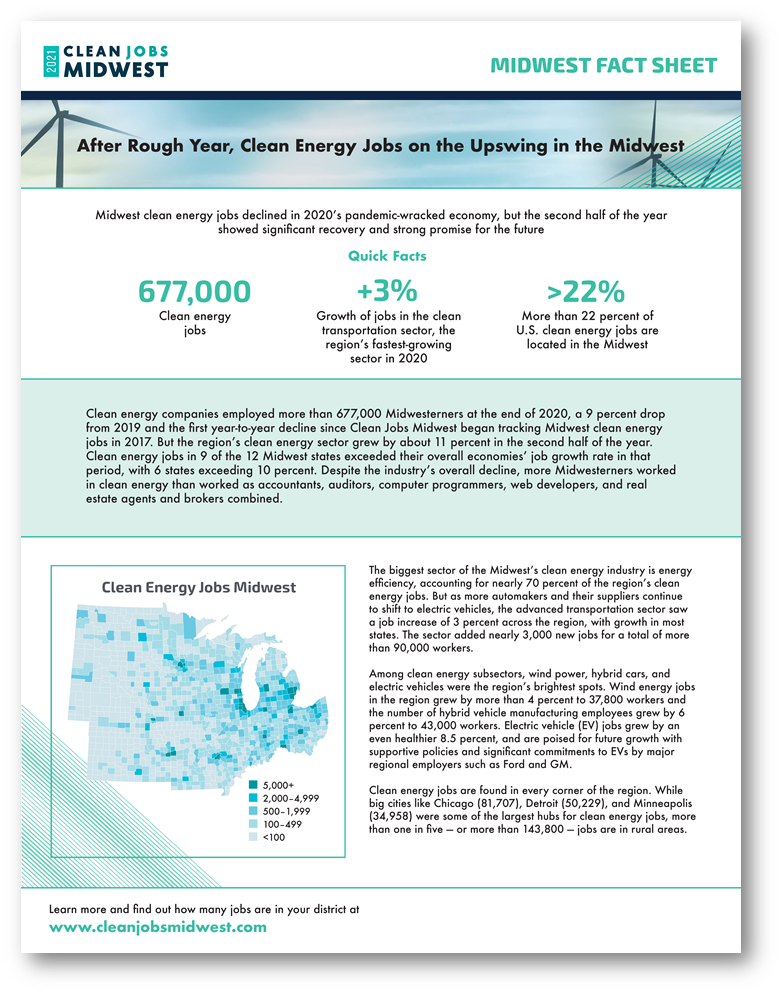
After Rough Year, Clean Energy Jobs on the Upswing in the Midwest
More than 677,900 Midwesterners worked in clean energy and clean vehicles at the end of 2020, making the sector a major – and promising – part of the region’s economy, according to this comprehensive analysis of employment data.
Like most of the economy, clean energy was hit hard by the COVID-19 pandemic and economic downturn in 2020. According to this year’s Clean Jobs Midwest, 2020 was the first year-to-year decline since E2 and Clean Energy Trust began tracking Midwest clean energy jobs. At one point, more than 131,600 Midwest clean energy workers had filed for unemployment, but the sector surged back 10.7 percent in the second half of the year to recover more than half of the jobs initially lost. The final 2020 job numbers represent an 8.9 percent drop in the Midwest clean energy workforce from 2019, or 66,100 jobs. Last year’s job losses were a dramatic change of pace for the industry. Last year’s job losses were a dramatic change of pace for the industry. In the 3 years leading up to 2020, for example, clean energy jobs grew almost 4 times as fast as overall employment.
MIDWEST HIGHLIGHTS
Energy Efficiency – 470,651 jobs
Clean Vehicles – 90,652 jobs
Renewable Energy – 84,881 jobs
Grid & Storage – 24,209 jobs
Clean Fuels – 7,525 jobs
ALL Clean Energy Sectors – 677,918 jobs
OTHER KEY FINDINGS
The biggest sector of the Midwest’s clean energy industry is energy efficiency, accounting for nearly 70 percent of the region’s clean energy jobs. But as more automakers and their suppliers continue to shift to electric vehicles, the advanced transportation sector saw a job increase of 3 percent across the region, with growth in most states. The sector added nearly 3,000 new jobs for a total of more than 90,000 workers.
Among clean energy subsectors, wind power, hybrid cars, and electric vehicles were the region’s brightest spots. Wind energy jobs in the region grew by more than 4 percent to 37,800 workers and the number of hybrid vehicle manufacturing employees grew by 6 percent to 43,000 workers. Electric vehicle (EV) jobs grew by an even healthier 8.5 percent, and are poised for future growth with supportive policies and significant commitments to EVs by major regional employers such as Ford and GM.
Clean energy jobs are found in every corner of the region. While big cities like Chicago (81,707), Detroit (50,229), and Minneapolis (34,958) were some of the largest hubs for clean energy jobs, more than one in five — or more than 143,800 — jobs are in rural areas.
DOWNLOAD
The complete report along with interactive breakdowns for all states is available at this link.
There has been an uptick in Energy Transition activity in Houston over the past several years. Currently, Houston boasts at least 100 solar energy-related companies and 30 wind energy-related companies. Environmental Entrepreneurs ranked Houston seventh among the top 50 U.S. metro areas for clean energy employment in the fourth quarter of 2019, with 1.9 percent […]
“…like the rest of or most of the economy in the United States, clean energy took a pretty big hit last year. Clean energy jobs fell for the first time since we’ve been tracking them nationally dropping about 307,000 jobs nationally.” But according to E2’s Clean Jobs in America 2021 report, data indicates that clean energy […]
Clean energy jobs increased by about 2% in 2019 and 4% in 2018, according to a report from Environmental Entrepreneurs, a national, nonpartisan group of business leaders, investors, and professionals. Building on those gains, for Biden to create just one million new clean energy jobs in his first four years, there would need to be […]
Yet while fossil-fuel companies likely will be hobbled by more restrictions, the industry’s production and jobs will be replaced by clean energy, resulting in a wash for the economy over time, Coglianese says. A report by the nonprofit Environmental Entrepreneurs says clean energy already employs nearly three times as many workers as does fossil fuel […]
The EPA officially revoked the endangerment finding for greenhouse gas (GHG) emissions and eliminated clean vehicle standards in a blow to both our economy and our environment.
Businesses abandoned $5.1 billion in large-scale factories and clean energy projects in December, capping a turbulent year for the sector that saw nearly $35 billion in investments disappear along with more than 38,000 current and future jobs, according to ...
The Trump administration is trying to halt offshore wind projects that are well-underway just two weeks after their initial attempt was deemed arbitrary and capricious by a federal judge.
December 22 2025
Donate Today
Make a donation to help E2 advance policies that are good for the economy and good for the environment. Your donation is 100% tax-deductible from our partner, the NRDC.
Please contact E2 Membership Director Ying Li at [email protected] or 212-727-4437 for stock and wire transfer instructions.
For stocks, alert us to the transfer and provide the name of the stock and the number of shares being donated. This will help us track your donation internally and enable NRDC to provide an accurate gift receipt in a timely fashion.
Donations to E2 go directly to NRDC, a 501(c)3, and are fully tax-deductible (Federal Tax ID: 13-2654926). E2 collects no funds. NRDC provides full-time staffing dedicated to E2, as well as administrative, communications, legislative and analyst/policy support for the work of E2.
By Check
Make personal, Foundation or Donor Advised Fund checks payable to NRDC (indicate your donation is for E2 Membership to expedite processing) and send to:
Natural Resources Defense Council
Attn: Gift Processing
40 West 20th Street, 11th floor
New York, NY 10011