Republicans Seek to Help Clean Energy in Next Virus Aid Package

Prior to the pandemic, the U.S. clean energy sector was one of the bright spots for the U.S. economy, with a total workforce of 3.4 million employees in 2019, and the sector grew twice as fast as the overall U.S. economy since 2017. The sector rebounded slightly in June, but more than half a million […]

Iowa’s clean energy workers can help speed up our economic recovery

Posted on July 20, 2020 by Troy Van Beek

Since founding a renewable energy business in rural Jefferson County nearly a decade ago, I’ve been fortunate to work alongside people whose grit, vision and ingenuity has helped our company grow and prosper. Although we started with just two workers, at the time of the coronavirus outbreak we employed about 40 women and men. All […]

Report: Clean Energy Stimulus Could Create 860,000 U.S. Jobs, Add $330 Billion to GDP

Report models impact of $99.2 billion of federal investments in existing programs and funding vehicles Stimulus could help get more than 500,000 unemployed clean energy workers in every state back on the job quickly WASHINGTON  – As Congress considers additional measures to support and jumpstart the U.S. economy, a new E2 (Environmental Entrepreneurs) and E4TheFuture […]

Build Back Better, Faster: How a federal stimulus focusing on clean energy can create millions of jobs and restart America’s economy

Date: July 15, 2020

Clean Energy Economic Stimulus Impacts

The coronavirus (COVID-19) pandemic has caused millions of Americans—including as many as 620,500 clean energy workers—to lose their jobs over just a few months. E2 and E4TheFuture partnered with BW Research Partnership on this economic impact assessment to demonstrate the potential for creating jobs from federal stimulus investments in three major sectors of the clean energy economy: Energy Efficiency, Renewable Energy, and Grid Modernization.

The clean energy industry is proven to provide a great return on stimulus investments. During the Great Recession, the American Recovery and Reinvestment Act of 2009 (ARRA) directed a portion of stimulus investments to supply chain components for major clean energy technology sectors such as advanced vehicles, batteries, renewable energy, carbon capture and sequestration, grid modernization, and energy efficiency. It is estimated that these $90 billion in strategic investments and incentives supported roughly 900,000 job-years from 2009 through 2015. These investments also set the stage for long-term job growth across the nation’s clean energy industry. By 2019, the clean energy workforce was 3.4 million workers strong and had been growing two times faster than nationwide employment since 2017.

Economic benefits of the proposed federal stimulus package include high-quality jobs for U.S. residents, labor income, boosts to local, state, and federal tax revenues, contributions to Gross Domestic Product (GDP), and energy cost savings. All these benefits ultimately translate to greater spending in the economy. Clean energy jobs are proven to be sustainable wage positions that are accessible to all localities across the U.S., regardless of geography, or politics, and provide new, equitable job opportunities that cannot be outsourced. Moreover, updates to the nation’s energy infrastructure are an investment in the collective economic future of Americans; the creation of a more resilient energy system is vital to economic growth and security.

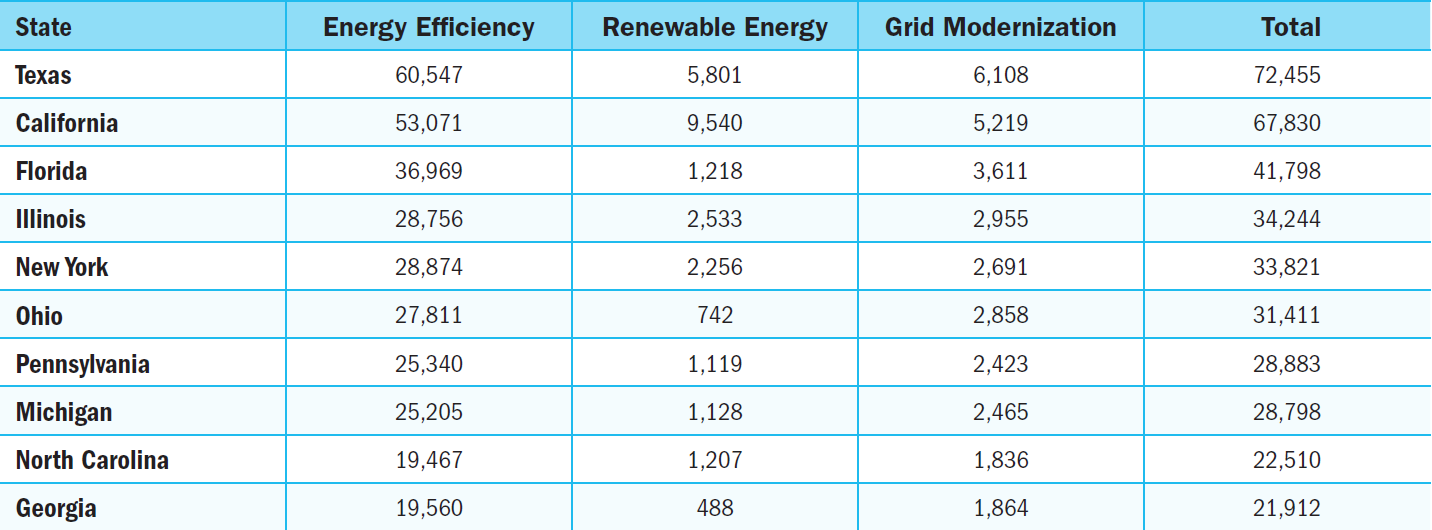
This report looks at the first five years of economic impacts from a robust federal clean energy stimulus totaling $99.2 billion—with targeted and strategic investments in energy efficiency, renewable energy, and grid modernization. Our modeling finds that such an investment in our shared future would create 860,300 full time direct, indirect and induced jobs that will last for at least five years (a total of 4.3 million job-years). A stimulus of this level and the jobs it would create would also generate more than $66 billion in GDP each year for the next five years—resulting in $330 billion in economic activity, more than triple the amount of investment. These are jobs that would support sustainable wages and help bring the U.S. economy out of the severe recession.

By Industry Impacts

States Most Impacted

Download

The complete report is available for download at this link.

Looking for More Info?

The analysis expands on data from the 2020 U.S. Energy and Employment Report (USEER) produced by the Energy Futures Initiative (EFI) in partnership with the National Association of State Energy Officials (NASEO), using data collected and analyzed by the BW Research Partnership. The report was released in March 2020 and is available at www.usenergyjobs.org. E2 is a partner on the USEER, the fifth installment of the energy survey first released by the Department of Energy in 2016 and subsequently abandoned under the Trump administration. Clean energy jobs have grown every year since the first report was released in 2016.

If you are looking for additional insight into this report or E2’s more than a dozen other annual clean energy employment reports, visit e2.org/reports. You can also contact E2 Communications Director Michael Timberlake ([email protected]).

View Report »

Clean Energy & COVID-19 Crisis | June 2020 Unemployment Analysis

Date: July 10, 2020

Clean Energy Unemployment Claims in COVID-19 Aftermath, June 2020

The U.S. clean energy sector added 106,320 jobs in June, leaving over half a million (514,270) clean energy workers out of work despite nationwide re-openings. Despite the gains in June, there remains a nearly 15 percent decline over pre-COVID-19 employment levels, according to the latest analysis of unemployment data by BW Research for E2, E4TheFuture, and the American Council on Renewable Energy (ACORE).

In all, clean energy employment is still down 15 percent from the start of the year, when nearly 3.4 million Americans worked in renewable energy, energy efficiency, clean vehicles and fuels and other clean energy sectors.

While the June jobs improvement is an encouraging sign of clean energy’s ability to quickly put Americans back to work, resuming a robust recovery in one of the nation’s biggest employment sectors anytime soon remains unlikely without direct action by Congress. Only one out of every six clean energy jobs lost since March returned in June, and as federal Paycheck Protection Program (PPP) funds are exhausted and states are forced to close businesses again in the face of COVID-19’s resurgence, more layoffs could be imminent without congressional action. According to the analysis, as many as 2.3 million clean energy workers are employed by small businesses that received PPP loans.

Other troubling trends include a sharp increase in permanent job losses, rising initial weekly unemployment claims, and COVID-19 cases spiking in states with some of the largest clean energy workforces, according to the analysis.

Before March, clean energy had been one of the U.S. economy’s biggest and fastest-growing employment sectors, growing 10.4% since 2015 to 3.4 million jobs at the end of 2019. That made clean energy by far the biggest employer of workers in all energy occupations, employing nearly three times as many people as the fossil fuel industry.

By Industry Job Losses, June 2020

SECTOR MARCH APRIL MAY JUNE TOTAL
Energy Efficiency -103,298 -309,584 -18,880 +71,786 -359,976
Renewables -23,739 -71,705 -4,272 +17,287 -82,429
Clean Vehicles -11,399 -35,070 -2,059 +10,335 -38,193
Grid & Storage -6,517 -19,666 -1,166 +4,561 -22,788
Clean Fuels -2,186 -10,390 -657 +2,351 -10,882
INDUSTRY TOTAL -147,139 -446,416 -27,035 +106,320 -514,270

State With Most Job Losses, May 2020

State March April May June Total Claims 
US TOTAL -147,139 -446,416 -27,035 +106,320 -514,270
California -27,583 -77,815 -4,313 +19,831 -89,881
Texas -5,965 -25,170 -1,709 +7,997 -24,847
Florida -3,963 -25,949 -2,563 +5,832 -26,643
Michigan -7,867 -22,245 -1,012 +6,465 -31,124
Georgia -1,909 -25,282 -1,741 +1,579 -27,353
North Carolina -9,124 -17,138 -955 +5,837 -21,380
Pennsylvania -8,283 -12,780 -571 +2,689 -18,945
Washington -5,646 -14,433 -1,163 +2,729 -18,513
New York -6,006 -13,868 -848 +3,314 -17,408
Ohio -6,929 -12,879 -612 +3,387 -16,582


For a full breakdown of clean energy jobs losses in each state, see the full analysis here.

Download

The complete report is available for download at this link.

Looking for More Info?
The analysis expands on data from the 2020 U.S. Energy and Employment Report (USEER) produced by the Energy Futures Initiative (EFI) in partnership with the National Association of State Energy Officials (NASEO), using data collected and analyzed by the BW Research Partnership. The report was released in March 2020 and is available at www.usenergyjobs.org. E2 is a partner on the USEER, the fifth installment of the energy survey first released by the Department of Energy in 2016 and subsequently abandoned under the Trump administration.

If you are looking for additional insight into this report or E2’s more than a dozen other annual clean energy employment reports, visit e2.org/reports. You can also contact E2 Communications Director Michael Timberlake ([email protected]).

Sign-Up for Email Updates

"*" indicates required fields

This field is for validation purposes and should be left unchanged.

View Report »

House Infrastructure Bill Meets the “Severity of the Challenges” U.S. Faces; Clean Energy Stimulus Needed Next

Statement from Director of Federal Advocacy, Sandra Purohit WASHINGTON (July 1, 2020) – The House of Representatives today passed the “Moving Forward Act” (H.R. 2), a $1.5 trillion infrastructure bill that prioritizes clean energy to combat the looming threat of climate change and accelerates America’s economic recovery. The bill includes investments in clean energy, clean […]

Sign Up for Email Updates


"*" indicates required fields

This field is for validation purposes and should be left unchanged.

Our Latest Press Releases


Releases

STATEMENT: Federal Rollback of Auto Fuel Efficiency Standards Will Increase Costs for Consumers, Businesses

The National Highway Traffic Safety Administration (NHTSA) is expected to announce the Administration’s intent to weaken federal Corporate Average Fuel Economy (CAFE) standards for vehicles. Such a dramatic shift in policy would halt five decades of progres...


Releases

Companies Cancel $4.4 Billion in Clean Energy Projects; $28 Billion, 30K Jobs Lost in 2025

WASHINGTON –Businesses canceled, closed, and scaled back more than $4.4 billion worth of large-scale factories and clean energy projects from late-September through October, bringing the total cost of projects cancelled in the private-sector to over $28.7 b...


Releases

REPORT: Clean energy grew 5X faster than rest of Pennsylvania economy, added 3K jobs in 2024

HARRISBURG (Nov. 20, 2025) – Clean energy jobs in Pennsylvania grew more than five times faster than the rest of the state's economy in 2024, raising the total number of clean energy workers in the state to over 104,000, according to the Clean Jobs Pennsylv...


Donate Today