Energy Efficiency Jobs in America: 2019

Date: September 16, 2019

Leading America’s Energy Workforce

For the second year in a row, energy efficiency is America’s fastest-growing energy industry — accounting for about half (76,000) of the sector’s entire job growth in 2018 (151,700) — now eclipsing 2.3 million American workers.

Led by a growth rate double the nationwide average, energy efficiency is currently responsible for one out of every four jobs in the energy sector while employing more Americans than the entire fossil fuel industry in 41 states and the District of Columbia. Nationwide, energy efficiency businesses employs twice the number of workers as fossil fuels.

This sector’s consistently strong year-over-year job growth—and growing integration in the economic value chain and built environment—is turning the industry into the energy sector’s most viable (and efficient) job creator. Across every time zone, state, county line, and even zip code, energy efficiency solutions are advancing economic opportunities for American workers and their families. Jobs that will grow locally, jobs that cannot be outsourced.

Download

The 2019 Energy Efficiency Jobs in America report includes an 7-page national summary and individual factsheets for all 50 U.S. states and the District of Columbia that include more detailed findings including job totals for every congressional and legislative district, industry and technology breakdowns, and maps of every state’s top counties.

Alabama | Alaska  Arizona | Arkansas | California | Colorado | Connecticut | Delaware |District of Columbia| Florida | Georgia | Hawaii | Idaho | Illinois | Indiana | IowaKansas | Kentucky | Louisiana | Maine | Maryland |MassachusettsMichiganMinnesota | Mississippi | Missouri | Montana | Nebraska Nevada | New Hampshire |  New Jersey | New Mexico | New York | North Carolina | North Dakota | Ohio | Oklahoma | OregonPennsylvania | Rhode Island | South Carolina | South Dakota | Tennessee | Texas | Utah | Vermont | Virginia | Washington | West Virginia | Wisconsin | Wyoming |

A Bigger Picture

This annual report focuses solely on the energy sector of the economy. Jobs in retail trade, vehicle efficiency-related work, and the 4.2 million jobs related to efficient manufacturing processes are excluded from these numbers.

Previous Reports

2019 SECTOR TOPLINES

  • ENERGY STAR® Appliances & Efficient Lighting – 538,390 jobs
  • Building Materials & Insulation – 357,765 jobs
  • Vital Energy Efficiency Services – 290,203 jobs
  • HVAC (Heating Ventilation & Air Conditioning) – 1,138,507 jobs
  • ALL Energy Efficiency Industries – 2,324,865 jobs

OTHER 2019 HIGHLIGHTS

According to the 2019 Energy Efficiency Jobs in America, America’s energy efficiency sector:

  • increased employment 3.4% in 2018, adding 76,000 new jobs to the economy
  • is America’s fastest growing and largest energy jobs sector
  • accounts for 28% of U.S. energy workers are involved in energy efficiency
  • supports 321,000 manufacturing workers
  • supports over 50,000 workers in 17 states and at least 11,000 in 40 states
  • employs workers in 99.7% of U.S. counties
  • employs 370,000 workers efficient lighting technologies
  • employs 167,000 workers in ENERGY STAR® appliances
  • employs 1.1 million in heating, ventilation, and cooling technologies
  • has twice as many workers as all fossil fuel sectors combined
  • is made up of 360,000 businessesdominated by small businesses employing fewer than 20 employees (79%)
  • employs more than 317,000 rural Americans, and 928,000 in America’s top 25 metro areas
  • accounts for more than 1 out of every 6 U.S. construction workers

AMERICA’S TOP 10 STATES | 2019 Energy Efficiency Jobs

QUESTIONS & FAQ

For questions on this report, methodology, reported job numbers, or requests for specific additional data, email E2 Communications Director Michael Timberlake ([email protected]). An FAQ for the report, including answers to questions on methodology, is available here.

LOOKING FOR MORE?

If you are looking for additional insight into E4The Future and E2’s other research and publications on the energy economy, visit E4TheFuture’s Publications homepage or E2’s Reports homepage.

This report follows E2’s Clean Jobs America analysis which found the clean energy jobs account for nearly 3.3 million jobs across all 50 states and the District of Columbia. Both reports expand on data from the U.S. Energy and Employment Report (USEER) produced by the Energy Futures Initiative (EFI) in partnership with the National Association of State Energy Officials (NASEO), using data collected and analyzed by the BW Research Partnership. E2 is a partner on the USEER, the fourth installment of the energy survey first released by the Department of Energy in 2016. Clean energy jobs have grown every year since the first report was released in 2016.

OTHER E2 JOBS REPORTS

Energy Efficiency Jobs in America is only one in a series of state and industry reports produced by E2 and our partners.

View Report »

Here are the winners and losers on climate policy in 2019

State lawmakers across the country either have wrapped up their legislative sessions or are on the verge of what they refer to as sine die. The result is a panoply of policy that’s mostly good, but also bad and ugly when it comes to our nation’s economy, environment and sustainability.

Clean Jobs Colorado 2019

Date: September 12, 2019
Colorado’s Clean Energy Potential Reaches New Heights

Colorado is leading the Mountain West’s clean energy economy.

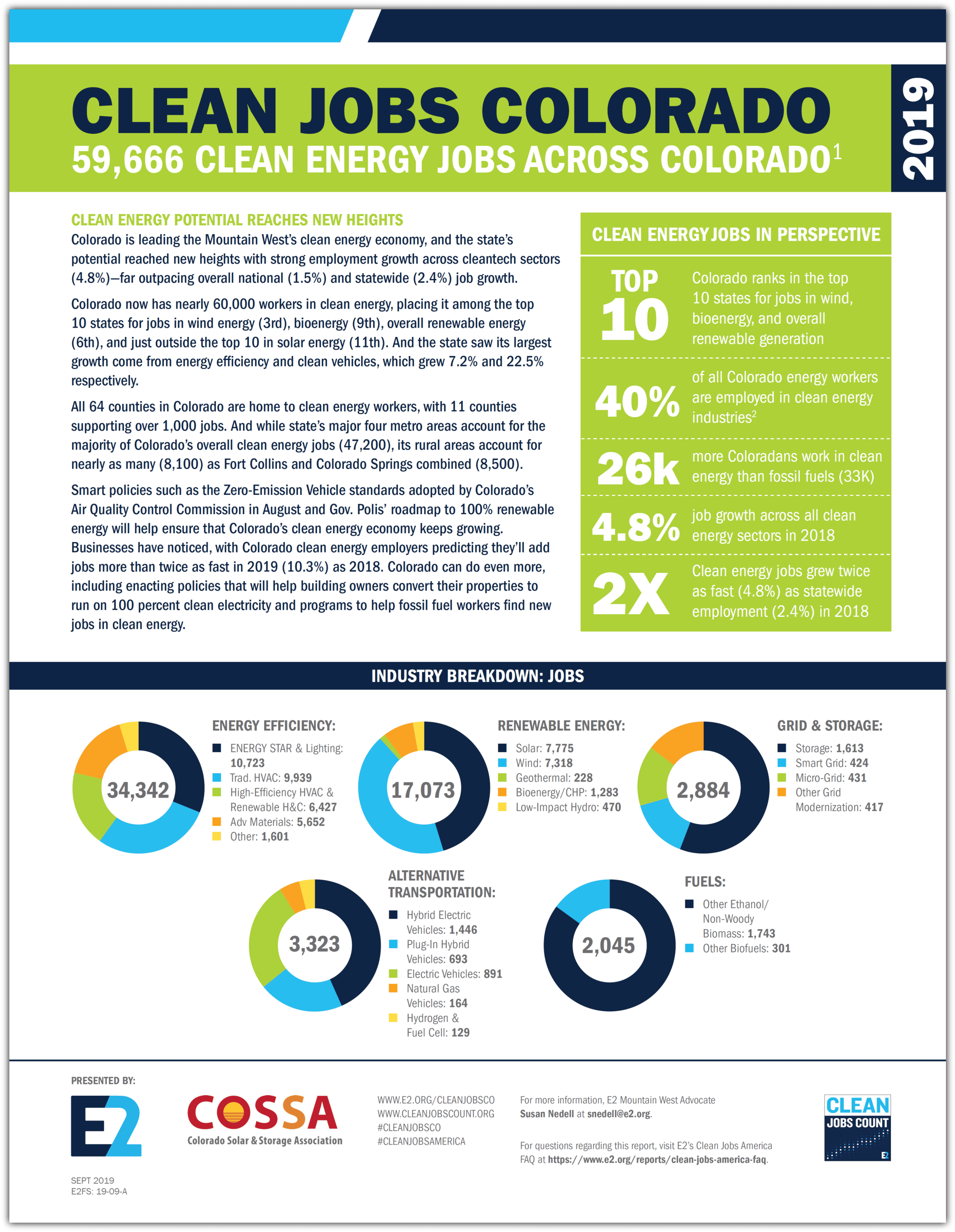
With nearly 60,000 clean energy workers now, the state’s potential reached new heights in 2018 with strong employment growth across cleantech sectors (4.8%)—far outpacing overall national (1.5%) and statewide (2.4%) job growth.

According to Clean Jobs Colorado 2019 (downloadable PDF) report, Colorado’s is now among the top 10 states for jobs in three sectors: wind energy (3rd), bioenergy (9th), and overall renewable energy (6th). The state fell just outside the Top 10 in solar energy (11th). However, the majority of Colorado’s clean energy job growth came from energy efficiency and clean vehicles, which grew 7.2% and 22.5%respectively.

Analyzing the state geographically,the employment analysis found that while Denver and Boulder accounted for nearly one out of every three clean jobs in the state, about 20 percent (29,000) are in areas outside the Denver, Boulder, Colorado Springs, and Fort Collins metro areas. Additionally, all 64 counties in the state are home to clean energy workers, with 11 counties supporting at least 1,100. Denver led all counties with more than 13,200 jobs, followed by Arapahoe (7,600) and Jefferson (5,800) counties. By density, Jackson, Denver, and Boulder counties led the state in clean jobs per 1,000 employable residents. All 64 counties in Colorado are home to clean energy workers, with 11 counties supporting over 1,000 jobs.

Smart policies such as the Zero-Emission Vehicle standards adopted by Colorado’s Air Quality Control Commission in August and Gov. Polis’ roadmap to 100% renewable energy will help ensure that Colorado’s clean energy economy keeps growing. And businesses have noticed, with Colorado clean energy employers predicting they’ll add jobs more than twice as fast in 2019 (10.3%) as 2018.

Colorado Job Sector Toplines

  • Energy Efficiency – 34,342 jobs
  • Renewable Energy – 17,073 jobs
  • Solar Energy – 7,775 jobs
  • Wind Energy – 7,318 jobs
  • Clean Vehicles – 3,323 jobs
  • Biofuels – 2,045 jobs
  • Energy Storage – 1,692 jobs
  • Grid Modernization – 1,272 jobs
  • ALL Clean Energy Sectors – 59,666 jobs

Other Highlights from 2018

  • Clean energy jobs also now employ 26,000 more workers than the state’s entire fossil fuel industry (10,022)
  • 8,100 workers Coloradans located in rural areas work in clean energy
  • 64% of clean energy workers are employed by businesses with fewer than 20 total employees
  • Colorado clean energy employers are projecting 10.3% employment growth for 2019.
  • Construction (37.6%) and professional services (40.7%) make up the majority of clean energy jobs.
  • 9.6% of Coloradans employed in clean energy are veterans
  • Denver led all counties in Colorado with 13,200 jobs, followed by Arapahoe (7,600) and Jefferson (5,868) counties

Looking for More Info?
This report follows E2’s Clean Jobs America analysis which found the clean energy jobs account for nearly 3.3 million jobs across all 50 states and the District of Columbia. Both reports expand on data from the U.S. Energy and Employment Report (USEER) produced by the Energy Futures Initiative (EFI) in partnership with the National Association of State Energy Officials (NASEO), using data collected and analyzed by the BW Research Partnership. E2 is a partner on the USEER, the fourth installment of the energy survey first released by the Department of Energy in 2016. Clean energy jobs have grown every year since the first report was released in 2016.

If you are looking for additional insight into E2’s Clean Jobs Colorado 2019 or our other Clean Jobs America reports, visit e2.org/reports. You can also contact E2 Communications Director Michael Timberlake ([email protected]). An FAQ is also available here to answer any questions.

DOWNLOAD

The complete report is available for download at this link.

OTHER CLEAN JOBS REPORTS

Clean Jobs North Carolina is only one in a series of state and industry reports produced by E2 and our partners.

View Report »

House Protects Coastal Economies From Threat of Offshore Oil Drilling

WASHINGTON (September 11, 2019) – Today, the U.S. House of Representatives passed HR 1941 and HR 205, which would permanently protect coastal economies along Florida’s Gulf Coast and the Atlantic and Pacific Coasts from expanded offshore drilling. Following is a statement from Bob Keefe executive director of the national nonpartisan business group E2 (Environmental Entrepreneurs): […]

Trump Lightbulb Rollback Will Cost Consumers, Businesses Billions

WASHINGTON (September 4, 2019) –The Department of Energy announced it will proceed with rolling back energy-saving standards for everyday light bulbs. DOE’s decision to exclude certain types of bulbs from current standards, in place since President George W. Bush signed legislation to phase out inefficient incandescent and halogen light bulbs in 2007, would increase consumer […]

Support CA Circular Economy & Plastic Pollution Reduction Act

As California Legislators consider the California Circular Economy and Plastic Pollution Reduction Act (SB 54/AB 1080), E2 members and supporters will submit this letter in support of establishing California as a leader working to address the growing plastic pollution crisis. This letter will be submitted to the legislature and shared will state lawmakers as one […]

Clean Jobs California 2019

Date: August 20, 2019

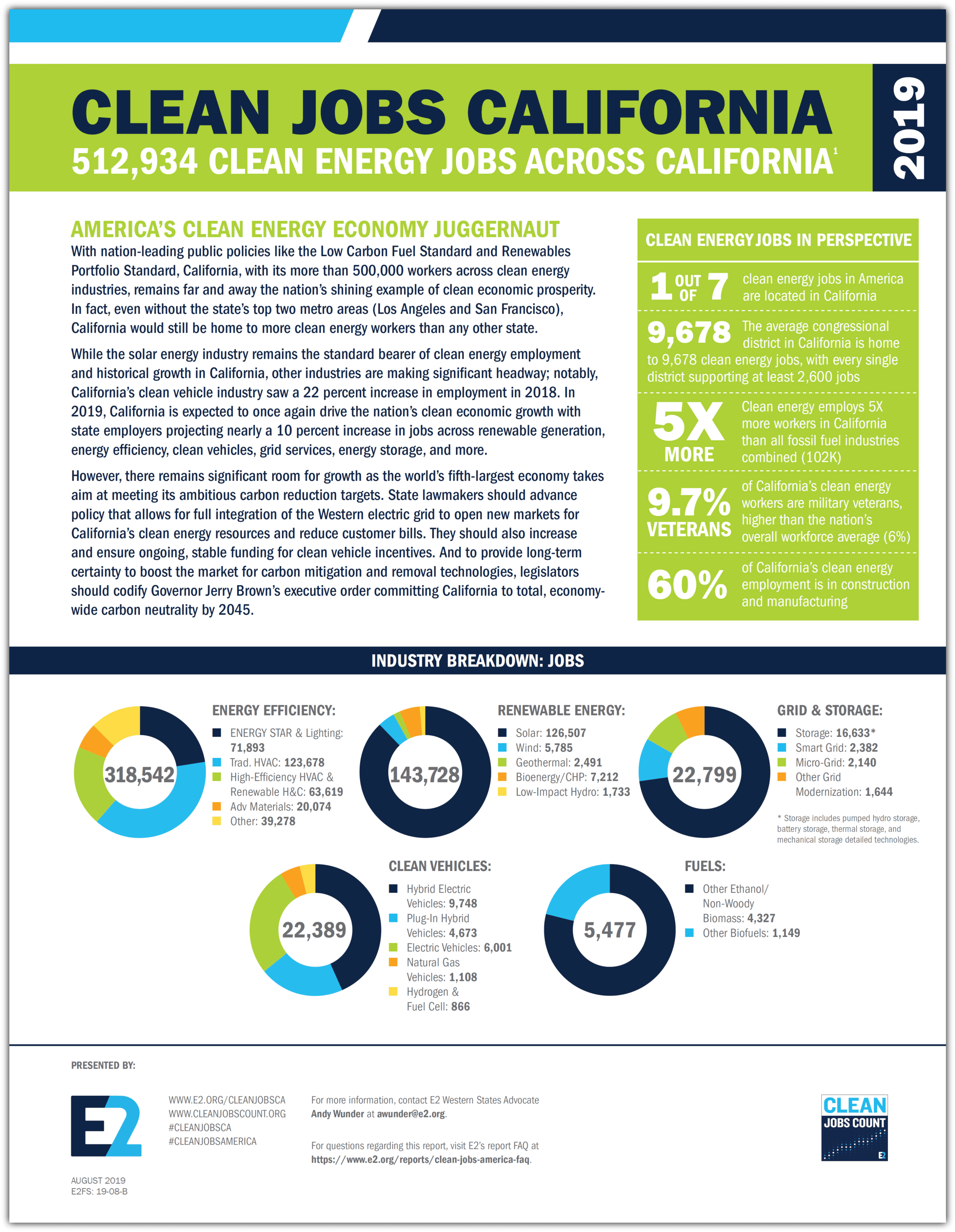
America’s Clean Energy Economy Juggernaut

With nation-leading public policies like the Low Carbon Fuel Standard and Renewables Portfolio Standard, California, with its more than half a million workers across clean energy industries, remains far and away the nation’s shining example of clean economic prosperity. Across all states, California supports one out of every seven U.S. clean energy jobs, four out of every ten U.S. solar energy jobs,  and one more than one out of every four U.S. renewable generation jobs. In fact, California’s is home to more renewable generation jobs than the next top six states combined and twice as many energy efficiency jobs as the no. 2 state (Texas).

While the solar energy industry remains the standard bearer of clean energy employment and historical growth in California, other industries are making significant headway; notably, California’s clean vehicle industry saw a 22 percent increase in employment in 2018. In 2019, California is expected to once again drive the nation’s clean economic growth with state employers projecting nearly a 10 percent increase in jobs across renewable generation, energy efficiency, clean vehicles, grid services, energy storage, and more.

Combined with this market domination, big opportunities remain as the world’s fifth-largest economy takes aim at meeting its ambitious carbon reduction targets.

A BIGGER PICTURE

This report focuses solely on the energy sector of the economy and does not include jobs in retail trade, repair services, water or waste management, and indirect employment or induced employment.

California Job Sector Toplines

  • Energy Efficiency – 318,542 jobs
  • Renewable Energy – 143,728 jobs
  • Solar Energy – 126,507 jobs
  • Clean Vehicles – 22,389 jobs
  • Energy Storage – 16,633 jobs
  • Bioenergy/CHP – 7,212 jobs
  • Grid Modernization – 6,166 jobs
  • Wind Energy – 5,785 jobs
  • Clean Fuels – 5,477 jobs
  • ALL Clean Energy Sectors – 512,934 jobs

Highlights

According to Clean Jobs California:

  • Clean energy employs five times more Californians than all fossil fuels combined (110,000)
  • More than 57% of California clean energy workers are employed by businesses with fewer than 20 employees
  • If included in E2’s state rankings, Los Angeles and San Francisco metro areas would rank no. 5 and no. 10 respectively. If combined, the two metros would be the no. 2 state for clean energy jobs in the U.S.
  • Clean vehicle technologies is the only industry California does not rank first in for jobs, trailing Michigan by fewer than 3,000 jobs
  • Nearly four out of every ten U.S. solar jobs are in California
  • Californian clean energy employers project nearly 10% growth in jobs in 2019
  • Bioenergy and combined heat and power made up the second most renewable generation jobs (7,212), followed by wind (5,785)
  • Construction (50.7%) accounts for half of California’s clean energy jobs.
  • 22,800 Californians now work in grid modernization (6,166) and energy storage (16,633)
  • 9.7 % of Californians employed in clean energy are veterans – far above the national average (6%)

DOWNLOAD

The complete report is available for download at this link.

Looking For More Info?

District-By-District Economic Impact

For details on clean energy’s overall economic impact in California, visit E2’s District-By-District: Clean Jobs California 2019  report page to download 120 individual factsheets for all 120 state legislative districts. The factsheets detail the investments in clean energy, jobs created, emissions, reduced, and cap and trade funds implemented in each district.

U.S. Energy & Employment Report (USEER)

This report follows E2’s Clean Jobs America analysis which found the clean energy jobs account for nearly 3.3 million jobs across all 50 states and the District of Columbia. Both reports expand on data from the U.S. Energy and Employment Report (USEER) produced by the Energy Futures Initiative (EFI) in partnership with the National Association of State Energy Officials (NASEO), using data collected and analyzed by the BW Research Partnership. E2 is a partner on the USEER, the fourth installment of the energy survey first released by the Department of Energy in 2016. Clean energy jobs have grown every year since the first report was released in 2016.

If you are looking for additional insight into E2’s Clean Jobs California 2019 or our other Clean Jobs America reports, visit e2.org/reports. You can also contact E2 Communications Director Michael Timberlake ([email protected]). An FAQ is also available here to answer any questions.

Other E2 Clean Jobs Reports

Clean Jobs California is only one in a series of state and industry reports produced by E2 and our partners.

View Report »
District-By-District | Clean Jobs California 2019

Date: August 20, 2019

Clean Jobs California | District-By-District

According to an analysis of every California legislative district released by E2 in August 2019, more than 512,000 Californians now work in clean energy industries, and more than $66 billion in public and private clean energy economy investments have been injected into the state. This job growth and investment is driven by California’s climate policies, including its leading Renewables Portfolio Standard and landmark cap-and-trade legislation, which reduces pollution while increasing clean energy production and energy efficiency.

California’s Statewide 2019 Clean Energy Jobs Report
Who Are My Representatives?

The state’s climate policies also have cut emissions by the equivalent of taking 22 million cars off the road and 57 percent of the $3.4 billion in clean energy investments stemming from cap-and-trade have gone specifically towards benefiting disadvantaged communities around the state.

How to Download: Use the tables below to locate and download all 120 factsheets for every California state legislative district. Each factsheet details out the district-specific jobs and economic impact resulting from California’s climate policies.

California State Senate

California State Assembly

District Assembly Member
District 1Vacant
District 2Jim Wood
District 3James Gallagher
District 4Cecilia Aguiar-Curry
District 5Frank Bigelow
District 6Kevin Kiley
District 7Kevin McCarty
District 8Ken Cooley
District 9Jim Cooper
District 10Marc Levine
District 11Jim Frazier
District 12Heath Flora
District 13Susan Talamantes-Eggman
District 14Tim Grayson
District 15Buffy Wicks
District 16Rebecca Bauer-Kahan
District 17David Chiu
District 18Rob Bonta
District 19Phil Ting
District 20Bill Quirk
District 21Adam Gray
District 22Kevin Mullin
District 23Jim Patterson
District 24Marc Berman
District 25Kansen Chu
District 26Devon Mathis
District 27Ash Kalra
District 28Evan Low
District 29Mark Stone
District 30Robert Rivas
District 31Joaquin Arambula
District 32Rudy Salas
District 33Jay Obernolte
District 34Vince Fong
District 35Jordan Cunningham
District 36S. Monique Limón
District 37Christy Smith
District 38Luz Maria Rivas
District 39James Ramos
District 40Chris Holden
District Assembly Member
District 41Chad Mayes
District 42Laura Friedman
District 43Jacqui Irwin
District 44Tom Lackey
District 45Jesse Gabriel
District 46Adrin Nazarian
District 47Eloise Gómez Reyes
District 48Blanca Rubio
District 49Edwin Chau
District 50Richard Bloom
District 51Wendy Carrillo
District 52Freddie Rodriguez
District 53Miguel Santiago
District 54Sydney Kamlager-Dove
District 55Phillip Chen
District 56Eduardo Garcia
District 57Ian C. Calderon
District 58Cristina Garcia
District 59Reginald Byron Jones-Sawyer, Sr.
District 60Sabrina Cervantes
District 61Jose Medina
District 62Autumn Burke
District 63Anthony Rendon
District 64Mike Gipson
District 65Sharon Quirk-Sirva
District 66Al Muratsuchi
District 67Melissa Melendez
District 68Steven Choi
District 69Tom Daly
District 70Patrick O’Donnell
District 71Randy Voepel
District 72Tyler Diep
District 73William Brough
District 74Cottie Petrie-Norris
District 75Marie Waldron
District 76Tasha Boerner Horvath
District 77Brian Maienschein
District 78Todd Gloria
District 79Shirley Weber
District 80Lorena Gonzalez Fletcher

Looking for More Info?

Statewide Jobs Report

For details on clean energy’s statewide impact on jobs in California, including at the county and metro levels, breakdowns for each clean tech subsector, by congressional districts, and information on how the jobs spread across the state’s value chain, visit E2’s Clean Jobs California 2019 report page to download .

U.S. Energy & Employment Report (USEER)

This district-by-district report follows E2’s Clean Jobs America analysis which found the clean energy jobs account for nearly 3.3 million jobs across all 50 states and the District of Columbia. Both reports expand on data from the U.S. Energy and Employment Report (USEER) produced by the Energy Futures Initiative (EFI) in partnership with the National Association of State Energy Officials (NASEO), using data collected and analyzed by the BW Research Partnership. E2 is a partner on the USEER, the fourth installment of the energy survey first released by the Department of Energy in 2016. Clean energy jobs have grown every year since the first report was released in 2016.

If you are looking for additional insight into E2’s District-by-District | Clean Jobs California 2019 or our other Clean Jobs America reports, visit e2.org/reports. You can also contact E2 Communications Director Michael Timberlake ([email protected]). An FAQ is also available here to answer any questions.

Other Clean Jobs Reports

District-by-District | Clean Jobs California 2019 is only one in a series of state and industry reports produced by E2 and our partners.

View Report »

Support ZEV Rule Making

On May 10, Colorado’s Air Quality Control Commission (AQCC) opened a rule making to consider adopting a Zero Emission Vehicle (ZEV) standard. In this letter, E2 members and supporters urge the Air Quality Control Commission (AQCC) at the Colorado Department of Public Health and Environment (CDPHE) to adopt the ZEV standard at their August meeting.

California-Automaker Fuel Economy Deal a Win for Innovation, Consumers

WASHINGTON (July 25, 2019) –  Four automakers agreed to continue strengthening vehicle greenhouse gas emission standards established under the Obama Administration through a deal struck with the state of California. The agreement could see average car fuel economy increase to about 51 miles per gallon by 2025, delivering a setback to the Trump administration’s attempt to rollback […]

“Bold” Plan for 100% Clean Energy Advances U.S. Economic Future

WASHINGTON (July 23, 2019) – House energy committee leaders today—led by chairman Frank Pallone of the Energy and Commerce Committee, chairman Paul Tonko of the Environment and Climate Change Subcommittee, and chairman Bobby Rush of the Energy Subcommittee—vowed to enact a “bold” plan to achieve 100 percent clean energy by 2050. The new initiative would […]

Sign Up for Email Updates


"*" indicates required fields

This field is for validation purposes and should be left unchanged.

Our Latest Press Releases


Releases

Six Emerging Environmental Entrepreneurs Selected for National Fellowship

The E2 & 1 Hotels the fellowship program is designed to help early career environmentally-minded entrepreneurs and community leaders to create and implement unique projects at the intersection of the economy and environment. This year’s projects span a wide...


Releases

E2: Repealing EPA’s Endangerment Finding For Vehicle Emissions Raises Costs for Businesses and Consumers

The EPA officially revoked the endangerment finding for greenhouse gas (GHG) emissions and eliminated clean vehicle standards in a blow to both our economy and our environment.


Releases

E2: Companies Cancelled $34.8B, 38K Jobs for Clean Energy Projects in 2025, Outpacing New Investments 3-to-1

Businesses abandoned $5.1 billion in large-scale factories and clean energy projects in December, capping a turbulent year for the sector that saw nearly $35 billion in investments disappear along with more than 38,000 current and future jobs, according to ...


Donate Today