Clean Jobs Oregon 2019
 Clean Energy Lead’s Oregon Energy Economy
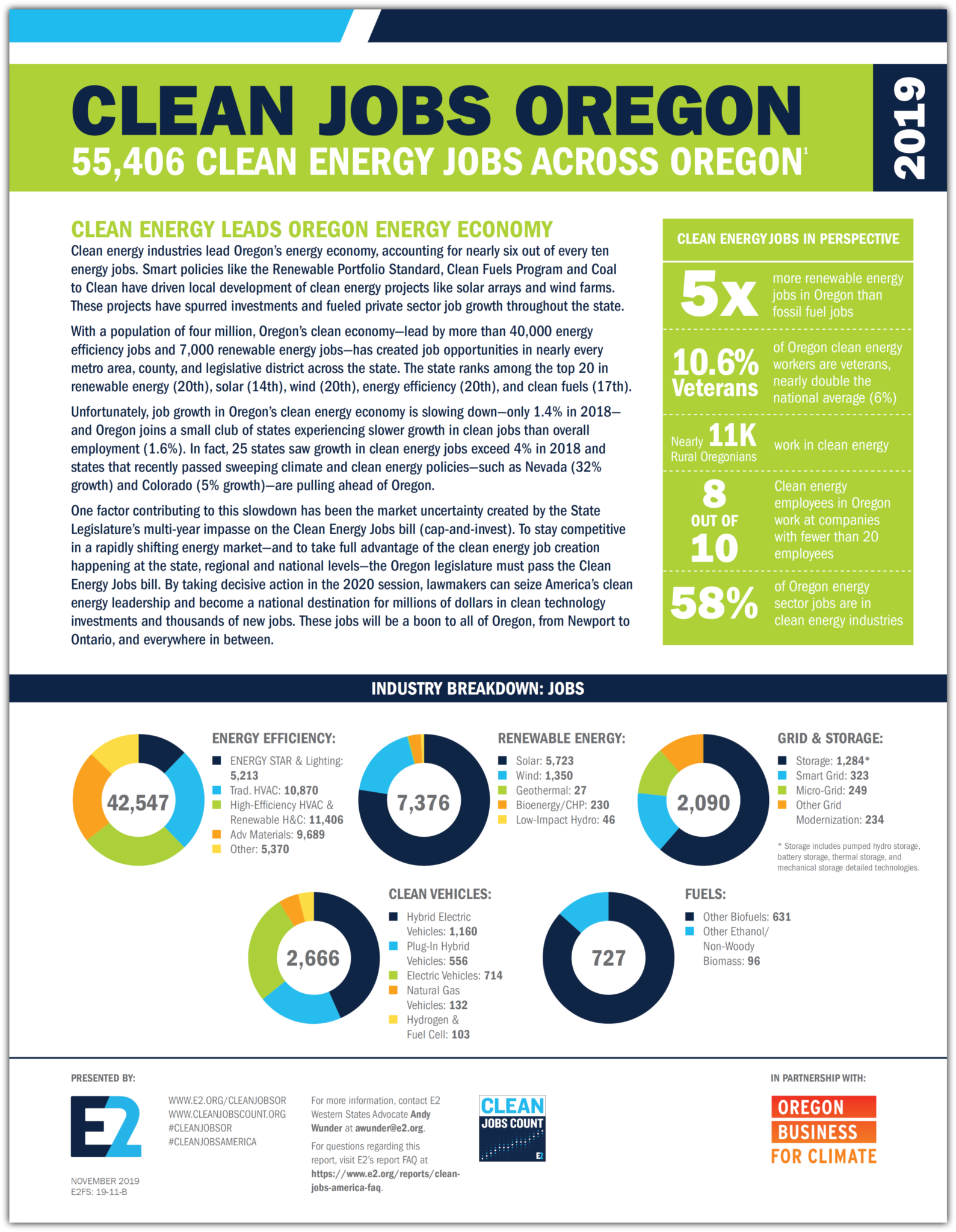
Clean energy industries lead Oregon’s energy economy, accounting for nearly six out of every ten energy jobs.
With a population of four million, Oregon’s clean economy—lead by more than 40,000 energy efficiency jobs and 7,000 renewable energy jobs—has created job opportunities in nearly every metro area, county, and legislative district across the state. The state ranks among the top 20 in renewable energy (20th), solar (14th), wind (20th), energy efficiency (20th), and clean fuels (17th).
Unfortunately, job growth in Oregon’s clean energy economy is slowing down—only 1.4% in 2018—and Oregon joins a small club of states experiencing slower growth in clean jobs than overall employment (1.6%). In fact, 25 states saw growth in clean energy jobs exceed 4% in 2018 and states that recently passed sweeping climate and clean energy policies—such as Nevada (32% growth) and Colorado (5% growth)—are pulling ahead of Oregon.
To stay competitive in a rapidly shifting energy market, the Oregon legislature must take decisive action in the 2020 session, so the state can seize America’s clean energy leadership and become a national destination for millions of dollars in clean technology investments and thousands of new jobs.
A BIGGER PICTURE
This report focuses solely on the energy sector of the economy and does not include jobs in retail trade, repair services, water or waste management, and indirect employment or induced employment.
OREGON JOB SECTOR TOPLINES
- Energy Efficiency – 42,547 jobs
- Renewable Energy – 7,376 jobs
- Solar Energy – 5,726 jobs
- Clean Vehicles – 2,666 jobs
- Wind Energy – 1,350 jobs
- Energy Storage – 1,284 jobs
- Grid Modernization – 806 jobs
- Clean Fuels – 727 jobs
- ALL Clean Energy Sectors – 55,406 jobs
HIGHLIGHTS
According to Clean Jobs Oregon 2019:
- Clean energy employs 50X more Oregonians than all fossil fuels combined (1,422). Renewable energy employs 5X more than fossil fuels.
- 58% of Oregon energy sector employees (95,806) work in clean energy (55,406)
- 3 out of 5 Oregon energy efficiency employees work in construction and repairs
- 50% of Oregon’s clean energy jobs are based outside the Portland metro area
- 1 out of every 4 Oregon construction workers are employed in energy efficiency
- Nearly 11,000 rural Oregonians work in clean energy, or about 1 in every 5 clean energy jobs.
- More than 83% of Oregon clean energy workers are employed by businesses with fewer than 20 employees
- Construction (58.9%) and manufacturing services (13.1%) make up the majority of clean energy jobs.
- 2,090 Oregonians now work in grid modernization (806) and energy storage (1,284)
- 10.6% of Oregonians employed in clean energy are veterans \
DOWNLOAD
The complete report is available for download at this link.
Looking For More Info?
District-By-District Economic Impact
For details on clean energy’s overall economic impact in Oregon, visit E2’s District-By-District: Clean Jobs Oregon 2019 report page to download 120 individual factsheets for all 120 state legislative districts. The factsheets detail the investments in clean energy, jobs created, emissions, reduced, and cap and trade funds implemented in each district.
U.S. Energy & Employment Report (USEER)
This report follows E2’s Clean Jobs America analysis which found the clean energy jobs account for nearly 3.3 million jobs across all 50 states and the District of Columbia. Both reports expand on data from the U.S. Energy and Employment Report (USEER) produced by the Energy Futures Initiative (EFI) in partnership with the National Association of State Energy Officials (NASEO), using data collected and analyzed by the BW Research Partnership. E2 is a partner on the USEER, the fourth installment of the energy survey first released by the Department of Energy in 2016. Clean energy jobs have grown every year since the first report was released in 2016.
If you are looking for additional insight into E2’s Clean Jobs California 2019 or our other Clean Jobs America reports, visit e2.org/reports. You can also contact E2 Communications Director Michael Timberlake ([email protected]). An FAQ is also available here to answer any questions.
Other E2 Clean Jobs Reports
Clean Jobs Oregon is only one in a series of state and industry reports produced by E2 and our partners.
-
- Clean Jobs America 2019 | Nearly 3.3 Million Clean Energy Jobs
- Energy Efficiency Jobs in America 2019 | Leading America’s Energy Workforce
- Clean Jobs California 2019 | America’s Clean Energy Economy Juggernaut
- Clean Jobs North Carolina 2019 | Top 10 in Jobs Across Clean Technologies
- District-By-District: Clean Jobs California 2019 | Analysis of Clean Energy’s Economic Benefits Across California Legislative Districts
- Clean Jobs Colorado 2019 |Colorado’s Clean Energy Potential Reaches New Heights
- Clean Jobs Midwest 2019 |Region added more than 28,000 clean energy jobs in 2018
- Clean Jobs Nevada 2019 | 32,211 Clean Energy Jobs Across Nevada
- Clean Jobs Massachusetts 2019 | 117,669 Clean Energy Jobs Across Massachusetts
- Clean Jobs New York 2019 | 148,453 Clean Energy Jobs Across Empire State
- Clean Jobs Pennsylvania 2019 | 90,772 Clean Energy Jobs Across the Keystone State
- Clean Jobs New Jersey 2019 |51,852 Clean Energy Jobs Across New Jersey