
Build Back Better, Faster: How a federal stimulus focusing on clean energy can create millions of jobs and restart America’s economy

Date: July 15, 2020

Clean Energy Economic Stimulus Impacts

The coronavirus (COVID-19) pandemic has caused millions of Americans—including as many as 620,500 clean energy workers—to lose their jobs over just a few months. E2 and E4TheFuture partnered with BW Research Partnership on this economic impact assessment to demonstrate the potential for creating jobs from federal stimulus investments in three major sectors of the clean energy economy: Energy Efficiency, Renewable Energy, and Grid Modernization.

The clean energy industry is proven to provide a great return on stimulus investments. During the Great Recession, the American Recovery and Reinvestment Act of 2009 (ARRA) directed a portion of stimulus investments to supply chain components for major clean energy technology sectors such as advanced vehicles, batteries, renewable energy, carbon capture and sequestration, grid modernization, and energy efficiency. It is estimated that these $90 billion in strategic investments and incentives supported roughly 900,000 job-years from 2009 through 2015. These investments also set the stage for long-term job growth across the nation’s clean energy industry. By 2019, the clean energy workforce was 3.4 million workers strong and had been growing two times faster than nationwide employment since 2017.

Economic benefits of the proposed federal stimulus package include high-quality jobs for U.S. residents, labor income, boosts to local, state, and federal tax revenues, contributions to Gross Domestic Product (GDP), and energy cost savings. All these benefits ultimately translate to greater spending in the economy. Clean energy jobs are proven to be sustainable wage positions that are accessible to all localities across the U.S., regardless of geography, or politics, and provide new, equitable job opportunities that cannot be outsourced. Moreover, updates to the nation’s energy infrastructure are an investment in the collective economic future of Americans; the creation of a more resilient energy system is vital to economic growth and security.

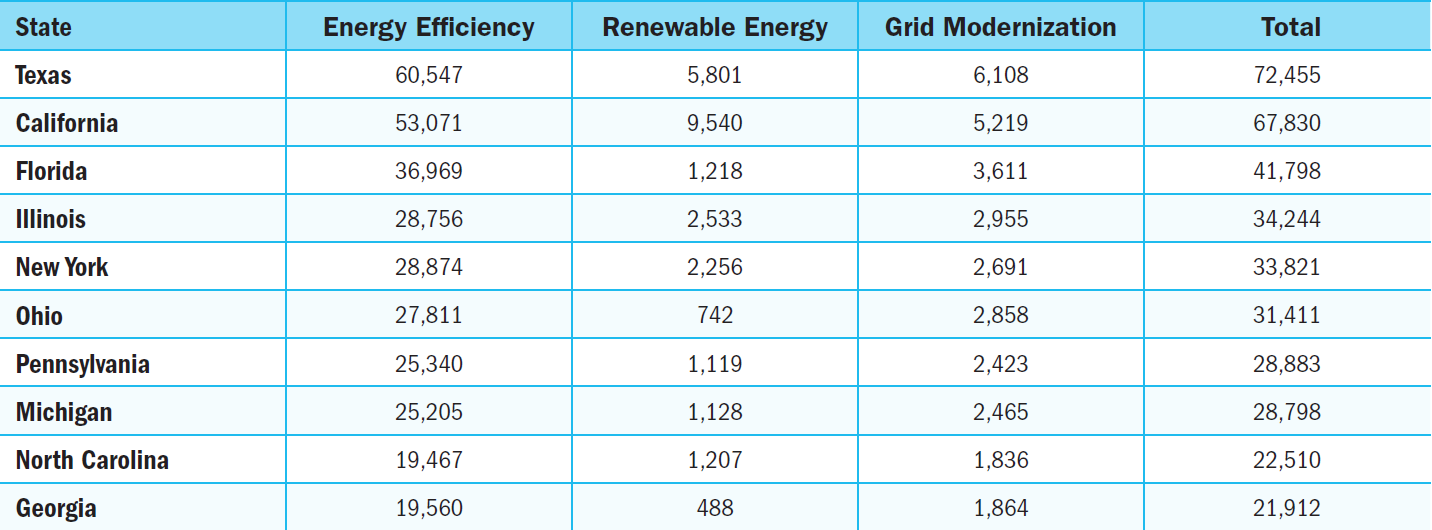
This report looks at the first five years of economic impacts from a robust federal clean energy stimulus totaling $99.2 billion—with targeted and strategic investments in energy efficiency, renewable energy, and grid modernization. Our modeling finds that such an investment in our shared future would create 860,300 full time direct, indirect and induced jobs that will last for at least five years (a total of 4.3 million job-years). A stimulus of this level and the jobs it would create would also generate more than $66 billion in GDP each year for the next five years—resulting in $330 billion in economic activity, more than triple the amount of investment. These are jobs that would support sustainable wages and help bring the U.S. economy out of the severe recession.

By Industry Impacts

States Most Impacted
Download

The complete report is available for download at this link.

Looking for More Info?

The analysis expands on data from the 2020 U.S. Energy and Employment Report (USEER) produced by the Energy Futures Initiative (EFI) in partnership with the National Association of State Energy Officials (NASEO), using data collected and analyzed by the BW Research Partnership. The report was released in March 2020 and is available at www.usenergyjobs.org. E2 is a partner on the USEER, the fifth installment of the energy survey first released by the Department of Energy in 2016 and subsequently abandoned under the Trump administration. Clean energy jobs have grown every year since the first report was released in 2016.

If you are looking for additional insight into this report or E2’s more than a dozen other annual clean energy employment reports, visit e2.org/reports. You can also contact E2 Communications Director Michael Timberlake ([email protected]).

View Report »

Clean Energy & COVID-19 Crisis | June 2020 Unemployment Analysis

Date: July 10, 2020

Clean Energy Unemployment Claims in COVID-19 Aftermath, June 2020

The U.S. clean energy sector added 106,320 jobs in June, leaving over half a million (514,270) clean energy workers out of work despite nationwide re-openings. Despite the gains in June, there remains a nearly 15 percent decline over pre-COVID-19 employment levels, according to the latest analysis of unemployment data by BW Research for E2, E4TheFuture, and the American Council on Renewable Energy (ACORE).

In all, clean energy employment is still down 15 percent from the start of the year, when nearly 3.4 million Americans worked in renewable energy, energy efficiency, clean vehicles and fuels and other clean energy sectors.

While the June jobs improvement is an encouraging sign of clean energy’s ability to quickly put Americans back to work, resuming a robust recovery in one of the nation’s biggest employment sectors anytime soon remains unlikely without direct action by Congress. Only one out of every six clean energy jobs lost since March returned in June, and as federal Paycheck Protection Program (PPP) funds are exhausted and states are forced to close businesses again in the face of COVID-19’s resurgence, more layoffs could be imminent without congressional action. According to the analysis, as many as 2.3 million clean energy workers are employed by small businesses that received PPP loans.

Other troubling trends include a sharp increase in permanent job losses, rising initial weekly unemployment claims, and COVID-19 cases spiking in states with some of the largest clean energy workforces, according to the analysis.

Before March, clean energy had been one of the U.S. economy’s biggest and fastest-growing employment sectors, growing 10.4% since 2015 to 3.4 million jobs at the end of 2019. That made clean energy by far the biggest employer of workers in all energy occupations, employing nearly three times as many people as the fossil fuel industry.

By Industry Job Losses, June 2020

SECTOR MARCH APRIL MAY JUNE TOTAL
Energy Efficiency -103,298 -309,584 -18,880 +71,786 -359,976
Renewables -23,739 -71,705 -4,272 +17,287 -82,429
Clean Vehicles -11,399 -35,070 -2,059 +10,335 -38,193
Grid & Storage -6,517 -19,666 -1,166 +4,561 -22,788
Clean Fuels -2,186 -10,390 -657 +2,351 -10,882
INDUSTRY TOTAL -147,139 -446,416 -27,035 +106,320 -514,270

State With Most Job Losses, May 2020

State March April May June Total Claims 
US TOTAL -147,139 -446,416 -27,035 +106,320 -514,270
California -27,583 -77,815 -4,313 +19,831 -89,881
Texas -5,965 -25,170 -1,709 +7,997 -24,847
Florida -3,963 -25,949 -2,563 +5,832 -26,643
Michigan -7,867 -22,245 -1,012 +6,465 -31,124
Georgia -1,909 -25,282 -1,741 +1,579 -27,353
North Carolina -9,124 -17,138 -955 +5,837 -21,380
Pennsylvania -8,283 -12,780 -571 +2,689 -18,945
Washington -5,646 -14,433 -1,163 +2,729 -18,513
New York -6,006 -13,868 -848 +3,314 -17,408
Ohio -6,929 -12,879 -612 +3,387 -16,582


For a full breakdown of clean energy jobs losses in each state, see the full analysis here.

Download

The complete report is available for download at this link.

Looking for More Info?

The analysis expands on data from the 2020 U.S. Energy and Employment Report (USEER) produced by the Energy Futures Initiative (EFI) in partnership with the National Association of State Energy Officials (NASEO), using data collected and analyzed by the BW Research Partnership. The report was released in March 2020 and is available at www.usenergyjobs.org. E2 is a partner on the USEER, the fifth installment of the energy survey first released by the Department of Energy in 2016 and subsequently abandoned under the Trump administration.

If you are looking for additional insight into this report or E2’s more than a dozen other annual clean energy employment reports, visit e2.org/reports. You can also contact E2 Communications Director Michael Timberlake ([email protected]).

Sign-Up for Email Updates

"*" indicates required fields

This field is for validation purposes and should be left unchanged.

View Report »

House Infrastructure Bill Meets the “Severity of the Challenges” U.S. Faces; Clean Energy Stimulus Needed Next

Statement from Director of Federal Advocacy, Sandra Purohit WASHINGTON (July 1, 2020) – The House of Representatives today passed the “Moving Forward Act” (H.R. 2), a $1.5 trillion infrastructure bill that prioritizes clean energy to combat the looming threat of climate change and accelerates America’s economic recovery. The bill includes investments in clean energy, clean […]

Want jobs and clean energy? This overlooked technology could deliver both

But scientists say humanity must slash fossil fuel emissions quickly and dramatically to limit the damage from worsening heat waves, droughts, fires and other consequences of climate change. And as COVID-19 hobbles global economies, organizations as diverse as the International Monetary Fund and the Sunrise Movement have called for stimulus plans that accelerate the transition away from fossil fuels and create […]

Time is Now to Embrace Clean Energy, House Dems Climate Action Plan

WASHINGTON – The House Select Committee on the Climate Crisis called on the need for investments in the clean energy economy, making it a focal point of the Committee’s Climate Crisis Action Plan released today. If enacted, the Plan would achieve net zero carbon emissions in the U.S. by 2050. Addressing climate change by unlocking […]

Want jobs and clean energy? This overlooked technology could deliver both

The Director of Federal Advocacy with Environmental Entrepreneurs (E2), Sandra Purohit spoke about why Congress should invest in clean energy in the next stimulus. She explained how E2 has called for policy solutions that are good for the economy and the environment. With the help of the next stimulus package Congress could act on these […]

Clean Jobs Midwest 2020

Date: June 25, 2020

Home to 744,000 Clean Energy Jobs

Prior to the COVID-19 crisis, clean energy companies employed more than 744,000 Midwesterners and clean energy jobs were growing in nearly every state, according to the latest available data. Across the region in 2019, the industry added more than 7,500 new jobs. At the end of 2019, more people in the Midwest worked in clean energy than the combined workforce of real estate agents and brokers, computer programmers, web developers, and waiters and waitresses. However, according to a recent analysis of U.S. Department of Labor unemployment data, in just the first three months after the pandemic began more than 131,600 workers in clean energy-related companies lost their jobs.

MIDWEST HIGHLIGHTS

  • Energy Efficiency – 534,567 jobs
  • Renewable Energy – 87,307 jobs
  • Grid & Storage – 26,251 jobs
  • Clean Vehicles – 87,993 jobs
  • Clean Fuels – 7,923 jobs
  • ALL Clean Energy Sectors – 744,041 jobs

OTHER KEY FINDINGS

The Midwest’s largest clean energy employer was energy efficiency. The sector has been home to more than 70 percent of all the region’s clean energy jobs. Last year, the Midwest also saw job growth rate increases in clean fuels (2.9 percent), grid and storage (3.4 percent), and renewable energy generation (2.7 percent).

Clean energy jobs are found in every corner of the region. While big cities like Chicago (88,930 jobs), Detroit (55,470 jobs), and Minneapolis (38,920 jobs) were some of the largest hubs for clean energy jobs, more than one in five — or more than 158,000 — were at the end of 2019 located in rural areas.

Thousands of Midwestern companies hire clean energy workers every year. Before the crisis hit, these employers anticipated adding nearly 37,000 clean energy jobs in 2020 — a nearly 5 percent growth rate.

DOWNLOAD

The complete report along with interactive breakdowns for all states is available at this link.

LOOKING FOR MORE INFO?

This report follows E2’s Clean Jobs America analysis which found the clean energy jobs account for nearly 3.3 million jobs across all 50 states and the District of Columbia. Both reports expand on data from the 2020 U.S. Energy and Employment Report (USEER) produced by the Energy Futures Initiative (EFI) in partnership with the National Association of State Energy Officials (NASEO), using data collected and analyzed by the BW Research Partnership. E2 is a partner on the USEER, the fifth installment of the energy survey first released by the Department of Energy in 2016. Clean energy jobs have grown every year since the first report was released in 2016.

If you are looking for additional insight into E2’s Clean Jobs Midwest or our other Clean Jobs America reports, visit e2.org/reports. You can also contact E2 Communications Director Michael Timberlake ([email protected]). An FAQ is also available here to answer any questions.

View Report »

Clean Jobs California 2020

Date: June 25, 2020

America’s Clean Energy Powerhouse in the Wake of COVID-19

After a fifth straight year of job growth since E2 (Environmental Entrepreneurs) began tracking U.S. clean energy employment, California’s clean energy economy is facing a torrent of job losses and work freezes so significant it could set the industry back years. What had been one of the nation’s fastest-growing job sectors over the last five years is now one of the fastest-shrinking in the wake of COVID-19-related shutdowns disrupting supply chains and building energy efficiency projects, halting new developments and emptying project pipelines, and slowing investments while wrecking financial outlooks.

Entering 2020, California’s clean energy economy had grown for five straight years since this annual report was first released with clean energy jobs growing to make up 3 percent of the state’s entire workforce.

E2’s Clean Jobs California 2020 details the sheer size of this important employment sector, the troubles it is currently facing due to COVID-19 and how focusing recovery policies on clean energy can get the Golden State’s economy humming again—quickly and for the long run.

INDUSTRY JOB TOPLINES | Q4 2019

  • Energy Efficiency – 323,529 jobs
  • Renewable Energy –142,957 jobs
    • Solar Energy – 124,817 jobs
    • Wind Energy – 2,520 jobs
  • Clean Vehicles – 40,627 jobs
  • Clean Storage – 17,397 jobs
  • Grid Modernization – 6,625 jobs
  • ALL Clean Energy Sectors – 536,919 jobs

DOWNLOAD

The complete report is available for download at this link.

Looking for More Info?

The analysis expands on data from the 2020 U.S. Energy and Employment Report (USEER) produced by the Energy Futures Initiative (EFI) in partnership with the National Association of State Energy Officials (NASEO), using data collected and analyzed by the BW Research Partnership. The report was released in March 2020and is available at www.usenergyjobs.org. E2 is a partner on the USEER, the fifth installment of the energy survey first released by the Department of Energy in 2016 and subsequently abandoned under the Trump administration. Clean energy jobs have grown every year since the first report was released in 2016.

If you are looking for additional insight into E2’s Clean Jobs California 2020 or our other Clean Jobs America reports, visit e2.org/reports. You can also contact E2 Communications Director Michael Timberlake ([email protected]). An FAQ is also available here to answer any questions.

PAST CLEAN JOBS AMERICA REPORTS

Clean Jobs America 2020 is the 3rd clean energy jobs report for California from E2. Previous reports can be accessed in the below links.

View Report »

Sign Up for Email Updates


"*" indicates required fields

This field is for validation purposes and should be left unchanged.

Our Latest Press Releases


Releases

E2: Repealing EPA’s Endangerment Finding For Vehicle Emissions Raises Costs for Businesses and Consumers

The EPA officially revoked the endangerment finding for greenhouse gas (GHG) emissions and eliminated clean vehicle standards in a blow to both our economy and our environment.


Releases

E2: Companies Cancelled $34.8B, 38K Jobs for Clean Energy Projects in 2025, Outpacing New Investments 3-to-1

Businesses abandoned $5.1 billion in large-scale factories and clean energy projects in December, capping a turbulent year for the sector that saw nearly $35 billion in investments disappear along with more than 38,000 current and future jobs, according to ...


Releases

E2: Trump Administration’s Latest Attempt to Kill Offshore Wind Hurts Consumers, Businesses

The Trump administration is trying to halt offshore wind projects that are well-underway just two weeks after their initial attempt was deemed arbitrary and capricious by a federal judge.


Donate Today