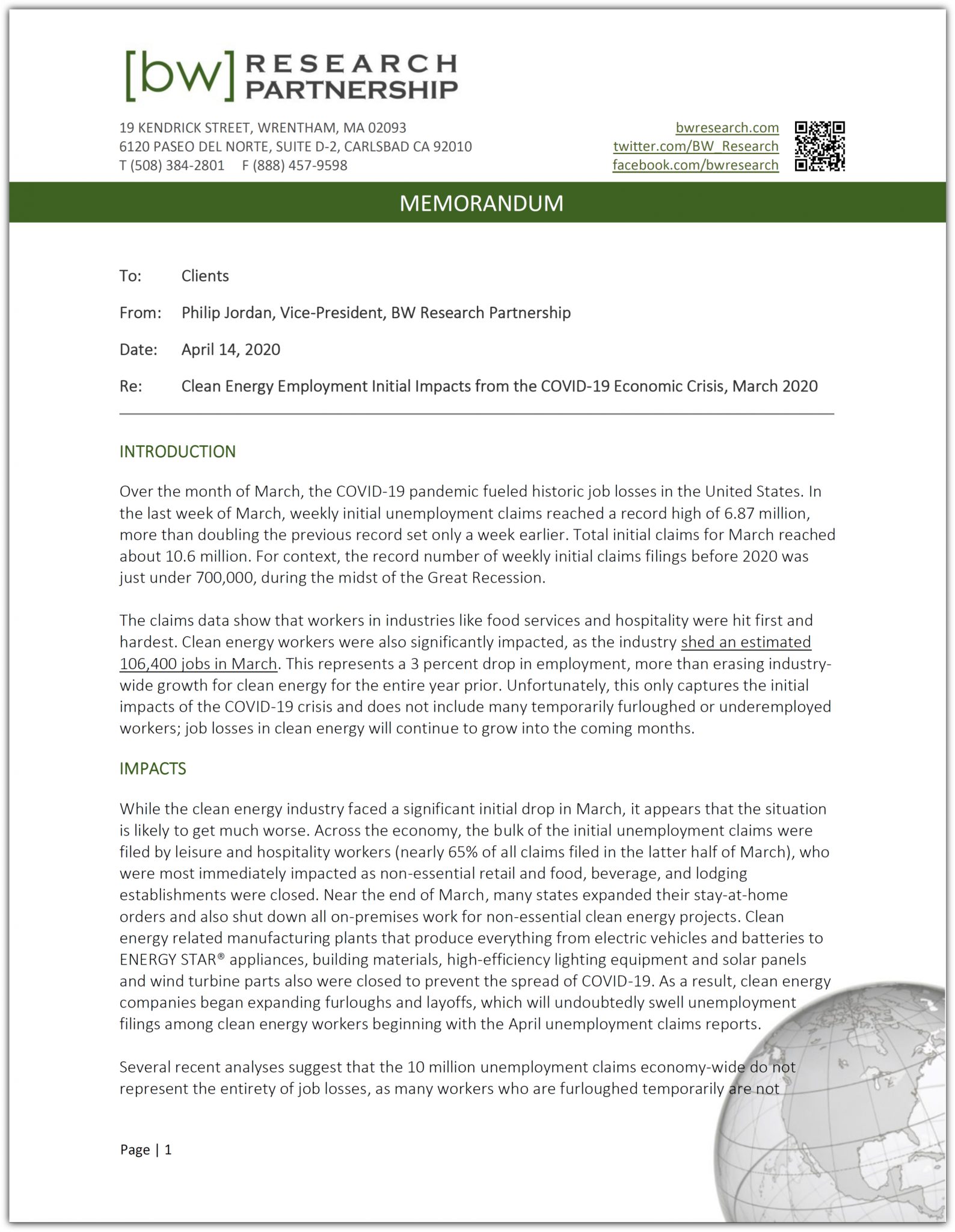
Coronavirus wiped out 2019’s clean energy job gains – report

Bob Keefe, E2’s executive director, said the groups hadn’t done an estimate of what new stimulus programs would cost. But “the price tag for not doing something is going to be humongous,” he said. “This economic tailspin is so massive and so unlike anything we’ve ever seen before, we really need some bold ideas and […]

106,000 Jobs in Clean Energy Lost in March Due to COVID-19 Economic Crisis

More than a year’s worth of job gains erased in a few weeks Analysis forecasts industry could lose more than 500K jobs in months ahead CA, NC, PA, MA, MI, NY, OH, TX, WA, IL among hardest hit states More than 106,000 clean energy workers lost their jobs in the month of March, and hundreds of thousands […]

Clean Jobs America 2020

Date: April 15, 2020
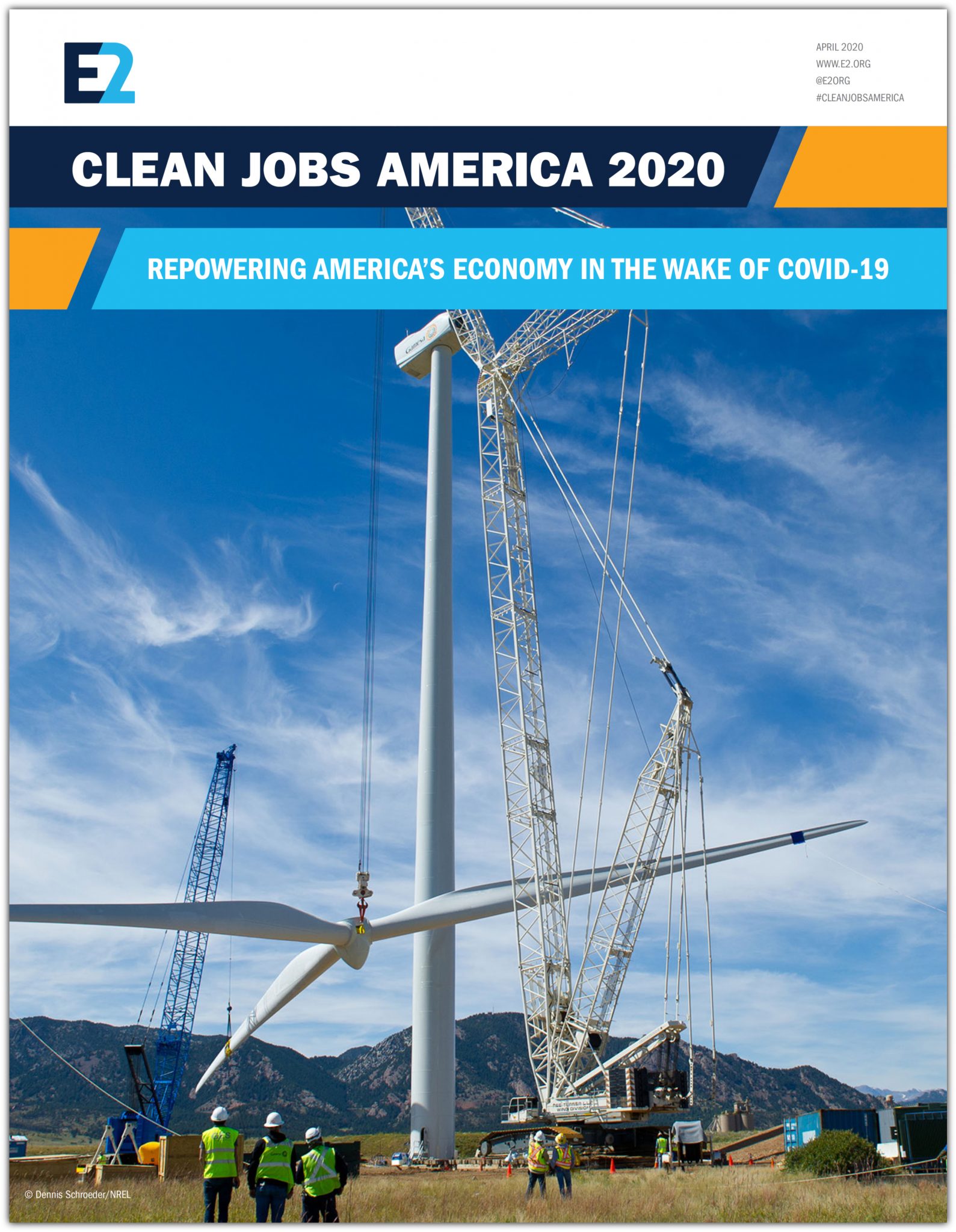
Repowering America’s Economy in the Wake of COVID-19

At the start of 2020, clean energy employment increased for the fifth straight year since this annual report was first released—growing beyond 3.3 million workers nationwide.

While California remained the nation’s undisputed leader in clean energy jobs through 2019, states as diverse in size and structure as Texas and Massachusetts also are in the top ten for clean energy jobs. Florida, North Carolina and Georgia continued to lead the South, while Michigan, Illinois and Ohio led the Midwest. On a per capita basis of statewide total employment, the Northeast claimed the top five spots with Vermont, Rhode Island, Massachusetts, Maryland, and Delaware employing the largest share of clean energy jobs per capita in the country.

Overall, clean energy jobs across the country grew by slightly more than two percent in 2019, slower than its nearly four percent growth in 2018. Jobs in renewable energy grew more than three percent, led in part by a rebound in solar jobs. Clean energy storage and grid modernization jobs increased four percent—faster than any other sector—while clean vehicle employment declined by about two percent after a 17 percent jump in 2018. Energy efficiency remains the single biggest sector of the clean energy economy, growing over two percent in 2019 and adding the most net new jobs (54,000) across the entire energy sector.

As a result of the industry’s consistent growth, clean energy accounted for more than 40 percent of America’s entire energy workforce and over 2.25% of the nation’s overall employment at the end of 2019.

INDUSTRY JOB TOPLINES

  • Energy Efficiency – 2,378,893 jobs
  • Renewable Energy –522,811 jobs
    • Solar Energy – 345,393 jobs
    • Wind Energy – 114,774 jobs
  • Clean Vehicles – 266,368 jobs
  • Clean Storage – 76,669 jobs
  • Grid Modernization – 67,945 jobs
  • ALL US Clean Energy Sectors – 3,355,419 jobs

DOWNLOAD

The complete report is available for download at this link.

Looking for More Info?

The analysis expands on data from the 2020 U.S. Energy and Employment Report (USEER) produced by the Energy Futures Initiative (EFI) in partnership with the National Association of State Energy Officials (NASEO), using data collected and analyzed by the BW Research Partnership. The report was released in March 2020and is available at www.usenergyjobs.org. E2 is a partner on the USEER, the fifth installment of the energy survey first released by the Department of Energy in 2016 and subsequently abandoned under the Trump administration. Clean energy jobs have grown every year since the first report was released in 2016.

If you are looking for additional insight into E2’s Clean Jobs America 2020 or our other Clean Jobs America reports, visit e2.org/reports. You can also contact E2 Communications Director Michael Timberlake ([email protected]). An FAQ is also available here to answer any questions.

PAST CLEAN JOBS AMERICA REPORTS

Clean Jobs America 2020 is the 5th national clean energy jobs report from E2. Previous reports can be accessed in the below links.

View Report »

Clean Energy & COVID-19 Crisis | March 2020 Unemployment Analysis

Date: April 15, 2020

Clean Energy Unemployment Claims in COVID-19 Aftermath, March 2020

More than 106,000 clean energy workers lost their jobs in the month of March alone, wiping out all the job gains in renewable energy, energy efficiency, clean vehicles and other clean energy sectors in 2019, according to an analysis of unemployment data by BW Research for E2.

The March layoffs were just the first indication of how badly the clean energy industry has been hit by the COVID-19 and economic crises. Much bigger job cuts are expected in the months ahead—making it imperative that Congress and state lawmakers seek ways to get the industry back on its feet, especially since clean energy has a proven history of helping pull the country out of economic crises.

What had been one the nation’s fastest-growing jobs sectors at the start of the year by March was experiencing significant job losses every week.

The job losses are across a wide variety of occupations, and in every state. Energy efficiency workers are losing their jobs after being shut out of homes and buildings to prevent the spread of the coronavirus. Solar and wind turbine companies are laying off workers as they’re unable to access panels and parts stranded in shut-down factories and as financing disappears. Factory workers are being let go as assembly lines for Energy Star appliances and electric and hybrid vehicles are ground to a halt.

Industry Job Losses, March 2020

  • Energy Efficiency – 69,800 job losses
  • Renewable Energy – 16,500 job losses
  • Clean Vehicles – 12,300 job losses
  • Grid & Clean Storage – 4,300 job losses
  • Clean Fuels – 3,400 job losses
  • ALL US Clean Energy Sectors – 106,472

Download

The complete report is available for download at this link.

Listen

A live press conference was held announcing the report’s findings on April 15, featuring:

  • Bob Keefe, executive director, E2
  • Pat Stanton, director of policy, E4TheFuture
  • Gregory Wetstone, president & CEO, American Council on Renewable Energy (ACORE)
  • Phil Jordan, vice-president and principal, BW Research

To download and listen to the one-hour press conference, click here.

Looking for More Info?

The analysis expands on data from the 2020 U.S. Energy and Employment Report (USEER) produced by the Energy Futures Initiative (EFI) in partnership with the National Association of State Energy Officials (NASEO), using data collected and analyzed by the BW Research Partnership. The report was released in March 2020 and is available at www.usenergyjobs.org. E2 is a partner on the USEER, the fifth installment of the energy survey first released by the Department of Energy in 2016 and subsequently abandoned under the Trump administration.

If you are looking for additional insight into this report or E2’s more than a dozen other annual clean energy employment reports, visit e2.org/reports. You can also contact E2 Communications Director Michael Timberlake ([email protected]).

Sign-Up for Email Updates

"*" indicates required fields

This field is for validation purposes and should be left unchanged.

View Report »

Energy Efficiency Industry Seeks Aid as House Panel Seeks Ideas

Bob Keefe, executive director for E2, which represents business leaders, investors, and others in clean energy, said his group has lobbied Capitol Hill offices asking for help, from clean energy grants to refundable tax credits that would would help reassure increasingly nervous private equity firms. Keefe said he’s making the case that energy efficiency workers […]

Smart cities are solar cities

“There’s no doubt about it: The solar industry is a major employer and an increasingly important part of our economy,” says Bob Keefe, Executive Director of E2 (Environmental Entrepreneurs), a national, nonpartisan business group advocating for sustainable energy policies. “It would benefit lawmakers to remember the hundreds of thousands of Americans who now work in […]

‘Horrible.’ Coronavirus unravels energy efficiency industry

“Bottom line, what we’re seeing and hearing is horrible,” said Bob Keefe, executive director of E2, a clean energy advocacy group. “We’re seeing work stoppages that are costing millions of dollars even for small companies. These people need help,” he added.

Economic Stimulus: What it means for business in the clean economy

The COVID-19 pandemic has affected all corners of the economy, and clean energy and clean economy businesses are no exception. Please join E2 to learn more about the just-passed CARES economic stimulus package, what it means to businesses and their and workers, and what E2 is doing to make sure the next economic stimulus package and other […]

This Chicagoan is on a mission to help auto dealers sell electric vehicles

Now, through a fellowship from the organization E2 (Environmental Entrepreneuers), Deylami will help dealers learn more about and promote electric vehicles. E2, an organization of investors and business leaders promoting smart energy policies, awarded 10 $20,000 fellowships to young U.S. business leaders nationwide. The only other Midwest recipient is Grant Behnke of Columbus, Ohio, who […]

Sign Up for Email Updates


"*" indicates required fields

This field is for validation purposes and should be left unchanged.

Our Latest Press Releases


Releases

Six Emerging Environmental Entrepreneurs Selected for National Fellowship

The E2 & 1 Hotels the fellowship program is designed to help early career environmentally-minded entrepreneurs and community leaders to create and implement unique projects at the intersection of the economy and environment. This year’s projects span a wide...


Releases

E2: Repealing EPA’s Endangerment Finding For Vehicle Emissions Raises Costs for Businesses and Consumers

The EPA officially revoked the endangerment finding for greenhouse gas (GHG) emissions and eliminated clean vehicle standards in a blow to both our economy and our environment.


Releases

E2: Companies Cancelled $34.8B, 38K Jobs for Clean Energy Projects in 2025, Outpacing New Investments 3-to-1

Businesses abandoned $5.1 billion in large-scale factories and clean energy projects in December, capping a turbulent year for the sector that saw nearly $35 billion in investments disappear along with more than 38,000 current and future jobs, according to ...


Donate Today