
Clean Jobs America 2022

Date: August 3, 2022

A return to rapid growth, with clean vehicle jobs driving ahead

Summary:

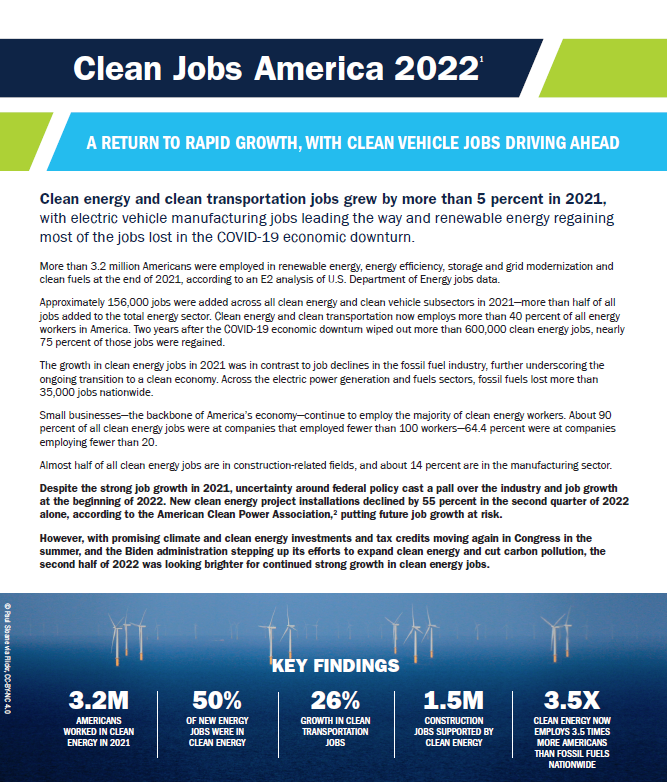
Clean energy and clean transportation jobs grew by more than 5 percent in 2021, with electric vehicle manufacturing jobs leading the way and renewable energy regaining most of the jobs lost in the COVID-19 economic downturn.

More than 3.2 million Americans were employed in renewable energy, energy efficiency, storage and grid modernization and clean fuels at the end of 2021, according to an E2 analysis of U.S. Department of Energy jobs data.

Approximately 156,000 jobs were added across all clean energy and clean vehicle subsectors in 2021—more than half of all jobs added to the total energy sector. Clean energy and clean transportation now employs more than 40 percent of all energy workers in America. Two years after the COVID-19 economic downturn wiped out more than 600,000 clean energy jobs, nearly 75 percent of those jobs were regained.
This field is for validation purposes and should be left unchanged.

Findings

  • 3.2 million Americans now work in clean energy, up 5 percent from a year earlier.
  • Every clean energy subsector, from renewables and energy efficiency to electric vehicles and grid modernization, grew last year. Conversely, fossil fuel jobs fell 4 percent.
  • While clean jobs grew along with most of the rest of the economy in 2021, they are still well below their pre-COVID peak, in part because of lingering uncertainty around federal policy.
  • California, Texas and New York continue to lead the U.S. in total clean energy jobs. Following (in order) were Florida, Illinois, Michigan, Massachusetts, Ohio, North Carolina and Pennsylvania.
  • New Mexico saw the biggest percentage growth in clean energy jobs last year after it passed some of the most promising clean energy policies in the country. But other states – led by Oklahoma, Kentucky, Indiana and Idaho – are also benefiting. Clean energy investments included in the Inflation Reduction Act would drive more job growth in those states and others.
  • Clean vehicles were the big story in 2022. Jobs building electric vehicles grew by a dramatic 26 percent. Many Republican-led states, including Georgia, Kentucky, Texas and Tennessee, benefited greatly from expansions of EV and other clean transportation manufacturers, and also would benefit from electric vehicle tax credits included in the Inflation Reduction Act.
  • Small businesses, the backbone of America’s economy, continue to employ the majority of the clean energy workforce. About 90 percent of all clean energy jobs were at companies that employed fewer than 100 workers.

Despite the strong job growth in 2021, uncertainty around federal policy cast a pall over the industry and job growth at the beginning of 2022. New clean energy project installations declined by 55 percent in the second quarter of 2022 alone, according to the American Clean Power Association, putting future job growth at risk.

However, with promising climate and clean energy investments and tax credits moving again in Congress in the summer, and the Biden administration stepping up its efforts to expand clean energy and cut carbon pollution, the second half of 2022 was looking brighter for continued strong growth in clean energy jobs.

2022 Clean Energy Employment Toplines

Total Clean Energy 3,201,602
Renewable Energy 515,248
Grid & Storage 143,052
Energy Efficiency 2,164,914
Clean Fuels 39,096
Clean Vehicles 339,291

Looking for More Info?

This is the seventh annual Clean Jobs America report produced by E2 based on analysis of the USEER, which was first released by the DOE in 2016. E2 was an original proponent of the DOE producing the USEER, and was a partner on the reports produced by the Energy Futures Initiative (EFI) and National Association of State Energy Officials (NASEO) after the Trump administration abandoned it in 2017.

If you are looking for additional insight into E2’s Clean Jobs America 2022 or our other clean energy employment reports, visit e2.org/reports. A FAQ is also available here to answer any questions.

Previous Reports

Clean Jobs America 2022 is the 7th national clean energy jobs report from E2. Previous reports can be accessed in the below links.
View Report »

Let’s Get Federal Climate Action Done!

This is it! Starting this week, Congress is going to vote on the biggest climate and clean energy package in US history. THANK YOU for making calls to get this essential climate package across the finish-line!

It’s quick and easy, and the program will walk you through step by step. At the end of the call the staff may ask you for your address to verify you are a constituent. Once you have made one call stay on the line to be connected to the next office.

Climate economics: Costs, opportunities – and your pocketbook

Climate change is a serious and growing threat to the U.S. economy, and North Carolina is no exception. Climate-related disasters inflicted nearly $150 billion in damage to the national economy last year, including up to $1 billion in damage in North Carolina alone. And those figures are just one piece of the puzzle, with rising […]

Climate economics: Costs, opportunities – and your pocketbook

Climate change is a serious and growing threat to the economy of Virginia and the country as a whole. Climate-related disasters inflicted nearly $150 billion in damage to the national economy last year, including up to $500 million in damage in Virginia alone. And those figures do not include hampered military preparedness, public funds spent […]

Building Opportunity: New York

Date: April 26, 2022

The Jobs, Economic and Equity Benefits of Decarbonizing
and Electrifying Buildings Across the Empire State


Summary

New York State is home to more than 120,000 workers engaged in work directly related to decarbonizing and electrifying buildings across the state. This includes work like installing electric induction stoves in apartment buildings on Staten Island, replacing old insulation in the attics of single-family homes in Plattsburgh and fitting new pipes for geothermal heating and cooling systems in commercial buildings in Rochester.

To better understand how decarbonizing and electrifying New York’s buildings would impact the state’s labor market, E2 took a deeper dive into the state’s overall building decarbonization and electrification employment data.

By looking at five employment areas — technology; value chain; residential and commercial energy efficiency; electrification, building envelope and other energy efficiency; and a specific occupational analysis — we found that:

  • In New York State, building decarbonization and electrification employment is 2.2 times greater than employment in fossil fuels as they relate to buildings.
  • While New York City, Long Island and the mid-Hudson Valley are home to the majority of the state’s building decarbonization and electrification jobs, Western New York, the Finger Lakes, Central New York, the Southern Tier, the North Country and every other region in the state is home to thousands of building decarbonization workers, and all counties and regions stand to gain from stronger building decarbonization and electrification policies.
  • Statewide, there are 73,000 workers involved in residential building decarbonization; nearly 48,000 work helping to decarbonize commercial buildings, suggesting broad opportunities across the state’s building stock, from ranch houses to apartments and high-rise office buildings to commercial buildings and industrial parks.
  • In 2020, average annual wages for five occupations within building decarbonization and electrification in New York State ranged from $48,800 (for workers who are involved in insulation, floors, ceilings and walls) to $81,200 (electricians)
  • The education required for entry-level jobs and the on-the-job training received varies
    depending on the occupation, suggesting a broad range of opportunities for workers
    across New York State.

Building Decarbonization and Electrification Employment by Technology, 2020

Energy Star 36,005
High Efficiency HVAC & Renewable H&C 35,315
Traditional HVAC 32,520
Other 8,993
Advanced Materials & Insulation 8,128
Total 120,961

Jobs Growth Potential 

While 120,000 workers represent a sizable segment of New York State’s current overall labor force, the number of people who work on building decarbonization and electrification is expected to dramatically increase in the coming decades. By 2050, over 400,000 New Yorkers could be expected to work in building decarbonization and electrification — nearly four times as many as today.

Policy Leading the Way

Power sector policies have helped put New York at the center of the nation’s rapidly growing clean energy industry. In 2019 the state enacted the Climate Leadership and Community Protection Act (CLCPA), which sets targets and timelines for economy-wide emissions reductions, requires at least 35 percent of climate action benefits directly impact environmental justice and disadvantaged communities, and establishes the New York Climate Action Council (CAC) to oversee the efforts required to meet these nation-leading climate and equity commitments.

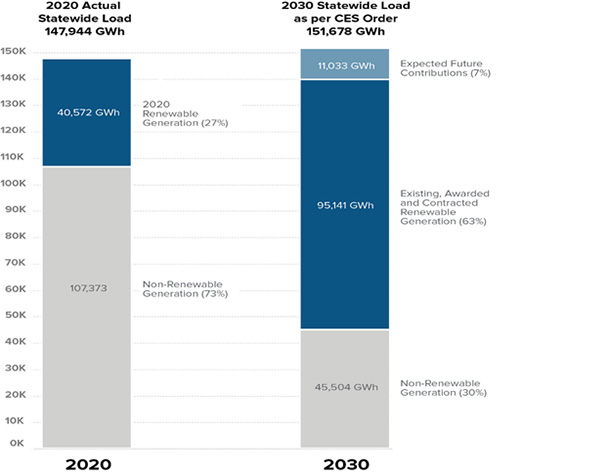
The state is already on track to meet CLCPA goals of sourcing 70 percent of its electricity supply from renewable energy by 2030, and making it 100 percent emissions-free by 2040. With buildings now representing a significant portion of economy-wide emissions, additional policies that could help equitably accelerate this shift include: better building codes; standards that help make appliances and other equipment found in residences and commercial buildings more efficient; statewide legislation that helps modernize new buildings; facilitating more disclosure of how buildings consume energy; eliminating fossil fuel subsidies while aligning incentives with state and local climate goals; and scaling up green, affordable housing.

Credit: NYSERDA.

DOWNLOAD

Download the complete report at at this link.

BACKGROUND

This is the first Building Opportunity: New York report produced by E2 based on analysis of the USEER, which was first released by the DOE in 2016. E2 was an original proponent of the DOE producing the USEER and was a partner on the reports produced by the Energy Futures Initiative (EFI) and National Association of State Energy Officials (NASEO) after the Trump administration abandoned it in 2017.

View Report »

Proposed California EV regs could be adopted by other states

“The strong policy leadership from Sacramento over the past 20 years has not only driven strong job growth but has helped California develop into a global hub of clean vehicle innovation and development,” said Andy Wunder, Western states advocate for E2, a national, nonpartisan group of business leaders, investors and professionals.

Offshore Wind to Generate Billions for North Carolina Economy

The state must actively pursue development of offshore wind projects to capture the maximum economic opportunity RALEIGH, N.C. – A new analysis shows that constructing 2.8-gigawatts of offshore wind off North Carolina’s coast by 2030 will result in a net economic benefit of up to $4.6 billion for the state’s economy. The North Carolina Offshore Wind […]

Sign Up for Email Updates


"*" indicates required fields

This field is for validation purposes and should be left unchanged.

Our Latest Press Releases


Releases

E2: Clean Energy Companies Announce 19K+ Jobs But Project Cancellations Erase Job, Investment Gains

Clean energy projects continued to grow in May and June as renewable energy developers and clean energy-related manufacturers raced to meet federal tax credit deadlines amid growing demand and prices for electricity. Still, federal policy rollbacks and othe...


Releases

Clean Energy Cancellations Cost U.S. 470,000 Jobs, Hundreds of Billions in GDP

One year after the One Big Beautiful Bill Act (OBBBA) was signed into law—rolling back tax credits and programs related to clean energy manufacturing and renewable electricity—a new economic analysis finds that large-scale clean energy projects abandoned si...


Releases

E2: Clean Energy Companies Announce Nearly $3 Billion in New Projects, Cancel $4 Billion

lean energy related companies announced 14 new manufacturing and utility-scale generation and storage projects totaling nearly $3 billion that would create 7,500 new jobs and add nearly 1 gigawatt (GW) in new capacity, according to E2’s latest Clean Economy...


Donate Today