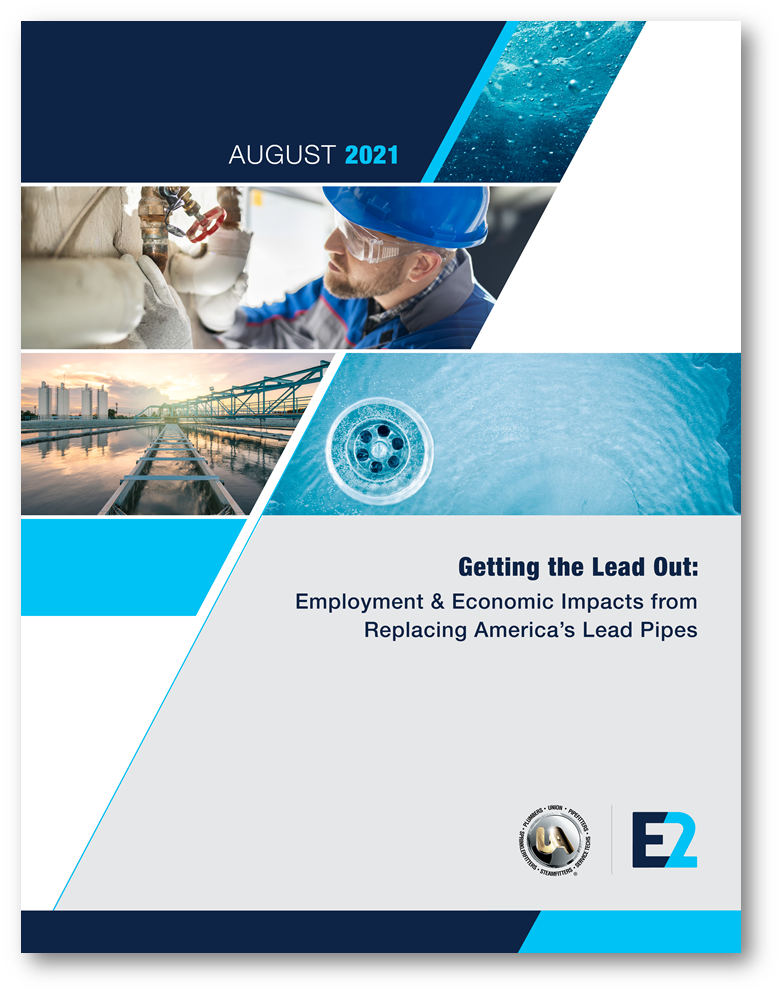
Getting the Lead Out: Employment & Economic Impacts of Lead Service Line Replacement

Date: August 3, 2021

Summary:

Based on the Biden administration’s plans to invest $45 billion to replace 100 percent of lead service lines in America, the findings from Getting the Lead Out: Employment & Economic Impacts from Replacing America’s Lead Service Lines, this report from E2 and the United Association of Union Plumbers & Pipefitters (UA) estimates that the $45 billion invested in this program will create and support 56,080 jobs annually for 10 years, or a total of 560,800 job-years. This annual estimate includes 26,900 direct jobs—construction workers, plumbers, pipefitters, heavy equipment operators—as a direct result of this activity. Another 13,600 jobs that last for 10 years are created throughout the value chain, and 13,800 jobs are created each year for 10 years as a result of workers spending their paycheck.

About 84 percent of all jobs created through this investment are in construction (52 percent), professional and business services (24 percent), and manufacturing industries (8 percent). Insofar as the bulk of these jobs involve high-skill construction occupations, the jobs created will provide good wages and training opportunities for local residents and promote economic benefits to affected communities.

This investment into cleaning up our nation’s water supply also would generate $38.3 billion in labor income, $11.7 billion in taxes, and $53.9 billion in additional value to the economy. That would represent a 120 percent return on investment.

In addition to the jobs created and value added to the economy from this activity, additional benefits like increased positive health outcomes would be generated. It has been estimated that an additional $22,000 of societal benefits are generated for every lead pipe replaced as a result of lower cardiovascular disease. Since in many areas lead service lines are more likely to exist in environmental justice communities, and since Black and Latino children have disproportionately high overall lead exposure, replacing these lead pipes will also greatly benefit low-income and minority households.

The scope of this work is massive and reaches every state. The Natural Resources Defense Council (NRDC) estimates that between 9.7 million to more than 12 million lead service lines are distributing water throughout our nation. About 700,000 or more of these service lines are found in Illinois, while Ohio, Michigan, New York, New Jersey Missouri and Wisconsin each contain more than 300,000 of the nation’s lead service lines; the top ten states total about 4 million.

This field is for validation purposes and should be left unchanged.

Findings

  • 560,800 total job-years*
  • $104 billion: total economic activity generated
  • 10 million lead service lines that need to be replaced

* 56,080 jobs annually over ten years

** Includes $38.3B in labor income, $11.7B in taxes and $53.9B in additional economic benefits

Methodology

BW Research used IMPLAN to conduct the economic impact analysis, resulting in the jobs, value-added, labor income, and taxes data. IMPLAN is an input-output modeling software that tracks spending patterns through the economy and their resulting impacts on economic indicators. The cumulative effects of the initial investment are quantified, and the results are categorized into direct, indirect, and induced effects. To capture interstate flows, direct and indirect impacts are results of national-level multipliers, distributed across states using state-level modeling. Induced impacts are the results of state-level multipliers, so as not to overestimate the impacts of household spending. Workforce data such as occupational demographics and wages are derived from JobsEQ by Chmura. JobsEQ is a workforce data software that derives data from Bureau of Labor Statistics and Census Bureau data, among other sources. Unionization rates are derived from unionstats.com.

  • Direct Impacts show the initial change in the economy associated with the investment. For example, pipefitters installing new service pipes or engineers planning the replacement.
  • Indirect Impacts include the supply chain responses as a result of the initial investment (i.e., water pipe manufacturers).
  • Induced Impacts refer to household spending and are the result of workers who are responsible for the direct and indirect effects spending their wages (i.e., direct and indirect workers spend income on clothes, food, healthcare, etc.).
  • Labor Income includes all forms of employment income, such as employee compensation (wages and benefits) and proprietor income (i.e. payments received by self-employed individuals and unincorporated business owners). Labor income is a component of value added.
  • Value Added is defined as the total value of production after netting out intermediate goods. This is another term for GDP.

About this Report

This economic impact analysis was conducted by BW Research Partnership for E2 in partnership with the United Association of Union Plumbers and Pipefitters. It uses the Biden Administration’s stated goal of 100 percent removal of lead service lines (LSLs) from America’s drinking water systems, the Natural Resources Defense Council’s (NRDC) national survey of LSLs, and the Environmental Protection Agency’s (EPA) estimated LSL replacement costs.

Special thanks to NRDC and BW Research. For a description of the methodology used in this report, please refer to the explanation on page in Appendix A.

Looking for More Info?

If you are looking for additional insight into Getting the Lead Out: Employment & Economic Impacts from Replacing America’s Lead Service Lines or E2’s other clean energy employment reports, visit e2.org/reports.

View Report »

Press Briefing: New Jobs Report on Replacing America’s Lead Pipes

In March, The Biden administration announced plans to remove 100 percent of America’s nearly 10 million lead service lines (LSLs) through the American Jobs Plan. A new report, from the national, nonpartisan business group E2 (Environmental Entrepreneurs) and the United Association of Union Plumbers and Pipefitters (UA), will detail the employment and economic gains if […]

New legislation sets the table to grow cleantech industry in the Grand Valley

The Grand Valley Cleantech Business Coalition (CBC), with help from the Grand Junction Chamber of Commerce, Grand Junction Economic Partnership, Colorado Cleantech Industry Association, and E2-Environmental Entrepreneurs has doggedly followed the proceedings to identify bills that could bring immediate economic benefits to our region by stimulating its burgeoning Cleantech Industry.

Equity & Workforce Development in the Clean Economy

Please join E2 for a national webinar discussion on access to clean energy job training. Before the pandemic, clean energy jobs were one of the fastest growing sectors of the economy, and will be a critical piece of how we build back better. But how do we ensure that clean energy employment opportunities are equitable? […]

The Demand for Clean-Energy Jobs Grows in Westchester

Here in New York, that comes as good economic news. The state ranks fourth in the nation in clean energy jobs (through 2019), according to research released by the nonpartisan business group E2. Westchester County is helping lead the way, with new companies popping up like spring tulips. And they need workers. The E2 report […]

Vermont clean energy jobs board aims to net more resumes from women

Job boards like the one that Renewable Energy Vermont has launched will be important to connect newly qualified workers with jobs, said Bob Keefe, executive director of E2, an environmental advocacy group that tracks clean energy workforce trends. But their impact will be limited without more investment in training workers who don’t yet have the […]

Electric Trucks Are Just The Start. Congress, Let’s Get Rolling.

Posted on May 20, 2021 by Bob Keefe

Electric pickup trucks are cool. But when it comes to building a cleaner economy and creating the jobs and other economic opportunities that come with it, so are heat pumps, Energy Star appliances and climate finance, the Biden administration showed this week. While up in Michigan the biggest game-changing electric vehicle since Tesla — the Ford F-150 Lightning — stole the […]

Clean energy, labor clashes reveal Biden’s CO2 challenge

The only industries to come out ahead in 2020 were wind, which saw a modest growth of 2,000 jobs, and electric vehicle manufacturing, which grew by 3% and added over 12,000 jobs. Those electric vehicle gains “would not have happened if companies like Ford, GM and VW had not decided in the latter half of […]

The promise of the clean energy economy for American workers

A study commissioned by E2 (Environmental Entrepreneurs), the American Council on Renewable Energy and the Clean Energy Leadership Institute found that in 2019, more than 3.3 million Americans worked in clean energy jobs – renewable energy, energy efficiency, clean vehicles and fuels – nearly three times the number in fossil fuels. Last year’s pandemic-triggered economic […]

Transitioning to Healthy Homes & Buildings and Clean Jobs

Join us to discuss Colorado’s transition to pollution-free energy and what the means for buildings, homes, and jobs. As Colorado works to ensure a more sustainable and equitable future, it is essential we reduce the greenhouse gas (GHG) emissions from residential and commercial buildings. In addition to achieving climate benefits, a move toward heating and […]

Pennsylvania announces 191MW solar energy plan

Pennsylvania Gov. Tom Wolf said Monday that half of state government’s electricity will come from solar energy as of 2023.

The commitment – the largest among any governmental agency nationwide – will harness 191 megawatts from seven solar arrays in central Pennsylvania to cover 100% of the electricity needs for more than 400 accounts across 16 state agencies, the Department of General Services said

Fight alongside the administration for a clean economy

Immediate and bold climate action is an economic imperative. We are falling behind China, which has outspent the U.S. in clean energy investments by hundreds of billions of dollars over the last decade. In doing so it has claimed the mantle of global leader in production, export, and installation of solar panels, wind turbines, batteries, […]

Sign Up for Email Updates


"*" indicates required fields

This field is for validation purposes and should be left unchanged.

Our Latest Press Releases


Releases

E2: Repealing EPA’s Endangerment Finding For Vehicle Emissions Raises Costs for Businesses and Consumers

The EPA officially revoked the endangerment finding for greenhouse gas (GHG) emissions and eliminated clean vehicle standards in a blow to both our economy and our environment.


Releases

E2: Companies Cancelled $34.8B, 38K Jobs for Clean Energy Projects in 2025, Outpacing New Investments 3-to-1

Businesses abandoned $5.1 billion in large-scale factories and clean energy projects in December, capping a turbulent year for the sector that saw nearly $35 billion in investments disappear along with more than 38,000 current and future jobs, according to ...


Releases

E2: Trump Administration’s Latest Attempt to Kill Offshore Wind Hurts Consumers, Businesses

The Trump administration is trying to halt offshore wind projects that are well-underway just two weeks after their initial attempt was deemed arbitrary and capricious by a federal judge.


Donate Today