Democrats at Crossroads to Merge Clean Energy Plans

“Both the Biden and Wyden plans would provide projects more assurances for financing” over the coming decade, said Sandra Purohit, director of federal advocacy for E2, a clean energy advocacy group. Projects that take longer to launch wouldn’t be at risk of losing out on incentives, which would translate into better terms for getting the […]

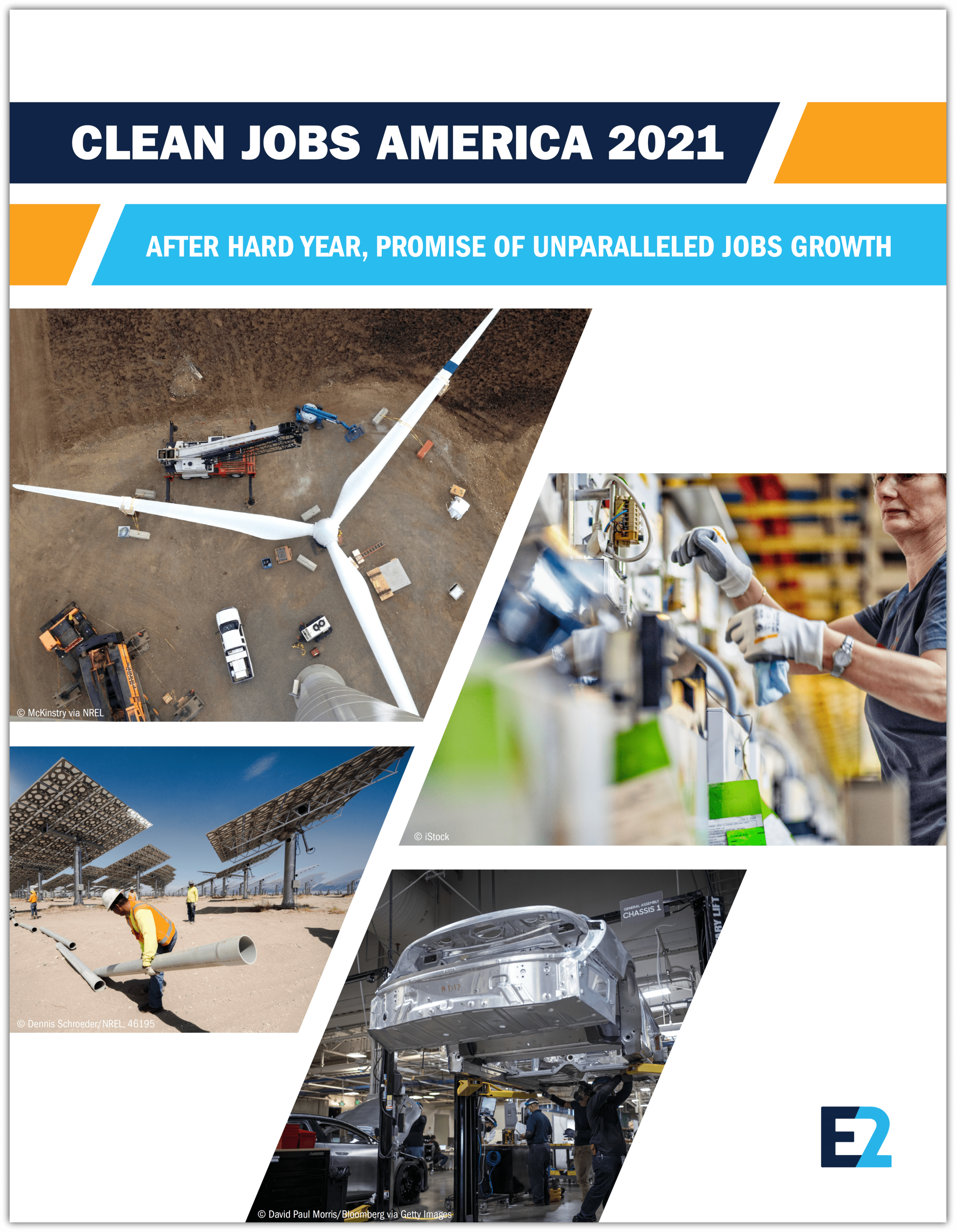
Clean Jobs America 2021

Date: April 19, 2021

After Hard Year, Promise of Unparalleled Jobs Growth

Summary:

In 2020, the number of clean energy jobs in America fell for the first time since E2 began tracking nationwide employment across the entire clean energy sector in 2015. Amid the COVID-19 pandemic and related economic contraction and the lingering impacts of policies from the previous administration that encouraged fossil fuels over clean energy, nearly 307,000 jobs were lost in wind, solar, energy efficiency and other clean energy sectors.

About 3 million Americans worked in clean energy at the end of 2020, down from 3.36 million the year before, according to the analysis of Bureau of Labor Statistics data and the findings of a national survey of more than 30,000 businesses across the U.S. economy.

This field is for validation purposes and should be left unchanged.

Findings

  • Jobs in energy efficiency, the biggest part of the U.S. energy sector, took the biggest tumble, falling more than 11 percent last year as COVID-19 pandemic restrictions prevented energy efficiency workers from entering commercial and residential buildings.
  • Wind energy employment increased slightly, while solar employment fell, driven by declines in residential solar sales and installation which were hit hard early in the pandemic and could not fully recover despite growth in the second part of the year. 2 Overall, renewable energy jobs fell by nearly 6 percent.
  • Jobs in grid modernization, battery and storage occupations dropped nearly 7 percent after two years of rapid growth driven by growing demand in batteries for electric vehicles and commercial and residential energy storage.
  • Clean vehicle manufacturing jobs defied overall energy sector job loss patterns and grew nearly 3 percent as automakers increasingly shifted to cleaner and more efficient electric cars, trucks and buses. Electric and hybrid electric vehicle employment grew more than six percent adding over 12,000 new jobs in 2020, the biggest increase of any clean energy category.

Despite the overall decline, clean energy remains the biggest job creator across America’s energy sector, employing nearly three times as many workers as work in fossil fuel extraction and generation. More Americans still work in clean energy than work as middle and elementary school teachers, bankers, farmers or real estate agents. Median hourly wages for clean energy jobs also are about 25 percent higher than the national median wage, and also pay better than most fossil fuel extraction jobs (See Clean Energy Wages And Making Good Jobs Even Better sidebar on page 5).

California, Texas, New York and Florida remain the nation’s leaders for clean energy jobs, but smaller states such as Illinois, Massachusetts, Michigan and Ohio all employed more than 100,000 clean energy workers each at the end of last year.

2021 Clean Energy Employment Toplines

Total Clean Energy 3,048,603
Renewable Energy 492,891
Grid & Storage 137,872
Energy Efficiency 2,107,174
Clean Fuels 37,036
Clean Vehicles 273,630

Looking for More Info?

This is the sixth annual Clean Jobs America report produced by E2 based on analysis of the USEER, which was first released by the DOE in 2016. E2 was an original proponent of the DOE producing the USEER, and was a partner on the reports produced by the Energy Futures Initiative (EFI) and National Association of State Energy Officials (NASEO) after the Trump administration abandoned it in 2017.

If you are looking for additional insight into E2’s Clean Jobs America 2021 or our other clean energy employment reports, visit e2.org/reports. An FAQ is also available here to answer any questions.

Previous Reports

Clean Jobs America 2021 is the 6th national clean energy jobs report from E2. Previous reports can be accessed in the below links.

View Report »

Fight alongside the administration for a clean economy

Immediate and bold climate action is an economic imperative. We are falling behind China, which has outspent the U.S. in clean energy investments by hundreds of billions of dollars over the last decade. In doing so it has claimed the mantle of global leader in production, export, and installation of solar panels, wind turbines, batteries, […]

Clean Jobs, Better Jobs

Date: October 22, 2020

About This Report

To understand the quality of employment opportunities in clean energy-related industries, E2 (Environmental Entrepreneurs), the American Council on Renewable Energy (ACORE), and the Clean Energy Leadership Institute (CELI) commissioned BW Research to analyze wages and benefits of occupations in clean energy industries in comparison to all occupations nationwide, sectors heavily impacted by the pandemic crisis, and other energy-related occupations.

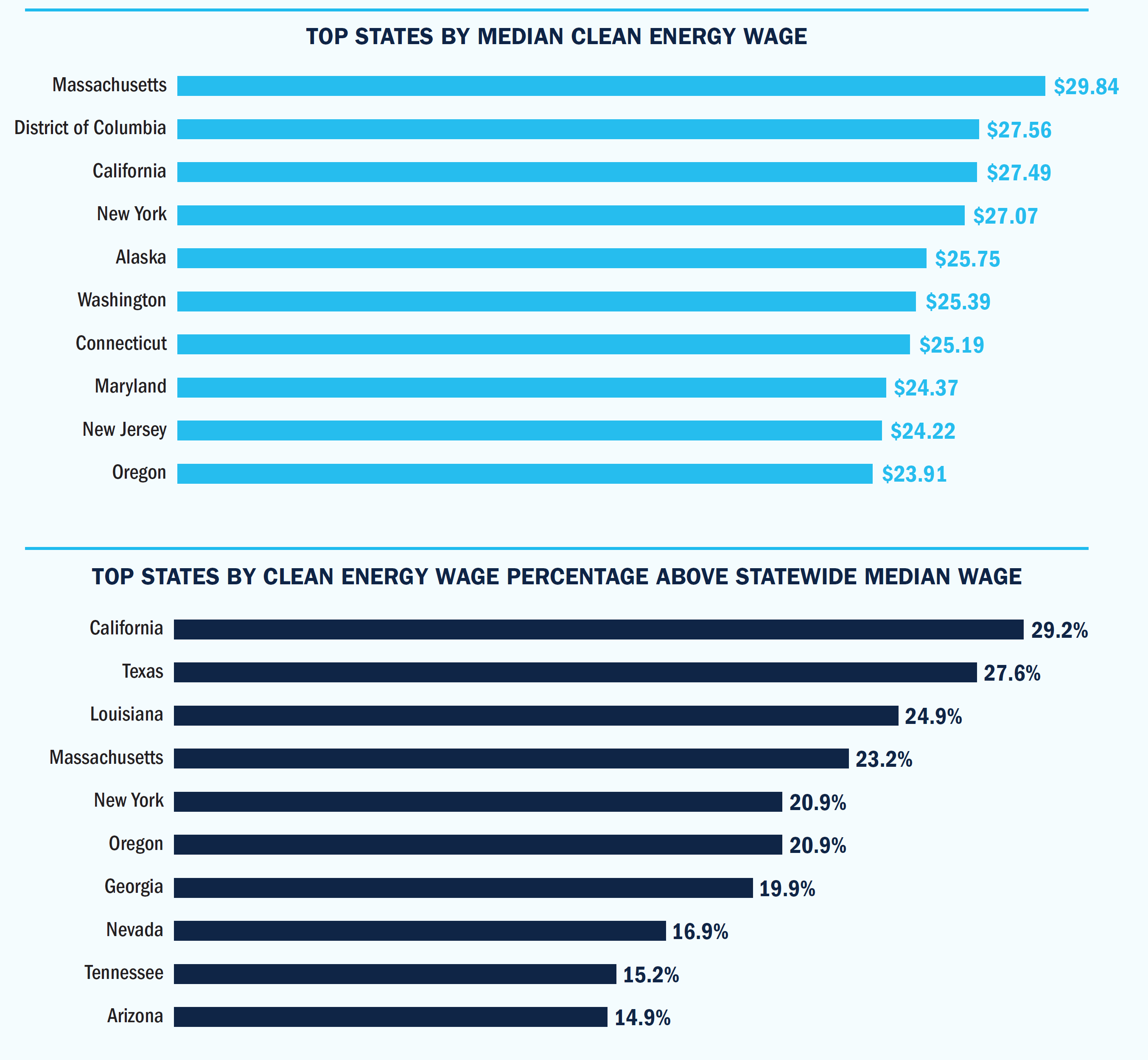
This report analyzed clean energy wages, benefits and unionization rates across all five clean energy sectors (renewable energy generation, energy efficiency, clean fuels, clean vehicles, and grid modernization and storage) with detailed demographic data for 15 specific clean energy occupations, and how they compare with similar jobs in other industries. Also detailed in the report are state-specific wage findings for all 50 states and the District of Columbia.

Key Findings

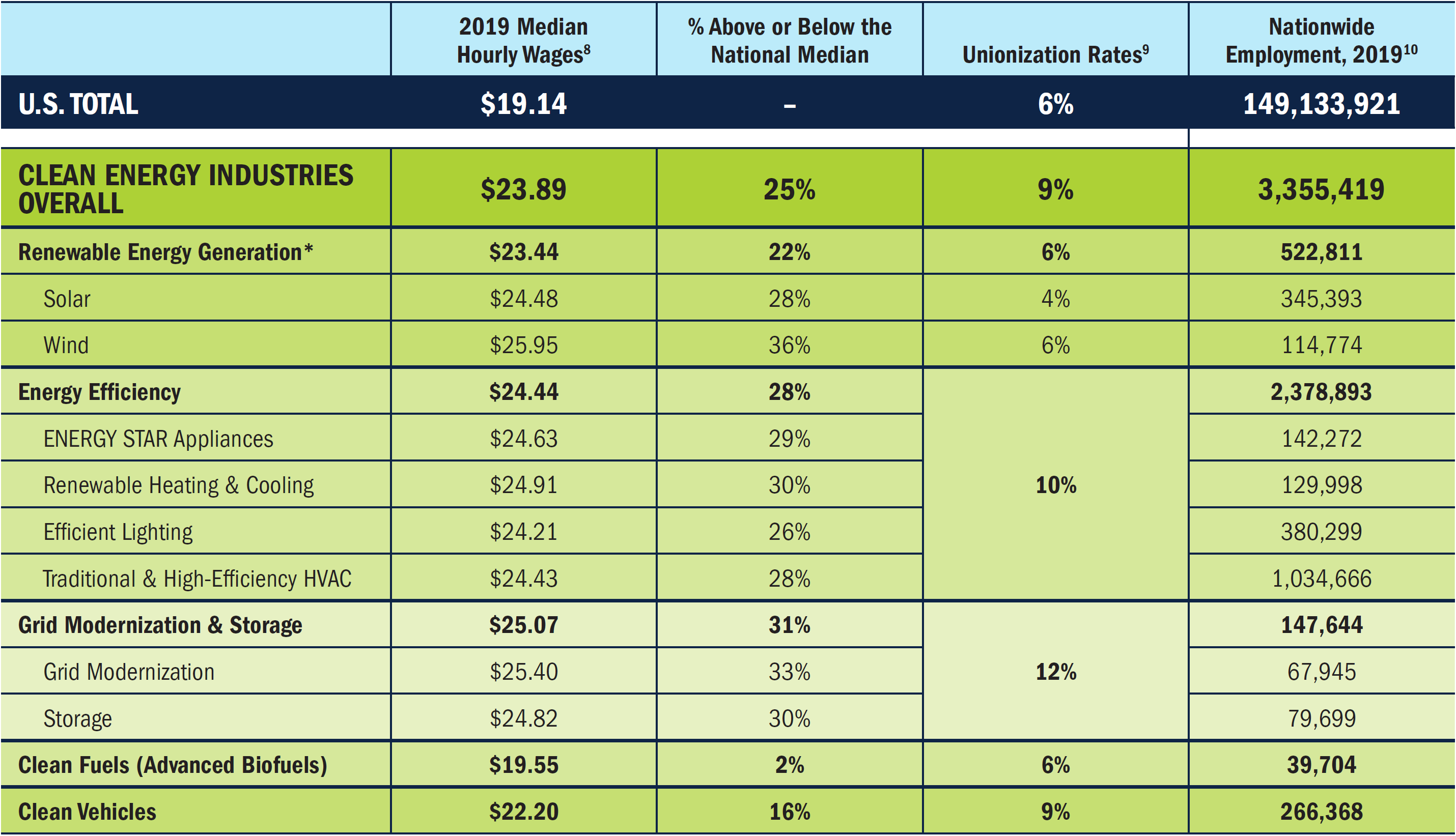
The Clean Jobs, Better Jobs report is the first comprehensive analysis of wages and benefits across the clean energy sector. According to the report, workers in renewable energy, energy efficiency, grid modernization and storage, clean fuels and clean vehicles earned a median hourly wage of $23.89 in 2019 compared with the national median wage of $19.14. In addition, jobs in many clean energy sectors are more likely to be unionized and come with health care and retirement benefits than the rest of the private sector, the analysis shows.

Clean Jobs, Better Jobs comes amid the growing national dialogue around clean energy as federal and state leaders look for ways to restart the economy. The findings underscore the opportunity to advance smart clean energy policies that create higher-wage opportunities putting Americans back to work quickly rebuilding a cleaner, more resilient and more equitable economy. The report also provides detailed wage, benefit, education and demographic data for 15 specific clean energy occupations, and how they compare with similar jobs in other industries outside of clean energy.

Overall, median wages in clean energy are significantly higher than median wages in sectors such as retail, services, recreation and accommodations, especially when it comes to entry-level wages. Solar energy workers earn $24.48 an hour, while wind and grid modernization jobs pay on average more than $25 an hour. Energy efficiency – the largest employer in the nation’s energy sector – supports a median hourly wage of $24.44, about 28% above the national median.

Many clean energy jobs also paid better than fossil fuel jobs. Jobs in coal, natural gas and petroleum fuels paid $24.37 an hour, while solar and wind jobs combined for a $24.85 median hourly wage. Clean energy industries also employed about three times more workers than fossil fuels did in 2019, and, unlike fossil fuel jobs, clean energy jobs are available in every state, regardless of geology or geography.

Before COVID-19, clean energy had been one of the nation’s fastest-growing sectors. At the end of 2019, clean energy employed nearly 3.4 million workers across 99% of U.S. counties, according to E2’s Clean Jobs America report.

Wages & Unionization Rates By Industry, 2019
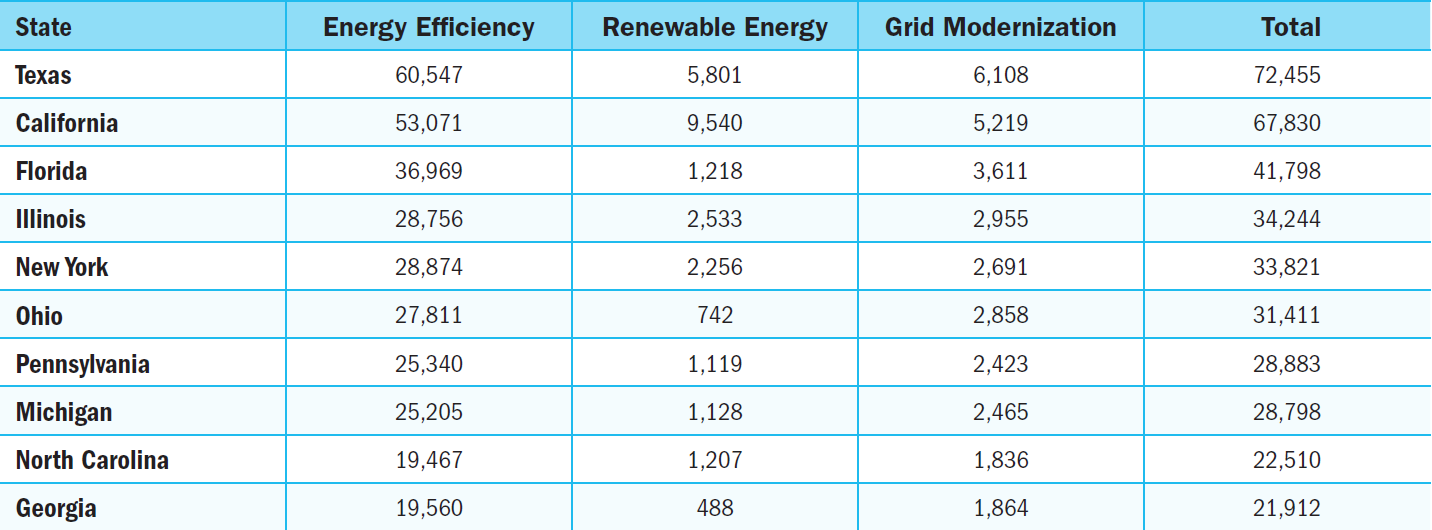
States Most Impacted
Download

The complete report is available for download at this link.

Looking for More Info?
The analysis expands on data from the 2020 U.S. Energy and Employment Report (USEER) produced by the Energy Futures Initiative (EFI) in partnership with the National Association of State Energy Officials (NASEO), using data collected and analyzed by the BW Research Partnership. The report was released in March 2020 and is available at www.usenergyjobs.org. E2 is a partner on the USEER, the fifth installment of the energy survey first released by the Department of Energy in 2016 and subsequently abandoned under the Trump administration. Clean energy jobs have grown every year since the first report was released in 2016.

If you are looking for additional insight into this report or E2’s more than a dozen other annual clean energy employment reports, visit e2.org/reports. You can also contact E2 Communications Director Michael Timberlake ([email protected]).

Sign-Up for Email Updates

"*" indicates required fields

This field is for validation purposes and should be left unchanged.

View Report »

Solar is surprising itself with a rebound

After staring into the abyss during the coronavirus lockdowns earlier this year, the solar industry is a bit startled to find itself thriving again. Many rooftop installers have hired back most of the people they furloughed. Stock prices are through the roof. The phones are ringing again with customers who want solar, this time with […]

Republicans Seek to Help Clean Energy in Next Virus Aid Package

Prior to the pandemic, the U.S. clean energy sector was one of the bright spots for the U.S. economy, with a total workforce of 3.4 million employees in 2019, and the sector grew twice as fast as the overall U.S. economy since 2017. The sector rebounded slightly in June, but more than half a million […]

Build Back Better, Faster: How a federal stimulus focusing on clean energy can create millions of jobs and restart America’s economy

Date: July 15, 2020

Clean Energy Economic Stimulus Impacts

The coronavirus (COVID-19) pandemic has caused millions of Americans—including as many as 620,500 clean energy workers—to lose their jobs over just a few months. E2 and E4TheFuture partnered with BW Research Partnership on this economic impact assessment to demonstrate the potential for creating jobs from federal stimulus investments in three major sectors of the clean energy economy: Energy Efficiency, Renewable Energy, and Grid Modernization.

The clean energy industry is proven to provide a great return on stimulus investments. During the Great Recession, the American Recovery and Reinvestment Act of 2009 (ARRA) directed a portion of stimulus investments to supply chain components for major clean energy technology sectors such as advanced vehicles, batteries, renewable energy, carbon capture and sequestration, grid modernization, and energy efficiency. It is estimated that these $90 billion in strategic investments and incentives supported roughly 900,000 job-years from 2009 through 2015. These investments also set the stage for long-term job growth across the nation’s clean energy industry. By 2019, the clean energy workforce was 3.4 million workers strong and had been growing two times faster than nationwide employment since 2017.

Economic benefits of the proposed federal stimulus package include high-quality jobs for U.S. residents, labor income, boosts to local, state, and federal tax revenues, contributions to Gross Domestic Product (GDP), and energy cost savings. All these benefits ultimately translate to greater spending in the economy. Clean energy jobs are proven to be sustainable wage positions that are accessible to all localities across the U.S., regardless of geography, or politics, and provide new, equitable job opportunities that cannot be outsourced. Moreover, updates to the nation’s energy infrastructure are an investment in the collective economic future of Americans; the creation of a more resilient energy system is vital to economic growth and security.

This report looks at the first five years of economic impacts from a robust federal clean energy stimulus totaling $99.2 billion—with targeted and strategic investments in energy efficiency, renewable energy, and grid modernization. Our modeling finds that such an investment in our shared future would create 860,300 full time direct, indirect and induced jobs that will last for at least five years (a total of 4.3 million job-years). A stimulus of this level and the jobs it would create would also generate more than $66 billion in GDP each year for the next five years—resulting in $330 billion in economic activity, more than triple the amount of investment. These are jobs that would support sustainable wages and help bring the U.S. economy out of the severe recession.

By Industry Impacts

States Most Impacted

Download

The complete report is available for download at this link.

Looking for More Info?

The analysis expands on data from the 2020 U.S. Energy and Employment Report (USEER) produced by the Energy Futures Initiative (EFI) in partnership with the National Association of State Energy Officials (NASEO), using data collected and analyzed by the BW Research Partnership. The report was released in March 2020 and is available at www.usenergyjobs.org. E2 is a partner on the USEER, the fifth installment of the energy survey first released by the Department of Energy in 2016 and subsequently abandoned under the Trump administration. Clean energy jobs have grown every year since the first report was released in 2016.

If you are looking for additional insight into this report or E2’s more than a dozen other annual clean energy employment reports, visit e2.org/reports. You can also contact E2 Communications Director Michael Timberlake ([email protected]).

View Report »

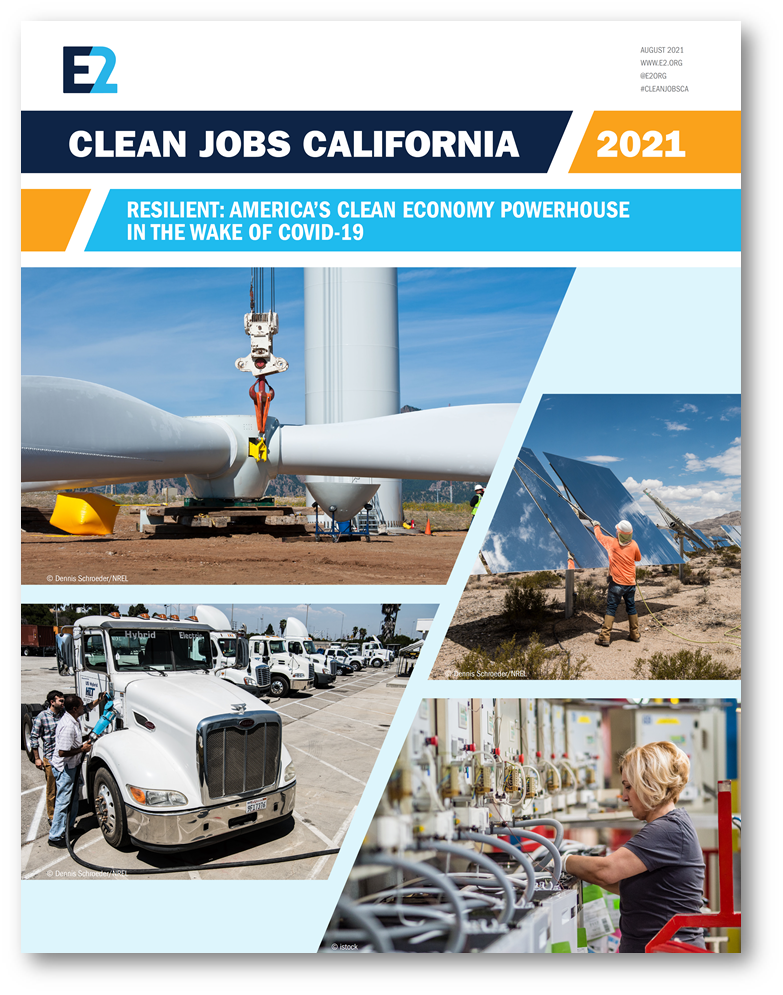
Clean Jobs California 2020

Date: June 25, 2020

America’s Clean Energy Powerhouse in the Wake of COVID-19

After a fifth straight year of job growth since E2 (Environmental Entrepreneurs) began tracking U.S. clean energy employment, California’s clean energy economy is facing a torrent of job losses and work freezes so significant it could set the industry back years. What had been one of the nation’s fastest-growing job sectors over the last five years is now one of the fastest-shrinking in the wake of COVID-19-related shutdowns disrupting supply chains and building energy efficiency projects, halting new developments and emptying project pipelines, and slowing investments while wrecking financial outlooks.

Entering 2020, California’s clean energy economy had grown for five straight years since this annual report was first released with clean energy jobs growing to make up 3 percent of the state’s entire workforce.

E2’s Clean Jobs California 2020 details the sheer size of this important employment sector, the troubles it is currently facing due to COVID-19 and how focusing recovery policies on clean energy can get the Golden State’s economy humming again—quickly and for the long run.

INDUSTRY JOB TOPLINES | Q4 2019

  • Energy Efficiency – 323,529 jobs
  • Renewable Energy –142,957 jobs
    • Solar Energy – 124,817 jobs
    • Wind Energy – 2,520 jobs
  • Clean Vehicles – 40,627 jobs
  • Clean Storage – 17,397 jobs
  • Grid Modernization – 6,625 jobs
  • ALL Clean Energy Sectors – 536,919 jobs

DOWNLOAD

The complete report is available for download at this link.

Looking for More Info?

The analysis expands on data from the 2020 U.S. Energy and Employment Report (USEER) produced by the Energy Futures Initiative (EFI) in partnership with the National Association of State Energy Officials (NASEO), using data collected and analyzed by the BW Research Partnership. The report was released in March 2020and is available at www.usenergyjobs.org. E2 is a partner on the USEER, the fifth installment of the energy survey first released by the Department of Energy in 2016 and subsequently abandoned under the Trump administration. Clean energy jobs have grown every year since the first report was released in 2016.

If you are looking for additional insight into E2’s Clean Jobs California 2020 or our other Clean Jobs America reports, visit e2.org/reports. You can also contact E2 Communications Director Michael Timberlake ([email protected]). An FAQ is also available here to answer any questions.

PAST CLEAN JOBS AMERICA REPORTS

Clean Jobs America 2020 is the 3rd clean energy jobs report for California from E2. Previous reports can be accessed in the below links.

View Report »

Renewable Energy Tax Credits: The Case for Refundability

The COVID-19 pandemic threatens to wipe out much of the progress that has been made in renewable energy growth in the United States during the past decade. A recent jobs report found that nearly 600,000 workers from across renewables, energy efficiency, clean vehicles, and grid and storage have lost their jobs since March.1 These losses […]

‘Worse than we thought’: Clean energy lost almost 450,000 jobs in April

“It’s a lot worse than we thought, and it doesn’t look like it’s getting any better,” said Bob Keefe, executive director of Environmental Entrepreneurs. The memo from BW Research projects the clean energy sector could lose 850,000 jobs by the end of the second quarter, about 25% of the total U.S. clean energy workforce, if […]

Sign Up for Email Updates


"*" indicates required fields

This field is for validation purposes and should be left unchanged.

Our Latest Press Releases


Releases

STATEMENT: Federal Rollback of Auto Fuel Efficiency Standards Will Increase Costs for Consumers, Businesses

The National Highway Traffic Safety Administration (NHTSA) is expected to announce the Administration’s intent to weaken federal Corporate Average Fuel Economy (CAFE) standards for vehicles. Such a dramatic shift in policy would halt five decades of progres...


Releases

Companies Cancel $4.4 Billion in Clean Energy Projects; $28 Billion, 30K Jobs Lost in 2025

WASHINGTON –Businesses canceled, closed, and scaled back more than $4.4 billion worth of large-scale factories and clean energy projects from late-September through October, bringing the total cost of projects cancelled in the private-sector to over $28.7 b...


Releases

REPORT: Clean energy grew 5X faster than rest of Pennsylvania economy, added 3K jobs in 2024

HARRISBURG (Nov. 20, 2025) – Clean energy jobs in Pennsylvania grew more than five times faster than the rest of the state's economy in 2024, raising the total number of clean energy workers in the state to over 104,000, according to the Clean Jobs Pennsylv...


Donate Today