SoCap 2020

SoCap 2020 is a weeklong virtual event covering climate action, water stewardship and corporate sustainability. October 19 – 23, the global impact community will come together to connect, learn and collaborate on unlocking the power of markets for impact. Join innovators from across the world who are building the impact economy and participate to build […]

E2 awards Boulder entrepreneur $20,000 grant

BOULDER — Environmental Entrepreneurs, an environmental advocacy organization known as E2, announced this week participants of the 2020 E2 1 Hotels Fellowship program, which includes Jock Gilchrist of Boulder. Gilchrist, who will receive a $20,000 grant as part of the program, is building a “multimedia campaign to make the business case for implementing regenerative agriculture, […]

$20,000 Awarded to 10 Emerging Clean Energy Leaders Across U.S.

2020 Fellows represent 8 states across 5 regions SAN FRANCISCO – National business group E2 (Environmental Entrepreneurs) and sustainability-driven hotel brand 1 Hotels announced today the 2020 1 Hotels Fellowship class at E2. This is the third-year of the annual fellowship, which awards ten young U.S. business leaders $20,000 each to execute projects that advance […]

Letters: Trump administration proposal tells business to forget lessons of Deepwater Horizon

On January 10, the Trump administration announced it plans to roll back the National Environmental Policy Act (NEPA), excluding more projects from NEPA review and allowing project developers to write the environmental analysis. We know what that looks like. Deepwater Horizon was exempted from full environmental review under NEPA. As a result, the economic and […]

Daybreak: A California carbon farming market

CDFA considers a carbon farming market CDFA measures the success of its Healthy Soils incentives program in part by how much carbon is sequestered in the soil. Now the department is considering a proposal to monetize that benefit through a carbon offset market, supplementing the incomes of those farmers. A coalition of businesses and organizations […]

Colorado FARMS project grant could help address climate change, make agriculture more sustainable

Just before Thanksgiving, the U.S. Department of Agriculture (USDA) announced more than $13 million in grants to support nine on-farm pilot projects designed to demonstrate and improve soil health practices. The innovative new pilot project, part of the 2018 Farm Bill, was developed through a unique collaboration of environmental, business and farming groups led by E2 (Environmental […]

E2 report: Investing in water infrastructure can boost economy, jobs, improve health

Michigan should spend the billions of dollars required to improve its fresh and storm water infrastructure, along the way creating thousands of new jobs and other economic dividends, according to a report from the advocacy group Environmental Entrepreneurs. While expensive, E2 said Michigan’s water infrastructure is so underfunded — $90 per capita lower than the […]

REPORT: Beyond Flint, “Water Investing Gap” in Michigan Stands in Way of 90,000 New Jobs in State, $8.8 Billion in Workers’ Paychecks

$22,000 a Day on Bottled Water for Flint:  Chronically Underfunded, Maintenance-deferred Water Infrastructure Costs Michigan Money. LANSING (November 14, 2019) – Investing $12 billion on top of existing water infrastructure expenditures over the next two decades would address the Flint water problem and also create nearly 90,000 direct full-time jobs and generate $8.8 billion in total […]

Investing in Michigan’s Water Infrastructure – An Economic Opportunity

Date: November 14, 2019
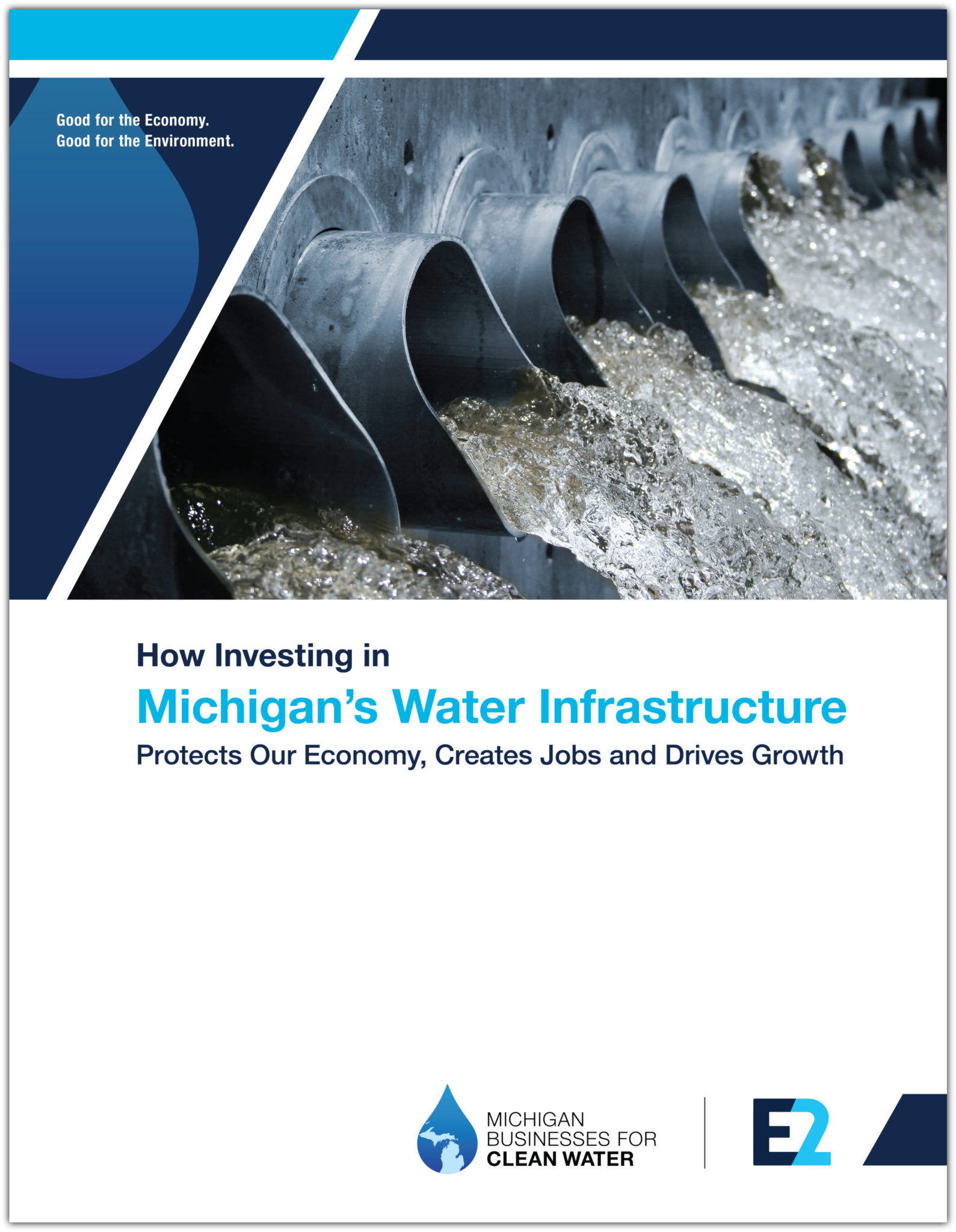
Michigan water infrastructure report cover

PROTECTING THE ECONOMY, CREATING NEW JOBS, AND DRIVING GROWTH

Michigan has for decades underinvested in its water infrastructure at the expense of the economy and the health of families in the state. To ensure Michigan’s economy continues to grow — and that all Michiganders enjoy a high quality of life — this gap should be closed.

Fortunately, investing an additional $12.2 billion in Michigan’s own water infrastructure needs on top of existing expenditures would over the next two decades help create nearly 90,000 direct job-years in multiple industries — including good jobs for veterans — while generating about $441.3 million in additional earned income for state residents annually.

This essential spending would also help businesses in the state’s water services industry become national leaders in developing and commercializing new water technologies, just as early-mover states like California have become national leaders in clean tech. And it would ensure that all Michigan industries, whether they are directly or indirectly reliant on clean, affordable water, are in the best position possible for decades of ongoing growth.

But first, we must fix the system.

REPORT TOPLINES

  • $12 billion in new spending is needed to update critical water infrastructure in Michigan and avoid more long-term economic and health damage to the state
  • New expenditures directly lead to the creation of 89,880 full-time job-years
  • Those 90,000 direct jobs would generate $8.8 billion in new wages workers and their families can inject into their local economies
  • New jobs and wages will generate $694 million in total tax revenue over two decades, with more than 80 percent going to local and state municipalities ($560 million)
  • Michigan is currently spending $22,000 a day on bottled water for Flint, Michigan alone. Continuing to underfund and defer critical maintenance improvements to water systems across the state risks similar impacts in other cities.
  • While the cost of improving Michigan’s safe drinking water systems is greater than the direct economic benefits, this report focuses only on one small piece of the economic benefits – the direct additional jobs and spending. E2 and BW Research did not analyze indirect or induced benefits like improved health outcomes for citizens, long-term benefits on younger populations, and economic activity created by improving clean water access for businesses.

METHODOLOGY

For the jobs, income and tax revenue data, E2 contracted BW Research which used the Emsi Input-Output model that traces spending and infrastructural developments through the economy to determine the economic impact of the change in water infrastructure spending in the state of Michigan.45

The cumulative effects of the initial job change are quantified and the results are categorized into direct, indirect and induced effects.

  • Direct effects show the change in the economy associated with the initial job creation (or loss), or how the industry experiences the change (i.e., workers digging ditches to replace pipe).
  • Indirect effects include all the backward linkages, or the supply chain responses as a result of the initial job change (i.e., water pipe manufacturers).
  • Induced effects refer to household spending and are the result of workers who are responsible for the direct and indirect effects spending their wages (i.e., direct and indirect workers spend income on clothes, food, healthcare, etc.).

DOWNLOAD

The complete report is available for download at this link.


View Report »
E2 1 Hotels Fellowship: 2018-2019 Fellow Showcase

The E2 1Hotels Fellowship supports emerging business leaders develop and implement projects that amplify the business and economic case for smart policies to address pressing environmental issues. This will be the final webinar showcasing our 2018-2019 class of fellows who have been working on a diverse set of issues ranging from clean water, energy and agriculture. […]

Sign Up for Email Updates


"*" indicates required fields

This field is for validation purposes and should be left unchanged.

Our Latest Press Releases


Releases

REPORT: Colorado clean energy sector grew by 4 percent, added 2K jobs in 2024

DENVER, CO (Dec. 10, 2025) – Clean energy jobs grew more than five times faster in Colorado than the rest of the state's economy in 2024, raising the total number of clean energy workers in the state to 69,859 – 18th most in the country – according to the s...


Releases

STATEMENT: Federal Rollback of Auto Fuel Efficiency Standards Will Increase Costs for Consumers, Businesses

The National Highway Traffic Safety Administration (NHTSA) is expected to announce the Administration’s intent to weaken federal Corporate Average Fuel Economy (CAFE) standards for vehicles. Such a dramatic shift in policy would halt five decades of progres...


Releases

Companies Cancel $4.4 Billion in Clean Energy Projects; $28 Billion, 30K Jobs Lost in 2025

WASHINGTON –Businesses canceled, closed, and scaled back more than $4.4 billion worth of large-scale factories and clean energy projects from late-September through October, bringing the total cost of projects cancelled in the private-sector to over $28.7 b...


Donate Today