How We Decarbonize California’s Buildings

California’s building sector is responsible for a quarter of the state’s greenhouse gas emissions and decarbonizing our built environment presents a critical opportunity ripe for climate action. Over the last few years, state policymakers have made progress in tamping down building emission across California. And at the local level more than 40 cities and counties […]

REPORT: Fighting Climate Change Offers Recovery, New Revenues for America’s Farms

Making stored carbon farming’s next cash crop is vital to U.S. climate battle WASHINGTON – America’s farms were struggling just to make a profit even before the COVID-19 pandemic, but long-ignored soil practices could provide new revenue opportunities and long-term profitability for thousands of hard-hit farms across the U.S., according to a new report from […]

Making the Clean Economy a Reality

Our current Administration and many in Congress are committed to bring about the clean energy, climate resilient and equitable economy that is desperately needed, nothing is certain, and timing is urgent. Please join E2 in a conversation with Senator Tom Carper and Congressman Paul Tonko, to explore how we can move quickly to mitigate the […]

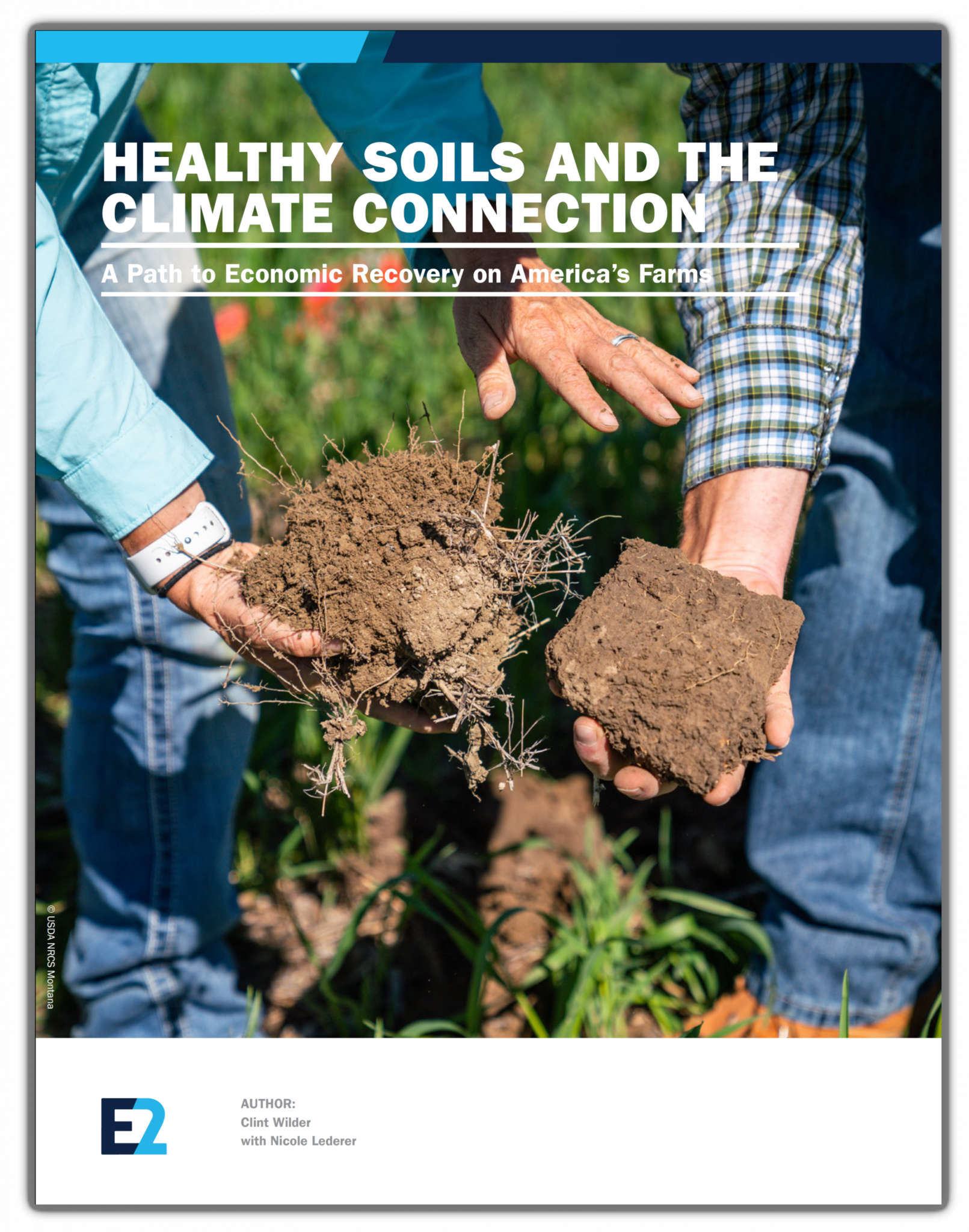
Healthy Soils and the Climate Connection: A Path to Economic Recovery on America’s Farms

Date: February 9, 2021

Fighting Climate Change Offers Recovery, New Revenues for America’s Farms

Summary:

Most initiatives to fight climate change today focus on reducing fossil fuel emissions from electricity generation, transportation, and buildings. But to avoid the worst impacts of climate change we must also significantly reduce the atmospheric carbon that has already been emitted. While efforts are underway to develop new and high tech mechanisms to accomplish this, there is an immediately available and economically viable pathway for atmospheric carbon removal—one that provides a compelling new value proposition for farmers to revitalize their soils and get paid for doing it.

Regenerative agriculture methods such as cover cropping, crop rotation, low-till or no-till practices, and reduced reliance on fossil-fuel based inputs can mitigate climate change by drawing down atmospheric CO2 and sequestering that carbon in the soil, while improving microbial soil health, and increasing soil fertility, crop yield and resilience. These practices also produce multiple additional economic and environmental benefits.

For most of the past decade, agriculture has been one of the most challenging sectors of the U.S. economy. American farmers have had to endure plummeting crop prices, trade-war tariffs, rising costs for inputs like fertilizer, and increasing crop and livestock losses from extreme weather events and less predictable growing seasons—an estimated 85% of U.S. crop losses are due to extreme weather events. Then came COVID-19, disrupting supply chains, upending markets such as restaurants, schools, and institutional food, and further dimming farmers’ prospects with a likely extended recession. According to the Food and Agriculture Policy Research Institute at the University of Missouri, net farm income could plunge by 19% ($20 billion) in 2020.

But climate-smart agriculture and soil carbon drawdown are in the nascent stages of ushering in a potentially gamechanging chapter in 21st century agriculture. Through strategic direction of Farm Bill funds and other state and federal policies, partnerships with private sector companies seeking to go carbon-negative, and increased consumer demand for low-carbon food, fiber and fuel, regenerative cultivation practices can deliver four significant economic, environmental, and political opportunities for the U.S. farm economy.

This field is for validation purposes and should be left unchanged.

An Opportunity on Four Fronts

Farm Profits and Economic Recovery

Climate-smart agricultural practices offer a path to economic recovery and long-term profitability for hard-hit farmers by delivering increased and more consistent crop yields, reduced costs for inputs (fertilizer, fuel, pesticides) and crop insurance, and the opportunity to participate in markets for soil-based carbon removal. ‘Reduced carbon’ or ‘negative carbon’ crop outputs and the products derived from them may also have increased market value as consumer awareness and demand increases for products with these attributes.3 Healthier soils also make farms and ranches more resilient in the face of increasingly common extreme weather events.

Ag Tech & Job Creation

“Ag tech” is one of the fastest-growing technology sectors, with investors from across the financial sector funding startup companies creating highly skilled jobs in technologies such as microbial soil additives, advanced sensors, drones, monitoring software, GPS mapping, genomics, AI, and data analytics. The demand for accurate soil data measurement and analysis is strong, and college programs to train new ag tech professionals are growing throughout the Farm Belt. Additional innovation is taking place in the creation of agricultural carbon trading platforms, establishing carbon as a new farm commodity.

Valuing Carbon Removal & Ecosystem Services

While storing carbon from the atmosphere in agricultural soils can be a key factor in the battle against climate change, the practices that sequester carbon also deliver a wide range of other environmental benefits—including improved water quality and conservation, improved air quality, greater biodiversity, and reduced toxic inputs. Markets and other opportunities that monetize these practices are emerging, creating new revenue streams for farmers and ranchers across the U.S.

Bridging Partisan Divides

Support for policies to incentivize agricultural carbon sequestration has bridged the historically contentious divide between the environmental and agricultural communities because the practices that restore and enhance soil carbon produce both economic benefits for farmers and natural resource benefits to society. In 2017, for instance, an unprecedented coalition of environmental, business, and farm industry groups helped forge and recruit bipartisan Congressional support for the Soil Health Demonstration Trial in the 2018 Farm Bill, a key soil health enhancement and soil carbon measurement program. Since then, numerous policies building on that provision have been proposed at the state and federal levels by lawmakers on both sides of the political aisle, as diverse stakeholders recognize the benefits of valuing agricultural carbon removal.

About the Report

Healthy Soils and the Climate Connection: A Path to Economic Recovery on America’s Farms provides a roadmap for how climate-smart agriculture policies could provide profit boosts for farmers and climate wins for advocates.

View Report »

Report: Virginia’s 100% Clean Energy Law Insufficient to Tackle Climate Change

The economy has lost more than 450,000 jobs in clean energy and energy efficiency since the pandemic began, even after employment increases in recent months, according to data released Wednesday by E2, E4TheFuture, the American Council on Renewable Energy, and BW Research Partnership. In Virginia, the RMI and Energy Innovation scenario forecasts the addition of […]

Climate Action & Economic Equity in Oregon

E2 and our business community are well-versed on the climate crisis—highlighting the economic imperative of climate action is a central pillar of our advocacy work. However, climate is not the only crisis facing our country, nor the only one that demands action. For too long, the US has experienced growing economic inequality, especially along racial […]

Vice-Presidential Debate Fueled By Talk Of Energy, Environment And Climate Change

Consumer sentiment is already driving this movement. But those market forces are not enough to stave off the ill-effects of global warming. According to a just-released study by Environmental Entrepreneurs, E4TheFuture and the American Council on Renewable Energy, the recession has taken its toll: before the coronavirus, employers projected at least 175,000 clean energy jobs […]

VERGE 20 Conference

Climate change is the most significant global threat we face today. It also represents an unprecedented opportunity to build a clean economy by electrifying and decarbonizing our world, equitably and profitably. Momentum is building as businesses and governments transform their organizations to be more efficient and resilient. The VERGE 20 online event is the leading […]

NEPA Rollbacks ‘A Recipe for Disaster’

WASHINGTON – Today the President will discuss finalizing rollbacks to the National Environmental Policy Act (NEPA) that, among other things, are expected to enable agencies to purposely ignore the economic and social costs of climate impacts from major government-approved projects. The changes to the landmark bipartisan 50-year-old law are also expected to give the administration […]

Time is Now to Embrace Clean Energy, House Dems Climate Action Plan

WASHINGTON – The House Select Committee on the Climate Crisis called on the need for investments in the clean energy economy, making it a focal point of the Committee’s Climate Crisis Action Plan released today. If enacted, the Plan would achieve net zero carbon emissions in the U.S. by 2050. Addressing climate change by unlocking […]

GOP Edges Gingerly Toward Climate Plan After Sowing Doubts

“From our perspective the climate crisis is huge and its going to need Democrats and Republicans alike working toward solving it,” said Sandra Purohit, director of federal advocacy for E2, a group of environmental business leaders that is partnering with the Natural Resources Defense Council. “We see these as building blocks, its not the whole […]

Sign Up for Email Updates


"*" indicates required fields

This field is for validation purposes and should be left unchanged.

Our Latest Press Releases


Releases

E2: Repealing EPA’s Endangerment Finding For Vehicle Emissions Raises Costs for Businesses and Consumers

The EPA officially revoked the endangerment finding for greenhouse gas (GHG) emissions and eliminated clean vehicle standards in a blow to both our economy and our environment.


Releases

E2: Companies Cancelled $34.8B, 38K Jobs for Clean Energy Projects in 2025, Outpacing New Investments 3-to-1

Businesses abandoned $5.1 billion in large-scale factories and clean energy projects in December, capping a turbulent year for the sector that saw nearly $35 billion in investments disappear along with more than 38,000 current and future jobs, according to ...


Releases

E2: Trump Administration’s Latest Attempt to Kill Offshore Wind Hurts Consumers, Businesses

The Trump administration is trying to halt offshore wind projects that are well-underway just two weeks after their initial attempt was deemed arbitrary and capricious by a federal judge.


Donate Today