Clean Economy Works June 2023 | 10 New Projects Announced

Date: July 12, 2023

FOCUS: ‘The industrial revolution of our time’

In press releases and news stories touting the 10 major clean economy announcements tracked by E2 in June alone– amounting to nearly $1 billion in new investment and 3,140 jobs – business leaders and elected officials didn’t hold back their excitement about what they’re seeing happening on the ground across America’s booming clean economy:

  • “The passage of the [Inflation Reduction Act] was a landmark moment for the clean energy future of the United States,” said VSK Energy co-chairman Sriram Das, whose company announced plans to develop a $250 million solar module manufacturing facility in Adams County, Colo., estimated to create 900 jobs.
  • “The latest partner in making Georgia the epicenter of the industrial revolution of our time,” said Georgia Gov. Brian Kemp (R) of NVH Korea and its new $72 million EV battery system component facility in Henry County, which could create more than 160 jobs.
  • “Another example of the unprecedented growth happening here…for what continues to be an economic explosion for this area,” said Tennessee State Rep. Johnny Shaw, a Democrat, upon Enchem’s decision to invest $152 million in a Haywood County facility that will manufacture electrolytes for EV batteries and create 190 jobs.

Federal clean energy policies like the IRA and the Bipartisan Infrastructure Law are now clearly having a tangible impact in towns and cities across the country – big, small and sometimes off the beaten path.

A Nucor employee sits perched in a pulpit inside a mill that manufactures steel rolls. The company announced plans to build a new facility in Indiana to produce utility structures that will help electrify America. (Photo courtesy of Nucor)

In addition to the projects above, the latest batch of announcements E2 tracked came from places like Canyonville, Ore., where a 4-megawatt solar array spread across 18 acres of field will be designed to support agriculture underneath; Crawfordville, Ind., where a state-of-the art steel plant will manufacture utility structures to help support electrification initiatives nationwide, and Mesquite, Texas, where yet another $250 million facility will manufacture solar modules, this one creating 1,500 jobs.

All told, since the IRA passed last August, 189 projects have been announced across 37 states totaling more than $84 billion in investments and more than 66,000 jobs.

Given these numbers, it’s easy to understand why businesses and politicians – Republicans and Democrats alike – are growing increasingly excited about America’s clean economy.

SPOTLIGHT


SHAUGHN DOLCY

Founder
Climate64
New York, New York

Where do you currently live?

I live in Brooklyn. There’s a good tech scene here and as a full-stack software engineer it was a logical place to be within New York City. But a lot of my friends call me a traitor, because I grew up in the Bronx.

What kind of access do you have to residential clean energy?

We live in Crown Heights. Back around 2017, we were an early client of BlocPower, which is now backed by VC firms and the likes of Goldman Sachs. BlocPower employs a lot more people now than the eight or so who worked there during our energy efficiency upgrades. We also have solar on our eight-apartment co-op. The array was installed by Brooklyn SolarWorks and Solar One, a nonprofit that connects New Yorkers to renewable energy incentive programs while helping train workers.

How has living in a green home impacted your own career?

I had previously worked in the nonprofit sector and thought I could help people join the green economy, particularly low-income people in the city, doing the kind of work I saw being done on my home. So I became business development manager for sustainability and clean energy at The HOPE Program, which helps people overcome barriers like racism and the digital divide to find good careers in the green economy. I built the business cultivation arm of their first HVAC training program and partnered with businesses and organizations from around the city.

Did that lead to other opportunities?

Absolutely. I was invited to join a green jobs working group within a larger network of organizations in New York. Our group developed a green jobs board, and given my software engineering background, I was asked to develop the software. I was like, ‘Okay, that sounds right up my alley.’

Is that what inspired you to start your current company, Climate64?

Yes. What I realized is that before people even get into the green economy, they have to have certifications. All these companies need talent and trained workers, but they are scarce. Before you can even set foot on a construction site, you need to have certain entry-level certifications, like OSHA 30, OSHA 40 and EPA 608 for handling refrigerants. We are basically an AI-driven certification matching system for workers and employers in a niche market, which is climate tech.

What advice would you give to a hiring manager at a clean economy company that wants to reach underserved communities to diversify their workforce?

I’ve been in workforce development for a while, focusing particularly on sustainability, and one of the things companies should be doing is partnering with community-driven sustainability programs. They need to get the word out with local communities and initiatives. They need to build some trust.

Anything else employers can do?

Unfortunately, one problem I run into with employers is they’re reluctant to hire people from these communities, because some people can have rough edges – maybe they have a record, maybe a misdemeanor. So they’ve kind of been shunned because of their background. But the truth is, people from these areas are some of the hardest-working people and all they need is opportunity. Some of my best experiences have been with employers who are a little bit more open to giving people a second chance.

On the other side of the equation, what advice would you give young people who want to break into the clean economy?

The green economy gives you an avenue to have a great job and take care of your family. More and more, it’s important for people to participate in the very projects happening in their neighborhoods. I’ll take an example from where I grew up in the Bronx. In a part of the borough called Hunt’s Point Market, it’s basically an industrial zone with fabrication plants, big truck depots and storage facilities where so much of the food and produce that feeds New York City passes through. That whole facility and all those trucks will be going electric. There are job opportunities in that transition.

OPPORTUNITIES

Environmental Protection Agency (EPA) launches $7 billion ‘Solar for All’ grant competition to fund residential solar programs

The EPA launched a $7 billion grant competition to increase access to solar energy for millions of low-income households. The Solar for All competition will help create and expand low-income solar programs that provide financing and technical assistance, such as workforce development, to enable low-income and disadvantaged communities deploy and benefit from residential solar. Read more.

First-ever national clean hydrogen strategy and roadmap is released

The Biden-Harris Administration released the “U.S. National Clean Hydrogen Strategy and Roadmap,” a comprehensive framework for accelerating production, processing, delivery, storage and use of clean hydrogen. Read more.

Commerce announces $575 million for coastal and Great Lakes climate resilience

The Commerce Department announced its first-ever Climate Resilience Regional Challenge, which will provide $575 million to help coastal and Great Lakes communities become more resilient to extreme weather and other climate impacts. The Challenge is the first and largest funding opportunity released under the $2.6 billion Inflation Reduction Act climate resilience framework unveiled by the Commerce Department earlier this month. Read more.

EPA announces over $278 million in funding to improve water infrastructure for tribes and Alaska Native villages

The EPA announced more than $278 million in funding to improve access to safe and reliable drinking water and wastewater services for American Indian tribes and Alaska Native villages, helping to improve compliance with existing water regulations, identify and replace lead service lines, and address harmful emerging contaminants in drinking water and wastewater, such as per- and polyfluorinated substances, or PFAS. Read more.

New funding to advance battery recycling technology is announced

The Energy Department announced more than $192 million in new funding for recycling batteries from consumer products, launching an advanced battery R&D consortium and the continuation of the Lithium-Ion Battery Recycling Prize. Read more.

America’s industrial sector to receive $135 million to reduce emissions

Department of Energy (DOE) is investing $135 million in 40 projects to reduce carbon pollution from the industrial sector. The selected projects will support research, development and pilot-scale demonstrations in industries including cement and concrete, chemicals, food and beverage, iron and steel and petroleum refining. Read more.

Department of Energy announces $80 million to strengthen American manufacturing

DOE announced up to $80 million in grant funding help small- and medium-sized manufacturers improve energy efficiency, cut costs, increase productivity and reduce industrial emissions. Applications due July 14. Read more.

National Oceanic and Atmospheric Administration (NOAA) invests $60 million to create a Climate-Ready Workforce

NOAA opened a competitive funding opportunity for the Climate-Ready Workforce for Coastal States, Tribes and Territories Initiative to connect people to good-paying jobs, such as landscape technicians, heat health outreach specialists and climate equity officers. NOAA will invest $60 million from the Inflation Reduction Act. Read more.

Energy Department intends to fund up to $36 million for industrial thin-film photovoltaic RD&D

The Solar Energy Technologies Office issued a notice of intent to release a funding opportunity announcement of up to $36 million for research, development and demonstration projects on two major thin-film PV technologies: metal halide perovskites and cadmium telluride. Read more.

DOE announces $4 million to reduce wood heater pollutants and accelerate innovative technology

Nearly 11 million U.S. homes use cordwood or wood pellets for space heating, producing 7 percent of the nation’s harmful particulate emissions. Now, Brookhaven National Laboratory and Lawrence Berkeley National Laboratory are teaming up to improve air quality through wood heater innovation, with $4 million in funding provided by EERE’s Bioenergy Technologies Office. Concept papers due August 11. Read more.

DOE launches new round of American-made solar prize

The Energy Department launched the American-Made Solar Prize Round 7 – a $4 million prize program to spur innovations in solar hardware and software technologies. The round offers additional cash prizes and business development support for new and diverse teams. Read more.

JUNE CLEAN ENERGY ANNOUNCEMENTS

In JUNE, E2 tracked 10 project announcements across nine states that are expected to drive at least $1 billion in private-sector investments and create at a minimum 3,100 jobs.

DATE COMPANY/ORG STATE ANNOUNCEMENT SECTOR DETAILS
6/1 Manner Polymers IL Link EV
Solar Mfg
60 Jobs
$54M
6/7 Woory Industrial Co GA Link EV 130 jobs
$18M
6/8 Toyota MI Link EV
Battery/Storage
$50M
6/14 Nucor IN Link Charging/Grid 200 Jobs
$115M
6/15 Canadian Solar TX Link Solar Mfg. 1,500 Jobs
$250M
6/18 SolRiver Captial OR Link Solar Gen. 4MW
6/20 Holcim US MI Link Solar Gen. 25MW
6/22 VSK Energy CO Link Solar Mfg. 900 Jobs
$250M
6/23 NVH Korea GA Link EV 160 Jobs
$72M
6/26 Enchem America Inc. TN Link EV
Battery/Storage
190 Jobs
$152.5M

ABOUT THIS ANALYSIS

This analysis is based on publicly available information for new clean energy projects, expansions, and renewed productions only announced since the Inflation Reduction Act (IRA) passed on August 16, 2022. Projects that began development, were proposed, or applied for local and state approval before the passage of the IRA are not included. For more information on other projects that stand to benefit to benefit from clean energy investments in different ways, see other resources below from the White House, Climate Power, the Climate Action Campaign, American Clean Power, and Energy Innovation.

OTHER RESOURCES

Investing in America | Invest.gov | Interactive map that illustrates the impact of these record-breaking levels of public and private investment across states and territories under the Biden Administration.

Clean Energy Projects Tracker | ClimatePower.us | Climate Power’s analysis includes public announcements of clean energy developments that have been proposed, launched or advanced since the passage of the Inflation Reduction Act (IRA).

Climate Wins Here Map | ActOnClimate.com | Interactive map off federal investments made in nationwide through the IRA and Infrastructure Investment and Jobs Act.

Clean Energy Investing in America | CleanPower.org | Analysis of utility-scale  clean energy investments announced since August 16, 2022.

Federal Clean Energy Tax Credit Benefits By State | EnergyInnovation.org | Analysis of potential state-level benefits from the IRA on economic growth, jobs, and public health in the 48 contiguous states, focusing on clean electricity and clean vehicle tax credits.

View Report »

Clean Economy Works May 2023 | 13 New Projects Announced

Date: June 9, 2023

FOCUS: Foreign investments in U.S. soaring thanks to IRA – especially from Europe

With bipartisan agreement finally reached on the debt ceiling, the threat of the U.S. either defaulting on its debts or repealing Inflation Reduction Act investments and tax credits responsible for driving a mammoth economic boom is behind us – at least for now.

That’s good news for the nearly 200 major clean energy and clean transportation projects and factories announced since the IRA’s passage – including 13 just last month – that suddenly faced uncertainty when the IRA was tossed around as a debt ceiling bargaining chip.

And it’s also good news for foreign companies which continue to reap benefits from investing in America. Nearly half the clean energy projects announced in May – including the majority of all expected new jobs – came from companies based in Europe.

It’s the kind of race to the top where everyone wins.

But what does all this international competition mean? America’s clean energy economy is vital to global economic growth, and in many industries helping decarbonize the world, the U.S. has staked its claim as a global leader.

Norwegian hydrogen electrolyzer manufacturer Nel, for instance, announced a $400 million project in Michigan. “I can tell you as a European, [the IRA] does work,” CEO Håkon Volldal said at an investment summit covered by the Detroit News. “Some of our largest orders are now coming from the United States, and we as a supplier want to be close to our customers.”

Italian utility company Enel said it will build a $1 billion solar manufacturing plant in Oklahoma. It is the largest of five projects announced by European companies in May. (Photo courtesy of Enel)

Other European companies announcing new U.S. projects last month include Italian energy giant Enel’s $1 billion solar manufacturing facility in Oklahoma (the largest single investment in the state’s history); a Portuguese company that plans to manufacture steel tubing for the solar industry in Tennessee and a Spanish electrical engineering business that credited federal EV provisions with its decision to expand a 140,000-square-foot production facility in Milwaukee.

Europe had a big month for investment in the U.S. clean economy, but since it was signed into law last summer, the IRA has attracted investments from around the world. Just look at Toyota’s $2.1 billion investment expanding EV manufacturing in North Carolina, or South Korea-owned QCells’ $2.5 billion investment to build a new solar manufacturing plant in Georgia.

Not long ago, America was exporting jobs to other countries; now, foreign companies are investing here, in clean energy, in clean transportation and in American workers.

Members of Congress should recognize that the clean energy revolution spurred on by the IRA – and the steady stream of foreign investments it’s attracting to America – is making our country more competitive in the industries that will drive global economic growth for decades to come.

SPOTLIGHT

AMANDA GODWARD
Owner/Chief Energy Engineer
Ecotelligent Homes
E2 member
Farmington, Michigan

What does your company do?
We evaluate how energy is used in homes and make recommendations for how to be more energy efficient. We send crews to homes to implement the improvements we’ve identified, whether it’s updating insulation or installing a new heat-pump system that uses electricity instead of natural gas to heat a home.

How many homes have you upgraded so far this year?
Ecotelligent Homes has upgraded thousands of homes in metro Detroit over the past 13 years. It’s hard to come across a client who doesn’t want to make improvements that lower their utility bill and make their house more comfortable. After all, it’s important to have a warm house in the winter and a cool house in the summer!

Have you been hiring more staff?
Yes. We have three full crews of 15 people on staff and we’re hiring more. We’ve already added four new staff members and plan to add at least three more before the end of this year. I bring people onto my team who have never swung a hammer before, but through this work, they enter meaningful careers where they can make tangible impact in our clients’ lives.

How has the IRA impacted your company?
My company started as a side hustle more than a decade ago when I was still a mechanical engineer in the auto industry. We’ve steadily grown since 2009, but when the clean energy tax credits were passed by Congress last summer in the Inflation Reduction Act, I’ve been getting a lot more calls from old and new clients asking how they can benefit. The stability of the federal investments through the IRA and the longevity in the nation’s focus on a clean energy future is really driving much more demand from homeowners who want to invest in energy efficiency and renewable energy upgrades.

Does the IRA help your company overcome any obstacles to growth you had been encountering?
For lots of people, the upfront cost of home energy efficiency improvements can still be a barrier. That can be true even if you know you will get your money back over time through lower utility costs. For these homeowners, federal tax credits and rebates make a world of difference. As home energy upgrades become more accessible to more people, the industry will grow – and along with it, jobs.

Big companies have been attracting lots of attention for major announcements in Michigan. What’s happening with the IRA and small businesses in your state?
Huge investments are making headlines for all the great jobs they promise to create in electric vehicles, batteries and chip manufacturing. But I think what is being missed are the thousands of skilled trades jobs that the IRA investment is also helping to support at smaller employers like us. It’s really giving smaller employers the confidence to grow. Over the next five years, we’re projecting even more growth. To support small business, Michigan lawmakers should keep moving full-steam ahead toward a clean economy – and at the same time push back hard against any efforts to roll back the clean economy incentives passed last year.

OPPORTUNITIES

Biden-Harris administration makes historic, $11 billion investment to advance clean energy across rural America through investing in America agenda

The Biden-Harris Administration announced the availability of nearly $11 billion in grants and loan opportunities that will help rural energy and utility providers bring affordable, reliable clean energy to their communities across the country. This represents the single-largest investment in rural electrification since President Franklin D. Roosevelt signed the Rural Electrification Act into law in 1936. Read more.

DOE announces $187 million to ensure widespread and accelerated electrification of America’s transportation sector

The U.S. Department of Energy (DOE) today announced a new $99.5 million funding opportunity in addition to the selection of 45 projects totaling $87 million to advance production of next-generation electric vehicle (EV) technologies, train the future electrified transportation workforce, and ensure the equitable deployment of clean mobility options in disadvantaged communities. Read more.

$45 million funding opportunity to advance tidal and current energy development

DOE released funds to advance a comprehensive approach to tidal and current energy development in the U.S. Up to $35 million will support development of a pilot tidal and/or current energy technology demonstration site in state waters, and up to $10 million will support a community-led tidal and/or current energy planning and development project. Read more.

Wind energy funding for offshore wind Centers of Excellence

EERE’s Wind Energy Technologies Office released a $4.75 million funding opportunity that will create one or more university-led Centers of Excellence to increase offshore wind expertise at U.S. universities; develop partnerships to address key offshore wind development challenges; and educate the next generation of offshore wind experts in the United States. Read more.

Workshop (June 14): Creating Good, Inclusive Clean Energy Jobs

DOE is seeking stakeholder input about a potential workforce program aimed at ensuring that historic investments in clean energy result in high-quality, accessible careers. Join this virtual workshop to learn about the program concept and discuss ideas about the quality of jobs in the growing field of clean energy development. Read more.

DOE launches new ‘Energy Earthshot’ to decarbonize transportation and industrial sectors

Energy Secretary Jennifer M. Granholm announced the launch of the Clean Fuels & Products Shot, which aims to significantly reduce greenhouse gas (GHG) emissions from carbon-based fuels and products critical to our way of life. This is the seventh DOE Energy Earthshot, and it focuses on reducing carbon emissions from the fuel and chemical industry through alternative, sustainable sources of carbon to achieve a minimum of 85 percent lower GHG emissions compared to fossil-based sources by 2035. Read more.

DOE invests $26 million to support clean energy grid

As part of President Biden’s Investing in America agenda, DOE announced $26 million for eight selected projects across 13 states and Puerto Rico to demonstrate how solar, wind, storage and other clean energy resources can support a reliable and efficient U.S. power grid. Read more.

DOE announces nearly $60 million to advance clean hydrogen technologies and improve the electric power grid

The U.S. Department of Energy announced nearly $42 million in funding for 22 projects in 14 states to advance critical technologies for producing, storing and deploying clean hydrogen. DOE also announced $17.8 million to establish a new North American university research consortium that will help states and tribal communities implement grid resilience programs and achieve decarbonization goals. Read more.

MAY CLEAN ENERGY ANNOUNCEMENTS

In MAY, E2 tracked 13 project announcements across nine states that are expected to drive at least $5 billion in private-sector investments and create at a minimum 2,900 jobs.

DATE COMPANY/ORG STATE ANNOUNCEMENT SECTOR DETAILS
5/3 Nel Hydrogen MI Link Fuel Cells/Hydrogen 500 Jobs
$400M
5/4 Electric Hydrogen Co MA Link Fuel Cells/Hydrogen 1.2GW
5/9 Atom Power NC Link EV
Charging/Grid
205 Jobs
$4.2M
5/9 Ingeteam WI Link EV
Charging/Grid
100 Jobs
$20M
13K Chargers/Y
5/15 Syntex Industries AK Link Fuel Cells/Hydrogen $250M
500MW
5/18 Anovion Technologies GA Link Battery/Storage Mfg. 400 Jobs
$800M
40K MT/Y
5/18 Nextracker
MSS Steel Tubes
TN Link Solar Mfg. 129 Jobs
$6M
5/22 Enel OK Link Solar Mfg. 900 Jobs
$1B
3GW/Y
5/23 alpitronic Americas LLC NC Link EV
Charging/Grid
300 Jobs
$18.3M
5/23 GE Vernova NY Link Wind Mfg 200 Jobs
$50M
5/23 Hanon Systems GA Link EV 160 Jobs
$40M
5/26 Plug Power NY Link Fuel Cells/Hydrogen 19 Jobs
$387M
5/31 Toyota NC Link EV
Battery/Storage Mfg.
$2.1B

ABOUT THIS ANALYSIS

This analysis is based on publicly available information for new clean energy projects, expansions, and renewed productions only announced since the Inflation Reduction Act (IRA) passed on August 16, 2022. Projects that began development, were proposed, or applied for local and state approval before the passage of the IRA are not included. For more information on other projects that stand to benefit to benefit from clean energy investments in different ways, see other resources below from the White House, Climate Power, the Climate Action Campaign, American Clean Power, and Energy Innovation.

OTHER RESOURCES

Investing in America | Invest.gov | Interactive map that illustrates the impact of these record-breaking levels of public and private investment across states and territories under the Biden Administration.

Clean Energy Projects Tracker | ClimatePower.us | Climate Power’s analysis includes public announcements of clean energy developments that have been proposed, launched or advanced since the passage of the Inflation Reduction Act (IRA).

Climate Wins Here Map | ActOnClimate.com | Interactive map off federal investments made in nationwide through the IRA and Infrastructure Investment and Jobs Act.

Clean Energy Investing in America | CleanPower.org | Analysis of utility-scale  clean energy investments announced since August 16, 2022.

Federal Clean Energy Tax Credit Benefits By State | EnergyInnovation.org | Analysis of potential state-level benefits from the IRA on economic growth, jobs, and public health in the 48 contiguous states, focusing on clean electricity and clean vehicle tax credits.

View Report »

Clean Economy Works April 2023 | 14 New Projects Announced

Date: May 3, 2023

FOCUS: Drove my EV to the levee but the levee was dry


When the president of South Korea smoothly belts out the first verse of the Don McLean classic “American Pie” at a White House state dinner, you can be sure the two countries are collaborating on much more than just the occasional live music performance.

That certainly seems to be the case within the booming EV industry, at least judging from the latest batch of clean economy announcements tracked by E2.

A rendering of Seohan’s Georgia facility announced in April. It will manufacture auto parts for a larger, multi-billion-dollar Hyundai plant nearby. (Photo courtesy of Seohan)

Last month, there were 14 project announcements across 12 states that are expected to drive $2.23 billion in private-sector investments and create at least 1,821 jobs. One of those announcements came from Georgia, where Gov. Brian Kemp (R) announced that Seohan Auto Georgia, a Hyundai parts supplier, will invest $72 million in a new facility in Liberty County. The project is expected to create 180 jobs helping to manufacture shafts, axels and brake systems.

This is at least the 11th major clean economy project announcement made by a South Korean company since the Inflation Reduction Act was signed into law last summer. Ahead of the state dinner/rock performance last week, a fact sheet released by the U.S. Embassy in the Republic of Korea highlighted a few of them, including Hyundai’s new multi-billion-dollar plant in Bryan, Georgia (8,100 jobs, according to the White House), as well as Hanwah Q Cell’s $2.5 billion expansion of its solar factories in Dalton, Georgia.

Both these projects were previously tracked by E2. The new Seohan facility will supply Hyundai’s Bryan plant.

There are several reasons for the steady pace of outsized investments South Korean companies are making in the clean economy in Georgia and other states. One is the proposed federal rule that stipulates tax credits cannot go to clean vehicles that contain battery components manufactured by “a foreign entity of concern,” which is likely to benefit South Korea at the expense of China, at least for now.

At the same time, states like Georgia have been actively courting South Korean companies that are operating in the clean economy, whether it’s Seohan, Hyundai, SK, LG or others. Georgia’s collaboration with South Korea has been so fruitful that in January Gov. Kemp paused his State of the State address to ask Yoonie Kim, his director for Korean investment, to stand and be recognized.

In the months ahead, more opportunities – and challenges – are sure to emerge around foreign investment in the U.S. clean economy. For now, though, the U.S. and South Korea are singing the same tune.

Spotlight

DAVID COHEN-TANUGI
Cleantech venture builder
MIT Proto Ventures
E2 member
Boston, MA

David Cohen-Tanugi is a physicist, entrepreneur, French-American dual national, China expert and former NRDC fellow. At the end of April, he started a new position as the head of cleantech commercialization at MIT’s new venture studio, Proto Ventures. E2 recently caught up with Cohen-Tanugi to talk about his career, venture building and the Inflation Reduction Act.*

How would you describe where you fit into the wider professional landscape?

My specialty is developing and commercializing clean energy technologies. Almost by definition, that requires being a strong technologist and scientist on one hand, but also a savvy, real-world professional      with business and leadership experience. I try to bridge those two worlds for maximum impact.

What motivates you?

Two things: the end goal of a cleaner, more sustainable and more just planet, and the desire to make sure that scientific breakthroughs and innovative technologies are being put to good use to tackle climate and sustainability challenges.

How are you helping to make this happen?

I’ve just started a new role as MIT’s first clean energy venture builder. MIT has identified that while there is a lot of entrepreneurial interest among some researchers and students – with dozens or even hundreds of would-be entrepreneurs and teams and spin-offs – big swaths of the technology and knowledge portfolio at MIT are still not being applied in any impactful way.

My job for two years will be to identify the problems in the clean energy space that are the most pressing and that have technology gaps with no clear solutions today. If we then rethink how we approach the technologies, inventions, patents and capabilities coming out of MIT that are not currently being put to good use, that could have a tremendous impact on our clean energy future. At Proto Ventures, we’re working to commercially deploy breakthrough innovations that leverage MIT research and that will have a strong positive impact on the availability of clean energy. We want to use knowledge and MIT’s exceptional people to solve the world’s great challenges in clean energy.

How closely do you pay attention to the cleantech policy landscape?

Certainly, as I enter this new role at MIT and ask myself which problems are the most pressing, I won’t just be looking at dollars and cents and business problems, I’ll also try to get a sense of where the world is headed, where it needs to be headed and where the current policy landscape takes things in the U.S.: What needs to happen? Is there a big gap between where we will need to be, and what’s possible today?

What about the IRA?

The IRA has a big emphasis on domestic production requirements. I think that’s powerful politically, to make sure this is a piece of legislation that has staying power and has broad bipartisan support, including support from different states and different stakeholder groups. It’s also tremendously important that the IRA has a particular emphasis on growing a workforce that benefits from the clean energy transition and the growth of this new sector of the economy.

At the same time, America is a big part of an interdependent global economy, and different countries have a lot to benefit from each other’s competitive strengths and projects. So we need to find a way to make sure all the countries, continents and companies that are aggressively tackling climate change and deploying energy technology can leverage each other and benefit from each other, as opposed to being primarily in competition with each other, or else we just end up with a lot of wasted opportunity. That’s something where I think there are still a lot of open questions, and it’s fascinating to look at.

The IRA also amplifies clean energy venture building at a leading university like MIT by providing the long-term price signals that are essential for raising venture capital in the clean energy sector. The breakthrough technologies and cleantech ventures that come out of Proto Ventures will doubtless leverage the IRA to reach the scale and impact that we really need to transition to a green, clean jobs economy.

*This interview has been edited and condensed.

Opportunities

National funding opportunity calendar for the Bipartisan Infrastructure Law
This document highlights funding opportunities that communities can apply for today, as well as a calendar of key upcoming funding opportunities for 2023. For more information on the full set of programs in the Bipartisan Infrastructure Law, including upcoming milestones, visit build.gov. Read more.

Request for Information: Scaling the U.S. solar manufacturing workforce
DOE’s Solar Energy Technologies Office released an RFI to better understand the anticipated quantity, quality and accessibility of solar manufacturing roles. The RFI will solicit feedback from unions, industry, academia, research laboratories, government agencies and other stakeholders on the challenges and opportunities associated with a historic expansion of the U.S. solar manufacturing workforce. Read more.

Biden-Harris Administration proposes strongest-ever pollution standards for cars and trucks to accelerate transition to a clean-transportation future
The EPA announced new proposed federal vehicle emissions standards that will accelerate the ongoing transition to a clean vehicles future and tackle the climate crisis. The new proposed emissions standards for light-, medium-, and heavy-duty vehicles for model year 2027 and beyond would significantly reduce climate and other harmful air pollution, unlocking significant benefits for public health, especially in communities that have borne the greatest burden of poor air quality. At the same time, the proposed standards would lower maintenance costs and deliver significant fuel savings for drivers and truck operators. Read more.

EPA releases framework for the implementation of the Greenhouse Gas Reduction Fund
The EPA released new details about the design of the $27 billion Greenhouse Gas Reduction Fund, a first-of-its-kind, national-scale competitive grant program created by the President’s Inflation Reduction Act. This program will leverage public investment with private capital and finance clean energy projects that reduce pollution and energy costs, increase energy security and create good-paying jobs, especially in low-income and disadvantaged communities and places that have historically shouldered the burden of pollution. Read more.

DOE: $450 million to deploy clean energy projects on mine lands
DOE announced up to $450 million from the Bipartisan Infrastructure Law to advance clean energy demonstration projects on current and former mine lands. Approximately 17,750 mining sites occupy 1.5 million acres in the U.S. Repurposing this extensive area of land for clean energy projects could generate up to 90 GW of clean energy – enough to power nearly 30 million American homes – while reducing greenhouse gas emissions that jeopardize public health and pollute local ecosystems. Read more.

Biden-Harris Administration announces availability of $1 billion to help farmers, ranchers and rural businesses invest in renewable energy systems and energy-efficiency improvements
The USDA announced it is accepting applications for $1 billion in grants to help agricultural producers and rural small businesses invest in renewable energy systems and make energy-efficiency improvements. USDA is making the grants available under the Rural Energy for America Program, with funding from the Inflation Reduction Act. Read more.

Energizing Rural Communities Prize
The $15 million Energizing Rural Communities Prize challenges individuals and organizations to develop partnership plans or innovative financing strategies to help rural or remote communities improve their energy systems and advance clean energy demonstration projects.  The application period for Phase 1 closes May 24. This prize is part of the $1 billion Energy Improvements in Rural or Remote Areas Program, created by DOE’s Office of Clean Energy Demonstrations. The program supports projects that improve the resilience, reliability, safety, availability and environmental performance of energy systems in rural or remote areas of the U.S. with populations of no more than 10,000 people. Read more.

Biden-Harris Administration announces nearly $585 million from Bipartisan Infrastructure Law to repair aging water infrastructure, advance drought resilience
The White House announced a nearly $585 million investment from the Bipartisan Infrastructure Law for infrastructure repairs on water delivery systems throughout the West. Funding will go to 83 projects in 11 states to improve water conveyance and storage, increase safety, improve hydro power generation and provide water treatment. Among the projects selected for funding are efforts to increase canal capacity, provide water treatment for Tribes, replace equipment for hydropower production and provide necessary maintenance to aging project buildings. Projects will be funded in Arizona, California, Colorado, Idaho, Montana, Nevada, New Mexico, North Dakota, Oregon, South Dakota and Washington. Read more.

Biden-Harris Administration announces historic funding for 37 projects to improve safety, fix old, leaky gas pipes and create jobs
The U.S. Dept. of Transportation and the Pipeline and Hazardous Materials Safety Administration announced $196 million in grants for 37 projects across 19 states. This new grant program helps improve public safety, protect public health and reduce methane emissions from natural gas distribution pipes. The Natural Gas Distribution Infrastructure Safety and Modernization grant program, established by the Bipartisan Infrastructure Law, provides nearly $1 billion in funding over the course of five years to modernize municipally and community-owned natural gas distribution pipes. Read more.

April Clean Economy Announcements

In April, E2 tracked 14 project announcements across 12 states that are expected to drive $2.23 billion in private-sector investments and create at least 1,821 jobs.

DATE COMPANY/ORG STATE ANNOUNCEMENT SECTOR DETAILS
4/3 ABB NM Link Charging/Grid 55 Jobs
$40M
4/4 BorgWarner MI Link EV 186 Jobs
$20.6M
4/5 Toyota AL Link Solar Generation $49M
4/6 UCore North America LA Link EV/Wind Manufacturing 100 Jobs
$75M
4/11 Seohan Auto GA Link EV 180 Jobs
$72M
4/18 6k Energy TN Link Battery/Storage 230 Jobs
$250M
4/19 BorgWarner SC Link Battery/Storage 122 Jobs
$42M
4/21 Jinko Solar FL Link Solar Manufacturing 250 Jobs
$53M
4/25 Alliant Energy WI Link Solar Generation
4/26 Prolec GE USA LA Link Solar Manufacturing/Wind Manufacturing 153 Jobs
$28.5M
4/26 Bosch CA Link EV
4/26 Prysmian Group PA Link Charging/Grid 27 Jobs
$22.5M
4/26 SEM Wafertech & Solar4America SC Link Solar Manufacturing 300 Jobs
$65.8M
4/27 Rivian KY Link EV 218 Jobs
$10M

(more…)

View Report »

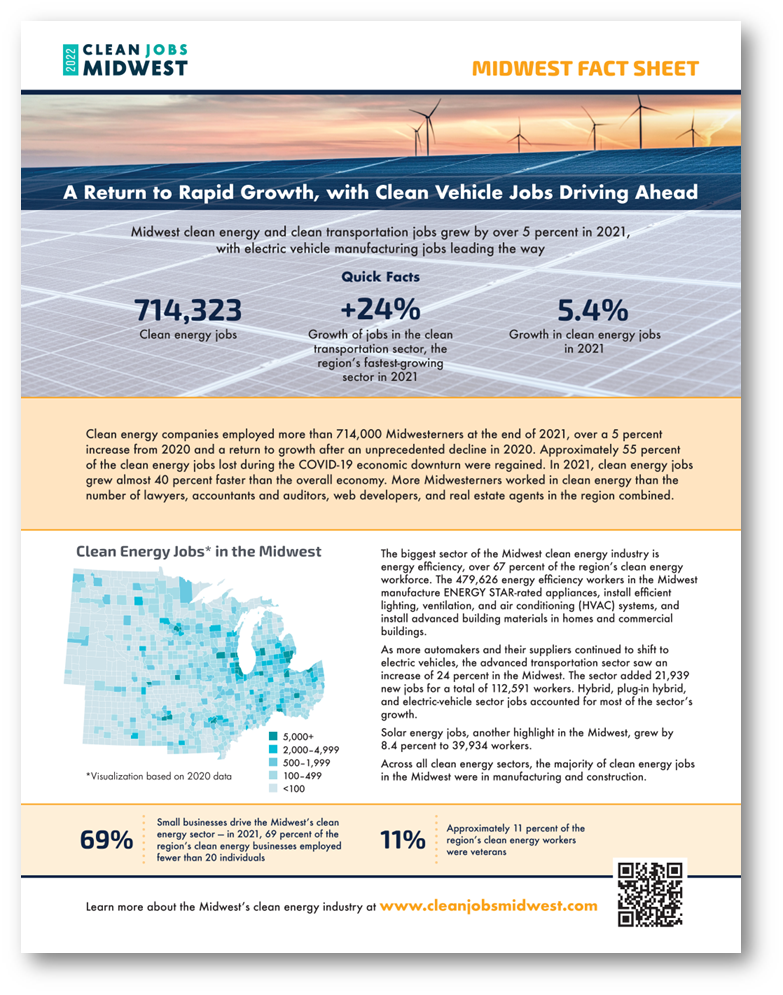
Clean Jobs Midwest 2022

Date: August 11, 2021

A Return to Rapid Growth, with Clean Vehicle Jobs Driving Ahead

Clean energy companies employed more than 714,000 Midwesterners at the end of 2021, over a 5 percent increase from 2020 and a return to growth after an unprecedented decline in 2020. Approximately 55 percent of the clean energy jobs lost during the COVID-19 economic downturn were regained. In 2021, clean energy jobs grew almost 40 percent faster than the overall economy. More Midwesterners worked in clean energy than the number of lawyers, accountants and auditors, web developers, and real estate agents in the region combined.

The biggest sector of the Midwest clean energy industry is energy efficiency, over 67 percent of the region’s clean energy workforce. The 479,626 energy efficiency workers in the Midwest manufacture ENERGY STAR-rated appliances, install efficient lighting, ventilation, and air conditioning (HVAC) systems, and install advanced building materials in homes and commercial buildings.

As more automakers and their suppliers continued to shift to electric vehicles, the advanced transportation sector saw an increase of 24 percent in the Midwest.

The sector added 21,939 new jobs for a total of 112,591 workers. Hybrid, plug-in hybrid, and electric-vehicle sector jo

MIDWEST HIGHLIGHTS

  • Energy Efficiency – 479,626 jobs
  • Clean Vehicles – 112,591 jobs
  • Renewable Energy – 88,898 jobs
  • Grid & Storage – 25,279 jobs
  • Clean Fuels – 7,928 jobs
  • ALL Clean Energy Sectors – 714,323 jobs

OTHER KEY FINDINGS

  • Clean energy occupations accounted for 23% of all construction jobs and 4% of all
    manufacturing jobs in the Midwest.
  • Small businesses drive Midwest’s clean energy sector – in 2021, 69% of Midwest’s clean
    energy businesses employed fewer than 20 people.
  • 11% of Midwesterners employed in clean energy are veterans

DOWNLOAD

The complete report along with interactive breakdowns for all states is available at this link.

PREVIOUS CLEAN JOBS MIDWEST REPORTS

View Report »

Clean-energy jobs split nearly equally between Republican, Democratic districts — this shows where the most jobs are

The nation’s more than 3 million clean-energy jobs are nearly evenly split across Republican and Democratic congressional districts, new research out Monday shows. Nonprofit E2, which tracks clean-energy initiatives, particularly jobs in renewable energy, electric-vehicle manufacturing and electric-grid modernization, conducted the research with outside firm BW Research. Democratic-led districts make up 54.3%, while Republican-led districts account for […]

Final reconciliation bill likely to include energy efficiency funding, but some cuts possible: Rep. Welch

The efficiency sector provides more jobs than any other in the U.S. energy industry but employment has not returned to pre-pandemic levels, according to a report released Tuesday by nonpartisan business group E2 and clean energy nonprofit E4TheFuture… …The E2 and E4TheFuture employment report highlighted the sector’s importance and challenges. Pre-pandemic, the efficiency sector was […]

Greens crank up the pressure on Democrats to deliver

And more than 1,000 business leaders signed onto one of three letters backing both the budget and infrastructure bills, in campaigns organized by the American Sustainable Business Council, Environmental Entrepreneurs and Clean Energy for America.

House Pay-Fors “Fiscally Responsible”, Essential For a Resilient US Economy

 WASHINGTON –  The House Ways and Means Committee unveiled its list of revenue priorities and tax reforms (or “pay-fors”) it will rely on to fund the $3.5 trillion reconciliation bill. Statement from Sandra Purohit, director of federal advocacy for the national, nonpartisan business group E2 (Environmental Entrepreneurs): “The cost of going small is too high. […]

Sign Up for Email Updates


"*" indicates required fields

This field is for validation purposes and should be left unchanged.

Our Latest Press Releases


Releases

Six Emerging Environmental Entrepreneurs Selected for National Fellowship

The E2 & 1 Hotels the fellowship program is designed to help early career environmentally-minded entrepreneurs and community leaders to create and implement unique projects at the intersection of the economy and environment. This year’s projects span a wide...


Releases

E2: Repealing EPA’s Endangerment Finding For Vehicle Emissions Raises Costs for Businesses and Consumers

The EPA officially revoked the endangerment finding for greenhouse gas (GHG) emissions and eliminated clean vehicle standards in a blow to both our economy and our environment.


Releases

E2: Companies Cancelled $34.8B, 38K Jobs for Clean Energy Projects in 2025, Outpacing New Investments 3-to-1

Businesses abandoned $5.1 billion in large-scale factories and clean energy projects in December, capping a turbulent year for the sector that saw nearly $35 billion in investments disappear along with more than 38,000 current and future jobs, according to ...


Donate Today