Illinois House Passes Historic Climate Bill To Boost Economy

Illinois set to remain regional leader in clean energy job growth through bold renewable energy policies, funding for workforce training and equity SPRINGFIELD, IL  – Last night the Illinois House passed energy legislation that makes Illinois the first state in the Midwest to commit to 100% carbon-free power by 2045. This critical step for Illinois’ […]

Illinois Senate Passes “Critical Boost” for State’s Economy, Clean Energy Future

Bill takes steps for Illinois to remain regional leader in clean energy job growth through bold renewable energy policies, funding for workforce training and equity but falls short on climate action  SPRINGFIELD — Last night the Illinois Senate passed comprehensive energy legislation that would make Illinois the first state in the Midwest to commit to 100 percent carbon-free power by 2045. However, the bill lacks a […]

E2 Supports Oregon’s HB 2021: 100% Clean Electricity

As the Oregon Legislature considers House Bill 2021,  which will ensure 100% clean electricity through ambitious but achievable targets for reducing and eventually eliminating greenhouse gas emissions, 45 Oregon private sector executives, investors, entrepreneurs, and other business professionals signed onto this E2 letter in support of the proposal.

Nearly 400 Business Leaders to Biden: Cut Emissions 50% by 2030

Letter signed by 388 business executives, entrepreneurs, and investors says bold target would send right signal to drive growth As the Biden administration prepares for its April 22 international Leaders Summit on Climate,  nearly 400 business leaders from across the U.S. on Monday called on President Joe Biden and his administration to commit to a […]

Biden American Jobs Plan: What U.S. Economy, Environment Needs

E2: Administration takes a “whole of economy” approach to climate action WASHINGTON (March 31, 2021) – President Biden will outline his plan for rebuilding America’s infrastructure in a speech later today in Pittsburgh. Biden’s American Jobs Plan will focus on how smart investments in priorities such as ensuring safe drinking water, modernizing the energy grid, […]

Achieving California’s Clean Energy Targets: Where The Rubber Meets The Road

WHAT Profound change is afoot in the quest to meet California’s ambitious decarbonization targets and our state’s electric grid is a critical lynchpin; delivering zero-carbon electricity to California citizens and businesses is critical as we work to power our industries, buildings, and transportation sector with clean electricity.  Realizing 100% clean energy and statewide carbon neutrality […]

Fight alongside the administration for a clean economy

Immediate and bold climate action is an economic imperative. We are falling behind China, which has outspent the U.S. in clean energy investments by hundreds of billions of dollars over the last decade. In doing so it has claimed the mantle of global leader in production, export, and installation of solar panels, wind turbines, batteries, […]

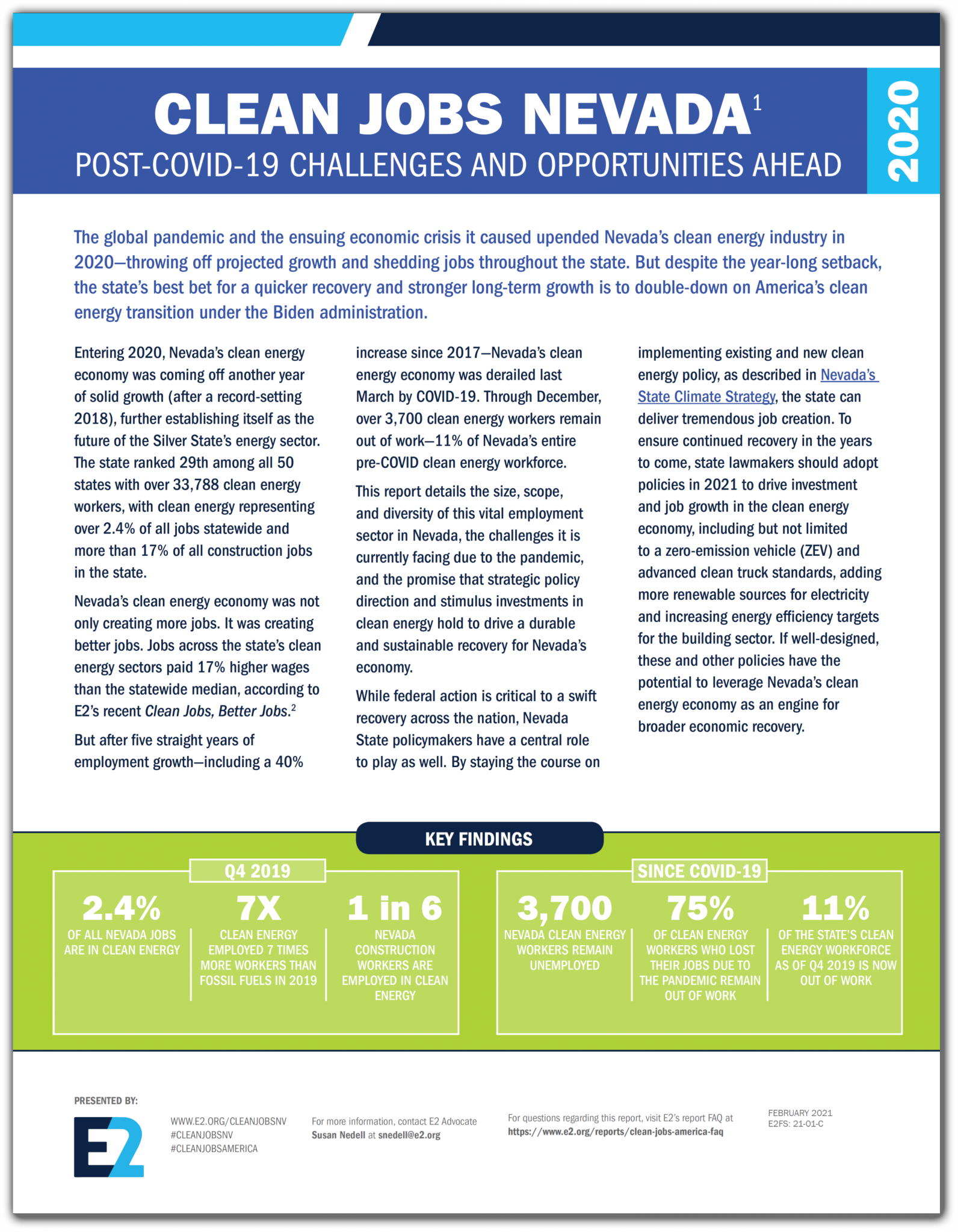
Clean Jobs Nevada 2020

Date: March 2, 2021

Nevada’s Post-COVID Challenges & Opportunities Ahead

Summary:

Driven by the impact of the COVID-19 pandemic and resulting economic crisis, Colorado experienced its first decline in clean energy jobs in 2020 since E2 began tracking the industry with this methodology in 2017. Colorado’s clean energy economy employed more than 58,000 workers at the end of 2020, down from 62,400 the year before, according to an analysis of Bureau of Labor Statistics data and the findings of a national survey of more than 35,000 businesses across the U.S. economy.

By May of last year, more than 7,500 clean energy workers in Colorado had lost their jobs since the COVID-19 pandemic began spreading widely, according to monthly analysis of unemployment data by E2 and partners.2 Since the sector’s losses peaked at the end of May 2020, jobs grew back by 6 percent. In fact, by the end of 2020 more than about 40 percent of the clean energy jobs lost between March and May had been regained, leaving the sector down about 7 percent (about 4,200 jobs) since COVID-19.

Thanks to smart state climate policy leadership, Colorado’s clean energy economy has proven to be a core part of the state’s economy—representing more than 2 percent of overall state employment. It has been resilient and robust in the face of crushing economy-wide pressures.

A  Bigger Picture

This report focuses solely on the energy sector of the economy and does not include jobs in retail trade, repair services, water or waste management, and indirect employment or induced employment.

This field is for validation purposes and should be left unchanged.

Findings

  • Small businesses are the backbone of Nevada’s clean energy economy. Nearly three out of every five (58%) clean energy workers were employed at companies with fewer than 20 employees;
  • 17% of construction jobs in Nevada were in clean energy occupations, from solar installers and site workers to electricians, HVAC technicians, lighting technicians, carpenters and others who work in energy efficiency;
  • Nevada ranked tenth in the country for clean energy unionization, with 9% of clean energy workers part of a union – behind only Washington, California, and Oregon in the West and well above the nation’s economywide average;
  • More than four in ten Nevada clean energy workers were of non-white or Hispanic ethnicity in 2019;
  • Clean energy accounts for 55% of all energy sector jobs in Nevada, and seven times more jobs than fossil fuels in the state;
  • Rural areas in Nevada are home to more than 1,300 of the state’s clean energy jobs.

Nevada Clean Energy Employment Q4 2019

Energy Efficiency 11,988 jobs
Renewable Energy 11,265
Solar Energy 10,101
Energy Storage 8,634
Clean Vehicles 1,299
Grid Modernization 465
Clean Fuels 138
Wind Energy 124
All Clean Energy Sectors 33,788 jobs

Looking for More Info?

This report follows E2’s Clean Jobs America analysis which found the clean energy jobs account for nearly 3.3 million jobs across all 50 states and the District of Columbia. Both reports expand on data from the U.S. Energy and Employment Report (USEER) produced by the Energy Futures Initiative (EFI) in partnership with the National Association of State Energy Officials (NASEO), using data collected and analyzed by the BW Research Partnership. E2 is a partner on the USEER, the fifth installment of the energy survey first released by the Department of Energy in 2016.

If you are looking for additional insight into E2’s Clean Jobs Nevada 2019 or our other Clean Jobs America reports, visit e2.org/reports. You can also contact E2 Communications Director Michael Timberlake ([email protected]). An FAQ is also available here to answer any questions.

Previous Reports

View Report »

Clean Jobs Oregon 2020

Date: February 18, 2021

The Promise of a Bright Future and Strong Economy

Summary:

Nurtured by smart clean energy policy over the past decade, including the Renewable Portfolio Standard, Clean Fuels Program and Coal to Clean, Oregon’s clean energy economy has fueled private sector job growth throughout the state. Heading into 2020, Oregon’s clean energy economy had firmly established itself as the powerhouse of the state’s energy sector and was only gaining steam. At the beginning of 2020, nearly 57,000 Oregonians worked in clean energy, representing 58% of all energy sector jobs and almost 3% of the statewide workforce. In fact, the clean energy economy was outpacing Oregon’s economy-wide job growth by over 60% and contributing to the local economy in every county and every state senate district. Companies surveyed across Oregon anticipated even more robust growth, projecting to add about 2,800 clean energy jobs in 2020. All that changed with the COVID-19 global pandemic and the economic recession it precipitated. Oregon’s clean energy economy has been hammered since the pandemic’s arrival in March, with over 6,000 of Oregon’s clean energy workers—10% of the state’s clean energy workforce pre-COVID—out of work at the beginning of 2021.

Clean Jobs Oregon details the size, scope, and diversity of this core sector of Oregon’s economy, the challenges it continues to face due to the pandemic, and the promise that strategic policy action and targeted stimulus investments in clean energy hold to drive a strong and durable recovery for Oregon’s economy. Complementing this report is E2’s recent Clean Jobs, Better Jobs report that shows wages and benefits in clean energy compare favorably to other industries; in fact, Oregon’s clean energy economy pays nearly 21% more than the state’s economy-wide median wage. Taken together, these reports demonstrate that—by leveraging clean energy’s job creation potential—Oregon policymakers can help stimulate an economic recovery, make progress towards achieving Oregon’s climate goals and create jobs that come with pay and benefits that are better than many of the jobs that have been lost

Federal policies from the Biden administration and Congress are crucial for economic recovery across the nation and in Oregon. However, Oregon policymakers have a critical role to play in facilitating recovery in the state’s clean energy sector to recuperate its recent job losses and position it for continued growth in the years to come. To help realize clean energy’s job creation potential in Oregon, state lawmakers should stay the course and ensure strong implementation of existing clean energy policies and regulations, including Gov. Kate Brown’s March 2020 Executive Order on Climate Action (EO 20-04). And by adopting additional policies in 2021 that will drive investment and job growth in the clean energy economy—such as a 100% clean electricity bill and a zero-emission truck standard called the Advanced Clean Trucks Rule—state officials can leverage Oregon’s clean energy economy as an engine for growth, both now and into the future.

A BIGGER PICTURE

This report focuses solely on the energy sector of the economy and does not include jobs in retail trade, repair services, water or waste management, and indirect employment or induced employment.

This field is for validation purposes and should be left unchanged.

Findings

  • Small businesses are the backbone of Oregon’s clean energy economy. More than eight in ten (83%) clean energy workers were employed at companies with fewer than 20 employees;
  • 3 in 10 construction jobs in Oregon are in clean energy occupations, from solar installers and site workers to electricians, HVAC technicians, lighting technicians, carpenters and others who work in energy efficiency;
  • Oregon ranked ninth in the country for clean energy unionization, with 9% of clean energy workers part of a union – behind only Washington and California in the West and well above the nation’s economywide average;
  • Nearly four in ten Oregon clean energy workers were of non-white or Hispanic ethnicity in 2019;
  • Clean energy accounts for 55% of all energy sector jobs in Oregon, 35 times more than fossil fuels;
  • Rural areas in Oregon are home to more than 10,000 of the state’s clean energy jobs.

Oregon Clean Energy Employment Q4 2019

Energy Efficiency 42,935 jobs
Renewable Energy 7,540 jobs
Solar Energy 5,759 jobs
Clean Vehicles 2,493 jobs
Grid Modernization 1,524 jobs
Wind Energy 1,407 jobs
Energy Storage 1,348 jobs
Clean Fuels 776 jobs
All Clean Energy Sectors 56,617 jobs

Looking for More Info?

This report follows E2’s Clean Jobs America analysis which found the clean energy jobs account for nearly 3.3 million jobs across all 50 states and the District of Columbia. Both reports expand on data from the U.S. Energy and Employment Report (USEER) produced by the Energy Futures Initiative (EFI) in partnership with the National Association of State Energy Officials (NASEO), using data collected and analyzed by the BW Research Partnership. E2 is a partner on the USEER, the fifth installment of the energy survey first released by the Department of Energy in 2016.

If you are looking for additional insight into E2’s Clean Jobs Oregon 2019 or our other Clean Jobs America reports, visit e2.org/reports. You can also contact E2 Communications Director Michael Timberlake ([email protected]). An FAQ is also available here to answer any questions.

View Report »

Clean Jobs Washington 2020

Date: November 24, 2020

Primed to Lead Washington’s Economic Recovery

At the onset of 2020, Washington’s clean energy economy was coming off another year of solid growth, further establishing itself as the backbone—and future—of the Evergreen State’s energy sector. With more than 85,000 clean energy workers, the state ranked 13th for clean energy employment. Illustrating the important role this sector plays in Washington’s economy, the clean energy industry accounts for more than 25% of all construction jobs in the state. Importantly, these jobs’ wages and benefits compare favorably to other industries; E2’s recent Clean Jobs, Better Jobs report shows that the median wage for Washington’s clean energy economy pays nearly 11% more than the state’s overall median wage.

But following five straight years of job growth, Washington’s clean energy economy has been derailed by the economic recession driven by COVID-19. state policymakers have a central role to play as well. Tremendous job creation can be delivered by staying the course on implementation of existing clean energy policy, prime among them Washington’s Clean Energy Transformation Act. To ensure continued recovery and economic development in the years to come, state lawmakers should adopt additional policies in 2021 to drive investment and job growth in the clean energy economy. These policy opportunities—including a clean fuels program, clean truck standards, a state-wide limit on carbon pollution, and carbon pricing—can drive strong investments in climate solutions across the state. If well-designed, these and other policies have the potential to leverage Washington’s clean energy economy as an engine for broader economic recovery. Through October, more than 17,000 clean energy workers—almost one-fifth of Washington’s clean energy workforce pre-COVID—remain out of work.

Clean Jobs Washington 2020 comes at a critical juncture in the state’s efforts to recover from the COVID-19 health and economic crises. With the Washington state Legislature set to reconvene in January, policymakers will have the opportunity to leverage clean energy as an engine for broader economy recovery by enacting policies to get clean energy back on its growth trajectory. Policies such as a clean fuels program, clean truck standards, a state-wide limit on carbon pollution, and carbon pricing can drive investments in climate solutions and bring robust economic growth across the state.

This report details the size, scope, and diversity of this core Washington state employment sector, the troubles it is currently facing due to the pandemic, and the promise that strategic policy direction and stimulus investments in clean energy hold to drive a durable and sustainable recovery for Washington’s economy. In addition to detailing sector-by-sector employment, Clean Jobs Washington 2020 also breaks down jobs at the city, county, legislative and congressional district levels. See more details here.

A BIGGER PICTURE

This report focuses solely on the energy sector of the economy and does not include jobs in retail trade, repair services, water or waste management, and indirect employment or induced employment.

WASHINGTON CLEAN JOB EMPLOYMENT Q4 2019

  • Energy Efficiency – 64,930 jobs
  • Renewable Energy – 11,189  jobs
  • Solar Energy – 5,081 jobs
  • Clean Vehicles – 3,351 jobs
  • Wind Energy – 3,310 jobs
  • Energy Storage – 2,451 jobs
  • Clean Fuels – 1,936 jobs
  • Grid Modernization – 1,176 jobs
  • ALL Clean Energy Sectors – 85,035 jobs

OTHER FINDINGS

  • Small businesses are the backbone of Washington’s clean energy economy. More than two out of every three (69%) clean energy workers were employed at companies with fewer than 20 workers;
  • 1 in 4 construction jobs in Washington are in clean energy occupations, from solar installers and site workers to electricians, HVAC technicians, lighting technicians, carpenters and others who work in energy efficiency;
  • Washington ranked in the top 15 for jobs in 12 sectors and subsectors in 2019 – helping the state diversify jobs growth across the clean energy economy;
  • Clean energy accounts for 55% of all energy sector jobs in Washington and made up 74% of the sector’s total job growth in 2019;

DOWNLOAD

The complete report is available for download at this link.

Previous Reports

Looking For More Info?
This report follows E2’s Clean Jobs America analysis which found the clean energy jobs account for nearly 3.3 million jobs across all 50 states and the District of Columbia. Both reports expand on data from the U.S. Energy and Employment Report (USEER) produced by the Energy Futures Initiative (EFI) in partnership with the National Association of State Energy Officials (NASEO), using data collected and analyzed by the BW Research Partnership. E2 is a partner on the USEER, the fifth installment of the energy survey first released by the Department of Energy in 2016.

If you are looking for additional insight into E2’s Clean Jobs Washington 2019 or our other Clean Jobs America reports, visit e2.org/reports. You can also contact E2 Communications Director Michael Timberlake ([email protected]). An FAQ is also available here to answer any questions.

View Report »

Colorado’s Climate Strategy Webinar Series: A Primer for Business Leaders

The passage of Colorado’s Climate Action Plan in 2019 (HB19-1261) set goals to reduce greenhouse gas emissions (GHG) by at least 26% by 2025, 50% by 2030, and 90% by 2050, based on the statewide GHG emissions in 2005. Please join fellow business leaders to learn how the process to set Colorado on a path […]

Sign Up for Email Updates


"*" indicates required fields

This field is for validation purposes and should be left unchanged.

Our Latest Press Releases


Releases

E2: Trump Administration’s Latest Attempt to Kill Offshore Wind Hurts Consumers, Businesses

The Trump administration is trying to halt offshore wind projects that are well-underway just two weeks after their initial attempt was deemed arbitrary and capricious by a federal judge.


Releases

REPORT: New Mexico clean energy sector grew faster than overall state economy, adding 600 jobs in 2024

Clean energy jobs grew fifteen times faster in New Mexico than the rest of the state's economy in 2024 (4.6 percent compared to 0.3 percent), adding 613 new jobs to the workforce.


Releases

Companies Announce $550 Million for Clean Energy Manufacturing Projects in November, Cancel $575 Million as Losses Continue to Outpace New Investment

Businesses cancelled the fewest investments in large-scale factories and clean energy projects in over a year last month but losses continued to outpace new project announcements, according to E2’s latest monthly analysis of clean energy projects tracked by...


Donate Today