
Clean Energy & COVID-19 Crisis | July 2020 Unemployment Analysis

Date: August 12, 2020

Clean Energy Unemployment Claims in COVID-19 Aftermath, July 2020


<< The July unemployment analysis was revised up to 10,400 on September 11, 2020 and is available here >>

The U.S. clean energy sector added just 3,200 jobs in July, signaling the sector’s surge of workers returning in June was short-lived, according to the latest analysis of unemployment data by BW Research for E2, E4TheFuture, and the American Council on Renewable Energy (ACORE).

The 0.1% increase in jobs still leaves over half a million (511,075) clean energy workers out of work despite nationwide re-openings – about 15 percent of the sector’s workforce before the COVID-19 outbreak. While July represents the second straight month of job growth for the industry after three months of devastating job losses, fewer than 10 states saw 100-plus clean energy employees return to work and at the current pace it would take nearly 15 years for the U.S. clean energy sector to reach pre-COVID-19 employment levels.

The new analysis also does little to alleviate long-term concerns for the industry. In addition to continued high unemployment, casual or paused re-openings, and the exhaustion of many programs from earlier stimulus, long-term and permanent unemployment has risen sharply to more than 4.4 million as initial weekly unemployment claims continue at historic pace.

Only one out of every six clean energy jobs lost since March returned in June and July, and as federal Paycheck Protection Program (PPP) funds are exhausted and states are forced to close businesses again in the face of COVID-19’s resurgence, more layoffs could be imminent without congressional action.

Before March, clean energy had been one of the U.S. economy’s biggest and fastest-growing employment sectors, growing 10.4% since 2015 to 3.4 million jobs at the end of 2019. That made clean energy by far the biggest employer of workers in all energy occupations, employing nearly three times as many people as the fossil fuel industry.

By Industry Job Losses, July 2020

SECTOR MARCH APRIL MAY  JUNE JULY TOTAL
Energy Efficiency -103,298 -309,584 -18,880 71,786 2,105 -357,871
Renewables -23,739 -71,705 -4,272 17,287 591 81,840
Clean Vehicles -11,399 -35,070 -2,059 10,335 276 -37,917
Grid & Storage -6,517 -19,666 -1,166 4,561 132 -22,656
Clean Fuels -2,186 -10,390 -657 2,351 91 -10,791
INDUSTRY TOTAL -147,139 -446,416 -27,035 106,320 3,195 -511,075

States With Most Job Losses, July 2020

STATE TOTAL CLAIMS Percent of  Pre-COVID19  Workforce Unemployed
California 89,158 16.60%
Georgia 27,316 32.60%
Florida 26,521 16.00%
Texas 24,659 10.20%
Michigan 24,525 19.60%
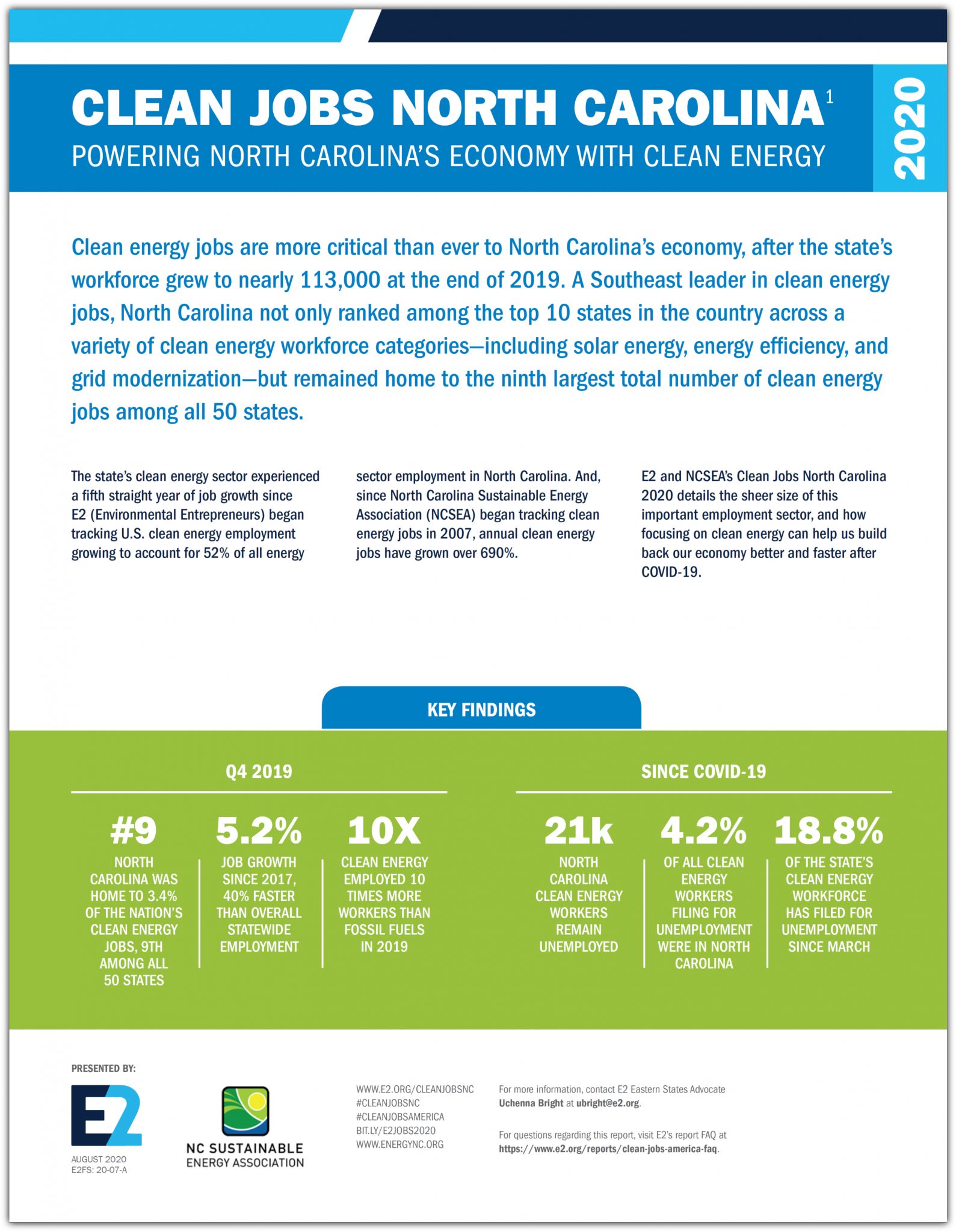
North Carolina 21,214 18.80%
Pennsylvania 18,866 20.10%
Washington 18,444 21.70%
New York 17,239 10.80%

Download

For a full breakdown of clean energy jobs losses in each state, download the full analysis here

Looking for More Info?

The analysis expands on data from the 2020 U.S. Energy and Employment Report (USEER) produced by the Energy Futures Initiative (EFI) in partnership with the National Association of State Energy Officials (NASEO), using data collected and analyzed by the BW Research Partnership. The report was released in March 2020 and is available at www.usenergyjobs.org. E2 is a partner on the USEER, the fifth installment of the energy survey first released by the Department of Energy in 2016 and subsequently abandoned under the Trump administration.

If you are looking for additional insight into this report or E2’s more than a dozen other annual clean energy employment reports, visit e2.org/reports. You can also contact E2 Communications Director Michael Timberlake ([email protected]).

Sign-Up for Email Updates

"*" indicates required fields

This field is for validation purposes and should be left unchanged.

View Report »

Recovery Stalls as Few Clean Energy Employees Return to Work in July

Stagnant growth despite nationwide reopenings raises long-term concerns 511,100 clean energy workers remain jobless as COVID-19 crisis continues Without strong policy action, recovering lost jobs could take many years WASHINGTON (August 12, 2020) – Despite nationwide reopenings, job recovery in the U.S. clean energy sector slowed to a trickle in July. Only 3,200 clean energy […]

E2 1 Hotels Fellowship: 2020 Fellow Showcase

The E2 1Hotels Fellowship supports emerging business leaders develop and implement projects that amplify the business and economic case for smart policies to address pressing environmental issues. This is the second webinar showcasing our 2020 fellows who are working on a diverse set of issues ranging from clean water, energy and agriculture. Please join us […]

Colorado’s Climate Strategy Webinar Series: A Primer for Business Leaders

The passage of Colorado’s Climate Action Plan in 2019 (HB19-1261) set goals to reduce greenhouse gas emissions (GHG) by at least 26% by 2025, 50% by 2030, and 90% by 2050, based on the statewide GHG emissions in 2005. Please join fellow business leaders to learn how the process to set Colorado on a path […]

Colorado’s Climate Strategy Webinar Series: A Deep Dive for Business Leaders

The passage of Colorado’s Climate Action Plan in 2019 (HB19-1261) set goals to reduce greenhouse gas emissions (GHG) by at least 26% by 2025, 50% by 2030, and 90% by 2050, based on the statewide GHG emissions in 2005. Please join fellow business leaders to learn how the process to set Colorado on a path […]

North Carolina Clean Economy Summit

Please join Gov. Roy Cooper, E2’s new Southeast Chapter, fellow business leaders and our partners for a first-of-its-kind virtual NC Clean Economy Summit to discuss how together we can build back a better, cleaner, more equitable and more resilient economy. You’ll be among the first to learn about Clean Jobs North Carolina 2020 – the latest, most comprehensive […]
Opinion: Climate Goals Are Key to Economic Recovery

The economic pain and public health impact of COVID-19 is deep and will not disappear overnight. But fortunately, Gov. Brown’s executive order provides the vision and framework to ensure deployment of the clean technologies and solutions that will help Oregon build its economy back stronger, faster and more equitably. Our business members are excited to […]

Republicans Seek to Help Clean Energy in Next Virus Aid Package

Prior to the pandemic, the U.S. clean energy sector was one of the bright spots for the U.S. economy, with a total workforce of 3.4 million employees in 2019, and the sector grew twice as fast as the overall U.S. economy since 2017. The sector rebounded slightly in June, but more than half a million […]

Iowa’s clean energy workers can help speed up our economic recovery

Posted on July 20, 2020 by Troy Van Beek

Since founding a renewable energy business in rural Jefferson County nearly a decade ago, I’ve been fortunate to work alongside people whose grit, vision and ingenuity has helped our company grow and prosper. Although we started with just two workers, at the time of the coronavirus outbreak we employed about 40 women and men. All […]

Sign Up for Email Updates


"*" indicates required fields

This field is for validation purposes and should be left unchanged.

Our Latest Press Releases


Releases

E2: Repealing EPA’s Endangerment Finding For Vehicle Emissions Raises Costs for Businesses and Consumers

The EPA officially revoked the endangerment finding for greenhouse gas (GHG) emissions and eliminated clean vehicle standards in a blow to both our economy and our environment.


Releases

E2: Companies Cancelled $34.8B, 38K Jobs for Clean Energy Projects in 2025, Outpacing New Investments 3-to-1

Businesses abandoned $5.1 billion in large-scale factories and clean energy projects in December, capping a turbulent year for the sector that saw nearly $35 billion in investments disappear along with more than 38,000 current and future jobs, according to ...


Releases

E2: Trump Administration’s Latest Attempt to Kill Offshore Wind Hurts Consumers, Businesses

The Trump administration is trying to halt offshore wind projects that are well-underway just two weeks after their initial attempt was deemed arbitrary and capricious by a federal judge.


Donate Today