Over 50,000 Missourians now work in clean energy jobs. That growing figure currently ranks the state a middling 22nd in number of clean energy jobs and 25th as a percentage of total employment. But renewable energy advocates in the state are particularly encouraged by Missouri’s recent surge in wind power production and new legislation that is expected to speed the […]
By E2 Interns: Kai Diep and Andrea Guerra California regulators have a critical opportunity to drive economic growth in the state’s blossoming zero-emission vehicle (ZEV) industry and help achieve state climate targets by advancing a strong Advanced Clean Fleets (ACF) rule with a 100% electric truck sales requirement by 2035. This ambitious yet achievable goal […]
Missouri’s clean energy job market faced a considerable decline during 2020’s economic downturn but still managed to bounce back by the end of the year, according to a recent study. More than 9,300 clean energy workers filed for unemployment in Missouri at the peak of the economic crisis tied to the COVID-19 pandemic, according to the 2020 Clean Jobs Midwest report from […]
The COVID-19 pandemic hit the Midwest clean energy job market hard, with more than 17,000 workers at one point filing for unemployment. But the industry appears to be rebounding, according to an analysis of employment data released by the nonpartisan business group E2 (Environmental Entrepreneurs) and Clean Energy Trust. Clean energy companies employed 113,456 Michiganders at the […]
According to the nonpartisan business group E2, or Environmental Entrepreneurs, more than 115,000 Illinoisans worked in the clean energy sector at the end of last year, with workers in all of the state’s 102 counties. The final 2020 job numbers show an 8.2% drop in Illinois’ clean energy workforce from 2019, representing more than 10,000 […]
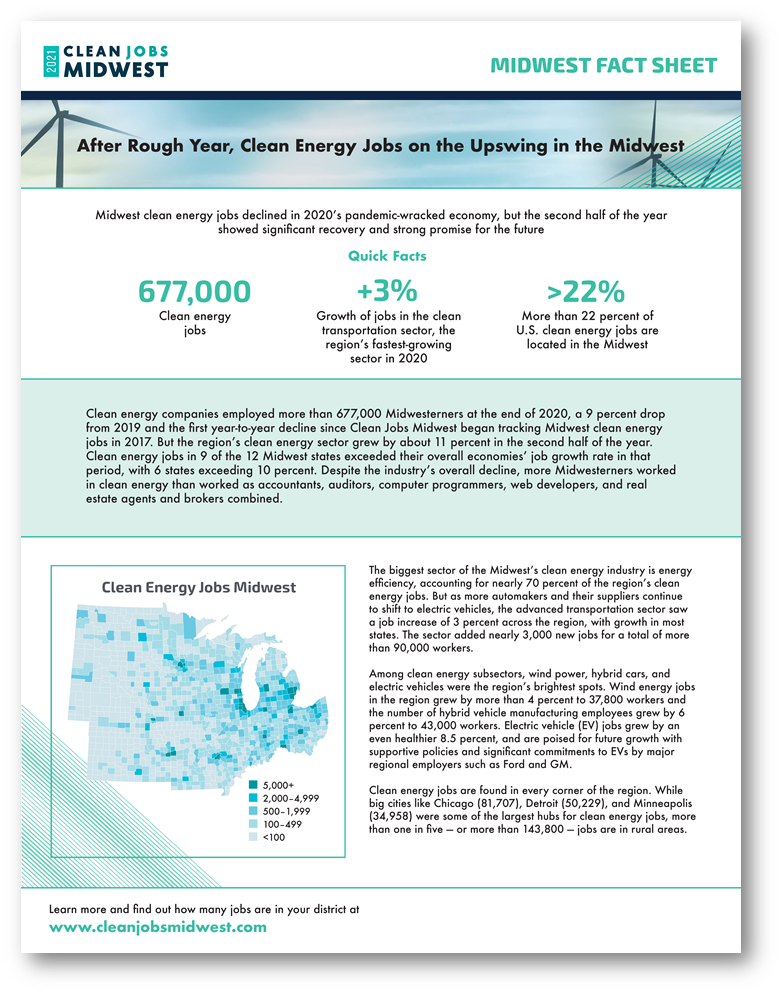
After Rough Year, Clean Energy Jobs on the Upswing in the Midwest
More than 677,900 Midwesterners worked in clean energy and clean vehicles at the end of 2020, making the sector a major – and promising – part of the region’s economy, according to this comprehensive analysis of employment data.
Like most of the economy, clean energy was hit hard by the COVID-19 pandemic and economic downturn in 2020. According to this year’s Clean Jobs Midwest, 2020 was the first year-to-year decline since E2 and Clean Energy Trust began tracking Midwest clean energy jobs. At one point, more than 131,600 Midwest clean energy workers had filed for unemployment, but the sector surged back 10.7 percent in the second half of the year to recover more than half of the jobs initially lost. The final 2020 job numbers represent an 8.9 percent drop in the Midwest clean energy workforce from 2019, or 66,100 jobs. Last year’s job losses were a dramatic change of pace for the industry. Last year’s job losses were a dramatic change of pace for the industry. In the 3 years leading up to 2020, for example, clean energy jobs grew almost 4 times as fast as overall employment.
MIDWEST HIGHLIGHTS
Energy Efficiency – 470,651 jobs
Clean Vehicles – 90,652 jobs
Renewable Energy – 84,881 jobs
Grid & Storage – 24,209 jobs
Clean Fuels – 7,525 jobs
ALL Clean Energy Sectors – 677,918 jobs
OTHER KEY FINDINGS
The biggest sector of the Midwest’s clean energy industry is energy efficiency, accounting for nearly 70 percent of the region’s clean energy jobs. But as more automakers and their suppliers continue to shift to electric vehicles, the advanced transportation sector saw a job increase of 3 percent across the region, with growth in most states. The sector added nearly 3,000 new jobs for a total of more than 90,000 workers.
Among clean energy subsectors, wind power, hybrid cars, and electric vehicles were the region’s brightest spots. Wind energy jobs in the region grew by more than 4 percent to 37,800 workers and the number of hybrid vehicle manufacturing employees grew by 6 percent to 43,000 workers. Electric vehicle (EV) jobs grew by an even healthier 8.5 percent, and are poised for future growth with supportive policies and significant commitments to EVs by major regional employers such as Ford and GM.
Clean energy jobs are found in every corner of the region. While big cities like Chicago (81,707), Detroit (50,229), and Minneapolis (34,958) were some of the largest hubs for clean energy jobs, more than one in five — or more than 143,800 — jobs are in rural areas.
DOWNLOAD
The complete report along with interactive breakdowns for all states is available at this link.
The pandemic year of 2020 saw a sharp decline in clean energy jobs across the Midwest, the first year-to-year drop since the 2017 inception of annual clean energy jobs reports by the Clean Energy Trust and Environmental Entrepreneurs (E2). At one point in 2020, more than 131,600 Midwest clean energy workers had filed for unemployment, […]
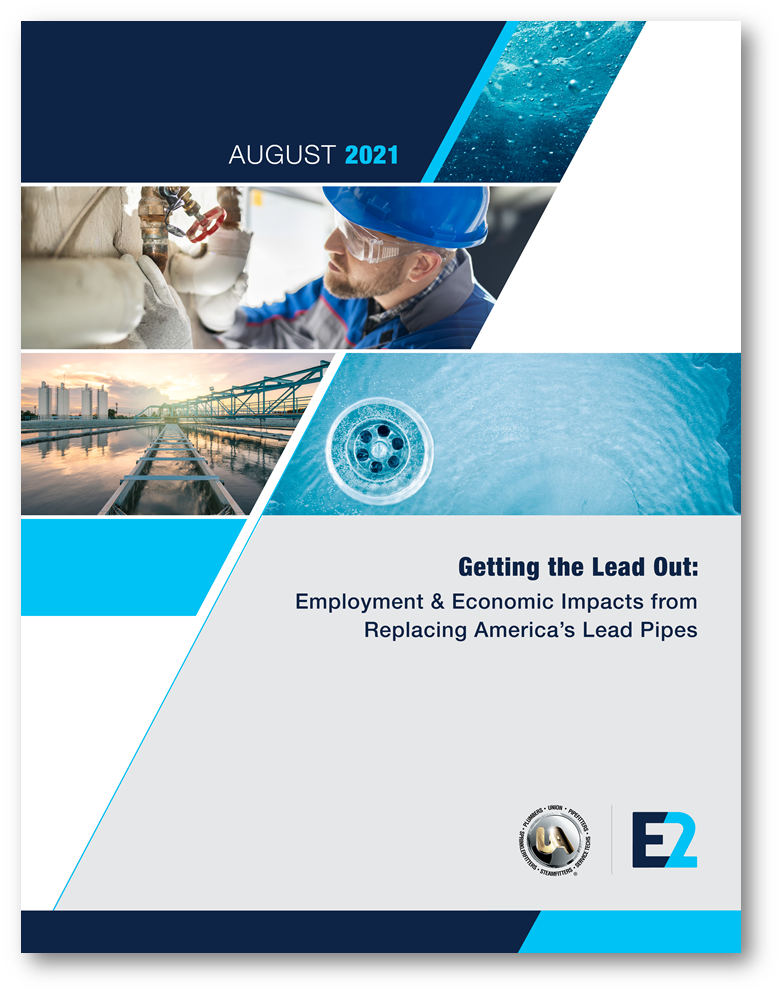
WASHINGTON, DC – Replacing all of America’s lead service lines would create 56,000 jobs that will last at least 10 years (560,000 job-years) and inject about $104 billion into the nation’s economy, a new study from E2 (Environmental Entrepreneurs) and the United Association of Union Plumbers & Pipefitters (UA) shows. Based on the Biden administration’s […]
Based on the Biden administration’s plans to invest $45 billion to replace 100 percent of lead service lines in America, the findings from Getting the Lead Out: Employment & Economic Impacts from Replacing America’s Lead Service Lines, this report from E2 and the United Association of Union Plumbers & Pipefitters (UA) estimates that the $45 billion invested in this program will create and support 56,080 jobs annually for 10 years, or a total of 560,800 job-years. This annual estimate includes 26,900 direct jobs—construction workers, plumbers, pipefitters, heavy equipment operators—as a direct result of this activity. Another 13,600 jobs that last for 10 years are created throughout the value chain, and 13,800 jobs are created each year for 10 years as a result of workers spending their paycheck.
About 84 percent of all jobs created through this investment are in construction (52 percent), professional and business services (24 percent), and manufacturing industries (8 percent). Insofar as the bulk of these jobs involve high-skill construction occupations, the jobs created will provide good wages and training opportunities for local residents and promote economic benefits to affected communities.
This investment into cleaning up our nation’s water supply also would generate $38.3 billion in labor income, $11.7 billion in taxes, and $53.9 billion in additional value to the economy. That would represent a 120 percent return on investment.
In addition to the jobs created and value added to the economy from this activity, additional benefits like increased positive health outcomes would be generated. It has been estimated that an additional $22,000 of societal benefits are generated for every lead pipe replaced as a result of lower cardiovascular disease. Since in many areas lead service lines are more likely to exist in environmental justice communities, and since Black and Latino children have disproportionately high overall lead exposure, replacing these lead pipes will also greatly benefit low-income and minority households.
The scope of this work is massive and reaches every state. The Natural Resources Defense Council (NRDC) estimates that between 9.7 million to more than 12 million lead service lines are distributing water throughout our nation. About 700,000 or more of these service lines are found in Illinois, while Ohio, Michigan, New York, New Jersey Missouri and Wisconsin each contain more than 300,000 of the nation’s lead service lines; the top ten states total about 4 million.
Findings
560,800 total job-years*
$104 billion: total economic activity generated
10 million lead service lines that need to be replaced
* 56,080 jobs annually over ten years
** Includes $38.3B in labor income, $11.7B in taxes and $53.9B in additional economic benefits
Methodology
BW Research used IMPLAN to conduct the economic impact analysis, resulting in the jobs, value-added, labor income, and taxes data. IMPLAN is an input-output modeling software that tracks spending patterns through the economy and their resulting impacts on economic indicators. The cumulative effects of the initial investment are quantified, and the results are categorized into direct, indirect, and induced effects. To capture interstate flows, direct and indirect impacts are results of national-level multipliers, distributed across states using state-level modeling. Induced impacts are the results of state-level multipliers, so as not to overestimate the impacts of household spending. Workforce data such as occupational demographics and wages are derived from JobsEQ by Chmura. JobsEQ is a workforce data software that derives data from Bureau of Labor Statistics and Census Bureau data, among other sources. Unionization rates are derived from unionstats.com.
Direct Impacts show the initial change in the economy associated with the investment. For example, pipefitters installing new service pipes or engineers planning the replacement.
Indirect Impacts include the supply chain responses as a result of the initial investment (i.e., water pipe manufacturers).
Induced Impacts refer to household spending and are the result of workers who are responsible for the direct and indirect effects spending their wages (i.e., direct and indirect workers spend income on clothes, food, healthcare, etc.).
Labor Income includes all forms of employment income, such as employee compensation (wages and benefits) and proprietor income (i.e. payments received by self-employed individuals and unincorporated business owners). Labor income is a component of value added.
Value Added is defined as the total value of production after netting out intermediate goods. This is another term for GDP.
About this Report
This economic impact analysis was conducted by BW Research Partnership for E2 in partnership with the United Association of Union Plumbers and Pipefitters. It uses the Biden Administration’s stated goal of 100 percent removal of lead service lines (LSLs) from America’s drinking water systems, the Natural Resources Defense Council’s (NRDC) national survey of LSLs, and the Environmental Protection Agency’s (EPA) estimated LSL replacement costs.
Special thanks to NRDC and BW Research. For a description of the methodology used in this report, please refer to the explanation on page in Appendix A.
Please review this E2 action alert letter and add your e-signature by using the fields below and clicking the ADD YOUR SIGNATURE button. Note that your are signing on as an individual and not as a representative of your employer.
In March, The Biden administration announced plans to remove 100 percent of America’s nearly 10 million lead service lines (LSLs) through the American Jobs Plan. A new report, from the national, nonpartisan business group E2 (Environmental Entrepreneurs) and the United Association of Union Plumbers and Pipefitters (UA), will detail the employment and economic gains if […]
The EPA officially revoked the endangerment finding for greenhouse gas (GHG) emissions and eliminated clean vehicle standards in a blow to both our economy and our environment.
Businesses abandoned $5.1 billion in large-scale factories and clean energy projects in December, capping a turbulent year for the sector that saw nearly $35 billion in investments disappear along with more than 38,000 current and future jobs, according to ...
The Trump administration is trying to halt offshore wind projects that are well-underway just two weeks after their initial attempt was deemed arbitrary and capricious by a federal judge.
December 22 2025
Donate Today
Make a donation to help E2 advance policies that are good for the economy and good for the environment. Your donation is 100% tax-deductible from our partner, the NRDC.
Please contact E2 Membership Director Ying Li at [email protected] or 212-727-4437 for stock and wire transfer instructions.
For stocks, alert us to the transfer and provide the name of the stock and the number of shares being donated. This will help us track your donation internally and enable NRDC to provide an accurate gift receipt in a timely fashion.
Donations to E2 go directly to NRDC, a 501(c)3, and are fully tax-deductible (Federal Tax ID: 13-2654926). E2 collects no funds. NRDC provides full-time staffing dedicated to E2, as well as administrative, communications, legislative and analyst/policy support for the work of E2.
By Check
Make personal, Foundation or Donor Advised Fund checks payable to NRDC (indicate your donation is for E2 Membership to expedite processing) and send to:
Natural Resources Defense Council
Attn: Gift Processing
40 West 20th Street, 11th floor
New York, NY 10011