Taxiing to the electric vehicle transition on the Western Slope

Ryan Kohlman cites data from E2’s “Clean Jobs Colorado” report in an article supporting Gov. Hickenlooper’s executive order ensuring Colorado adopts advanced vehicles standards. “According to the just-released “Clean Jobs Colorado” report from the Rocky Mountain chapter of the national, nonpartisan business group E2 (Environmental Entrepreneurs) and Golden-based Energy Efficiency Business Coalition, more than 57,500 […]

Senate Passes Farm Bill with Incentives for Farmers to Build Soil Health, Sequester Carbon

Louisa Burwood-Taylor cites E2 co-founder and chair, Nicole Lederer, in an article discussing the Senate Agriculture Committee’s passing of its version of the 2018 Farm Bill – one that included provisions aimed at promoting soil health. “This initiative — and to successfully include soil health and carbon provisions in the Senate farm bill — was a […]

Macroeconomic Analysis of Clean Vehicle Scenarios for Colorado

Date: June 12, 2018

REPORT

As the Environmental Protection Agency (EPA) moves to weaken federal greenhouse gas (GHG) regulations for light-duty vehicles, Colorado is moving to counter the negative affects to our air quality, reduced consumer fuel savings and the stifling of our budding auto electrification industry, by adopting Advanced Clean Car Standards. When complete, Colorado will join the 12 states that have adopted the Clean Cars standards—which promise to promote technology improvements, create jobs, ensure that American auto manufacturers remain competitive internationally, and lower emissions.

This study analyzed the macroeconomic impacts of a Clean Vehicles scenario in which Colorado enacts more aggressive GHG emission standards and pursues increased electric vehicle (EV) penetration, relative to a baseline in which GHG standards remain constant at federally set 2020 levels and EV adoption remains low. The study used the IMPLAN economic input-output model to evaluate impacts on employment and gross domestic product (GDP) over the period from 2020 through 2035.

FINDINGS

The analysis found that the pursuit of a cleaner, light-duty passenger vehicle fleet is likely to result in small but positive long-term macroeconomic impacts in Colorado. We estimate average annual increases of approximately $72 million in GDP and 1,700 jobs under the Clean Vehicles scenario. While these impacts are small in the context of the nearly $350 billion total Colorado economy, the net positive impacts of cleaner vehicles are expected to grow over time as fuel savings accumulate and EVs become cheaper. This report’s findings indicate that Colorado can achieve the health and environmental benefits of vehicle emission reductions while continuing to strengthen its economy.

FULL REPORT

Full report can be found at this link or by clicking the cover below.

LOOKING FOR MORE INFO?

If you are looking for additional insight into Macroeconomic Analysis of Clean Vehicle Scenarios for Colorado, contact E2 Rocky Mountains State Advocate Susan Nedell ([email protected]) or Communications Director Michael Timberlake ([email protected]).

View Report »

Mapping Clean Energy: Missouri

Date: June 6, 2018

Missouri’s clean energy economy is clearly thriving.

But where is all this economic activity happening?

That’s exactly what E2 — along with our partners at FracTracker Alliance — attempted to find out with this series of interactive maps showing the location of more than 400 clean energy businesses across the state as well as sites where renewable energy is generated.

The purpose of these maps is to help policymakers, the media, and individuals better understand the scope of Missouri’s clean energy economy – and how much room it has to grow.

Key Takeaways:

  • There are over 400 businessesdisplayed in the map, which includes energy efficiency contractors and renewable energy (solar, wind, and geothermal) installers, covering all 34 state senate districts.
  • Approximately 75 percent of the state has above average potential for solar power
  • There is 702 MW of utility-scale wind and solar capacity currently installed with 458 MW of wind and solar capacity proposed to be built.

We’ve done our best to capture as many businesses as possible but if you know we’ve missed something, please send an email to Micaela Preskill ([email protected]) and we’ll add it to the map. This map isn’t comprehensive; it represents one snapshot in time of an industry to help you understand just how robust it is, and where it still has room to grow.

How to Use the Maps:

We’ve created 3 maps to show different parts of Missouri’s clean energy economy. One map shows clean energy businesses, one shows renewable energy utility-scale infrastructure, and one shows renewable energy potential.

When viewing the map, zoom in to see the intricacies of what’s happening in each part of the state. If you click “Layers” on the black bar at the top of the map you will see a drop-down menu, which you can use to make data appear or disappear on the map.

For more information about what you’re seeing, click directly on the map. A pop-up box will appear to show you specifics. Use the arrows on the top right of the pop-up box to see all the information that applies to that spot on the map. For example, if you click on a pin representing a energy efficiency contractor, you’ll see information about that business. You can also use the arrow to see what legislative districts that business is in.

The Maps

The Clean Energy Business Map shows locations of energy efficiency contractors and solar, wind and geothermal installers.

The Renewable Energy Infrastructure Map shows utility-scale wind and solar generation facilities larger than 1 MW and schools with solar energy generation.

The Renewable Potential Map shows the potential for wind, geothermal and solar power generation.

Other Resources:

Missouri supports 55, 251 clean energy jobs – 2017 Clean Jobs Midwest Report
Nearly 3.2 million Americans work in clean energy – Clean Jobs America

View Report »
Oppose DTE’s plan to build a gas plant in St. Clair County

As Detroit Edison (DTE) unveils a plan to build a new, 1,100-megawatt gas plant in St. Clair County, Michigan, E2 members sent this letter to mayors across the state, opposing the plan and urging them to prioritize clean energy and cost-effective energy efficiency programs. 

The New Mobility: The Intersection of Technology, Electrification, and Transportation

Thursday, May 31, 2018 | Doors Open at 6:30 PM, Program at 7:15 PM Patagonia NYC Meatpacking 414 W 14th St, New York, NY 10014 **Drinks and snacks will be provided** Technological advancements are delivering a clean vehicles future that until just recently seemed like a fantasy. Personal electric vehicle adoption is booming, and through […]

New Map Details Ohio’s Clean Energy Economy

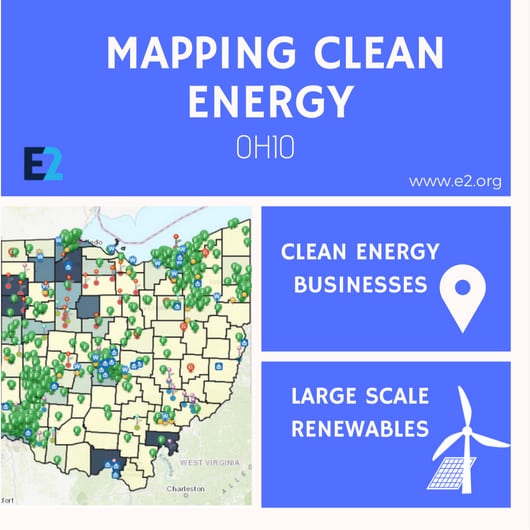
Online map shows clean energy sites, energy efficiency contractors, renewable energy installers and electric vehicle charging stations COLUMBUS, OH – A new interactive map shows where renewable energy is being generated across Ohio, the location of public EV charging stations and schools with solar panels, and where nearly 650 Ohio clean energy businesses (solar, wind, energy efficiency, […]

Mapping Clean Energy: Ohio

Date: May 23, 2018

Ohio’s clean energy industry is a significant part of the economy.

But where is all this economic activity happening?

That’s exactly what E2 — along with our partners at FracTracker Alliance — attempted to find out with this interactive map showing the location of clean energy businesses across the state as well as sites where renewable energy is generated.

The purpose of this map is to help policymakers, press and individuals better understand the scope of Ohio’s clean energy economy – and how much room it has to grow.

Strong clean energy standards in Ohio have supported the growth of a healthy industry. There are clean energy businesses in 92 out of Ohio’s 99 state house legislative districts. In particular, energy efficiency contractors dominate the map.

On the map you’ll find:

  • Clean energy businesses: Locations of energy efficiency and solar, wind and geothermal installers.
  • Renewable energy infrastructure: Existing and proposed utility-scale wind, solar and hydroelectric generation facilities larger than 1 MW as well as schools with solar energy generation and public EV fueling stations.
  • State legislative and congressional district boundaries.

We’ve done our best to capture as many businesses as possible but we know we’ve missed some. This map isn’t comprehensive; it represents one snapshot in time of an industry to illustrate how robust it is.

If you know we’ve missed something, please send an email to Micaela Preskill at [email protected] and we’ll add it to the map.

How to Use the Map:

When viewing the map, zoom in to see the intricacies of what’s happening in each part of the state. If you click “Layers” on the black bar at the top of the map you will see a drop-down menu, which you can use to make data appear or disappear on the map.

For more information about what you’re seeing, click directly on the map. A pop-up box will appear to show you specifics. Use the arrows on the top right of the pop-up box to see all the information that applies to that spot on the map. For example, if you click on a pin representing a energy efficiency contractor, you’ll see information about that business. You can also use the arrow to see what legislative districts that business is in.

The Map

Other Resources:

Ohio supports 105, 443 clean energy jobs – 2017 Clean Jobs Midwest Report
Nearly 3.2 million Americans work in clean energy – Clean Jobs America

View Report »
Clean Jobs America 2018

Date: May 16, 2018

POWERING JOBS GROWTH ACROSS AMERICA

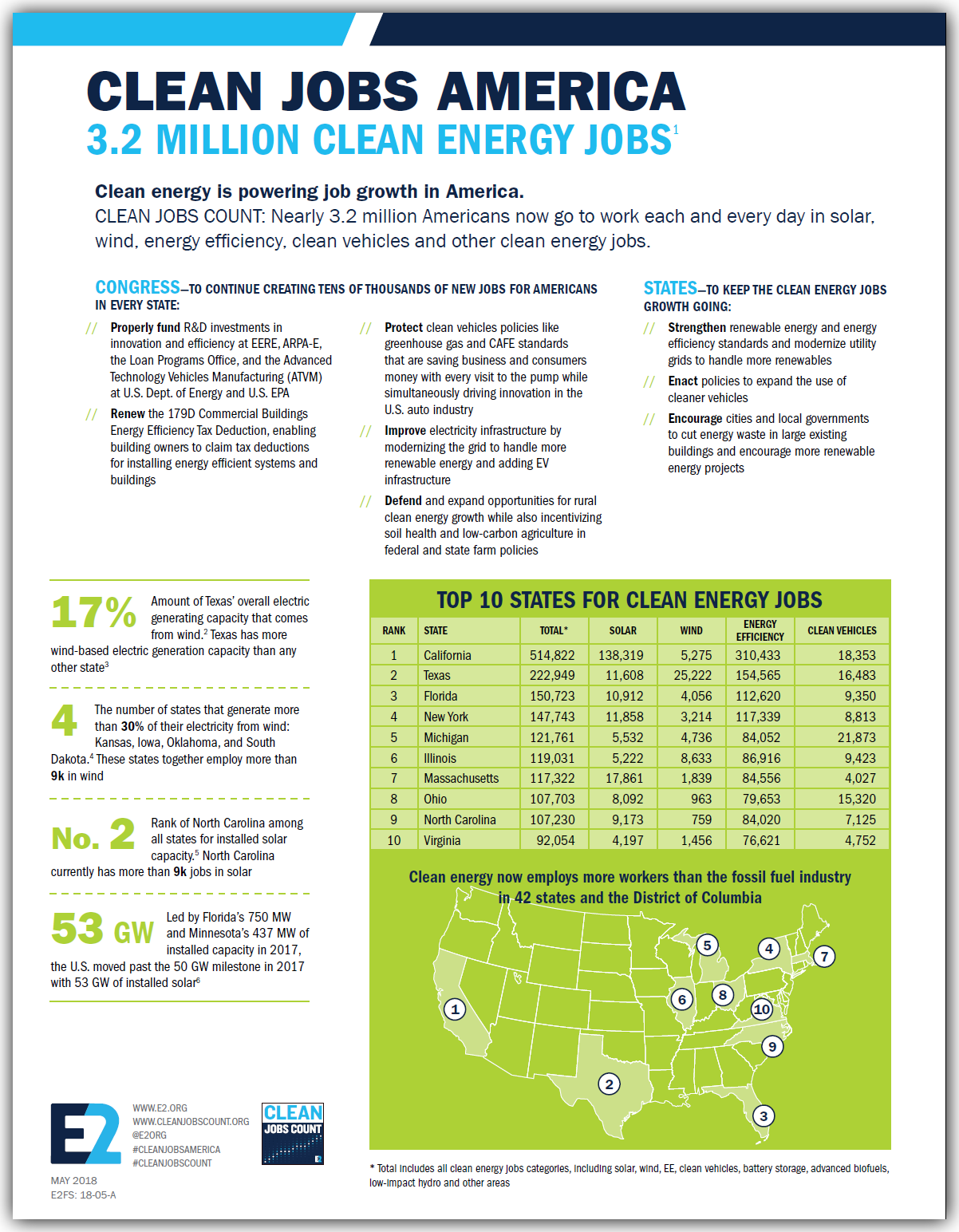
Clean energy is powering job growth in America. Clean jobs count: Nearly 3.2 million Americans now go to work each and every day in solar, wind, energy efficiency, clean vehicles and other clean energy jobs.

HIGHLIGHTS

  • Energy Efficiency Jobs – 2,250,000
  • Solar Jobs – 349,000
  • Clean Vehicle Jobs – 220,000
  • Wind Jobs – 107,000
  • Energy Storage Jobs – 91,000
  • TOTAL US Clean Energy Jobs – 3,177,000

LOOKING FOR MORE INFO?

If you are looking for additional insight into E2’s Clean Jobs America or our other Clean Jobs America reports, visit e2.org/reports or see Clean Jobs Count for a full interactive jobs breakdown of every U.S. state and clean energy industry. You can also contact E2 Communications Director Michael Timberlake ([email protected]). An FAQ is also available here to answer any questions.

DOWNLOAD

The complete report is available for download here.

View Report »

Clean Jobs Rural Midwest

Date: May 10, 2018

Growing Rural Economies

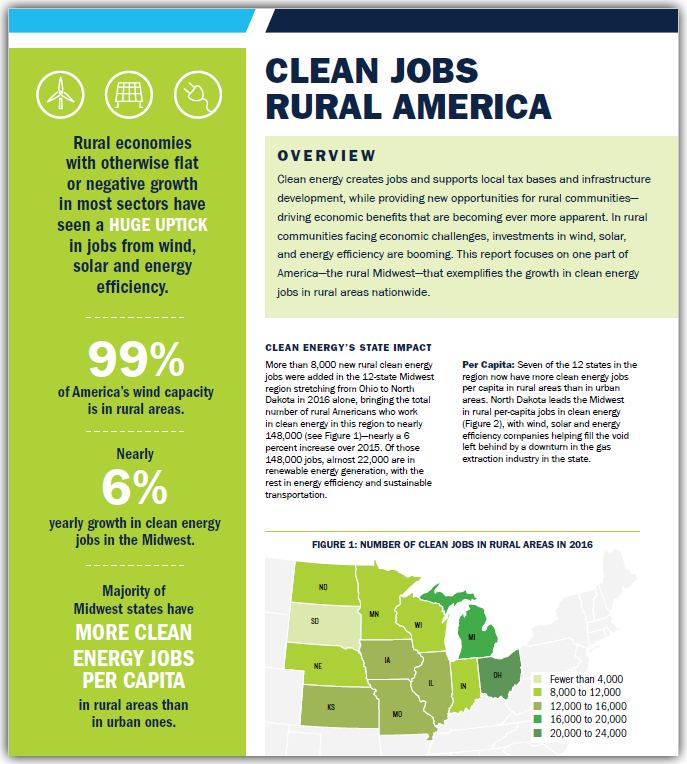
Clean energy creates jobs, supports local tax bases and infrastructure development, while providing new opportunities for farmers—driving economic benefits that are becoming ever more apparent. In rural communities facing economic challenges, investments in wind, solar, and energy efficiency are growing. This report from E2 focuses on one part of America – the rural Midwest – that exemplifies the growth in clean energy jobs in rural areas nationwide.

More than 8,000 new rural clean energy jobs were added in the 12-state Midwest region stretching from Ohio to North Dakota in 2016 alone, bringing the total number of rural Americans who work in clean energy in this region to nearly 148,000 (see Figure 1)—nearly a 6 percent increase over 2015. Of those 148,000 jobs, almost 22,000 are in renewable energy generation, with the rest in energy efficiency and sustainable transportation.

Key Findings

  • Majority of Midwest states have more clean energy jobs per capita in rural areas than urban ones
  • Clean energy employment represents a bright spot in rural communities that have otherwise lost population and jobs
  • Clean energy jobs in the Midwest are growing 6% a year
  • 99% of U.S. wind capacity is in rural areas
  • Nearly 150,000 rural Midwesterners work in clean energy, including almost 22,000 in renewable energy generation
  • More than 8,000 new rural clean energy jobs were added in rural Midwest areas in 2016 alone

Looking for More Info?

This report follows E2’s Clean Jobs America analysis which found the clean energy jobs account for nearly 3.3 million jobs across all 50 states and the District of Columbia. Both reports expand on data from the U.S. Energy and Employment Report (USEER) produced by the Energy Futures Initiative (EFI) in partnership with the National Association of State Energy Officials (NASEO), using data collected and analyzed by the BW Research Partnership. E2 is a partner on the USEER, the fourth installment of the energy survey first released by the Department of Energy in 2016. Clean energy jobs have grown every year since the first report was released in 2016.

If you are looking for additional insight into E2’s Clean Jobs Rural Midwest 2018 or our other Clean Jobs America reports, visit e2.org/reports. You can also contact E2 Communications Director Michael Timberlake ([email protected]). An FAQ is also available here to answer any questions.

Download

The complete report is available for download at this link.

View Report »

Mapping Clean Energy: Illinois

Date: April 26, 2018

Illinois’ clean energy economy is clearly thriving.

But where is all this economic activity happening?

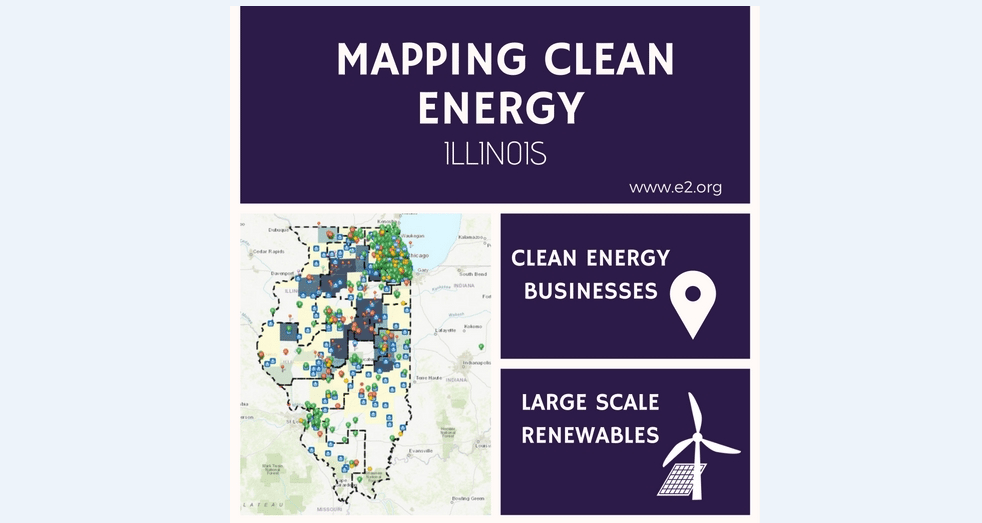
That’s exactly what E2 — along with our partners at FracTracker Alliance — attempted to find out with this interactive map showing the location of more than 1,000 clean energy businesses across the state as well as sites where renewable energy is generated.

The purpose of this map is to help policymakers, press and individuals better understand the scope of Illinois’s clean energy economy – and how much room it has to grow.

On the map you’ll find:

  • Clean energy businesses: Locations of energy efficiency and solar, wind and geothermal installers.
  • Renewable energy infrastructure: Existing and proposed utility-scale wind, solar and hydroelectric generation facilities larger than 1 MW as well as schools with solar energy generation and public EV fueling stations.
  • Income per capita and legislative and congressional district boundaries.

Key Takeaways from the Map:

  • There are nearly 1,000 businesses displayed in the map, which includes energy efficiency contractors and renewable energy (solar, wind and geothermal) installers, covering the vast majority of the state.
  • Half the state already has utility-scale renewable energy projects, with many utility-scale projects in the queue waiting to be built.

We’ve done our best to capture as many businesses as possible but we know we’ve missed some.  This map isn’t comprehensive; it represents one snapshot in time of an industry to show how robust it is. If you know we’ve missed something, please send an email to Micaela Preskill at [email protected] and we’ll add it to the map.

How to Use the Map:

When viewing the map, zoom in to see the intricacies of what’s happening in each part of the state. If you click “Layers” on the black bar at the top of the map you will see a drop-down menu, which you can use to make data appear or disappear on the map.

For more information about what you’re seeing, click directly on the map. A pop-up box will appear to show you specifics. Use the arrows on the top right of the pop-up box to see all the information that applies to that spot on the map. For example, if you click on a pin representing a energy efficiency contractor, you’ll see information about that business. You can also use the arrow to see what legislative districts that business is in.

The Map

Other Resources:

Illinois supports 119,395 clean energy jobs – 2017 Clean Jobs Midwest Report
Over 3 million Americans work in clean energy – Clean Jobs America

View Report »
Sign Up for Email Updates


"*" indicates required fields

This field is for validation purposes and should be left unchanged.

Our Latest Press Releases


Releases

Six Emerging Environmental Entrepreneurs Selected for National Fellowship

The E2 & 1 Hotels the fellowship program is designed to help early career environmentally-minded entrepreneurs and community leaders to create and implement unique projects at the intersection of the economy and environment. This year’s projects span a wide...


Releases

E2: Repealing EPA’s Endangerment Finding For Vehicle Emissions Raises Costs for Businesses and Consumers

The EPA officially revoked the endangerment finding for greenhouse gas (GHG) emissions and eliminated clean vehicle standards in a blow to both our economy and our environment.


Releases

E2: Companies Cancelled $34.8B, 38K Jobs for Clean Energy Projects in 2025, Outpacing New Investments 3-to-1

Businesses abandoned $5.1 billion in large-scale factories and clean energy projects in December, capping a turbulent year for the sector that saw nearly $35 billion in investments disappear along with more than 38,000 current and future jobs, according to ...


Donate Today