Clean Jobs California 2019

Date: August 20, 2019

America’s Clean Energy Economy Juggernaut

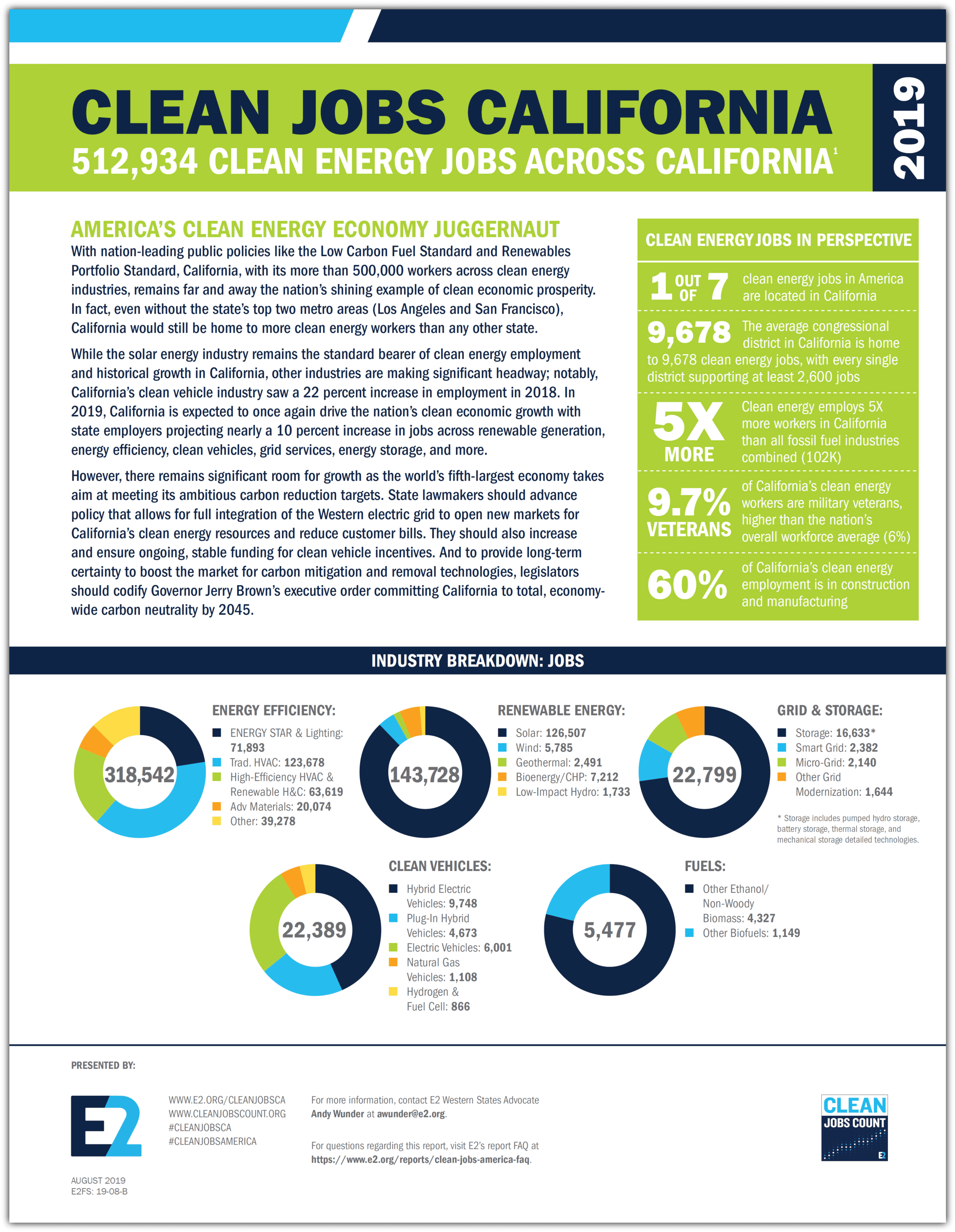
With nation-leading public policies like the Low Carbon Fuel Standard and Renewables Portfolio Standard, California, with its more than half a million workers across clean energy industries, remains far and away the nation’s shining example of clean economic prosperity. Across all states, California supports one out of every seven U.S. clean energy jobs, four out of every ten U.S. solar energy jobs,  and one more than one out of every four U.S. renewable generation jobs. In fact, California’s is home to more renewable generation jobs than the next top six states combined and twice as many energy efficiency jobs as the no. 2 state (Texas).

While the solar energy industry remains the standard bearer of clean energy employment and historical growth in California, other industries are making significant headway; notably, California’s clean vehicle industry saw a 22 percent increase in employment in 2018. In 2019, California is expected to once again drive the nation’s clean economic growth with state employers projecting nearly a 10 percent increase in jobs across renewable generation, energy efficiency, clean vehicles, grid services, energy storage, and more.

Combined with this market domination, big opportunities remain as the world’s fifth-largest economy takes aim at meeting its ambitious carbon reduction targets.

A BIGGER PICTURE

This report focuses solely on the energy sector of the economy and does not include jobs in retail trade, repair services, water or waste management, and indirect employment or induced employment.

California Job Sector Toplines

  • Energy Efficiency – 318,542 jobs
  • Renewable Energy – 143,728 jobs
  • Solar Energy – 126,507 jobs
  • Clean Vehicles – 22,389 jobs
  • Energy Storage – 16,633 jobs
  • Bioenergy/CHP – 7,212 jobs
  • Grid Modernization – 6,166 jobs
  • Wind Energy – 5,785 jobs
  • Clean Fuels – 5,477 jobs
  • ALL Clean Energy Sectors – 512,934 jobs

Highlights

According to Clean Jobs California:

  • Clean energy employs five times more Californians than all fossil fuels combined (110,000)
  • More than 57% of California clean energy workers are employed by businesses with fewer than 20 employees
  • If included in E2’s state rankings, Los Angeles and San Francisco metro areas would rank no. 5 and no. 10 respectively. If combined, the two metros would be the no. 2 state for clean energy jobs in the U.S.
  • Clean vehicle technologies is the only industry California does not rank first in for jobs, trailing Michigan by fewer than 3,000 jobs
  • Nearly four out of every ten U.S. solar jobs are in California
  • Californian clean energy employers project nearly 10% growth in jobs in 2019
  • Bioenergy and combined heat and power made up the second most renewable generation jobs (7,212), followed by wind (5,785)
  • Construction (50.7%) accounts for half of California’s clean energy jobs.
  • 22,800 Californians now work in grid modernization (6,166) and energy storage (16,633)
  • 9.7 % of Californians employed in clean energy are veterans – far above the national average (6%)

DOWNLOAD

The complete report is available for download at this link.

Looking For More Info?

District-By-District Economic Impact

For details on clean energy’s overall economic impact in California, visit E2’s District-By-District: Clean Jobs California 2019  report page to download 120 individual factsheets for all 120 state legislative districts. The factsheets detail the investments in clean energy, jobs created, emissions, reduced, and cap and trade funds implemented in each district.

U.S. Energy & Employment Report (USEER)

This report follows E2’s Clean Jobs America analysis which found the clean energy jobs account for nearly 3.3 million jobs across all 50 states and the District of Columbia. Both reports expand on data from the U.S. Energy and Employment Report (USEER) produced by the Energy Futures Initiative (EFI) in partnership with the National Association of State Energy Officials (NASEO), using data collected and analyzed by the BW Research Partnership. E2 is a partner on the USEER, the fourth installment of the energy survey first released by the Department of Energy in 2016. Clean energy jobs have grown every year since the first report was released in 2016.

If you are looking for additional insight into E2’s Clean Jobs California 2019 or our other Clean Jobs America reports, visit e2.org/reports. You can also contact E2 Communications Director Michael Timberlake ([email protected]). An FAQ is also available here to answer any questions.

Other E2 Clean Jobs Reports

Clean Jobs California is only one in a series of state and industry reports produced by E2 and our partners.

View Report »
Opinion: Electric vehicles are the future for Colorado

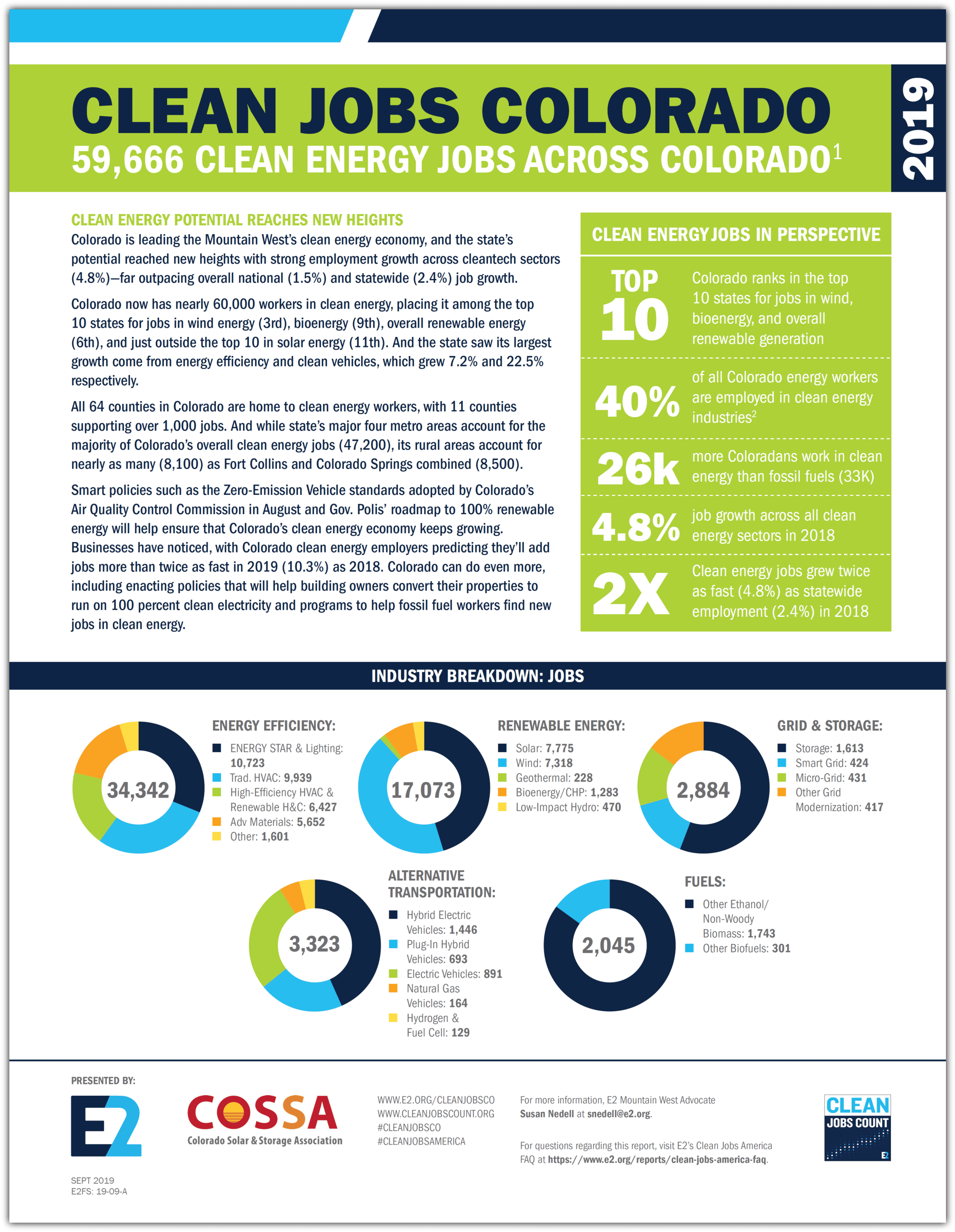
According to the 2018 Clean Jobs Coloradoreport from the Rocky Mountains chapter of the national, nonpartisan business group Environmental Entrepreneurs (E2), more than 2,700 Coloradans work in the electric vehicle and advanced automotive industry, including technological innovation in lightweight materials, engine design, aerodynamics and EV charging infrastructure.

Veterans Advanced Energy Summit

E2 is proud to be a sponsor of the summit, designed to address the trends, technologies, and policies that are shaping the energy sector and to develop a community of veterans and allies committed to advancing US energy leadership.The Summit will feature business and military leaders, policymakers, and others with insights into where energy markets and […]

Clean Energy & America’s Ocean Economy | By the Numbers

Date: August 9, 2019

Report Summary

As the Trump administration considers opening more of our coasts to offshore drilling, E2 worked with local partners on the east coast – the Business Alliance for Protecting the Atlantic Coast (BAPAC) and the west coast – the Business Alliance for Protecting the Pacific Coast (BAPPC) to produce economic analysis on the enormous financial and employment value America’s ocean economy brings to states and their coastal communities across the country.

In the links below are one-page factsheets detailing the commercial and jobs benefits generated from ocean-related tourism, recreation and fishing across eight states and 51 congressional districts, as well as the direct investments and jobs created by clean energy industries in those same communities.

Download

California | Statewide Ocean Economy

New York | Statewide Ocean Economy

New Jersey | Statewide Ocean Economy

Virginia | Statewide Ocean Economy

North Carolina | Statewide Ocean Economy

South Carolina | Statewide Ocean Economy

Georgia | Statewide Ocean Economy

Florida | Statewide Ocean Economy

Looking for More Info?

If you are looking for additional insight into the economic benefits of clean energy to America’s coastal economies, please visit e2.org/reports to access E2’s annual clean energy jobs report or contact E2 Communications Director Michael Timberlake ([email protected]) with any questions.

All findings in the factsheets are based on the data reported from the following reports:

View Report »

E2 1 Hotels Fellowship: 2018-2019 Fellow Showcase

The E2 1Hotels Fellowship supports emerging business leaders execute projects that amplify the business and economic case for smart policies to address pressing environmental issues. In September, E2 announced our 2018-2019 class of 10 fellows at the Global Climate Action Summit. This will be the second of three webinars showcasing our new class of remarkable fellows working on […]

E2 Nevada Meet & Greet

Please join national nonpartisan business group, E2, and your fellow Las Vegas area business leaders for an invitation-only gathering and networking event to learn more about E2 and how Nevada’s updated renewable energy policy and other new legislation are poised to create jobs, drive economic growth and bring new clean energy investments to the Silver State. This […]

Support ZEV Rule Making

On May 10, Colorado’s Air Quality Control Commission (AQCC) opened a rule making to consider adopting a Zero Emission Vehicle (ZEV) standard. In this letter, E2 members and supporters urge the Air Quality Control Commission (AQCC) at the Colorado Department of Public Health and Environment (CDPHE) to adopt the ZEV standard at their August meeting.

California-Automaker Fuel Economy Deal a Win for Innovation, Consumers

WASHINGTON (July 25, 2019) –  Four automakers agreed to continue strengthening vehicle greenhouse gas emission standards established under the Obama Administration through a deal struck with the state of California. The agreement could see average car fuel economy increase to about 51 miles per gallon by 2025, delivering a setback to the Trump administration’s attempt to rollback […]

“Bold” Plan for 100% Clean Energy Advances U.S. Economic Future

WASHINGTON (July 23, 2019) – House energy committee leaders today—led by chairman Frank Pallone of the Energy and Commerce Committee, chairman Paul Tonko of the Environment and Climate Change Subcommittee, and chairman Bobby Rush of the Energy Subcommittee—vowed to enact a “bold” plan to achieve 100 percent clean energy by 2050. The new initiative would […]

Clean Jobs North Carolina 2019

Date: July 18, 2019

Top 10 in Jobs Across Clean Technologies

North Carolina is the Southeast’s leader in clean energy jobs. Not only does the Tar Heel state rank among the top 10 states in the country across clean energy categories such as solar energy, energy efficiency, and overall clean energy.

According to Clean Jobs North Carolina 2019 (downloadable PDF), the state’s clean energy jobs grew 3.5 percent last year – nearly double statewide employment growth (1.9%) —and now account for more than half of North Carolina’s entire energy sector workforce (212,172).  Clean vehicles led all sectors in growth, adding more than 1,000 jobs for a 19.5% growth rate.

Along with being a national pioneer in solar energy as the No 2. state for installed solar and No. 9 for jobs, North Carolina is fast becoming a powerhouse in energy efficiency as well with over 86,000 jobs – employing more workers in energy efficiency alone than 39 states do in all clean energy sectors.

All 100 counties in North Carolina—from Cherokee to Currituck—are home to residents who work in clean energy jobs, and 26 counties are home to at least 900 jobs. And while the metropolitan areas of Charlotte and Raleigh combine to make up the largest portion of the state’s clean jobs (37,700), its rural areas account for 25 percent of all the state’s jobs in renewable energy, efficiency, storage, and clean vehicles and fuels (29,000).

North Carolina Job Sector Toplines

  • Energy Efficiency – 86,559 jobs
  • Renewable Energy – 12,091 jobs
  • Solar Energy – 8,912 jobs
  • Clean Vehicles – 7,280 jobs
  • Grid Modernization – 2,124 jobs
  • Energy Storage – 1,692 jobs
  • Wind Energy – 908 jobs
  • ALL Clean Energy Sectors – 110,913 jobs

Other Highlights from 2018

  • Clean energy jobs also now employ more than ten times more workers than the state’s entire fossil fuel industry (10,022)
  • 80% of clean energy employers reported it was “very difficult” or “somewhat difficult” hiring qualified workers
  • More than 4 out of every 5 clean energy workers are employed by businesses with fewer than 20 employees
  • Construction (44.3%) and manufacturing (16.8%) make up the majority of clean energy jobs
  • 3,468 North Carolinians now work in grid modernization (2,124) and energy storage (1,344)
  • 11.4% of North Carolinians employed in clean energy are veterans – nearly double the percentage of veterans in the overall national workplace (6%)
  • 11 of North Carolina’s congressional districts are home to at least 5,000 clean jobs
  • 40 of the state’s 50 senate districts along with 39 house districts had over 1,000 clean energy jobs.
  • 26 of North Carolina’s 100 counties employ at least 900 clean energy workers
  • Mecklenburg led all counties in North Carolina with 20,142 jobs, followed by Wake (17,491) and Guilford (6,318) counties

Looking for More Info?

This report follows E2’s Clean Jobs America analysis which found the clean energy jobs account for nearly 3.3 million jobs across all 50 states and the District of Columbia. Both reports expand on data from the U.S. Energy and Employment Report (USEER) produced by the Energy Futures Initiative (EFI) in partnership with the National Association of State Energy Officials (NASEO), using data collected and analyzed by the BW Research Partnership. E2 is a partner on the USEER, the fourth installment of the energy survey first released by the Department of Energy in 2016. Clean energy jobs have grown every year since the first report was released in 2016.

If you are looking for additional insight into E2’s Clean Jobs North Carolina 2019 or our other Clean Jobs America reports, visit e2.org/reports. You can also contact E2 Communications Director Michael Timberlake ([email protected]). An FAQ is also available here to answer any questions.

DOWNLOAD

The complete report is available for download at this link.

OTHER CLEAN JOBS REPORTS

Clean Jobs North Carolina is only one in a series of state and industry reports produced by E2 and our partners.

View Report »
Sign Up for Email Updates


"*" indicates required fields

This field is for validation purposes and should be left unchanged.

Our Latest Press Releases


Releases

REPORT: Colorado clean energy sector grew by 4 percent, added 2K jobs in 2024

DENVER, CO (Dec. 10, 2025) – Clean energy jobs grew more than five times faster in Colorado than the rest of the state's economy in 2024, raising the total number of clean energy workers in the state to 69,859 – 18th most in the country – according to the s...


Releases

STATEMENT: Federal Rollback of Auto Fuel Efficiency Standards Will Increase Costs for Consumers, Businesses

The National Highway Traffic Safety Administration (NHTSA) is expected to announce the Administration’s intent to weaken federal Corporate Average Fuel Economy (CAFE) standards for vehicles. Such a dramatic shift in policy would halt five decades of progres...


Releases

Companies Cancel $4.4 Billion in Clean Energy Projects; $28 Billion, 30K Jobs Lost in 2025

WASHINGTON –Businesses canceled, closed, and scaled back more than $4.4 billion worth of large-scale factories and clean energy projects from late-September through October, bringing the total cost of projects cancelled in the private-sector to over $28.7 b...


Donate Today