Support a Robust Advanced Clean Trucks Rule in California

As the California Air Resources Board considers the Advanced Clean Trucks rule to bring clean trucks to market at the scale necessary to help California meet its 2030 emission reduction target and achieve its goal of carbon-neutrality by 2045, 268 California private sector leaders, investors, entrepreneurs, and other business professionals signed onto this E2 letter […]

Clean Energy & COVID-19 Crisis | April 2020 Unemployment Analysis

Date: May 13, 2020

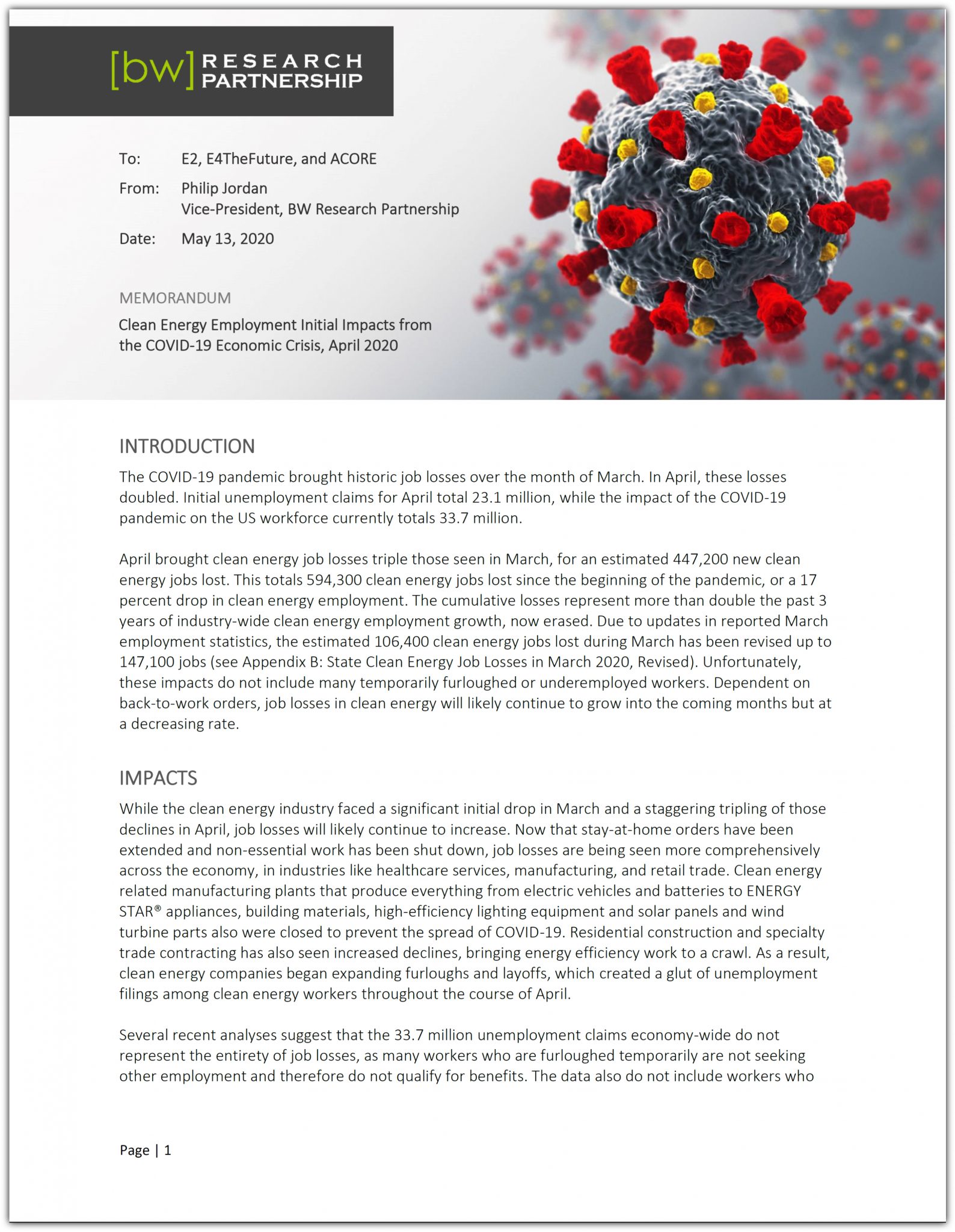
Clean Energy Unemployment Claims in COVID-19 Aftermath, April 2020

Nearly 600,000 U.S. clean clean energy workers have lost their jobs since March after 447,208 new workers filed unemployment claims in April, according to the latest analysis of unemployment data by BW Research for E2, E4TheFuture, and the American Council on Renewable Energy.

The analysis of Department of Labor data found that 594,347 workers in clean energy occupations, representing 17.8% of the industry’s workforce, filed for unemployment benefits in April and March. The number of jobs lost is more than double the number of clean energy jobs created since 2017. Before March, clean energy had been one of the U.S. economy’s biggest and fastest-growing employment sectors, growing 10.4% since 2015 to 3.4 million jobs at the end of 2019. That made clean energy by far the biggest employer of workers in all energy occupations, employing nearly three times as many people as the fossil fuel industry.

The job losses are across a wide variety of occupations, and in every state. Energy efficiency workers are losing their jobs after being shut out of homes and buildings to prevent the spread of the coronavirus. Solar and wind turbine companies are laying off workers as they’re unable to access panels and parts stranded in shut-down factories and as financing disappears. Factory workers are being let go as assembly lines for Energy Star appliances and electric and hybrid vehicles are ground to a halt.

By Industry Job Losses, April 2020

Sector March Claims (adj*) April Claims Total Claims
Energy Efficiency 103,298 310,188 413,486
Renewables 23,739 71,835 95,574
Clean Vehicles 11,339 35,101 46,501
Grid & Storage 6,517 19,685 26,202
Clean Fuels 2,186 10,398 12,584
INDUSTRY TOTAL 147,139 447,208 594,347

State With Most Job Losses, April 2020

State March Claims (adj.*) April Claims Total Claims
US TOTAL 147,139 447,208 594,347
California 27,583 77,860 105,443
Texas 5,965 25,227 31,192
Michigan 7,867 22,284 30,150
Florida 3,963 25,915 29,878
Georgia 1,909 25,251 27,161
North Carolina 9,124 17,293 26,417
Pennsylvania 8,283 12,810 21,093
New York 6,006 14,398 20,405
Washington 5,646 14,593 20,239
Ohio 6,929 12,869 19,798

For a full breakdown of clean energy jobs losses in each state, see the full analysis here.

Download

The complete report is available for download at this link.

Listen

A live press conference was held announcing the report’s findings on May 13, featuring:

  • Bob Keefe, executive director, Environmental Entrepreneurs (E2);
  • Pat Stanton, director of policy, E4TheFuture;
  • Gregory Wetstone, president & CEO, American Council on Renewable Energy (ACORE);
  • Phil Jordan, vice-president and principal, BW Research;

To download and listen to the one-hour press conference, click here.

Looking for More Info?

The analysis expands on data from the 2020 U.S. Energy and Employment Report (USEER) produced by the Energy Futures Initiative (EFI) in partnership with the National Association of State Energy Officials (NASEO), using data collected and analyzed by the BW Research Partnership. The report was released in March 2020 and is available at www.usenergyjobs.org. E2 is a partner on the USEER, the fifth installment of the energy survey first released by the Department of Energy in 2016 and subsequently abandoned under the Trump administration.

If you are looking for additional insight into this report or E2’s more than a dozen other annual clean energy employment reports, visit e2.org/reports. You can also contact E2 Communications Director Michael Timberlake ([email protected]).

Sign-Up for Email Updates

"*" indicates required fields

This field is for validation purposes and should be left unchanged.

View Report »

Clean Energy & COVID-19 Crisis | March 2020 Unemployment Analysis

Date: April 15, 2020

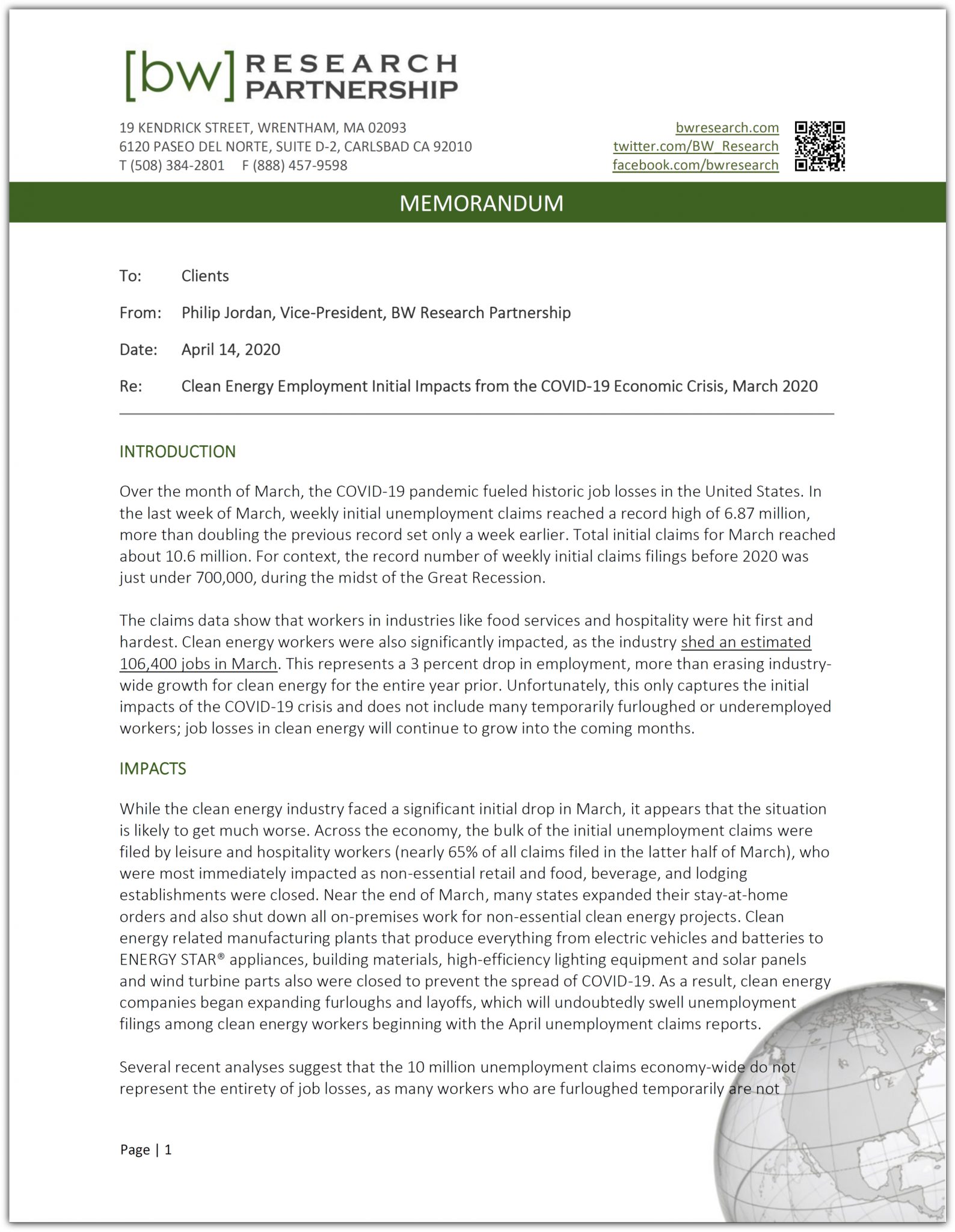
Clean Energy Unemployment Claims in COVID-19 Aftermath, March 2020

More than 106,000 clean energy workers lost their jobs in the month of March alone, wiping out all the job gains in renewable energy, energy efficiency, clean vehicles and other clean energy sectors in 2019, according to an analysis of unemployment data by BW Research for E2.

The March layoffs were just the first indication of how badly the clean energy industry has been hit by the COVID-19 and economic crises. Much bigger job cuts are expected in the months ahead—making it imperative that Congress and state lawmakers seek ways to get the industry back on its feet, especially since clean energy has a proven history of helping pull the country out of economic crises.

What had been one the nation’s fastest-growing jobs sectors at the start of the year by March was experiencing significant job losses every week.

The job losses are across a wide variety of occupations, and in every state. Energy efficiency workers are losing their jobs after being shut out of homes and buildings to prevent the spread of the coronavirus. Solar and wind turbine companies are laying off workers as they’re unable to access panels and parts stranded in shut-down factories and as financing disappears. Factory workers are being let go as assembly lines for Energy Star appliances and electric and hybrid vehicles are ground to a halt.

Industry Job Losses, March 2020

  • Energy Efficiency – 69,800 job losses
  • Renewable Energy – 16,500 job losses
  • Clean Vehicles – 12,300 job losses
  • Grid & Clean Storage – 4,300 job losses
  • Clean Fuels – 3,400 job losses
  • ALL US Clean Energy Sectors – 106,472

Download

The complete report is available for download at this link.

Listen

A live press conference was held announcing the report’s findings on April 15, featuring:

  • Bob Keefe, executive director, E2
  • Pat Stanton, director of policy, E4TheFuture
  • Gregory Wetstone, president & CEO, American Council on Renewable Energy (ACORE)
  • Phil Jordan, vice-president and principal, BW Research

To download and listen to the one-hour press conference, click here.

Looking for More Info?

The analysis expands on data from the 2020 U.S. Energy and Employment Report (USEER) produced by the Energy Futures Initiative (EFI) in partnership with the National Association of State Energy Officials (NASEO), using data collected and analyzed by the BW Research Partnership. The report was released in March 2020 and is available at www.usenergyjobs.org. E2 is a partner on the USEER, the fifth installment of the energy survey first released by the Department of Energy in 2016 and subsequently abandoned under the Trump administration.

If you are looking for additional insight into this report or E2’s more than a dozen other annual clean energy employment reports, visit e2.org/reports. You can also contact E2 Communications Director Michael Timberlake ([email protected]).

Sign-Up for Email Updates

"*" indicates required fields

This field is for validation purposes and should be left unchanged.

View Report »

This Chicagoan is on a mission to help auto dealers sell electric vehicles

Now, through a fellowship from the organization E2 (Environmental Entrepreneuers), Deylami will help dealers learn more about and promote electric vehicles. E2, an organization of investors and business leaders promoting smart energy policies, awarded 10 $20,000 fellowships to young U.S. business leaders nationwide. The only other Midwest recipient is Grant Behnke of Columbus, Ohio, who […]

Trump Rollback Doubles Down on Economic Damage

Rollback threatens 740,000 US jobs in cleaner, fuel-efficient vehicles WASHINGTON, DC (March 31, 2020) – The Trump administration today finalized its plan to roll back the popular Obama-era fuel economy standards, reversing the federal government’s largest effort to fight climate change impacts. Following is a statement from Sandra Purohit, director of federal advocacy for the […]

Nevada Transportation Electrification Forum

Join key policymakers and decision makers from around Nevada to discuss the benefits of transportation electrification, as well as the concrete policies and actions needed to achieve these benefits for all Nevadans.

2020 Not the Time to Put Clean Cars in Reverse

California’s fight against the Trump administration’s plans to roll back commonsense auto emissions and mileage standards may seem surprising to some who live beyond our state’s borders — but only if you ignore that the clean cars bill we passed in 2002 has been, simply put, a major success for California.

Clean Jobs Washington 2019

Date: December 18, 2019
Clean Energy Economy Integral to Evergreen State

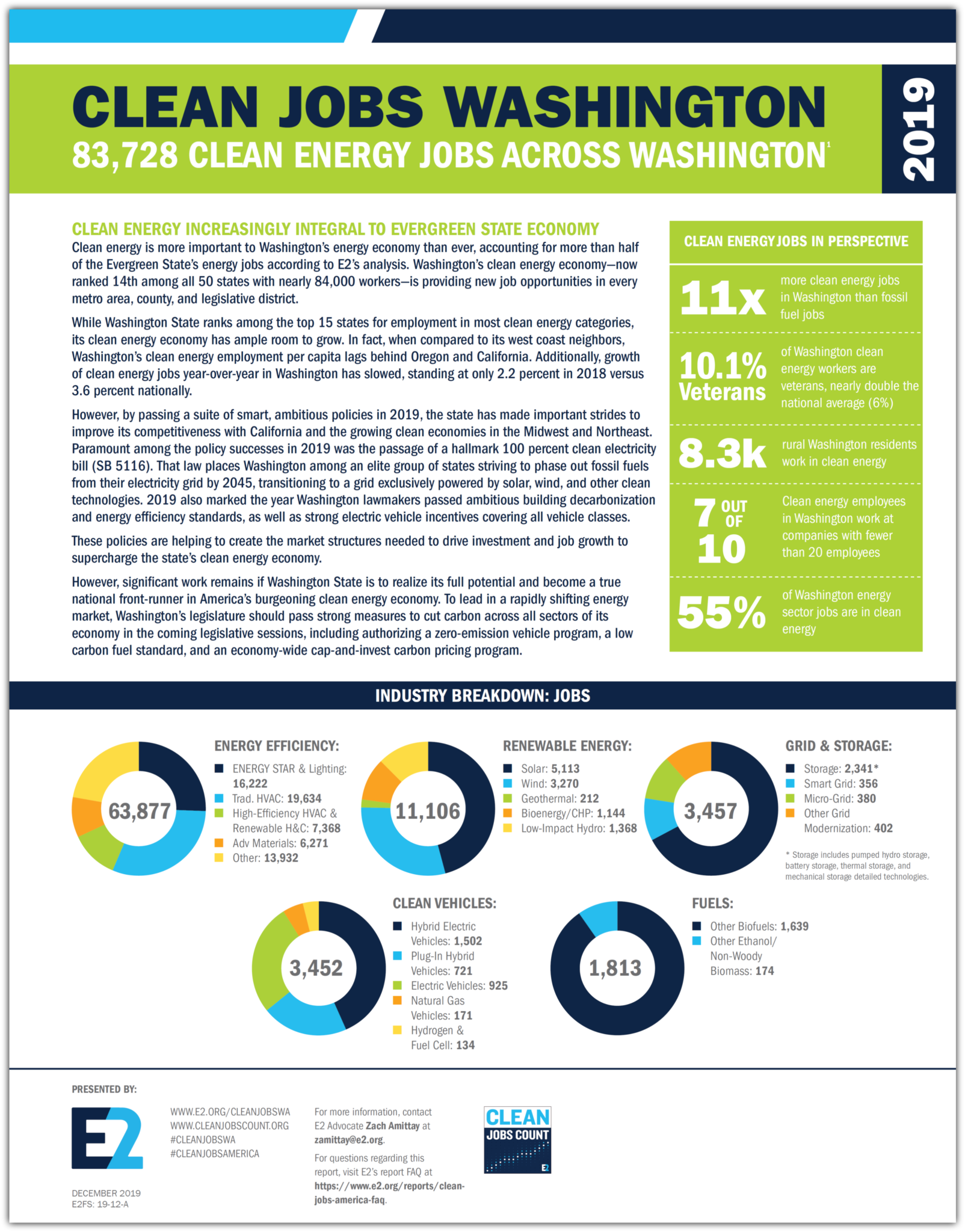
Clean energy is increasingly integral to Washington’s economic growth, as more than five out of every ten jobs in the Evergreen State’s energy economy are now in clean energy industries.  

Led by energy efficiency (63K) and renewable energy (11K), Washington’s clean energy economy—now ranked 14th among all 50 states with nearly 84,000 workers—is providing new job opportunities in every metro area, county, and legislative district.While Washington State ranks among the top 15 states for employment in most clean energy categories, its clean energy economy has ample room to grow. In fact, when compared to its west coast neighbors, Washington’s clean energy employment per capita lags behind Oregon and California.

However, by passing a suite of smart, ambitious policies in 2019, the state has made important strides to improve its competitiveness with California and the growing clean economies in the Midwest and Northeast. Paramount among the policy successes in 2019 was the passage of a hallmark 100 percent clean electricity bill (SB 5116).

But significant work remains if Washington State is to realize its full potential and become a true national front-runner in America’s burgeoning clean energy economy. To lead in a rapidly shifting energy market, Washington’s legislature should pass strong measures to cut carbon across all sectors of its economy in the coming legislative sessions, including authorizing a zero-emission vehicle program, a low carbon fuel standard, and an economy-wide cap-and-invest carbon pricing program.

A BIGGER PICTURE

This report focuses solely on the energy sector of the economy and does not include jobs in retail trade, repair services, water or waste management, and indirect employment or induced employment.

HOW WASHINGTON STACKS UP NATIONALLY

Washington ranks among the top 15 states for employment in 10 clean energy categories.

  • #11 Total Renewable energy
  • #13 Energy Efficiency
  • #6 Clean Storage
  • #11 Geothermal
  • #12 Bioenergy
  • #3 Small Hydropower
  • #10 Wind Energy
  • #2 Other Biofuels
  • #12 Total Transmission, Storage & Distribution
  • #14 Total Clean Energy

WASHINGTON CLEAN JOB SECTOR TOPLINES

  • Energy Efficiency – 63,877 jobs
  • Renewable Energy – 11,106 jobs
  • Solar Energy – 5,113 jobs
  • Clean Vehicles – 3,452 jobs
  • Wind Energy – 3,270 jobs
  • Energy Storage – 2,341 jobs
  • Clean Fuels – 1,813 jobs
  • Grid Modernization – 1,138 jobs
  • ALL Clean Energy Sectors – 83,728 jobs

HIGHLIGHTS

According to Clean Jobs Washington 2019:

  • Seven out of every ten (69.9%) clean energy workers are employed by businesses with fewer than 20 total employees.
  • Construction (64.3%) accounts for the majority of clean energy jobs.
  • If counted as a single metro area, Washington’s rural areas rank second in the state for clean energy jobs, behind only the Seattle-Tacoma-Bellevue metro.
  • 3,457 Washington residents now work in grid modernization (1,138) and energy storage (2,341)
  • 10.1% of Washington residents employed in clean energy are veterans, nearly double the national average (6%).
  • Of the top 10 counties by clean energy jobs per capita, five have populations under 100,000.
  • Washington’s clean vehicle job growth (21.4%) outpaced the sector’s national average (15.4%)
  • Clean energy employs 11X more Washington residents all fossil fuels combined (7,304).
  • 55% of Washington energy sector employees  (153,425) work in clean energy (83,728)
  • Less than 12,000 jobs separates Washington (#14) from the #10 state for clean energy employment (Virginia)
  • 45% of Washington’s clean energy jobs are based outside the Seattle metro area

DOWNLOAD

The complete report is available for download at this link.

Looking For More Info?

U.S. Energy & Employment Report (USEER)
This report follows E2’s Clean Jobs America analysis which found the clean energy jobs account for nearly 3.3 million jobs across all 50 states and the District of Columbia. Both reports expand on data from the U.S. Energy and Employment Report (USEER) produced by the Energy Futures Initiative (EFI) in partnership with the National Association of State Energy Officials (NASEO), using data collected and analyzed by the BW Research Partnership. E2 is a partner on the USEER, the fourth installment of the energy survey first released by the Department of Energy in 2016. Clean energy jobs have grown every year since the first report was released in 2016.

If you are looking for additional insight into E2’s Clean Jobs California 2019 or our other Clean Jobs America reports, visit e2.org/reports. You can also contact E2 Communications Director Michael Timberlake ([email protected]). An FAQ is also available here to answer any questions.

Other E2 Clean Jobs Reports

Clean Jobs Washington is only one in a series of state and industry reports produced by E2 and our partners.

View Report »

Thank Governor Sisolak for his Executive Order 2019-22

Governor Sisolak issued Executive Order 2019-22 on Friday, November 21, 2019, committing to reduce carbon pollution in Nevada and work toward an equitable and inclusive transition to a carbon neutral, clean energy economy. In his speech following the signing of the executive order, Governor Sisolak announced that Nevada intends to join the 11 other states in the […]

Support the 2019 Utility EV Infrastructure Bill (SB-77)

On October 23, The Colorado Public Utilities Commission (PUC) opened a proceeding to gather input from stakeholders on what information would be useful for electric utilities to include in upcoming proposals to support transportation electrification.In this letter, E2 members and supporters urge the PUC to act boldly to increase access to electricity as a transportation fuel while ensuring reliability […]

Sign Up for Email Updates


"*" indicates required fields

This field is for validation purposes and should be left unchanged.

Our Latest Press Releases


Releases

E2: Repealing EPA’s Endangerment Finding For Vehicle Emissions Raises Costs for Businesses and Consumers

The EPA officially revoked the endangerment finding for greenhouse gas (GHG) emissions and eliminated clean vehicle standards in a blow to both our economy and our environment.


Releases

E2: Companies Cancelled $34.8B, 38K Jobs for Clean Energy Projects in 2025, Outpacing New Investments 3-to-1

Businesses abandoned $5.1 billion in large-scale factories and clean energy projects in December, capping a turbulent year for the sector that saw nearly $35 billion in investments disappear along with more than 38,000 current and future jobs, according to ...


Releases

E2: Trump Administration’s Latest Attempt to Kill Offshore Wind Hurts Consumers, Businesses

The Trump administration is trying to halt offshore wind projects that are well-underway just two weeks after their initial attempt was deemed arbitrary and capricious by a federal judge.


Donate Today